
Chronic Disease Management at Home That Actually Works
A practical 2026 guide to chronic disease management at home, with daily routines, telehealth tools, medication tips, and clear warning signs to act on.
You're standing in the kitchen with pill bottles on the counter, a cuff on the table, and a phone buzzing with another alert nobody has time to interpret. That's chronic disease management at home in real life, not the neat version people sell in brochures. The issue usually isn't that you don't know what to do. It's that nobody owns the handoffs, the alerts, the timing, or the messiness of an ordinary Tuesday.
If you're a woman in midlife, the load can get even heavier. You're often managing your own symptoms, sleep changes, work, family logistics, and sometimes a parent's care too. A home plan that depends on perfect memory and endless bandwidth is going to fail. A home plan that names the reviewer, the trigger, and the next action has a chance.
Table of Contents
- Why Home Management Is Harder Than It Looks
- Building Your Daily Home Base
- Choosing the Right Home Monitoring Approach
- How Life Primary Care Can Help
- Medication Adherence Without the Nagging
- Sleep, Food, and Movement as One System
- When Tracking Becomes Too Much
- Warning Signs, Escalation, and Your One-Page Care Plan
Why Home Management Is Harder Than It Looks
The obvious failure mode is data overload. A smartwatch pings, a glucose reading sits in an app, the blood pressure cuff stores numbers, and nobody has a clear job for interpreting any of it. Recent reviews say the primary barrier isn't sensing itself, it's data overload, unclear responsibility, poor workflow integration, and device usability problems, which is exactly why so many home programs stall after the pilot stage (JMIR 2025 review).
The second failure mode is a routine built for an ideal household, not a real one. Home care collapses when it assumes you'll always have the same sleep schedule, the same workday, the same energy, and the same caregiver support. That's especially true in midlife, when sleep disruption, caregiving demands, and symptom fluctuations can make a “simple” plan feel like one more job.
The part nobody wants to admit
Patients often know the basics. They know to take the meds, check the numbers, and call if something looks wrong. What breaks down is operational. Who reviews the readings? How fast? What triggers a call?
That's the whole game.
Practical rule: if a number doesn't lead to an action, it's just decoration.
The third failure mode is writing care plans for the clinic visit instead of the home. A plan that sounds reasonable at 3 p.m. in a calm office can fail at 6 a.m. when a child is sick, a night of sleep was trash, and you're already running behind. Chronic disease management at home works only when it survives the bad night, the schedule shift, and the day when you can't do everything.
That's why I'm not interested in motivational nonsense. I'm interested in systems that hold up when life is inconvenient. The rest of this guide stays on that track, daily routines, monitoring choices, adherence systems, and clear escalation rules that don't fall apart the second your week gets weird.
Building Your Daily Home Base
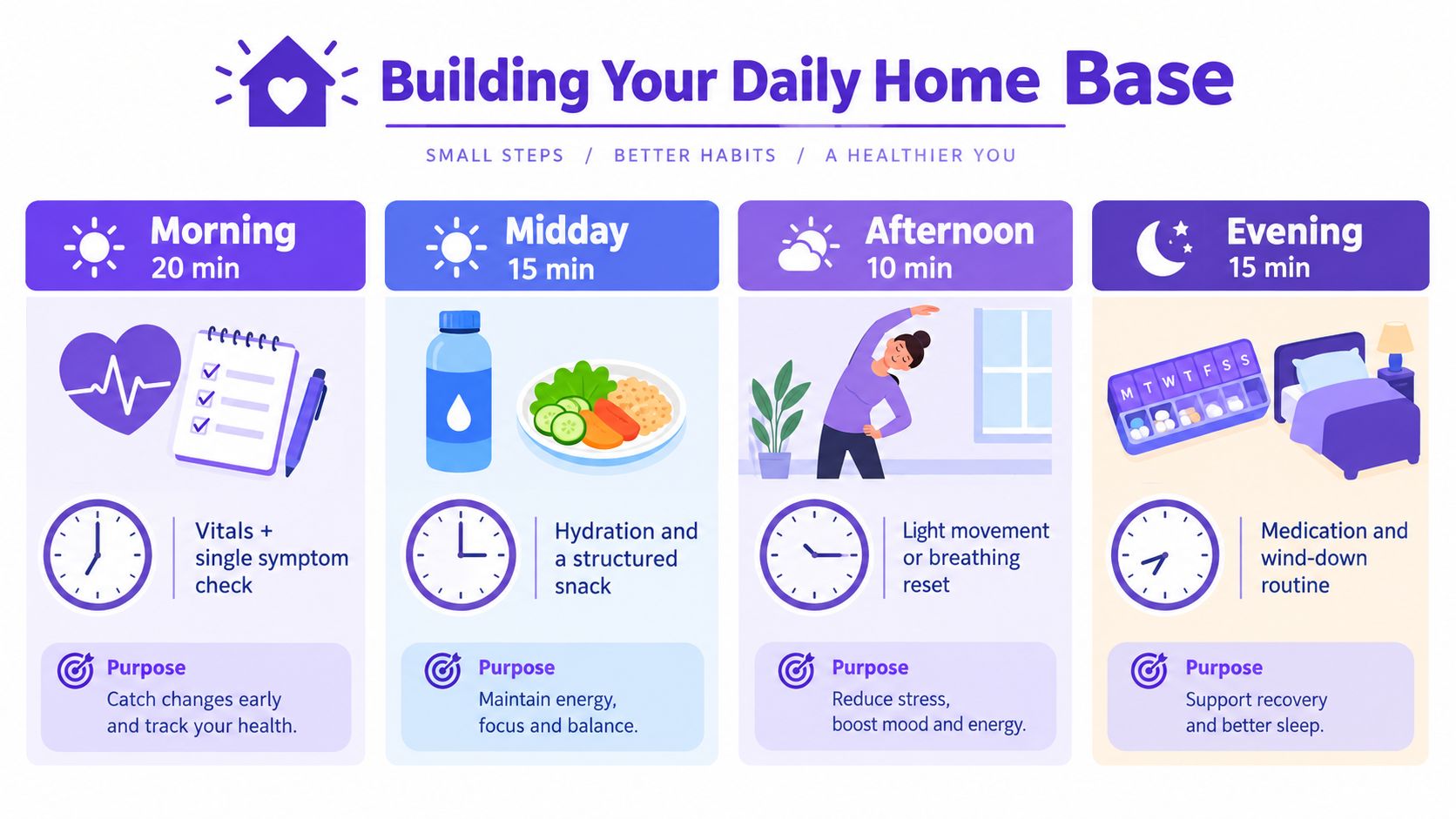
A good home base is boring on purpose. It should be so ordinary that you can do it half-asleep and so specific that you don't have to negotiate with yourself every morning. Write the whole thing on one index card and tape it inside the medicine cabinet.
Morning sets the baseline
Use the first 20 minutes of the day for one reading and one question. For heart failure, that means weight. For hypertension, use blood pressure. For diabetes, use glucose if that's part of your plan.
Then ask yourself one plain question, not a vague one. “Do I feel more short of breath than usual?” or “Am I more swollen than usual?” or “Do I feel shaky, lightheaded, or off?” Keep it to yes or no, because rambling doesn't help you spot change.
If the device is missing, don't improvise a whole new system. Use the same time slot to record symptoms only and mark the reading as skipped. Missing data is better than fake precision.
Midday keeps the routine from drifting
Midday should take five minutes, and it should happen next to something you already do. Lunch works. Coffee works. A desk break works. Check whether you've taken the dose you were supposed to take, then jot down one symptom note if anything changed.
Most home systems fall apart when people try to build a separate "health hour" and then miss it for a week straight. Anchor the task to an existing habit instead. That's not a trick. It's the difference between a routine and a wish.
Evening is for winding down, not chasing numbers
The evening slot should last about 10 minutes. Recheck the measure your condition needs, then stop. Don't turn the end of the day into a feedback loop of screens and alerts. Pair the check with sleep prep, medication setup, and a hard cutoff for stimulation.
The point is rhythm, not perfection. Home management gets easier when the same things happen in the same order.
Weekly review keeps the plan honest
Sunday evening, spend 30 minutes looking at the last seven days. Check trends, note missed doses, and look at refill timing before you run low. Bring one question to your next telehealth or office visit, not twelve. One good question is worth more than a pile of random notes.
If the routine is too complicated to explain in one minute, it's too complicated to sustain.
A few details matter more than many people realize:
- Heart failure: morning weight matters because fluid changes show up there first.
- Hypertension: blood pressure matters if it changes a medication decision.
- Diabetes: glucose matters when it affects insulin or another active treatment plan.
- Any condition: if you don't have the right device, keep the time slot and record symptoms, medications, and questions anyway.
Put the four time slots on that index card, then check the routine again at 30 days and 90 days. Don't ditch it in week two just because your calendar got messy.
Choosing the Right Home Monitoring Approach
A home monitoring setup only works when one person owns the review and there is a written response plan. If you cannot say who is looking at the data and what happens when a reading shifts, stop shopping for another device. People collect gadgets fast and still make no decisions.
The blunt truth is simple. Passive wearables like smartwatches, connected blood pressure cuffs, and continuous glucose monitors are useful for background trends and quiet problems, but they are noisy and do nothing on their own. Patient-reported tracking catches symptoms devices miss, especially when the patient is the best sensor in the room. Clinician-led telemonitoring does the most when it includes real follow-up, not just data collection.
What each approach is good for
Passive wearables are best when the question is, “Is something drifting over time?” They can show background variation and patterns you would otherwise miss. They are not a substitute for clinical judgment, and they are a bad replacement for a care plan.
Patient-reported tracking is underrated because it captures what devices ignore. Pain, fatigue, mood shifts, bloating, hot flashes, and the small changes that matter to the person living with the illness belong here. If you want a simple app-based option, the best symptom tracker app is the one you will open when you are tired, not the one with the most features.
Clinician-led telemonitoring is strongest when active review and clear follow-up are built in. Older evidence on in-home care for chronic conditions found fewer admissions and better combined outcomes when structured support was part of the program (home care synthesis). More recent telemonitoring research also points to the workflow that works, baseline enrollment, daily capture, automated thresholds, clinician review, then rapid medication or care-plan adjustment (telemonitoring workflow review).
Use the right tool for the right problem
Do not let consumer wearables bully you into tracking the wrong thing. Step counts do not replace blood pressure for hypertension. Sleep scores do not replace glucose trends. A shiny dashboard is not a treatment plan.
| Home Monitoring Approach | Cost | Time Burden | Evidence Strength | Best For | Main Limitation |
|---|---|---|---|---|---|
| Passive wearables | Usually lower upfront than formal telemonitoring, but device costs vary | Low to moderate, depending on how often you check | Helpful for trends, but inconsistent without clinical follow-up | Background trend spotting, symptom awareness | Noise without a reviewer |
| Patient-reported tracking | Low | Low if you keep it simple | Strong for symptom pattern recognition | Fatigue, pain, mood, perimenopausal symptom changes | Depends on honest, consistent input |
| Clinician-led telemonitoring | Higher operational burden | Moderate to high | Strongest when paired with active follow-up | Heart failure, COPD, tighter chronic disease oversight | Strongest when paired with active follow-up |
The decision rule is simple. Pick the option with a named reviewer and a response plan that people can use. If nobody owns escalation, the system is just performance.
How Life Primary Care Can Help
Some people do not need more apps. They need a clinician who comes to the house, sees the pills on the counter, and fixes the plan where the plan lives. That is what Life Primary Care is built to do in northern and central New Jersey.
They bring chronic disease management, primary care, urgent same-day visits, in-home labs, and medication review to the patient's home instead of making the patient haul everything into an office. That matters when mobility is limited, transportation is a problem, or post-hospital instructions are already confusing. It also matters when the household needs coordination, not just another appointment.
Where this model makes the most sense
This is a strong option when the problem is fragmentation. If one clinician prescribes one medication, another changes it, and the family is not sure what the current list is, an in-home visit can cut through the noise. It also fits after hospitalization, when early follow-up can reconcile orders and reduce avoidable back-and-forth.
The practical value is simple. The clinician sees the medication bottles, the stairs, the bathroom setup, the food environment, and the caregiving reality in one visit. That is the kind of context office care never fully captures.
What makes it different
Life Primary Care serves patients at home, with the coordination office handling scheduling, insurance verification, and follow-up. Visits happen where the patient lives, whether that is a private home, apartment, family residence, or assisted living community. For readers who want an in-home primary care team rather than another disconnected specialist visit, that is a legitimate advantage.
If you are comparing options and want to understand how house calls fit into broader home management, their page on chronic disease management at home is worth a look.
Medication Adherence Without the Nagging
Medication adherence gets better when you remove decisions, not when you lecture yourself harder. People don't need more guilt. They need fewer opportunities to get it wrong.
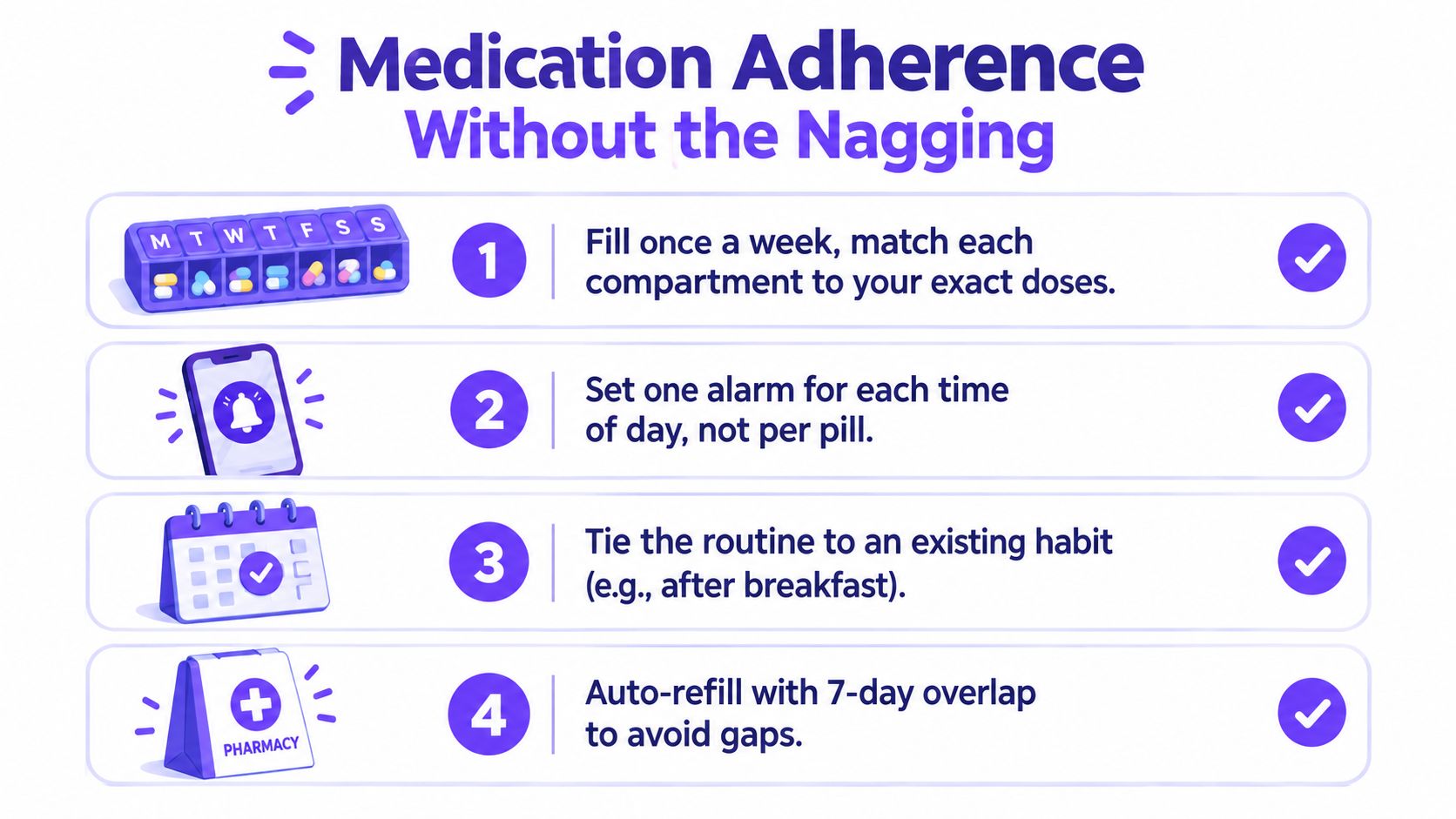
Start with a weekly pillbox that matches your exact dosing schedule. If you travel, keep a small backup container, because blister packs and overengineered packaging can become a nuisance fast. Then set one phone alarm per dose time, not a wall of random notifications that you'll ignore by day three.
Make the refill date impossible to miss
Build a refill trigger that starts 5 days before you run out. That buffer matters because weekends, weather, and pharmacy delays are real. If your refill always lands on a bad day, it isn't a habit problem, it's a timing problem.
Use a one-line label on each medication in plain language. Not the drug class, not the brand name alone, just what it does for you. “For blood pressure.” “For swelling.” “For blood sugar.” That small step helps when you're tired or somebody else is helping with the meds.
Use services when they simplify, not when they complicate
Auto-refill can be useful if your regimen is stable and your pharmacy is reliable. Pill-pack services and mail-order programs can also help when the medication list is long. They become a problem when doses change often, when travel is frequent, or when you need flexibility after a hospitalization.
The lesson is boring but true. The service should reduce friction, not create a new layer of admin work. If the package arrives too early, too late, or in a format that doesn't fit your routine, you're not being disorganized. The system is.
Midlife also brings timing issues that people brush off too quickly. Sleep shifts, hot flashes, irregular meals, and changing routines can all throw off when you can reliably take a dose. The right answer is usually to anchor the dose to the same daily event, like brushing your teeth or breakfast, rather than pretending every day has identical timing.
▶ PlaySleep, Food, and Movement as One System
Treat sleep, food, and movement as one lever. If you change one piece and ignore the other two, you usually end up confused about why the plan stopped working. A better target is simple and sustainable, about 7 hours of consistent sleep timing, two or three protein-anchored meals, and movement that fits a real midlife body.
Build a week that your nervous system can handle
Late caffeine, big evening meals, alcohol, and bright screens are classic sleep thieves. Morning-only exercise can also backfire if it's the only movement you do and your body never gets a calm reset later in the day. If sleep is the bottleneck, the fix usually isn't another supplement stack. It's a cleaner evening.
For women in midlife, resistance training matters because it helps protect against muscle loss. Walking after meals is also a smart move when glucose control is part of the picture. If falling asleep is the problem, some people use magnesium glycinate at night, but don't use supplements as a substitute for a routine that's already broken.
I'd rather see a slightly imperfect plan kept for months than a flashy elimination diet abandoned in two weeks. Sustainable beats dramatic almost every time.
Practical rule: if dinner, screens, and bedtime are all chaotic, don't blame breakfast.
| Time Block | Sleep | Food | Movement |
|---|---|---|---|
| Morning | Keep wake time steady as often as you can | Protein at breakfast if it helps prevent late-day overeating | Short walk or light mobility if your joints tolerate it |
| Midday | Don't nap so late that bedtime slides | Protein-anchored lunch | 10 to 15 minutes of walking after meals when possible |
| Evening | Lower lights, reduce screens, protect the wind-down | Avoid huge late meals if reflux, glucose, or sleep are issues | Gentle stretching or a brief reset, not a hard workout |
| Two days weekly | Maintain the same sleep window | Keep meals predictable enough to notice patterns | Resistance training twice weekly |
If you want more on why these pieces belong together, the piece on fitness and sleep importance is a useful companion.
The win is consistency, not perfection. A decent routine that survives ordinary life is worth more than a perfect one that collapses every Friday night.
When Tracking Becomes Too Much
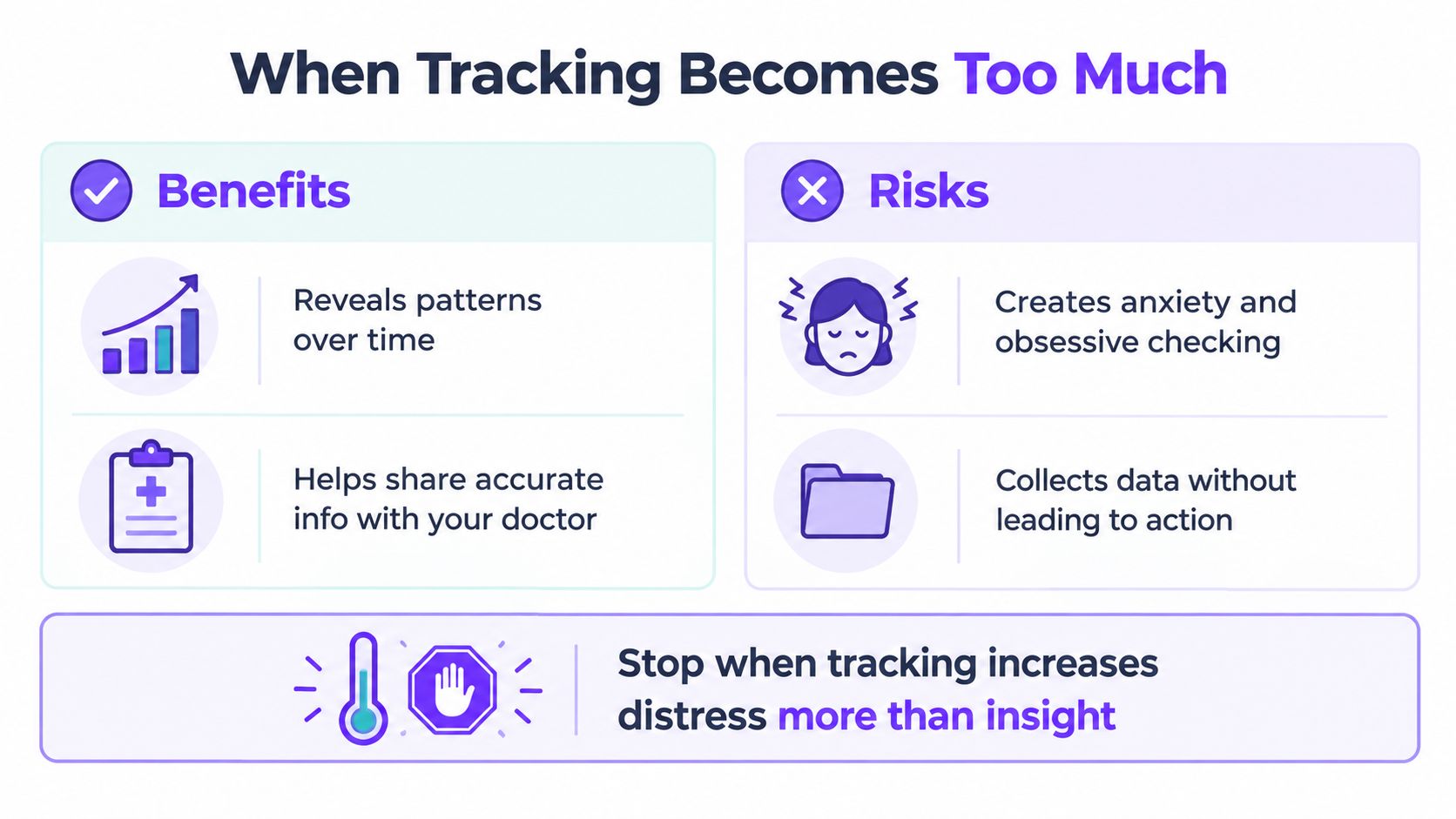
Managing illness at home can lead to tracking too much and acting too little. The stack gets bloated, the alerts get noisy, and the whole thing starts to feel like a second job. Once tracking starts raising anxiety more than insight, it's time to cut it back.
What to drop first
For the average patient, continuous glucose variability doesn't belong in the mix unless diabetes management depends on it. Heart rate variability without clinical context is often just a stress amplifier. Daily weight swings under 2 pounds are usually noise, not a crisis.
Replace that clutter with data tied to decisions. Blood pressure only matters if it changes dosing or triggers a call. Glucose only matters if insulin or another active treatment is being adjusted. If a tracked number hasn't changed a clinical decision in 60 days, drop it.
Know when the tracking itself is the problem
Tracking is hurting you if nobody reviews it, if it crowds out sleep or medication routines, or if you've started identifying with the numbers more than with your actual health. Data should inform action, not become the whole identity. That's especially true for women who already carry enough mental load without turning every symptom into a spreadsheet event.
Here's the cut list I'd use on most home setups:
- Remove metrics that never lead to a decision.
- Keep only the measures tied to medication changes or symptom escalation.
- Stop checking numbers multiple times a day if one planned check is enough.
- Write down the action you'll take before you collect the data.
If you need a one-page structure, use three zones. Green means keep doing what you're doing. Yellow means call the clinic during business hours. Red means urgent care or the ER, depending on the symptom. The plan should be written, not remembered.
Warning Signs, Escalation, and Your One-Page Care Plan
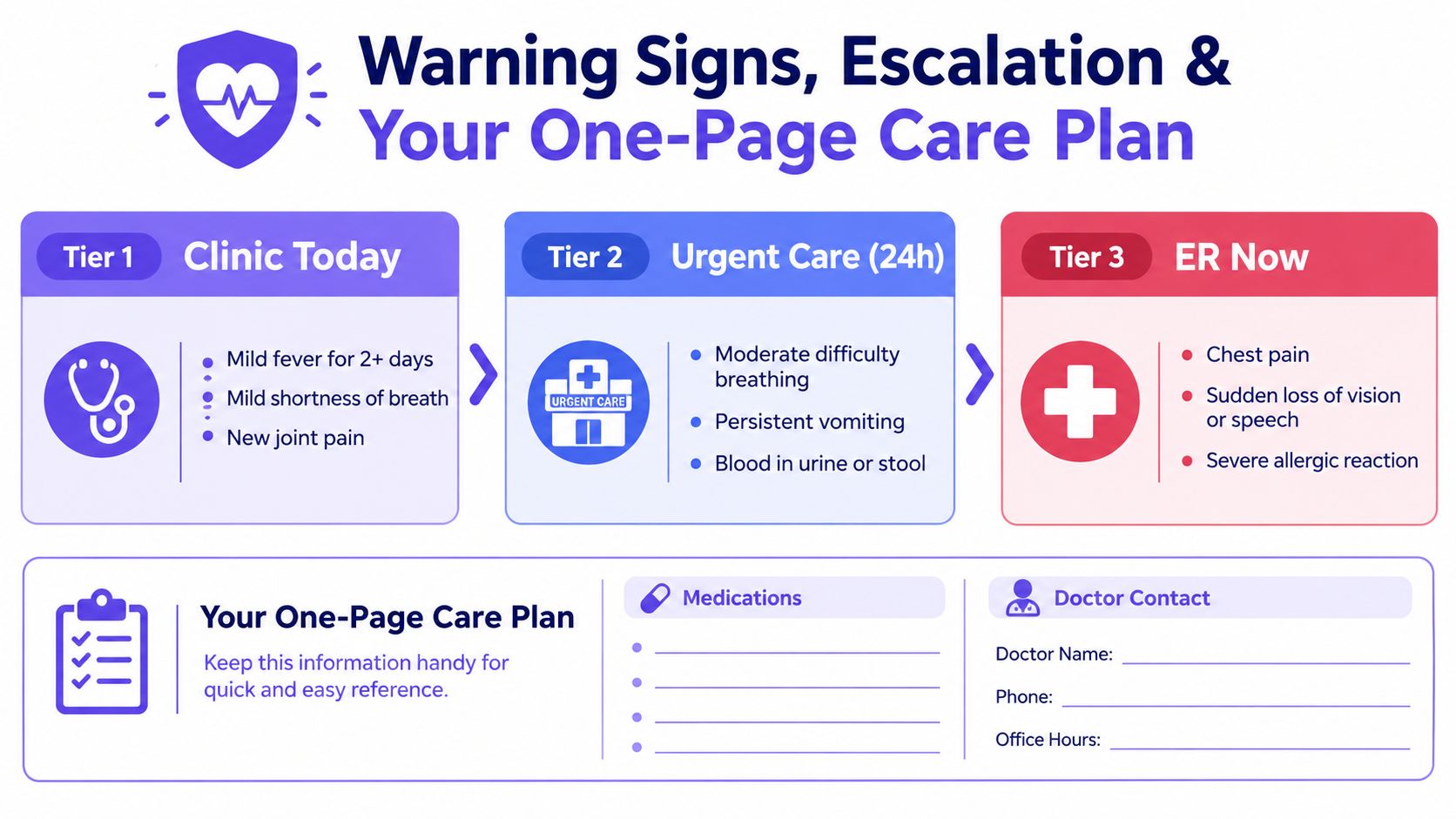
A home care plan without escalation rules is just a neat note on paper. Set the thresholds before you are tired, worried, or short of breath. Decide what means call today, what means urgent care within 24 hours, and what means ER now.
Clinic today
Use this tier for symptoms that are new but not severe. A mild fever that lingers, shortness of breath that is different from baseline, or new joint pain that is starting to interfere with function belongs here. This is the level where the clinic can usually adjust treatment without a full emergency response.
Urgent care within 24 hours
Use urgent care for moderate breathing difficulty, persistent vomiting, or blood in urine or stool. These are not wait-and-see symptoms. They need same-day attention because delay can turn a manageable problem into a bigger one.
ER now
Chest pain, sudden loss of vision or speech, and a severe allergic reaction belong in the emergency room right away. Do not troubleshoot these at home. Do not wait to see whether they settle down. Do not try to make it through the night.
If you are calling triage, be direct. Say, “I manage a chronic condition at home, and this is a change from my baseline.” Then name the symptom, the timing, and what you have already tried. Do not soften the message because you do not want to sound dramatic. Triage can only help if the description is accurate.
A one-page care plan should include:
- Diagnosis summary so nobody has to guess what is being managed.
- Current medications with dose timing, not just medication names.
- Baseline vitals so the clinician knows what normal looks like for you.
- Green, yellow, and red zone rules written in plain language.
- Named contacts for the primary clinician, nurse line, pharmacy, and a family backup.
- Advance directives or other end-of-life preferences if they are already set.
Bring that plan to the visit and have the clinician review it with you. If you need a broader clinical setup to shape it, the health assessment guide is a smart reference point.
Keep the plan where you will find it, near the meds or on the fridge, not buried in a drawer. Update it after every medication change, hospital stay, or major symptom shift. A care plan only works if it stays current.
If chronic disease management at home keeps drifting into confusion, get help from a clinician who will look at the whole setup, not just one lab value or one symptom. If you are in northern or central New Jersey and want in-home primary care that can handle chronic disease, post-discharge medication cleanup, and practical follow-up, start with Life Primary Care through their website and ask whether a house-call visit makes sense for your situation.
Get Lila, your personal coach for perimenopause.
Built for women in their 40s. 24/7 coaching, in your pocket.