
Sidereal vs Tropical Astrology: Key Differences Explained
Sidereal vs Tropical Astrology. Discover the key differences between sidereal and tropical astrology. Learn which system is right
Sidereal astrology tracks the fixed stars, tropical astrology tracks the seasons, and the gap between them has grown to nearly 24 degrees today. That's why the same birth date can land in different signs depending on which system you use.
Why does one person read as Aries in one chart and Pisces in another? The answer isn't that one chart is broken, it's that the two systems measure different reference points, then keep following their own rules from there.
| System | What it measures | Anchor point | Practical effect |
|---|---|---|---|
| Sidereal | The fixed star background | Stars and constellations | Signs stay aligned with the visible sky |
| Tropical | The seasonal cycle | The March equinox | Signs stay aligned with the year's seasons |
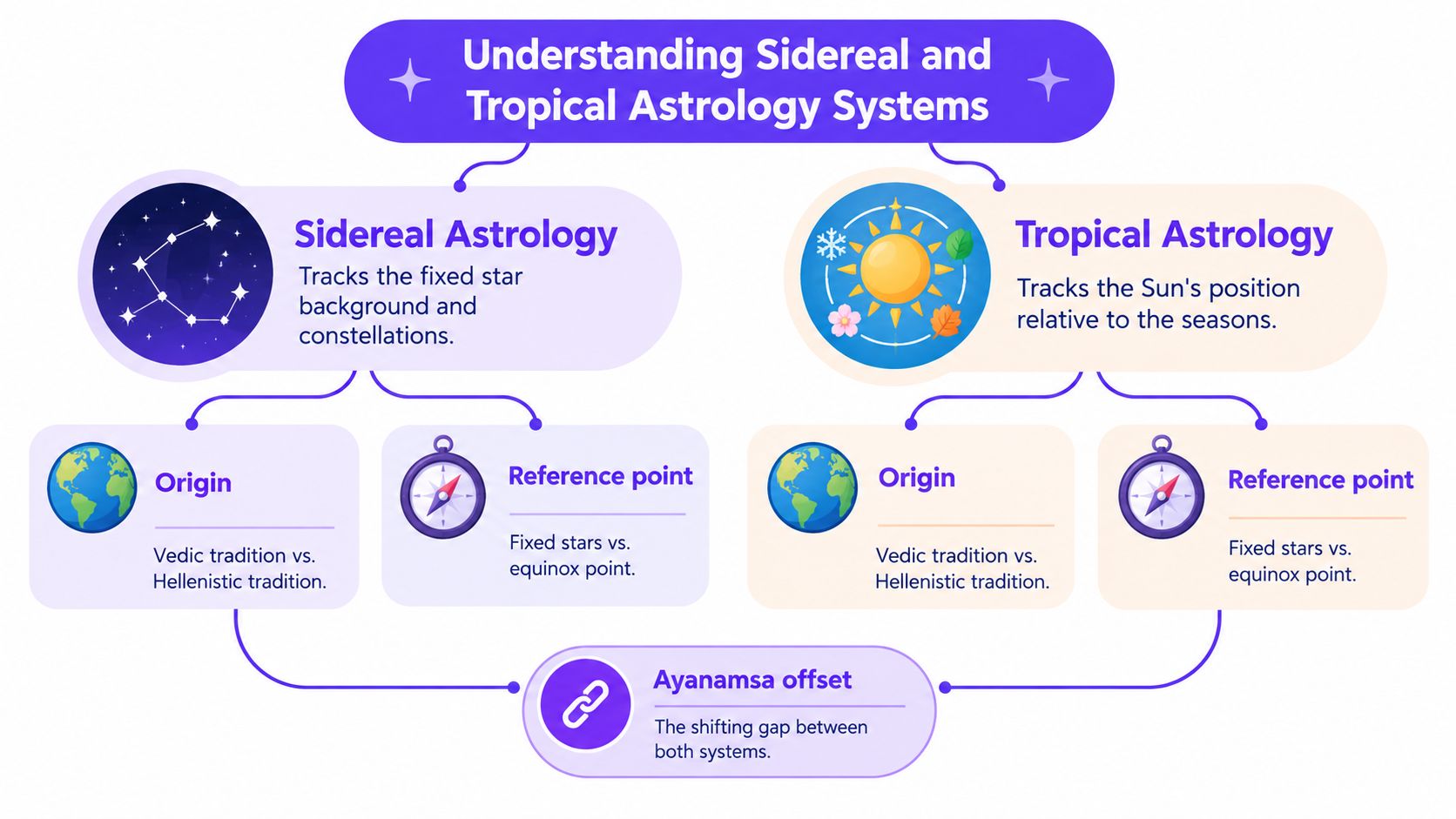
Table of Contents
- Understanding Sidereal and Tropical Astrology Systems
- The Astronomical Basis Precession of Equinoxes Explained
- Comparing Chart Interpretations Side by Side
- How VedicAstrology.com Can Help
- Real Examples of Same-Birth-Day Differences
- Evaluating Strengths and Limitations of Each System
- Converting Between Sidereal and Tropical Charts
- Choosing the Right System for Your Practice
Understanding Sidereal and Tropical Astrology Systems
If your birth chart says one sign in one app and a different sign in another, the confusion usually comes from reference point, not calculation error. Sidereal astrology tracks the sky against the fixed stars, while tropical astrology tracks the Sun's path through the seasons and starts Aries at the March equinox. Both systems use the same twelve sign names, but they begin counting from different places in the sky.
Two ways to read the same sky
It is like two maps of the same city. One map uses landmarks that do not move; the other uses the calendar of the year, including the turning points of spring, summer, autumn, and winter. Neither map is fake, but each one answers a different question.
That difference matters when you interpret a natal chart. A chart built on sidereal positions can shift a sign placement backward compared with a tropical chart, especially if a planet sits near a sign boundary. For someone who has always felt “off” about a calendar-based sign label, that shift can make the chart feel more coherent.
Practical rule: if you're trying to compare systems, don't start with personality language. Start with the chart's reference point, because that's what actually changes.
Why the systems stayed side by side
Historically, the split became sharply defined in the 2nd century CE. Hipparchus identified precession, and Claudius Ptolemy later formalized the tropical zodiac around 150 CE, anchoring 0° Aries to the March equinox instead of the fixed stars (Sidereal and tropical astrology). That choice made the seasonal zodiac distinct from the star-based one.
The practical result is easy to feel but easier to miss. Because Earth's axial precession shifts the equinox by about 1 degree every 72 years, the two zodiacs have drifted apart to nearly 24 degrees today (Sidereal and tropical astrology). That's enough to move many people into the previous sign in sidereal work, which is why the same birthday can produce different sign labels without either system being “wrong.”
The Astronomical Basis Precession of Equinoxes Explained
Earth doesn't spin in perfect stillness. It wobbles slowly, like a top that's beginning to lean, and that wobble is what astronomy calls precession of the equinoxes. In astrology, that slow motion is the reason the seasonal zodiac and the star-based zodiac no longer line up.
The wobble that changed the zodiac
Hipparchus recognized the precession pattern, and Ptolemy later used a seasonal starting point for the tropical zodiac around 150 CE (Sidereal and tropical astrology). Once Aries was fixed to the March equinox, the signs followed the seasons instead of the background stars. That made perfect sense for a system built around the annual cycle of light and dark.
The problem is that the equinox point doesn't stay pinned to the same stars. It drifts backward very slowly, about 1 degree every 72 years (Sidereal and tropical astrology). Over many centuries, a small drift becomes a large one. Today that accumulated offset is nearly 24 degrees, which is why a chart can show a different sign in sidereal and tropical calculation.
Why that matters for chart reading
A 24-degree shift is not a tiny cosmetic difference. It changes how astrologers place the Sun and other planets when they're close to the edge of a sign. If a planet sits late in one tropical sign, the sidereal version may push it into the previous one. That matters because astrologers interpret signs as whole archetypes, not just degree ranges.
The same mechanism also explains why people sometimes feel surprised by a sidereal chart. They expected a label based on the calendar date, but the sidereal system is following the sky's slowly changing background instead. That's not an error in either system. It's a different measurement standard.
The sky hasn't stopped moving. The chart only looks stable when you decide which point in that moving sky you want to call the starting line.
Comparing Chart Interpretations Side by Side
The easiest way to understand the difference is to see what changes and what stays stable. The biggest visible shift is usually the Sun sign, but the same offset can affect the Moon, rising sign, and any planet that sits near a boundary. When a placement is deep inside a sign, both systems may describe it similarly. When it's near the edge, the difference becomes much more obvious.
Side by side sign mapping
| Birth Date Range | Tropical Sign | Sidereal Sign |
|---|---|---|
| Early March to late March | Aries | Pisces |
| Late March to mid April | Aries | Pisces |
| Mid April to mid May | Taurus | Aries |
| Late May to late June | Gemini | Taurus |
| Late September to mid October | Libra | Virgo |
| Late October to mid November | Scorpio | Libra |
The table shows the practical pattern without pretending every chart is identical. A person born on April 15 may find that the tropical chart places the Sun in Taurus, while the sidereal chart places it in Aries. That is a real interpretive shift, not a typo.
What changes in interpretation
Tropical astrology usually reads the chart through seasonal symbolism. A sign means something because of where it sits in the annual cycle. Sidereal astrology reads the chart through stellar alignment. A sign means something because of where it sits against the fixed backdrop of the sky.
So the same birth date can invite different language. A tropical reading might emphasize continuity with the season, while a sidereal reading might emphasize alignment with the visible sky. Neither approach cancels the other out, but each asks you to pay attention to a different layer of meaning.
Where readers usually get stuck
Most confusion comes from assuming a sign name is a universal fact. It isn't. It's a label inside a system, and the system decides what that label points to. Once you see that, the disagreement looks less like a fight and more like two coordinate grids laid over the same moment.
A useful way to test the difference is to compare your Sun, Moon, and rising sign across both systems, then notice which placements shift and which ones don't. The ones that change are often the most instructive because they show where your chart is most sensitive to the choice of framework.
How VedicAstrology.com Can Help
For readers who want a sidereal chart without manually doing the conversion, VedicAstrology.com offers online Vedic astrology readings based on each user's sidereal birth chart. The service uses a messenger-style format, so you can ask about specific life areas instead of waiting for a live consultation.
What it helps with
The service calculates a personal Vedic birth chart from date, time, and place of birth using the sidereal zodiac. It also organizes readings into topic-based chats, including areas like love, work, money, health, family, travel, spirituality, and friends. That structure helps if you're trying to understand not just what sign you are, but how a sidereal chart changes the interpretation of your life areas.
For readers new to the tradition, Vedic (sidereal) astrology is a useful starting point because it explains the system's logic before you try to read your own chart. The articles library also covers janam kundli basics, nakshatras, and dasha timing, which can make the switch from tropical thinking feel less abrupt.
When it makes sense to use it
This kind of tool is helpful if you want a chart built around lagna, the Moon, nakshatras, and dasha periods, rather than a generic sun-sign description. It's also useful if you want to compare charts for compatibility or if you prefer a self-paced, text-based reading instead of booking time with someone live. The exact birth time matters here, so it's better for people who know their details fairly well.
The clearest use case is simple. If you're trying to understand sidereal astrology as a working system, not just as an abstract debate, a chart-first tool gives you something concrete to inspect.
Real Examples of Same-Birth-Day Differences
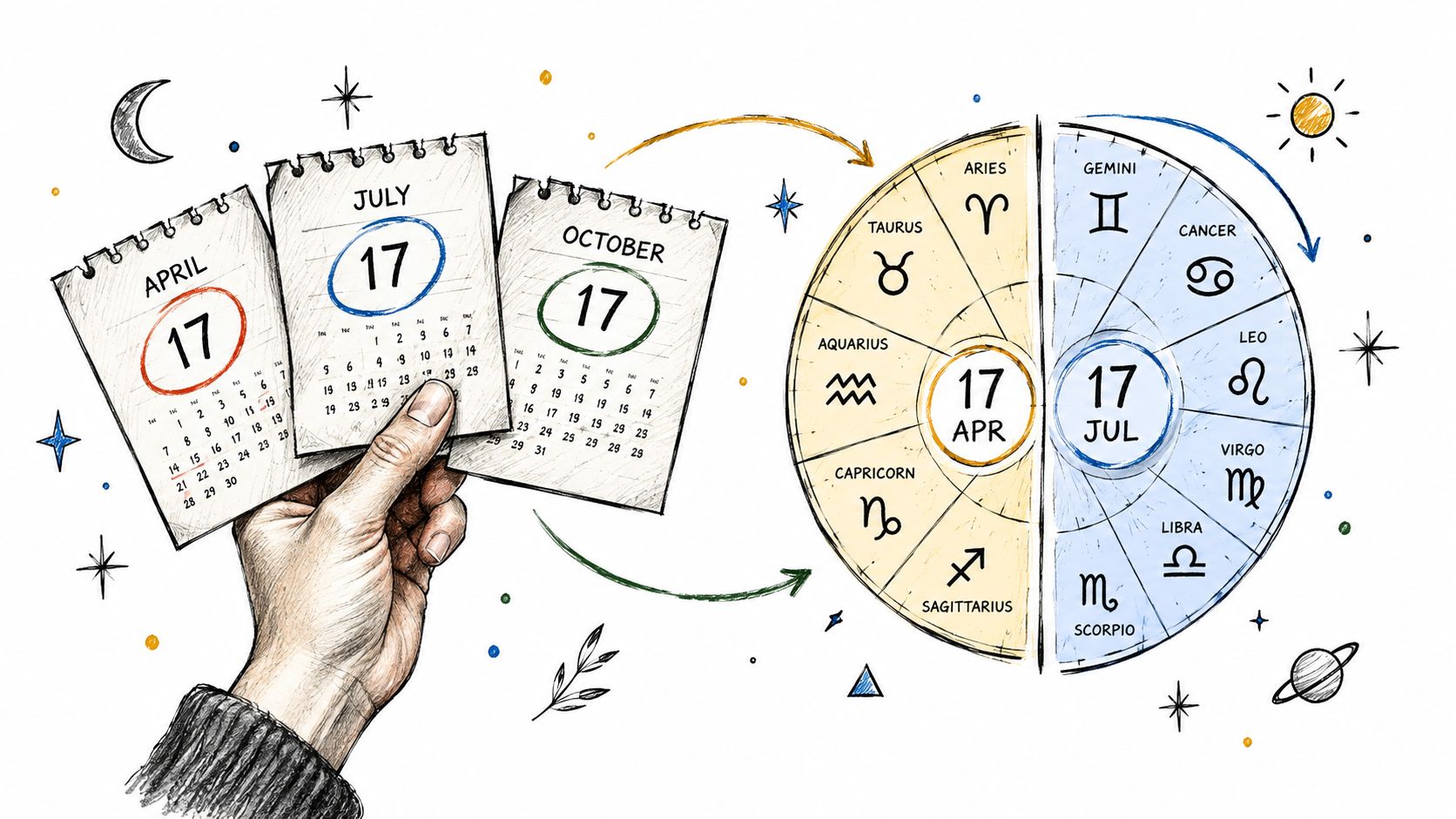
A side-by-side example helps more than theory here. On one birth date, both systems can land on the same broad story. On another, a sign boundary can change the tone completely. That's why readers often feel that one system “fits” better once they test it against actual dates.
Example one an early spring birthday
A birthday in early March often stays close to the Pisces area in both systems, though the exact degree can differ. That makes it a relatively stable comparison point. The chart doesn't suddenly become unrecognizable, but the emphasis can shift depending on which zodiac you trust.
Example two a boundary birthday
A birthday like April 15 can be more dramatic. Tropical calculation may place the Sun in Taurus, while sidereal calculation can pull it back into Aries. One reading focuses on steadiness, material grounding, and persistence. The other may emphasize initiation, directness, and quick movement.
Example three a late autumn birthday
A late October birthday can reveal a similar split. Tropical reading may keep the Sun in Scorpio, while sidereal reading can move it into Libra. That can change the tone from inward intensity to relational balancing, even though the birth moment itself hasn't changed at all.
▶ PlayWhat matters most is not memorizing which date equals which sign. It's noticing where the systems diverge most and asking what that says about the chart you're trying to read. Boundary birthdays tend to show the clearest differences, while birthdays in the middle of a sign usually produce less dramatic shifts.
Evaluating Strengths and Limitations of Each System
The better question isn't which system wins. It's what kind of reading you want to do, and what kind of symbolism you trust most. Sidereal and tropical astrology both have internal logic, but they support different interpretive habits.
What sidereal does well
Sidereal astrology stays close to the visible sky. That makes it appealing to readers who want the chart to feel anchored in observable astronomy rather than seasonal symbolism. It also fits naturally with Jyotish traditions, where the Moon, rising sign, nakshatras, and planetary periods carry a lot of interpretive weight.
A second strength is consistency with its own framework. If you want a chart that keeps the signs aligned with the stars you can see, sidereal astrology gives you that structure. For readers who value that kind of correspondence, the system feels coherent from top to bottom.
What tropical does well
Tropical astrology excels as a seasonal language. It connects signs to the annual rhythm of the Earth, which makes it easy to read as a symbolic map of time, growth, and transition. That's one reason it remains firmly embedded in Western astrological practice.
It also has a long interpretive history in psychological and personality-based reading. If your goal is to understand recurring themes, moods, and life cycles through seasonal imagery, tropical astrology gives you a rich vocabulary for that work.
Good practice: choose the system that matches the kind of question you're asking. Use sidereal for star-based calculation and Jyotish-style timing. Use tropical for seasonal symbolism and Western interpretive language.
The limitation on both sides is the same. If you treat a chart label like a final verdict instead of a symbolic framework, you'll miss what the system is trying to do. The stronger reading comes from matching method to intent.
Converting Between Sidereal and Tropical Charts
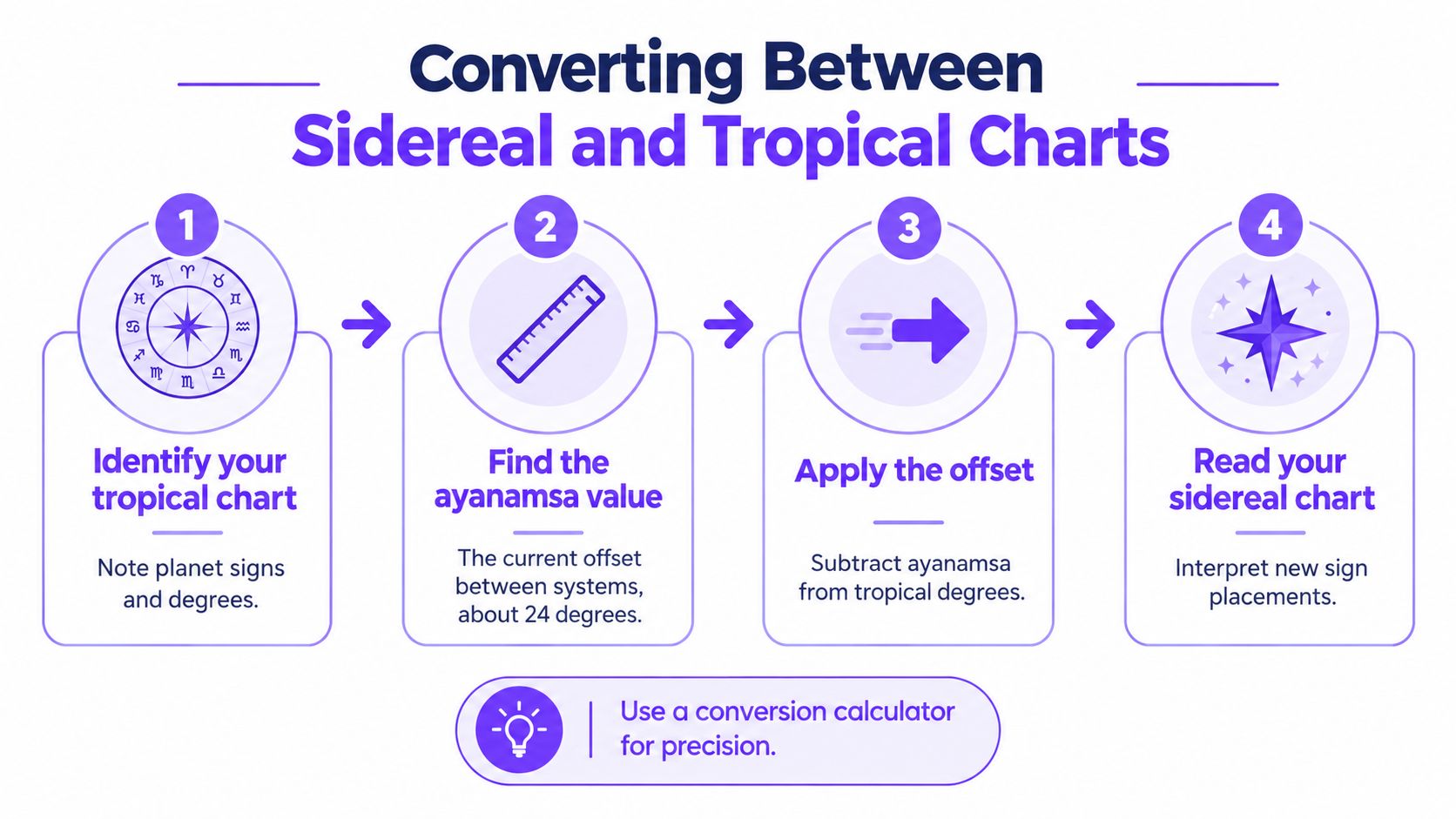
If you want to compare the systems directly, the key bridge is ayanamsa, the offset between tropical and sidereal positions. Today that offset is about 24 degrees, which is why conversion usually moves a placement backward by nearly a full sign (Sidereal and tropical astrology).
A simple way to think about the conversion
Start with the tropical chart, then subtract the offset from each degree position. After that, read the new sign placements in the sidereal frame. The sign change is most noticeable when a planet sits near the end of a tropical sign, because the offset can push it across the boundary.
That's the basic idea, but degree precision matters. A sign label alone can hide important details, especially for the Moon and rising sign. If you're comparing charts seriously, use a conversion calculator or a full charting tool rather than guessing from memory.
Choosing the right method for your goal
If your interest is spiritual practice or Jyotish tradition, sidereal calculation is the natural starting point. If your interest is psychological symbolism or seasonal interpretation, tropical astrology may feel more intuitive. If you're curious rather than committed, comparing both can show you where they agree and where they part ways.
Lila's natal chart feature is another option if you want chart calculation built into a broader health and lifestyle app, since it supports precise birth date, time, and location inputs along with multiple house systems. That said, the best choice still depends on what you want from the chart itself.
Choosing the Right System for Your Practice
The easiest way to choose is to ask what kind of meaning you want from the chart. If you care most about astronomical alignment, Vedic tradition, or a star-based framework, sidereal astrology usually fits that intention better. If you care most about seasons, symbolic language, and Western interpretive habits, tropical astrology may feel more natural.

A practical decision framework
- Choose sidereal if you want your chart to follow the fixed stars, the Jyotish tradition, or timing methods that lean on sidereal calculation.
- Choose tropical if you want a seasonal framework, Western-style chart reading, or a symbolic system centered on the Sun's annual cycle.
- Use both if you want a wider lens and are comfortable treating the chart as two overlapping languages.
The most useful choice is the one that matches your purpose. If you're studying a tradition, stay inside that tradition's rules. If you're exploring, compare both charts and notice which one gives you clearer language for the questions you're asking.
A lot of readers don't need to pick a winner. They need a method that fits their intent, then the discipline to apply it consistently. If you want, pull your own birth data into both systems, compare the placements that change, and see which framework gives you the cleaner reading.
Get Lila, your personal coach for perimenopause.
Built for women in their 40s. 24/7 coaching, in your pocket.