
Best Protein Shake in the Market for Menopause
Find the best protein shake in the market for menopausal women. Compare top options by protein source, sugar, and weight-loss support.
The best protein shake in the market for menopausal women isn't the one with the most protein per serving. It should provide 25–30 grams of quality protein, minimal added sugar, and transparent contaminant testing, while fitting your daily protein target and activity level.
Protein shakes have moved well beyond the gym crowd. The global protein-supplements market reached an estimated USD 28.15 billion in 2024, and forecasts project USD 55.32 billion by 2032, but market size doesn't tell you which product suits your body, goals, digestion, or dietary pattern. Those market figures show why shoppers face so much choice, not why one shake is universally superior.
For women in perimenopause and menopause, the useful question is more specific: does this shake help you meet an appropriate protein target without adding unnecessary calories, excessive sugar, digestive discomfort, or avoidable contaminant exposure? The answer depends on protein quality, leucine, testing, timing, and resistance training, not a flashy front-of-pack protein number.
Table of Contents
- Why the Best Protein Shake Depends on Your Menopausal Goals
- Evaluating Protein Quality Beyond Grams Per Serving
- Top Protein Shake Categories for Menopausal Women
- The Safety Factor - Contaminants in Protein Powders
- How to Calculate Your Personal Protein Strategy
- Making Your Final Selection - A Decision Framework
Why the Best Protein Shake Depends on Your Menopausal Goals
The most popular advice says to choose the shake with the highest protein number. That shortcut misses the context that determines whether the product helps. A large serving of protein won't compensate for an inadequate eating pattern, poor tolerance, or a lack of progressive resistance training.
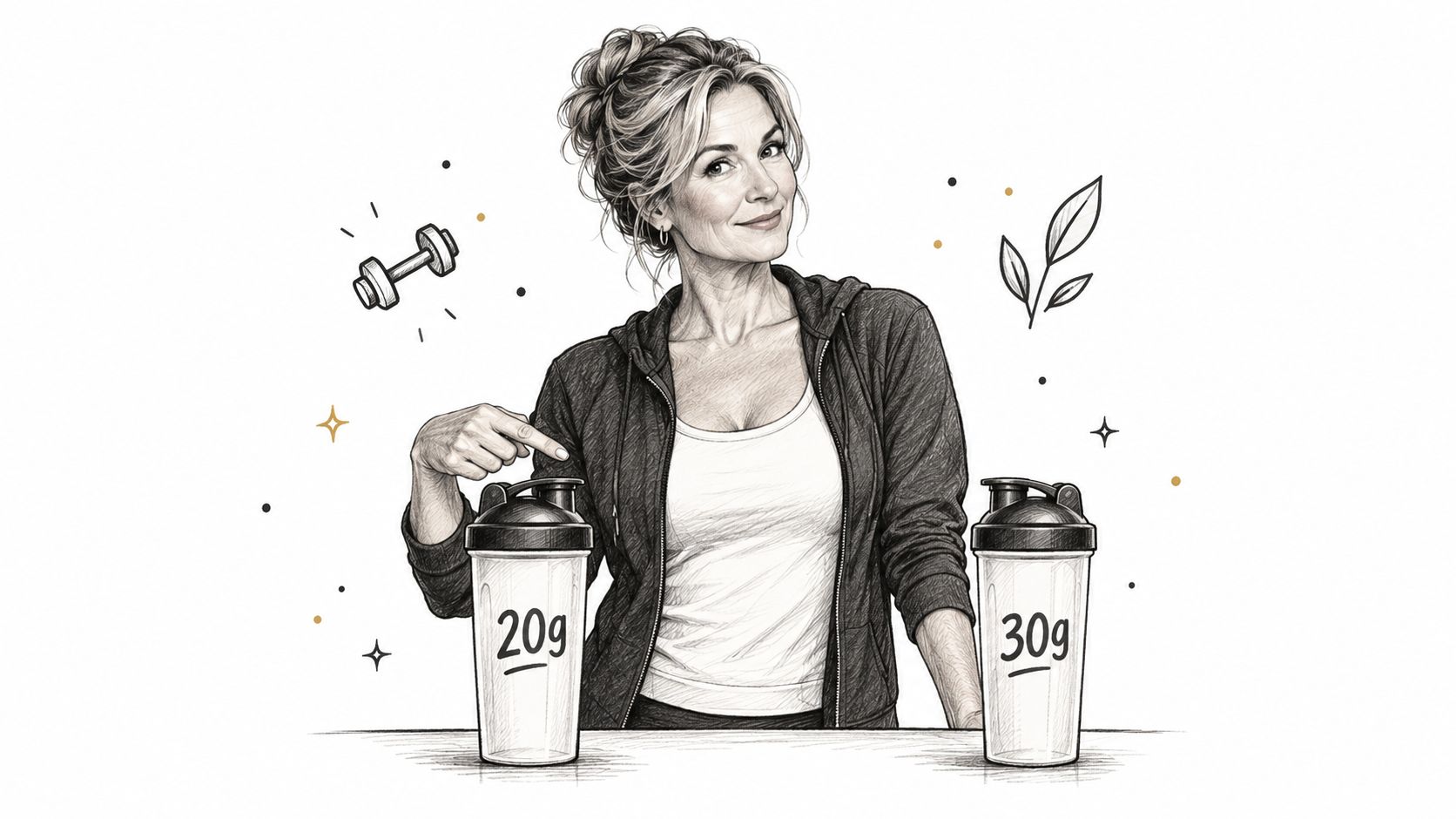
A 2024 double-blind randomized trial followed 171 healthy adults aged 50 and older who consumed a daily shake with 20 grams of protein for 12 weeks. Participants consuming either plant or dairy protein didn't experience significantly different changes in muscle strength, physical function, body composition, metabolic health, sleep quality, or quality of life compared with people drinking a low-protein control beverage. The controlled trial doesn't mean protein shakes are useless. It shows that protein alone isn't a guaranteed metabolic solution.
Match the shake to the outcome
Menopause can change appetite, meal patterns, sleep, training consistency, and body-composition goals. Those differences make selection personal.
- Preserving lean mass: Prioritize a complete protein with a useful leucine profile, then pair it with progressive strength training.
- Managing weight: Choose a shake that supplies protein without turning a small nutrition gap into an unnecessarily calorie-dense snack.
- Improving breakfast: Use a shake when your usual breakfast contains little protein, but don't assume a drink is better than eggs, yogurt, tofu, fish, or another protein-rich meal.
- Supporting convenience: A ready-to-drink option can help on busy mornings or low-appetite days if you can tolerate its ingredients consistently.
A product marketed as the best protein shake in the market may be popular, heavily advertised, or widely stocked. None of those qualities confirms that it provides the right amino acids or suits your goals. If you're comparing dairy options, a practical guide to the best whey protein for women can help you understand the differences between common whey formats.
Practical rule: Choose the shake that fills a real dietary gap, not the one that creates the biggest protein surplus.
Evaluating Protein Quality Beyond Grams Per Serving
A label's protein total tells you how much protein the manufacturer declares. It doesn't tell you how well that protein supplies the indispensable amino acids involved in muscle-protein synthesis.
Leucine deserves particular attention. Whey is generally the strongest single-source option for this purpose because it provides a high proportion of indispensable amino acids and is especially rich in leucine. A technical review found higher leucine amino-acid availability ratios for whey isolate and concentrate than for soy, pea, and rice proteins. The technical review also reports that approximately 0.010 grams of leucine per kilogram of body weight may represent a minimum muscle-protein-synthesis threshold, while more than 0.040 grams per kilogram may be needed after demanding exercise.
For a 70-kilogram adult, those thresholds correspond to roughly 0.7 grams at the lower level and more than 2.8 grams for the higher post-exercise target. The same review reports DIAAS values above 100% for milk, eggs, and beef, while many plant-derived proteins score below 80%. These figures don't make dairy automatically right for everyone. They explain why a plant shake needs thoughtful formulation rather than a simple comparison of protein grams.
Protein sources compared
| Protein source | DIAAS value (%) | Leucine profile |
|---|---|---|
| Whey isolate | Not specified in the reviewed data | Particularly rich, with high leucine availability |
| Whey concentrate | Not specified in the reviewed data | High leucine availability |
| Milk | Above 100 | Complete protein profile |
| Eggs | Above 100 | Complete protein profile |
| Beef | Above 100 | Complete protein profile |
| Soy | Not specified in the reviewed data | Lower leucine availability than whey in the review |
| Pea | Often below 80 for plant-derived proteins | Lower leucine availability than whey in the review |
| Rice | Often below 80 for plant-derived proteins | Lower leucine availability than whey in the review |
A 25-gram pea shake doesn't necessarily provide the same muscle-building signal as 25 grams of whey isolate. A blended plant formula combining complementary sources may offer a more useful amino-acid pattern than a single-source powder. Look for a declared leucine amount or a full amino-acid profile when the label provides one.
Protein quality also matters outside training. If you're trying to find weight loss snacks with Recipe One, use the same principle: assess the complete nutrition profile, not only the protein headline. For recovery ideas, post-workout protein snacks can help you compare shakes with ordinary foods.
Top Protein Shake Categories for Menopausal Women
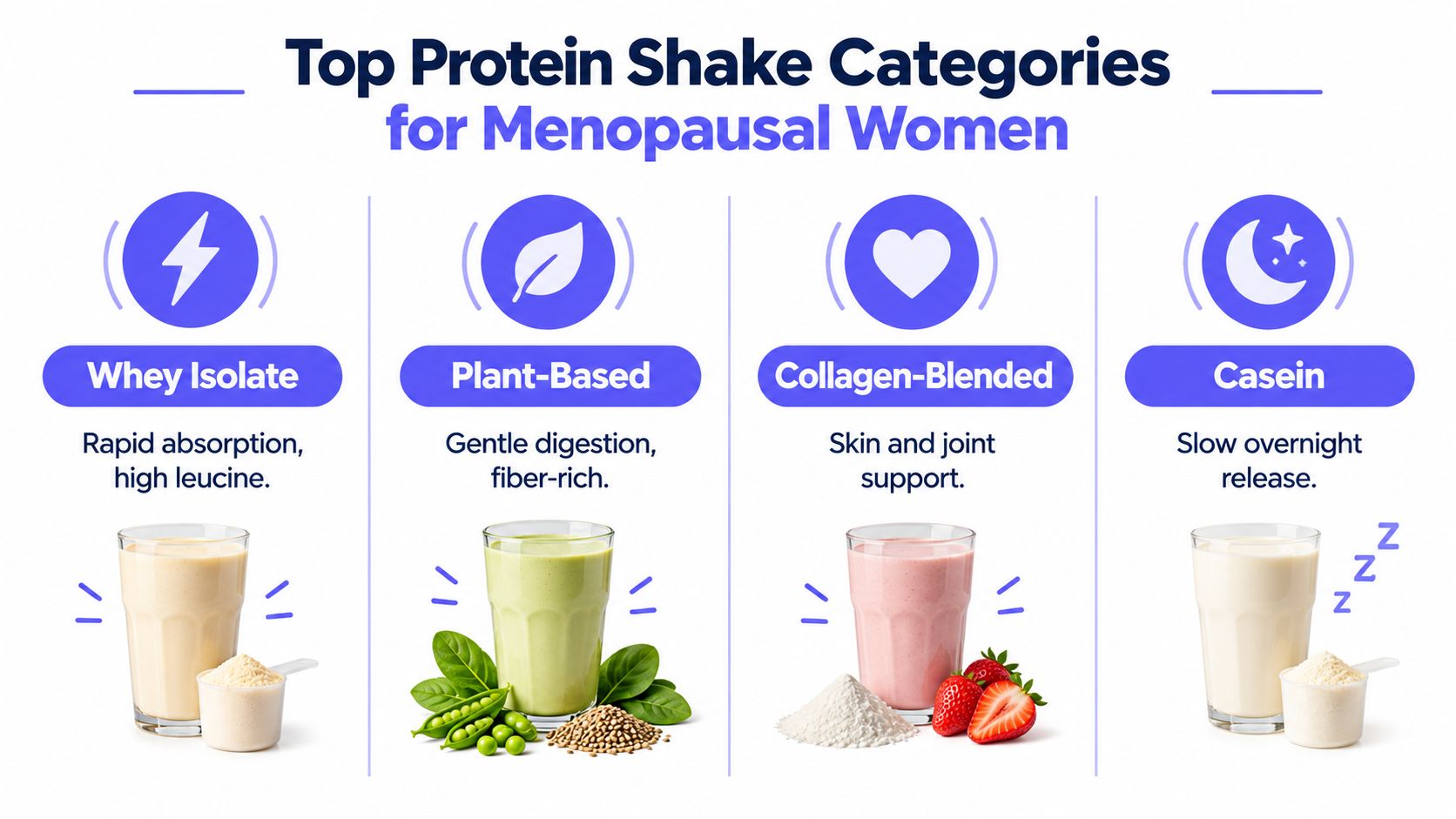
No single category wins for every woman. Whey isolate may suit someone focused on resistance-training recovery, while a plant blend may be a better everyday choice for someone avoiding dairy. A casein-containing formula may feel more filling, whereas a simple whey shake may work better when breakfast needs to be quick.
A 2025 review reports that healthy older adults generally need about 1.0–1.2 grams of protein per kilogram of body weight daily, with roughly 25–30 grams per meal helping support muscle-protein synthesis. A 2025 study in older women with sarcopenia found that 1.2 grams per kilogram per day improved muscle strength, reduced fat accumulation, and improved muscle composition compared with 0.8 grams per kilogram. The review and study support a meal-based strategy rather than relying on one oversized shake.
Four useful categories
Whey isolate is a strong choice for post-workout use. It usually has a high protein density and a high-quality amino-acid profile, and it may be easier to tolerate than whey concentrate for some people who are sensitive to lactose. Check the ingredient list rather than assuming every isolate is identical.
Whey concentrate can work well when you tolerate dairy and want a flexible everyday shake. It may contain more lactose and fat than an isolate, so digestive response matters more than a small difference in label claims.
Plant-based blends suit vegan, dairy-free, or dairy-avoiding diets. Pea, rice, and other plant proteins can complement one another, but a single-source plant powder may provide a less favorable amino-acid pattern. A well-formulated blend is usually a more logical comparison with whey than a single plant source.
Collagen-blended products require careful interpretation. Collagen can be included for specific connective-tissue or skin-related reasons, but it shouldn't automatically be treated as a complete substitute for a muscle-focused protein source. Casein-based or casein-blended shakes may provide a slower-digesting option, although the right choice still depends on total intake and tolerance.
For weight management, select a formula whose calories and added sugar fit your day. A low-sugar, protein-dense shake gives you more flexibility than a sweetened drink that functions like a dessert. If you're exploring broader dietary choices, this guide to a plant-based diet for menopause can help place a shake within a complete eating pattern.
The Safety Factor - Contaminants in Protein Powders
Protein quality isn't only about amino acids. A powder can look excellent on the nutrition panel and still deserve scrutiny for contaminants, manufacturing controls, and label accuracy.
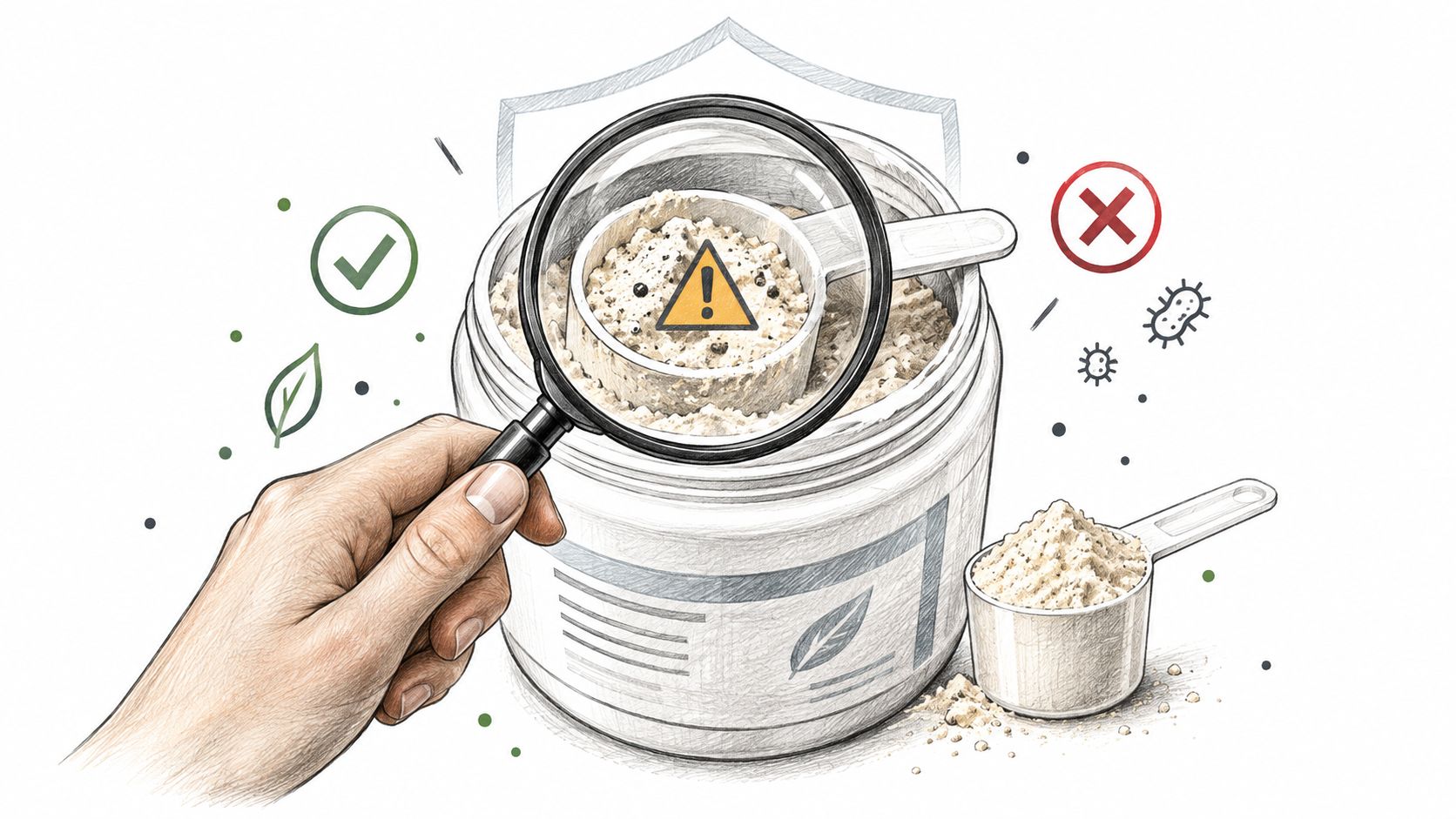
Consumer Reports tested 23 popular protein powders and ready-to-drink shakes. More than two-thirds exceeded its lead level of concern, and plant-based products averaged substantially more lead than whey-based products in that comparison. The Consumer Reports findings don't mean every plant product is unsafe. They do show why shoppers shouldn't treat “plant-based,” “natural,” or “premium” as proof of safety.
What testing should cover
Look for a manufacturer that explains how it verifies both the contents and the contaminants. Useful evidence includes:
- Independent contaminant testing: Check whether the product is tested for lead, cadmium, arsenic, and mercury.
- Lot-level documentation: Batch-specific results provide more meaningful information than a vague claim that a brand tests its products.
- Protein verification: Testing should confirm that the product contains the stated protein amount.
- Clear ingredient disclosure: Avoid formulas that hide meaningful ingredients inside proprietary blends.
- Certification scope: A certification seal can be useful, but check what the certification covers.
NSF dietary-supplement criteria cited in the reporting set daily limits of 10 micrograms for lead and inorganic arsenic and 4.1 micrograms for cadmium. Certification scope varies, and no single seal guarantees that every contaminant is absent. If you use shakes regularly, this safety check deserves the same attention as sugar, calories, and protein type.
A transparent label is helpful. Independent verification is stronger.
Use a broader guide to choosing supplements when comparing protein powders with other products. The goal isn't to fear every supplement. It's to choose one with enough quality-control evidence to justify regular use.
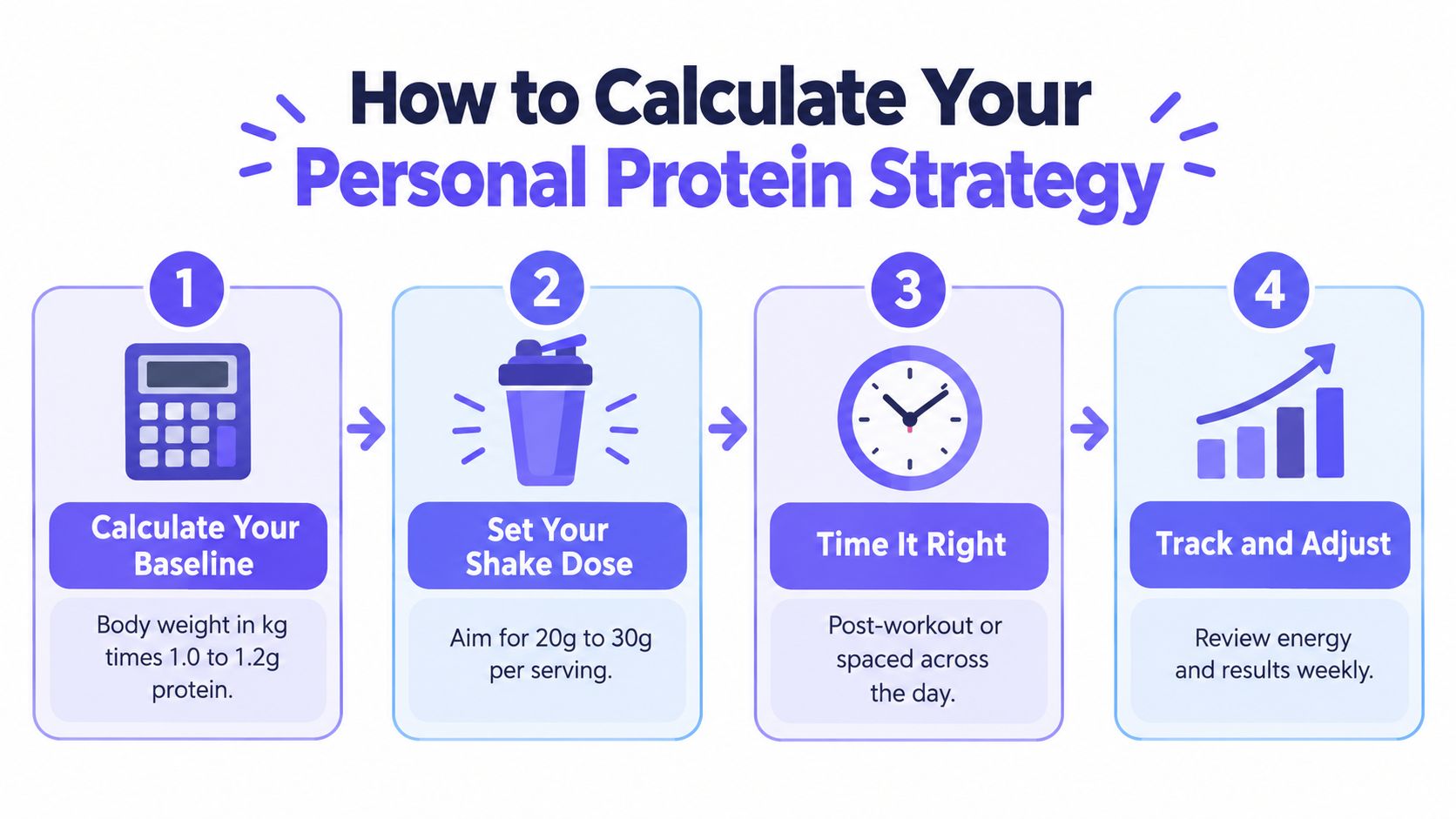
How to Calculate Your Personal Protein Strategy
A shake becomes useful when it solves a specific problem in your daily intake. Start with your body weight, consider your training and goals, then identify the meal or situation where protein is consistently missing.
Start with the daily target
Use your body weight in kilograms as the starting point for an approximate daily range. The evidence summarized earlier supports a higher protein pattern for many healthy older adults, but your appropriate target can differ with medical conditions, body composition, training, appetite, and dietary intake.
A 70-kilogram woman, for example, would use her body weight as the basis for an approximate daily range rather than choosing a shake at random. Divide the result across meals so one drink doesn't carry the entire responsibility for daily protein.
Next, inspect your meals. Breakfast is often the easiest place to find a gap, especially if it consists mainly of toast, fruit, or coffee. A shake can add value there, but so can Greek yogurt, eggs, cottage cheese, tofu, fish, or another protein-rich food that you enjoy and digest well.
Use timing to improve consistency
Timing doesn't turn a mediocre product into a superior one, but it can make a good strategy easier to follow.
- After resistance training: A quality shake can provide convenient protein when a full meal isn't practical.
- At a low-protein breakfast: Use it to strengthen an otherwise light meal.
- During a busy day: Keep a suitable ready-to-drink option available when preparation or appetite is limited.
- Before adding calories: Check whether the shake replaces food or sits on top of your usual intake.
The most important adjustment is often distribution. Concentrating protein in one evening drink may be less practical than including a meaningful amount at several meals. Progressive resistance training also matters because the shake supports the training stimulus rather than replacing it.
▶ PlayTrack how the product affects fullness, digestion, energy, and training consistency. A protein calculator for women over 50 can provide a starting point, but anyone with kidney disease or another medical condition should obtain individualized clinical guidance before increasing protein or using supplements regularly.
Making Your Final Selection - A Decision Framework
The best protein shake in the market for you is the product that passes several filters at the same time. Start with your goal, then assess the label, the protein source, safety evidence, and whether you'll use it.
Filter one for the nutrition profile
Look for a serving that contributes roughly 25–30 grams of protein when that amount fits your meal plan. Keep added sugar modest and check total calories, especially if your goal involves weight management. A shake that adds substantial calories to a complete meal may work against your plan, even if its protein quality is excellent.
Read the full ingredient list. Check for milk, soy, gluten, sweeteners, sugar alcohols, or other ingredients that cause you problems. Digestive tolerance is not a minor preference. A theoretically ideal shake that leaves you bloated won't support consistent intake.
Filter two for amino acids and use case
For post-training recovery, whey isolate is often the simplest single-source choice because of its leucine and indispensable amino-acid profile. If you avoid dairy, choose a plant blend with complementary sources and look for a disclosed amino-acid profile where available. If satiety is the priority, a blended or slower-digesting formula may fit better than a thin, rapidly consumed drink.
Don't confuse collagen inclusion with a complete muscle-focused protein. If a product combines collagen with whey or another complete protein, assess how much of the actual complete protein it supplies.
Filter three for quality control
Before buying, ask:
- Does the brand disclose independent testing?
- Does testing cover lead, cadmium, arsenic, and mercury?
- Does the label clearly state the protein source and amount?
- Can you identify allergens and sweeteners without guessing?
- Does the product fit your calories and daily target?
Flavor and mixing ease still matter because consistency matters. They should come after protein quality, tolerability, and safety evidence, not replace them.
Menopause doesn't create one universal nutrition prescription. It does make a strategic approach more valuable. Choose a shake that supplies useful protein, use it where your diet needs support, and combine it with adequate meals and progressive resistance training. If you have kidney disease, another medical condition, or take medication affected by dietary changes, ask a qualified clinician for personalized advice.
Lila offers symptom, meal, sleep, energy, mood, and cycle tracking alongside an AI-guided action plan and chat-based coaching, which can help you connect protein habits with broader menopausal goals. Visit Lila to explore a more organized way to track your routine and build sustainable health habits.
Get Lila, your personal coach for perimenopause.
Built for women in their 40s. 24/7 coaching, in your pocket.