
Hip Pain and Perimenopause: Causes and Relief
Discover the link between hip pain and perimenopause. Learn about hormonal shifts, differential diagnoses, and effective self-care strategies for relief.
You wake up and notice a deep ache in one hip. Or perhaps the pain sits on the outside of your thigh, sharp enough to make rolling over in bed unpleasant. A year ago, you could climb stairs, walk uphill, or stand on one leg without thinking about it. Now you're wondering whether you've strained something, changed your exercise routine, or just started “getting old.”
Hip pain and perimenopause often appear together, but that doesn't mean every ache is caused by hormones. The menopausal transition can change how your muscles, tendons, joints, and nervous system respond to everyday loads. The important question isn't only, “Can perimenopause cause hip pain?” It's also, “Which structure hurts, and what does it need?”
Table of Contents
- Why Your Hips Suddenly Hurt in Perimenopause
- The Biological Link Between Estrogen and Joint Health
- Identifying Your Specific Type of Hip Pain
- Targeted Self-Care and Load Management Strategies
- How Weight Shifts and Sleep Impact Hip Biomechanics
- When to Seek Medical Evaluation and Imaging
- Building a Sustainable Plan for Long-Term Mobility
Why Your Hips Suddenly Hurt in Perimenopause
Maya notices the pain while putting on her shoes. Her left hip feels stiff when she first stands, then begins to ache after she walks around the house. At night, lying on that side creates a tender, bruised sensation over the outer hip. She hasn't fallen, and she hasn't started a new sport, so the symptoms feel confusing.
Many women in their 40s and 50s have a similar experience. Pain may begin during a period of irregular cycles, disrupted sleep, hot flashes, or changes in mood and energy. Because the symptoms arrive gradually, it's easy to blame a desk chair, a new pair of shoes, or an ordinary busy week.
The broader evidence supports the idea that this isn't a made-up symptom or a personal failure. A synthesis of 37 studies involving 93,421 women found that 57% of perimenopausal women reported muscle or joint pain, compared with 40% of premenopausal women, representing a 1.35-fold higher risk (evidence on musculoskeletal pain during the menopausal transition). The same review reported a 59% prevalence in postmenopausal women, which suggests that pain can begin or intensify during the transition and continue afterward.
Aching is information, not a verdict on your age or fitness.
Hormonal fluctuation may make tendons and muscles less tolerant of loads they previously handled easily. At the same time, less sleep, reduced recovery, and changes in strength can alter how you move. A tendon that had been handling side-sleeping, stair climbing, or long walks without complaint may become sensitive when several stressors arrive together.
That connection doesn't mean you should attribute every symptom to estrogen. A useful overview of hormones and joint pain relief can help you understand the wider symptom picture, while this guide to perimenopause joint pain offers further context for tracking aches across your body.
The next step is to locate the pain rather than treating “hip pain” as one diagnosis. Outer-hip tendon pain behaves differently from deep joint pain, and pain referred from the lower back needs a different assessment again.
The Biological Link Between Estrogen and Joint Health
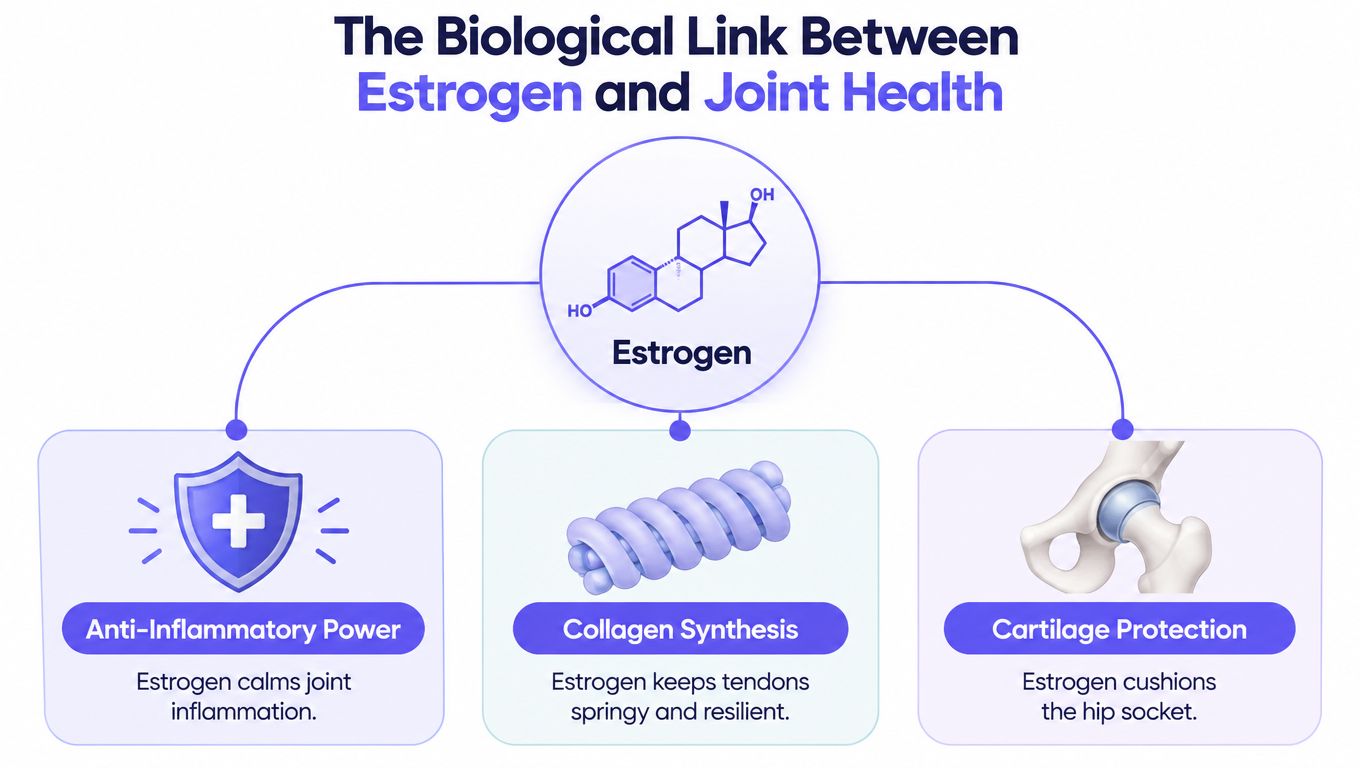
Estrogen doesn't act like a painkiller that switches discomfort off. It helps regulate several tissues involved in movement, including tendons, cartilage, muscle, and bone. During perimenopause, estrogen levels can fluctuate substantially before settling at a lower level after menopause. That changing environment may affect how tissues repair themselves and tolerate repeated stress.
A useful analogy is a well-oiled hinge. When the hinge has adequate lubrication and resilient surfaces, it moves smoothly under ordinary pressure. As the surrounding conditions change, the hinge may become less forgiving. It can still move, but friction, stiffness, and sensitivity appear sooner when the load rises.
What changes inside the tissues
Estrogen is linked with collagen regulation, and collagen forms much of the structural framework of tendons and other connective tissues. If a tendon becomes less resilient, everyday compression or repeated pulling can provoke pain. This matters at the outer hip, where the gluteal tendons help stabilise the pelvis during walking, stair climbing, and single-leg standing.
Estrogen also interacts with inflammatory processes. During the menopausal transition, some people become more sensitive to normal mechanical stress, so a movement that once felt harmless may produce a stronger pain response. That doesn't prove that inflammation is the sole cause of your symptoms, but it helps explain why pain can feel disproportionate to the activity that triggered it.
Cartilage and joint structures are part of the picture too. Reviews of menopause-related musculoskeletal changes identify the hip, knee, and hand as common osteoarthritis sites in aging women, with risk rising rapidly from around age 50 after menopause (review of menopause, musculoskeletal change, and osteoarthritis).
Why hormone levels aren't the whole diagnosis
The hormonal connection is real, but it doesn't identify the painful structure. Estrogen decline may make a tendon more vulnerable, while a sudden increase in walking creates the immediate overload. A stiff hip joint may coexist with weak hip abductors. A lower-back problem may feel like hip pain even when the hip joint itself is healthy.
You can learn more about the role of normal estradiol levels, but a blood test alone usually won't tell you whether your pain comes from a tendon, joint, nerve, or referred source. Your symptom location, movement pattern, strength, and clinical examination remain important.
The practical conclusion is simple. Hormonal changes may alter the conditions around your hip, but the treatment still needs to match the tissue involved.
Identifying Your Specific Type of Hip Pain
Start with one question: Where do you feel the pain most clearly? Place one finger on the most painful area. Then notice what brings it on. A pain map can't replace an examination, but it can help you describe the problem accurately and avoid choosing exercises that irritate the wrong structure.
| Pain Location | Common Triggers | Likely Underlying Cause |
|---|---|---|
| Outer hip, over or near the bony side of the hip | Sleeping on that side, climbing stairs, walking uphill, standing on one leg, rising from a low chair | Gluteal tendinopathy, sometimes described alongside lateral hip pain or bursitis |
| Deep groin or front-of-hip pain | Walking, turning, putting on socks, getting out of a car, reduced hip rotation | Hip joint irritation or osteoarthritis |
| Buttock, lower back, or pain travelling down the leg | Sitting, bending, spinal movement, coughing, or certain back positions | Referred pain from the lower back or pelvis |
| Sudden severe pain after a fall or twist | Weight-bearing, moving the leg, or any attempt to stand | Injury requiring prompt clinical assessment |
Lateral hip pain
Gluteal tendinopathy is often felt over the outer hip rather than deep in the groin. The gluteus medius and gluteus minimus tendons help keep your pelvis level when one leg is carrying your weight. If they become sensitive, side-lying can compress the tendon against the underlying bone, while stairs and single-leg standing increase its workload.
Some people call this “hip bursitis,” but outer-hip symptoms can involve the tendons, the bursa, or both. The distinction matters because repeatedly stretching the area or pushing through sharp pain may not provide the relief you expect.
Deep joint pain
Pain deep in the groin is more suggestive of the hip joint than of the outer tendons. You may notice stiffness when turning your leg, difficulty putting on shoes, or discomfort after sitting for a long time. Hip osteoarthritis becomes more relevant during and after the menopausal transition. In a large Spanish retrospective study of more than 5 million adults, hip and/or knee osteoarthritis diagnoses among people aged 50 to 75 were 1.5 to 2 times more common in women than in men (epidemiologic evidence on menopause and osteoarthritis).
Referred pain
The hip and lower back share nerves and movement patterns, so the brain may interpret spinal or pelvic pain as pain around the hip. Numbness, tingling, burning, or symptoms that travel below the buttock make a back or nerve contribution more likely. A clinician can test both areas rather than assuming the painful spot is the source.
The place that hurts is not always the place that needs treatment.
Targeted Self-Care and Load Management Strategies
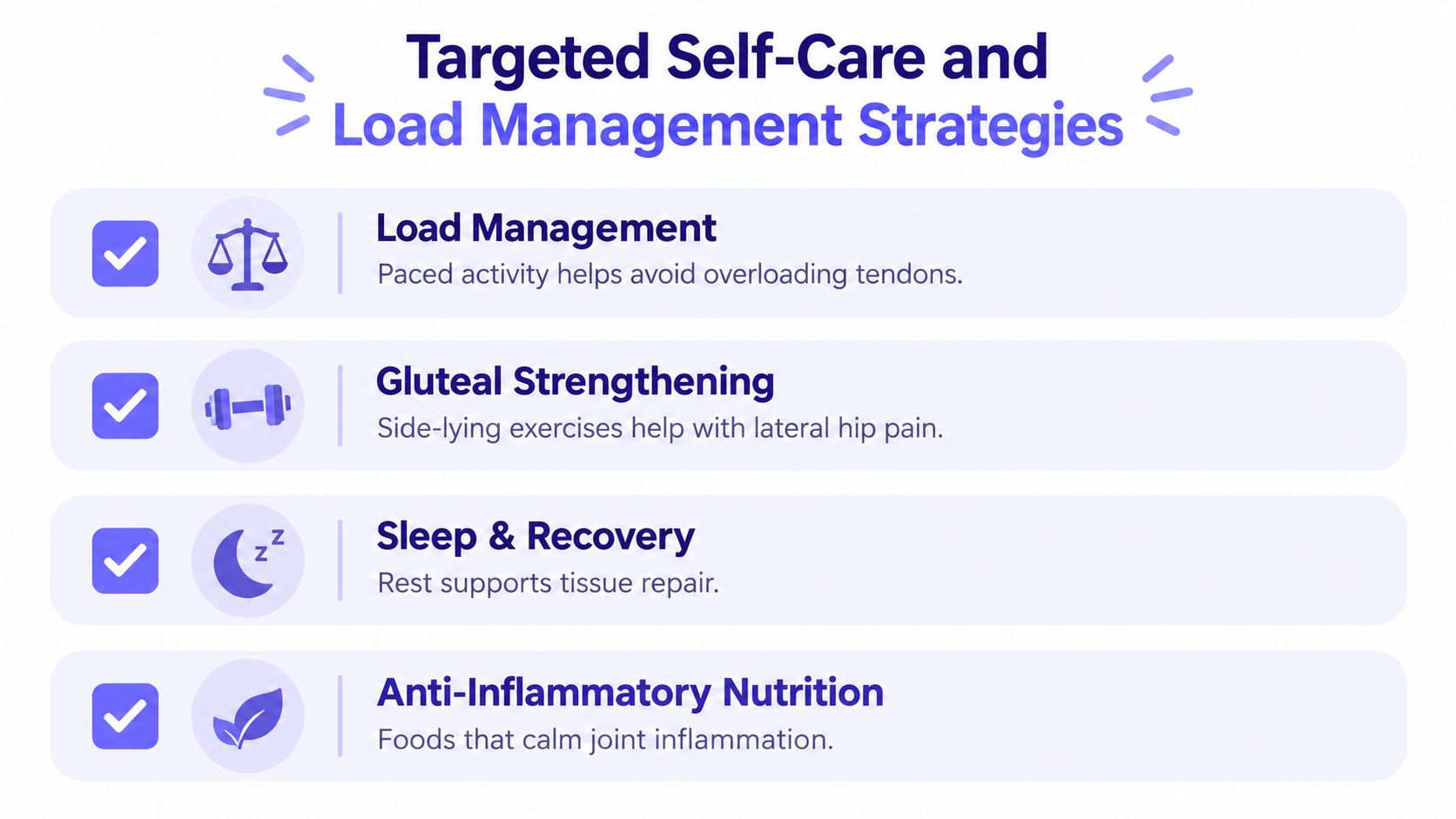
The safest starting point is to reduce the aggravating load without stopping all movement. Tendons usually need gradual, tolerable loading to rebuild capacity, while stiff joints often respond better to frequent, comfortable motion than to long periods of rest.
If the pain is on the outside
For lateral hip pain, begin by reducing compression. Don't sit cross-legged for long periods, lean your weight into one hip while standing, or lie directly on the painful side. If you sleep on your other side, place a firm pillow between your knees and ankles so the upper leg doesn't fall across your body and pull the hip into a compressed position.
Endless IT-band stretching isn't automatically helpful. Deep stretches that draw the knee across the body can compress the outer hip, particularly when the tendon is already irritable. Choose a comfortable range and let symptoms guide the dose.
A gentle isometric exercise can provide an entry point:
- Lie on your side with the painful hip on top and your pelvis stacked.
- Keep the top leg straight, slightly behind your body, and lift it only a small amount.
- Hold the position while breathing normally, then lower with control.
- Stop if you feel sharp pain, pinching, or increasing symptoms that linger afterward.
You can also practise standing hip abduction while holding a kitchen counter. Move one leg out to the side without leaning your trunk, then return slowly. The aim is not to exhaust the muscle. It's to give the hip a manageable signal that it can tolerate work.
If the pain feels deep in the joint
Use short, comfortable bouts of walking, gentle cycling, or controlled hip movements. Avoid forcing the joint into a painful range. A higher chair can make sit-to-stand easier than a deep sofa, and flatter walking routes may be more comfortable while symptoms settle.
Progress gradually. If an activity increases pain during the movement or leaves you noticeably worse later, reduce the range, repetitions, speed, or duration. Evidence-based guidance recommends combining symptom localisation with biomechanical load control and screening for arthritic processes, autoimmune disease, and vitamin deficiencies, rather than blaming estrogen deficiency alone (clinical guidance on menopause-related musculoskeletal pain).
The video below demonstrates movement ideas that may help you discuss an appropriate plan with a physiotherapist.
▶ PlayStrength training can be adapted to your symptoms, and this resource on strength training for perimenopause explains why progressive resistance belongs in a long-term plan. If pain is sharp, escalating, or affecting your walking pattern, get individual guidance before adding resistance.
How Weight Shifts and Sleep Impact Hip Biomechanics
Your hip doesn't experience hormones, body composition, sleep, and exercise as separate categories. They meet in the way you walk, stand, recover, and respond to effort.
During perimenopause, some women notice changes in where their body stores fat, often around the midsection. A change in mass distribution can alter how the trunk and pelvis move during walking or stair climbing. It doesn't mean that weight is the cause of your pain, and it doesn't justify judging your body. It means that a new movement pattern may ask more from the hip muscles than before.
Sleep creates another feedback loop. Hot flashes, night waking, and restless sleep can leave you less recovered the next day. Poor recovery may make ordinary loads feel harder, reduce your willingness to move, and increase protective muscle tension around the painful area. That can lead to less activity, lower strength, and a hip that becomes less prepared for the demands you want it to handle.
Track patterns instead of isolated symptoms
A single painful day can mislead you. A short record may reveal that symptoms rise after poor sleep, long sitting, hill walking, or several demanding days in a row. Note the location of pain, the activity that preceded it, your sleep quality, and how you feel the following morning.
A perimenopause tracker can help you place hip pain alongside sleep, energy, mood, meals, and cycle changes. This guide to perimenopause and sleep can help you consider how night-time disruption affects daytime recovery.
Make recovery part of the plan
If side-sleeping aggravates the outer hip, use a pillow between your legs and adjust your position before pain wakes you. A supportive mattress may also make side-lying more comfortable, particularly if heat disrupts your sleep. For readers comparing options, this guide to a cooling mattress for side sleepers in Lafayette discusses features that can matter when both pressure and overheating interfere with rest.
The goal isn't to control every variable. It's to identify the few patterns you can change consistently, such as breaking up prolonged sitting, reducing steep hills temporarily, or scheduling strength work after a better night rather than during a period of exhaustion.
When to Seek Medical Evaluation and Imaging
“Just push through it” is poor advice when the diagnosis is uncertain. A manageable tendon flare and a fracture, infection, inflammatory condition, or significant joint problem can all affect walking, but they don't belong in the same self-care plan.
Arrange a clinical assessment if the pain persists, interferes with sleep or daily activities, or keeps returning despite sensible load changes. Seek prompt care for:
- Sudden inability to bear weight: Especially after a fall, twist, or unexpected impact.
- Severe or rapidly worsening pain: Don't test it repeatedly by forcing movement.
- Systemic symptoms: Fever or feeling acutely unwell alongside hip pain needs medical attention.
- Neurological symptoms: Numbness, tingling, weakness, or pain travelling down the leg should be assessed.
- Unclear pain location: If you can't tell whether the source is your back, pelvis, or hip, an examination can prevent months of treating the wrong area.
A clinician may assess your walking pattern, hip range of motion, strength, spine, and nerve function. An X-ray can help evaluate joint space and bony changes when osteoarthritis is suspected. MRI is more useful for selected soft-tissue or bone questions, but imaging isn't automatically necessary for every new ache.
Hormone therapy also deserves an individual conversation rather than a blanket recommendation. Orthopedic guidance cites about a 30% reduction in hip fracture risk with estrogen-replacing therapy from large studies, although that skeletal benefit doesn't diagnose or automatically treat the source of your hip pain (guidance on menopause, tendons, joints, and skeletal risk). Your clinician can weigh symptoms, medical history, risks, and treatment goals.
Building a Sustainable Plan for Long-Term Mobility
Hip pain during perimenopause is manageable when you stop treating it as one undifferentiated symptom. Locate the pain, identify its triggers, reduce the loads that provoke it, and rebuild strength in a gradual way. Consistency matters more than forcing intense workouts through a flare.
Keep a simple record of walking tolerance, sleep, pain location, and exercises. Celebrate practical gains, such as climbing stairs more comfortably, turning in bed without waking, or standing from a chair with less hesitation. Guidance on hip mobility for daily life can complement a personalised rehabilitation plan, while strength training for bone density supports a broader approach to musculoskeletal health.
You don't need to wait for every symptom to disappear before taking action. You need a plan that respects the painful tissue, checks for non-menopausal causes, and adjusts as your sleep, energy, and tolerance change.
Lila brings symptom, sleep, energy, meal, mood, and cycle tracking into one place, with a personalised action plan and chat-based coaching that can help you notice patterns around hip pain and perimenopause. Visit Lila to start tracking your symptoms and build more consistent habits with guidance suited to your experience.
Get Lila, your personal coach for perimenopause.
Built for women in their 40s. 24/7 coaching, in your pocket.