
How to Practice Self-Care: A Guide for Midlife Women
Learn how to practice self-care that actually fits your midlife schedule. Simple, effective strategies to feel refreshed and recharged in 2026.
By 8 p.m., a lot of women in midlife are done. Not lazy. Not unmotivated. Done. The house is still noisy, your brain is foggy, your sleep has already been bad for three nights, and the last thing you need is another smug morning-routine video telling you to journal, meditate, dry-brush, and make a color-coded breakfast.
That version of self-care fails because it assumes stable energy.
The World Health Organization defines self-care as the ability of people to promote and maintain health, prevent disease, and cope with illness, with or without support from a health worker, which is a lot broader and more useful than the usual spa-day nonsense. It matters because access to care is still limited for many people, with 4.5 billion people not fully covered by essential health services in 2021, at least 400 million people still lacking access to the most essential services, and 2.1 billion people facing financial hardship from care costs, including 1.6 billion pushed into poverty because of out-of-pocket health expenses according to the World Health Organization's self-care overview.
So if you want to learn how to practice self-care in midlife, stop treating it like a luxury routine. Treat it like triage. Pick the smallest action with the biggest payoff. Build a plan that still works after a bad night, a stressful workday, or a week where your symptoms are louder than your motivation.
Table of Contents
- Why Self-Care Feels Harder in Midlife
- Your Daily Self-Care Check-In
- Sleep and Stress Strategies That Actually Work
- Nutrition and Movement for Real Energy
- Building Habits That Survive Bad Days
- Quick Self-Care Routines for Busy Days
- Tracking Progress and Adjusting Your Plan
Why Self-Care Feels Harder in Midlife
The biggest mistake I see is simple. Women try to copy routines built for people who slept well.
Midlife changes the math. Sleep gets fragmented. Stress hits harder. Caregiving load often peaks. Work is demanding. Hormonal shifts can change temperature regulation, mood, appetite, and mental sharpness. If you're dragging through the day, it doesn't mean you're failing at self-care. It means your current plan asks too much from a depleted system.
Recent menopause-care data points to the same reality. 67.8% reported sleep problems and 64.3% reported brain fog in a 2026 survey summarized in the Regence menopause care report. That matters because you can't build a complicated routine on top of broken sleep and low bandwidth.
Stop aiming for ideal and start aiming for durable
Self-care in midlife should answer one question first. What will still help when you feel awful?
That usually means:
- Short check-ins: enough to spot a pattern before the week derails
- Sleep-first decisions: because poor sleep wrecks follow-through
- Food and movement basics: because blood sugar chaos and complete inactivity make symptoms louder
- Flexible habits: because rigid streaks collapse fast in real life
If running helps your mood, great. Keep it. If you need a practical look at the benefits of running for mood, that resource is useful. But don't force running on a week when your body is asking for sleep, protein, hydration, and a slower nervous system first.
Triage beats ambition
Most women don't need more ideas. They need better order.
Practical rule: On low-capacity days, do the action that improves tomorrow, not the action that looks impressive today.
If fatigue is your main issue, start with sleep and symptom patterns before you pile on workouts or restrictive food rules. Lila has a solid breakdown of menopause fatigue causes and solutions if that's the symptom that keeps knocking your plan off course.
Build for your worst day. Your best day will take care of itself.
Your Daily Self-Care Check-In
Most self-care advice stays vague, which is why people abandon it. You need a repeatable check-in that gives you usable information in minutes, not a journaling assignment that turns into homework.
Use this in your notes app, on paper, or in a tracker.
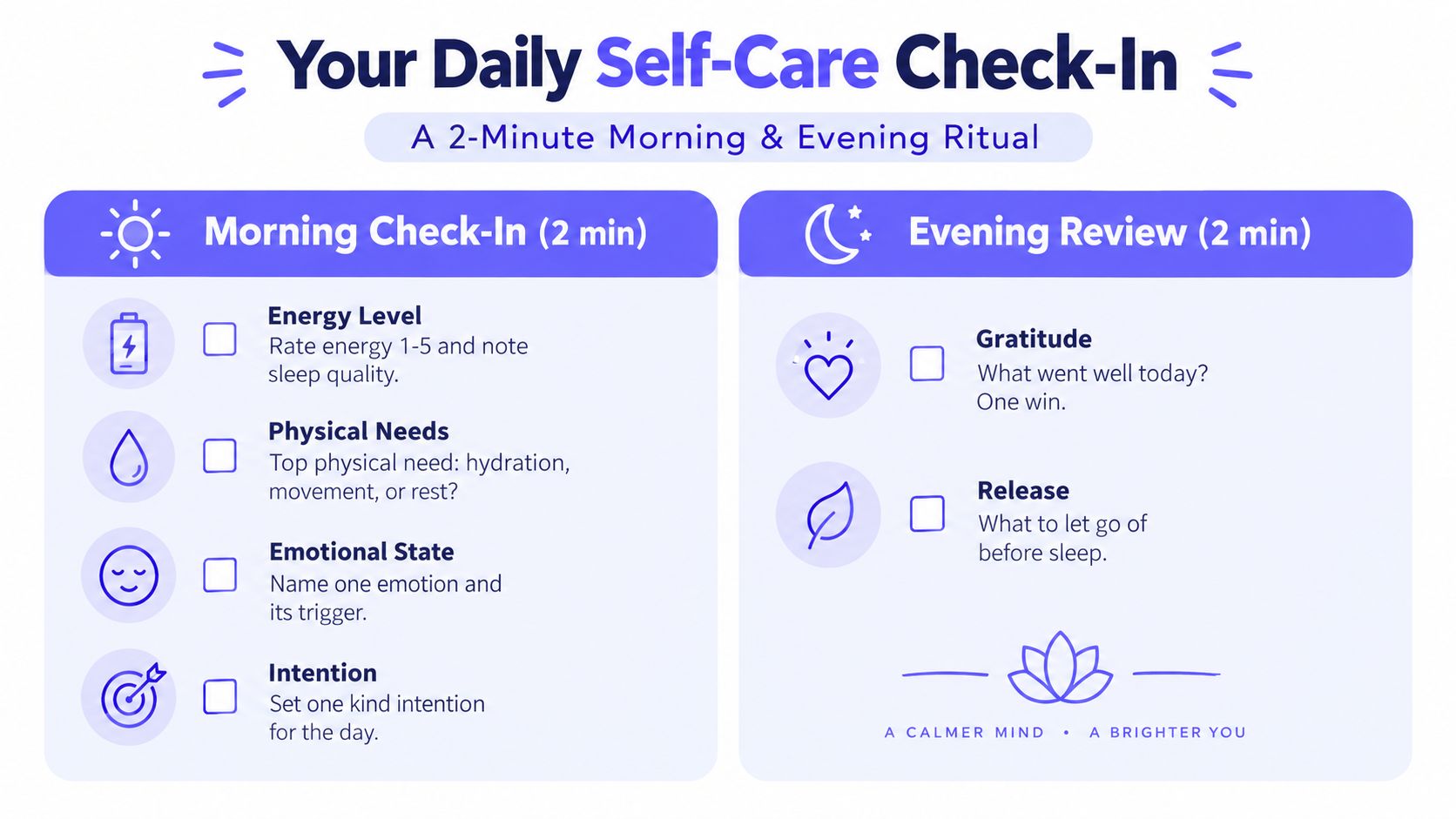
Your morning check-in
Keep it to two minutes.
- Energy score: Rate your energy from 1 to 5.
- Main symptom: Pick the loudest issue today. Hot flashes, brain fog, joint stiffness, irritability, low mood, poor sleep hangover.
- One essential action: Choose one self-care action for the next 12 hours.
That's it. Not five goals. One.
A strong practice might be:
- Sleep rescue: no alcohol tonight
- Fuel first: protein at breakfast
- Nervous system support: 10 minutes outside without your phone
- Symptom control: log hot flashes and triggers
Your evening review
Also two minutes.
Write down:
- What drained me today
- What restored me today
- Sleep estimate for tonight or last night
- One small win
The point isn't literary beauty. The point is pattern recognition.
Data beats memory. By Thursday, most women are guessing why they feel bad.
If you want a more guided version, Lila's article on a daily mental health check-in is a good companion to this habit.
A sample entry you can copy tonight
Morning
Energy: 2/5
Main symptom: brain fog
Non-negotiable: eat breakfast with protein before coffee refill
Evening
Drained me: back-to-back meetings and skipped lunch
Restored me: 8 minutes outside after dinner
Sleep estimate: likely poor if I stay on my phone
Win: I noticed the crash before I snapped at everyone
How to read your own patterns
Don't analyze every day. Look for repeats.
If you get three low morning scores in a row plus poor sleep, your next move isn't to add more habits. It's to protect sleep. If your worst afternoons happen after a low-protein breakfast or long gaps without food, fix that before buying supplements. If mood dips show up after overscheduling, your self-care problem may be a boundaries problem.
This is how to practice self-care without overthinking it. Track what matters. Ignore perfection.
Sleep and Stress Strategies That Actually Work
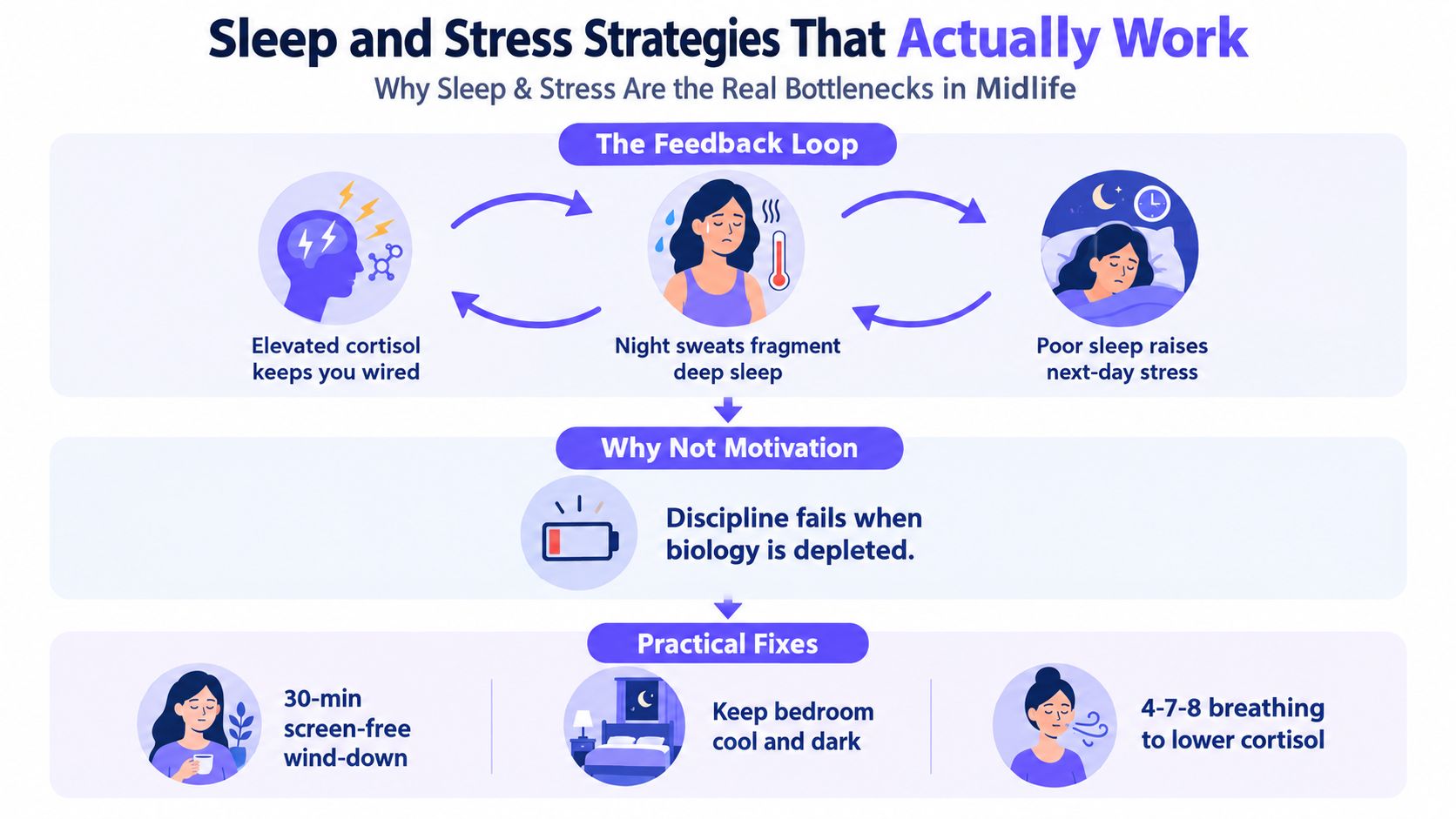
Motivation usually isn't the problem. Biology is.
When sleep gets disrupted, stress tolerance drops. When stress rises, sleep gets lighter and more fragmented. For a lot of women in perimenopause and menopause, hot flashes, temperature shifts, and nighttime waking make that loop worse. You don't need more discipline. You need a few high-impact fixes that calm the loop down.
Here's the sleep-stress cycle in plain view.
Start with the highest-return changes
Do these first for the next week:
- Keep the same wake time: even after a rough night. It helps reset rhythm faster than chasing sleep with random sleep-ins.
- Create a real wind-down: protect the last hour before bed. Lower stimulation. Dim lights. Stop working.
- Cool the room slightly: many women sleep better when the bedroom runs cooler.
- Cut alcohol close to bedtime: if sleep is fragile, evening alcohol often makes it worse later in the night.
How do you know it's working? You should notice one or more of these within several nights: fewer middle-of-the-night wakeups, shorter wakeups, less dread at bedtime, or a slightly better morning energy score.
Useful supports after the basics
Once the first layer is in place, add one support:
- Morning light exposure
- A brief breathing practice
- Magnesium glycinate or glycinate-rich foods if they agree with you
Don't stack everything at once. If you change six things, you won't know what helped.
A practical guide to a bedtime routine for better sleep can help if your evenings currently feel chaotic.
This short video gives a simple visual reset for winding down and easing stress before bed.
▶ PlayUse the fastest stress tool first
When stress spikes, don't reach for a complicated practice. Use your breath.
Try a 90-second extended-exhale reset:
- Inhale through the nose.
- Exhale longer than you inhale.
- Repeat slowly for about a minute and a half.
A longer exhale tells your body the threat has passed, even when your mind is still spinning.
Journaling and tea can help. They're just not first-line tools when your system is already overloaded. Sleep and stress self-care works better when it's boring, repeatable, and easy to test.
Nutrition and Movement for Real Energy
Generic advice falls apart fast in midlife. "Eat clean and exercise more" is too blunt to help a woman who's sleeping badly, overheating at night, and crashing by mid-afternoon.
Food and movement need to support energy, not drain it further.
Build breakfast like it matters
For many women, the first useful nutrition fix is a protein-forward breakfast. A practical target is roughly 25 to 30 grams at breakfast. It tends to be more stabilizing than coffee plus toast, especially if your mornings feel wired and shaky.
Then keep the rest simple:
- Fiber daily: get it from foods you'll eat consistently
- Omega-3-rich foods: useful for overall support, especially when mood and inflammation feel louder
- Caffeine earlier, not later: if your sleep is already fragile, late caffeine is a bad trade
If breakfast is where you fall apart, keep backup options in the house. These Gym Snack snack recommendations are a practical place to pull quick protein ideas from when you need convenience.
Move in a way your body can recover from
Midlife movement should preserve muscle, support metabolism, and regulate stress. It shouldn't leave you more depleted than when you started.
A useful weekly baseline looks like this, especially if you're rebuilding consistency.
| Session Type | Weekly Target | Why It Matters in Midlife | Minimum Effective Dose |
|---|---|---|---|
| Resistance training | Two sessions | Helps maintain lean mass and supports function during hormonal shifts | Short full-body sessions |
| Brisk walking | One dedicated session | Supports cardiovascular health and can calm the nervous system without frying you | One purposeful brisk walk |
| Mobility work | One session | Helps stiffness, recovery, and body awareness | A short mobility block |
If you want exercise ideas that fit symptom-heavy weeks, Lila's guide to the best exercises for menopause is worth saving.
Know when to rest and when to move
Women often misread themselves.
You likely need rest when:
- Your body feels heavy and flu-like
- Your sleep has been terrible for several nights
- Even light effort feels punishing
You likely need movement when:
- You feel stagnant, stiff, edgy, or mentally jammed
- A short walk usually helps once you start
- Your fatigue is more flat than crushed
Coach's rule: On high-symptom days, keep the protein and drop the heroics.
If energy is low, don't scrap everything. Drop the hardest part first. Keep food steady. Keep some form of movement tiny. That's how self-care becomes sustainable.
Building Habits That Survive Bad Days
Most habit advice is built for stable weeks. Midlife rarely gives you that.
You need habits with a floor, not just a ceiling. The floor is the version you can still do when you slept badly, feel bloated, and have no patience left.
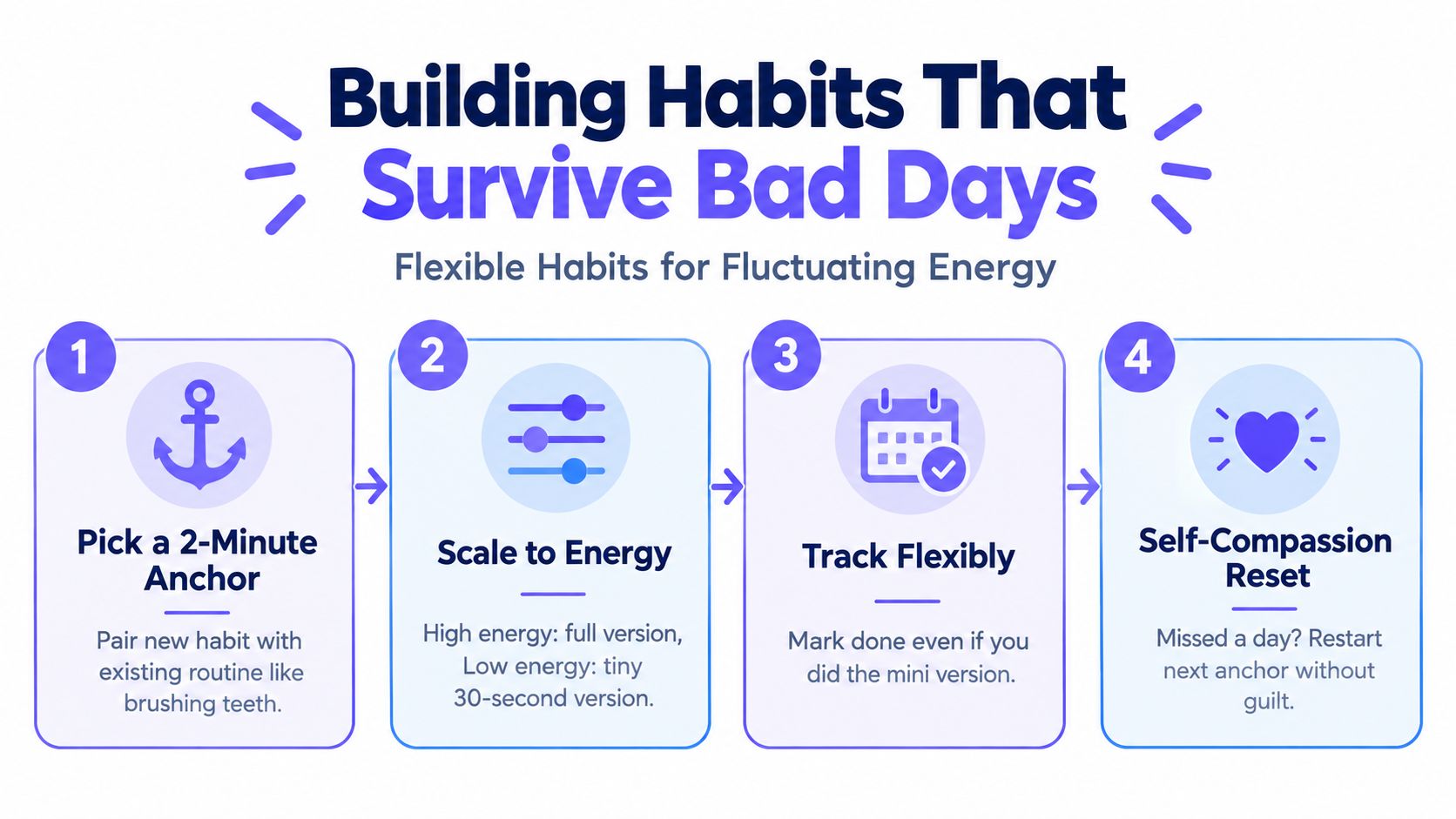
Use a two-minute anchor
Attach the new habit to something that already happens.
Examples:
- After brushing your teeth, do 30 seconds of stretching.
- After pouring coffee, put protein out for breakfast.
- After plugging in your phone at night, turn off the overhead lights.
The anchor matters more than intensity. A tiny habit done often beats a perfect habit done twice.
Never miss twice
One missed day is noise. Two missed days can become a new pattern fast.
So if you miss, don't restart with guilt and don't redesign your whole system. Recover within the next 24 hours:
- Pick one anchor.
- Do the smallest version tomorrow.
- Ignore the streak and resume the loop.
Track the mini version as a win
Most women sabotage themselves here. They say, "It didn't count because I only did five minutes."
It counted.
When energy is inconsistent, consistency means returning, not performing.
Identity helps too. Don't say, "I'm trying to be better at self-care." Say, "I'm a woman who checks in, adjusts, and keeps going." That identity survives bad weeks much better than motivation does.
Quick Self-Care Routines for Busy Days
Busy days need pre-made decisions. If you have to figure out what self-care means every time you're stressed, you'll skip it.
Match the routine to the day you're having.
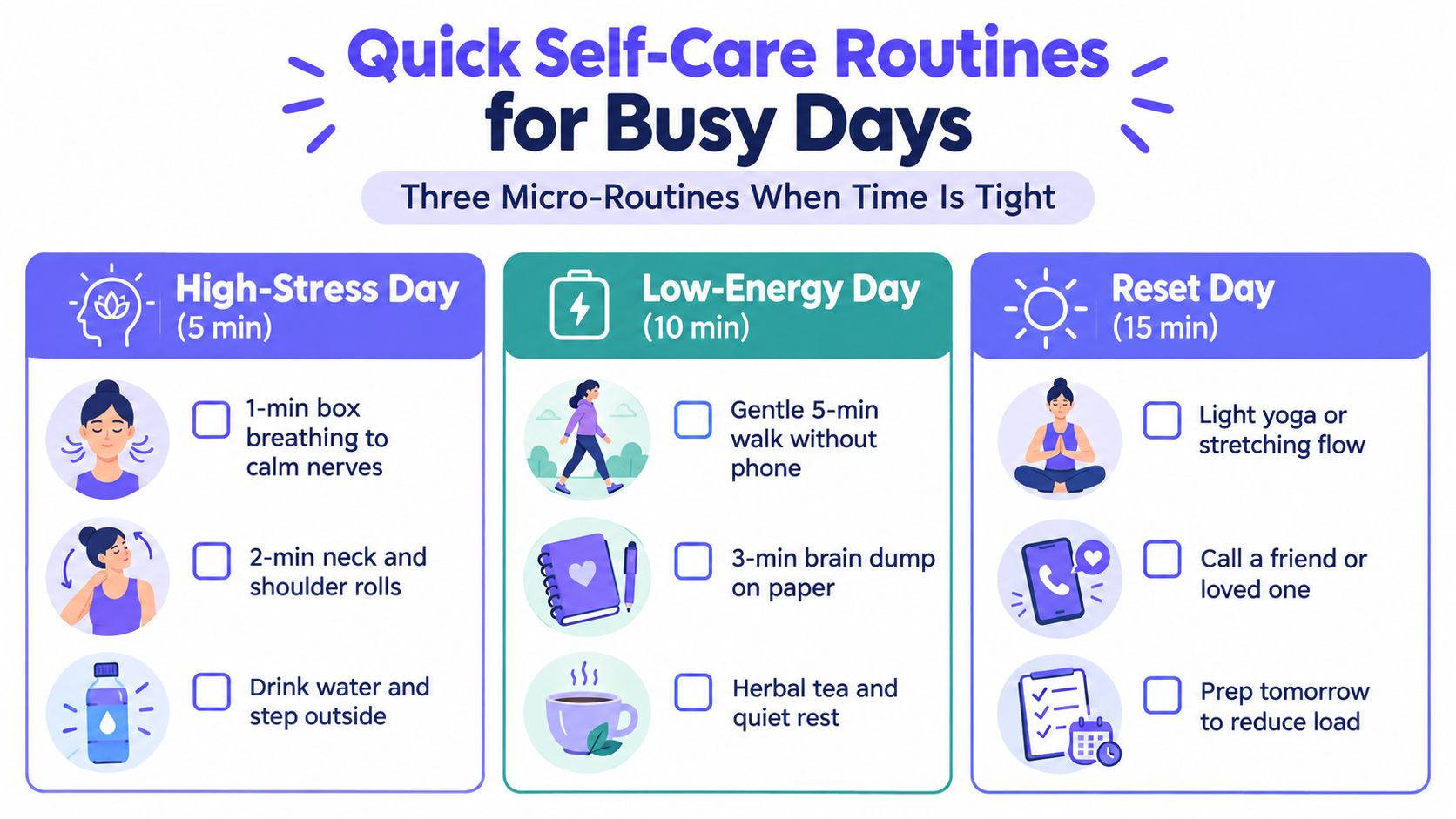
High-stress day routine
Use this when you're keyed up, overloaded, and mentally scattered.
Sequence
- Box breathing: inhale 4, hold 4, exhale 4, hold 4
- Eat a protein-forward snack
- Walk slowly outside for 10 minutes
- Write a two-line brain dump before bed
This routine works because it handles the nervous system first, then fuel, then mental clutter.
Low-energy day routine
Use this when you feel flat, foggy, or cooked. No workout required.
Sequence
- Cold water on your face
- Electrolytes or a glass of water
- Legs up the wall for about 90 seconds
- Send one text to a friend
That last one matters. Isolation makes hard days feel harder. Support counts as self-care.
If you want more low-cost ideas that don't require buying anything, Momotaro Apotheca has a practical piece on free wellness practices that fits well alongside this triage approach.
Moderate day routine
Use this when you have some capacity and want to invest in tomorrow.
Sequence
- Light strength work
- A simple meal-prep task
- A short evening wind-down
That might mean a quick bodyweight session, washing produce, cooking one protein, and setting out what you need for the morning. Nothing fancy. Just enough to lower friction.
Pick the routine by symptoms, not by guilt
Choose high-stress if your mind is racing.
Choose low-energy if your body feels drained.
Choose moderate if you can do a bit more without paying for it tomorrow.
This is how to practice self-care when time is tight. You don't need a perfect plan. You need the next right sequence.
Tracking Progress and Adjusting Your Plan
If you don't track, you'll rely on memory. Memory is terrible at noticing patterns when you're tired.
A basic log turns self-care from wishful thinking into something you can adjust. It also stops you from quitting a helpful habit too early or sticking with an unhelpful one for too long.
What to track
Keep it lean. A single line a day is enough.
Log:
- Sleep quality
- Sleep duration
- Mid-morning energy
- Evening mood
- Movement
- One nutrition marker
That nutrition marker could be protein at breakfast, meal regularity, or hydration. Pick one. Don't create a dashboard you'll resent.
If you prefer digital tools, use something customizable instead of a generic mood tracker. Lila is one option here. It lets users track symptoms, mood, sleep, energy, meals, and cycles in one place and pairs that with a daily check-in and action plan. If you want a broader look at what makes a good tracker, this guide to the best symptom tracker app is a practical filter.
Keep the format almost stupidly simple
Try one of these:
Notebook line
- Sleep 2/5, energy 2/5, walk yes, protein breakfast yes, mood irritable
Notes app line
- Woke at 3 a.m., brain fog by 10, better after lunch, no alcohol, hot bedroom
Checkbox style
- Sleep poor
- Energy low
- Movement done
- Protein done
- Mood flat
Fancy tracking systems fail because they ask for too much detail when your brain has the least to give.
Review weekly, not emotionally
Do not evaluate your whole life on a bad Wednesday.
Review once a week. Sunday works well. Scan for:
- Two things that improved
- One thing that got worse
- One variable to change next week
That's the entire review.
If sleep improved after you cooled the room and cut late alcohol, keep that. If your energy still crashed every afternoon, test one new variable next week, maybe breakfast composition or lunch timing. Change one thing at a time so the result means something.
Review rule: Adjust one lever per week. More than that turns your data into noise.
Use a seven-day reset if you feel lost
If your routine has fallen apart, don't wait for a new month. Start tomorrow with a clean, boring week.
Day 1
Set up your log. Write tonight's baseline.
Day 2
Do the morning check-in and evening review.
Day 3
Protect one sleep upgrade. Keep everything else the same.
Day 4
Add one two-minute anchor habit.
Day 5
Use the right day-type routine once.
Day 6
Read the week so far. Pick the single metric that needs the most help.
Day 7
Add nothing new. Notice what feels different from day one.
This works because it lowers drama. You aren't trying to transform your life in a week. You're installing a repeatable loop.
What progress actually looks like
Progress may mean:
- You catch a crash earlier
- You stop stacking too many habits
- You sleep a little more steadily
- You feel less blindsided by symptoms
- You know which actions help and which ones are fluff
That matters. A self-care plan is useful when it makes your days more manageable and your symptoms more understandable.
The World Health Organization's self-care guidance has treated self-care as part of formal health systems, not just informal advice, and the 2022 guidance highlights a large opportunity for access and long-term condition management in this area. In the same broader context, the Global Self-Care Federation's 2022 socioeconomic report estimated about $1.9 trillion in welfare benefits, 40.8 billion productive days, 22 million quality-adjusted life years, and $119.0 billion in monetary savings, as summarized in the WHO guideline on self-care interventions for health and well-being. That's a population-level view, but the personal lesson is straightforward. Small self-care actions become powerful when they're systematic.
There's also direct evidence that structured self-care support can improve outcomes for women in menopause. In one controlled study, the intervention group's quality-of-life score improved from 62.68 to 69.67 over 4 months, with self-care scores also improving significantly across checkpoints, and the study reported a large effect size of about η²=0.23 for quality of life in the menopausal self-care training study. Another review of menopause-focused trials found meaningful symptom improvement with self-care education and app-based training, including a mobile-app trial where the post-intervention symptom score was 30.27±6.09 versus 39.10±3.71 in controls, alongside findings that health literacy and self-efficacy strongly affect whether self-care behaviors translate into real results in the systematic review on self-care during menopause.
The message is blunt. Random tips don't change much. Structured, trackable, reinforced self-care does.
If you start this week, start here:
- Track one line per day
- Protect sleep before chasing optimization
- Eat in a way that steadies energy
- Use the smallest habit version on bad days
- Review weekly and change one variable at a time
That's how to practice self-care in a way that survives real life.
Lila helps you do exactly this without turning self-care into another job. You can use Lila to track symptoms, sleep, mood, energy, meals, and cycles in one place, then get a personalized daily plan based on what's going on in your body. If you're tired of guessing and want clearer next steps, it's a practical tool to support the kind of self-care that still works on hard days.
Get Lila, your personal coach for perimenopause.
Built for women in their 40s. 24/7 coaching, in your pocket.