
Long Menstrual Cycles: Causes, Tracking, and Care
Learn what long menstrual cycles mean, why ovulation can stretch them, when to see a clinician, and how to track patterns before your next appointment.
A 2020 global analysis of menstrual-tracking logs found that 89.04% of 1,579,819 nonpregnant participants who were not using oral contraceptives and had recorded at least three cycles averaged 21-35 days. Another 8.60% (135,824 people) averaged more than 35 days, while 0.17% averaged fewer than 21 days. These figures describe the study's participants, not every woman. The American College of Obstetricians and Gynecologists explains how cycle timing relates to abnormal uterine bleeding.
A long gap may be associated with cycle changes in your 40s or 50s, but one long cycle cannot establish that perimenopause is the cause. Record the dates and look for a pattern; a cycle-length gap is also different from bleeding that lasts unusually long or soaks through protection.
Table of Contents
- What a Long Menstrual Cycle Feels Like
- What Counts as a Long Menstrual Cycle
- Why Ovulation Timing Stretches Cycles
- When Long Cycles Need a Clinical Check
- How Cycle Length Differs from Heavy Bleeding
- How to Track Cycles and Choose Support
- A Practical Next Step After Noticing Change
What a Long Menstrual Cycle Feels Like
You mark day 28 because that used to be the day. Day 35 arrives and the calendar is still blank. You check the bathroom again, wonder whether a test is overdue, and put off the call because nothing hurts enough to feel like an emergency.
That wait lands differently in your 40s and 50s. The same months may bring broken sleep, a sudden heat through the chest, a mood that doesn't match the day, or a waistband that feels tighter by evening. Bloating can show up even when bleeding doesn't, and the hormonal causes of menstrual bloating are worth separating from "I must be about to start." Those body changes make a late period feel like a verdict. Often it is only one data point.
Why the blank week is so easy to misread
A single late month can follow illness, travel, a hard stretch at work, or a contraception change. A pattern of long menstrual cycles is different: the gap keeps clearing 35 days, or the length swings so much you can't plan around it. The tracking study above shows that an average longer than 35 days was common enough to fill a large city of logs. Common isn't the same as harmless.
What the wait can't settle: A late period doesn't tell you whether you ovulated, whether you're pregnant, or whether this is perimenopause. It tells you the interval is long. The meaning comes from the next few cycles and the symptoms that travel with them.
You can learn to count a cycle from the right day, see what delayed ovulation does to that count, and keep a short list of conditions worth asking about. You'll also see how a long gap differs from bleeding that lasts too long or runs too heavy, and what belongs in the notes you take to an appointment. The useful move is measurement, not a self-diagnosis made on day 36.
What Counts as a Long Menstrual Cycle
A long menstrual cycle is an interval of more than 35 days from the first day of one period to the first day of the next. ACOG treats 21-35 days as the usual adult span. One late month doesn't rewrite your baseline. An average built from at least three cycles does a better job, because stress, travel, illness, or a contraception change can shove a single month without setting a new pattern. Prevalence also shifts with age, reproductive stage, contraception, health conditions, and how many cycles you observe.
How to count without resetting on spotting
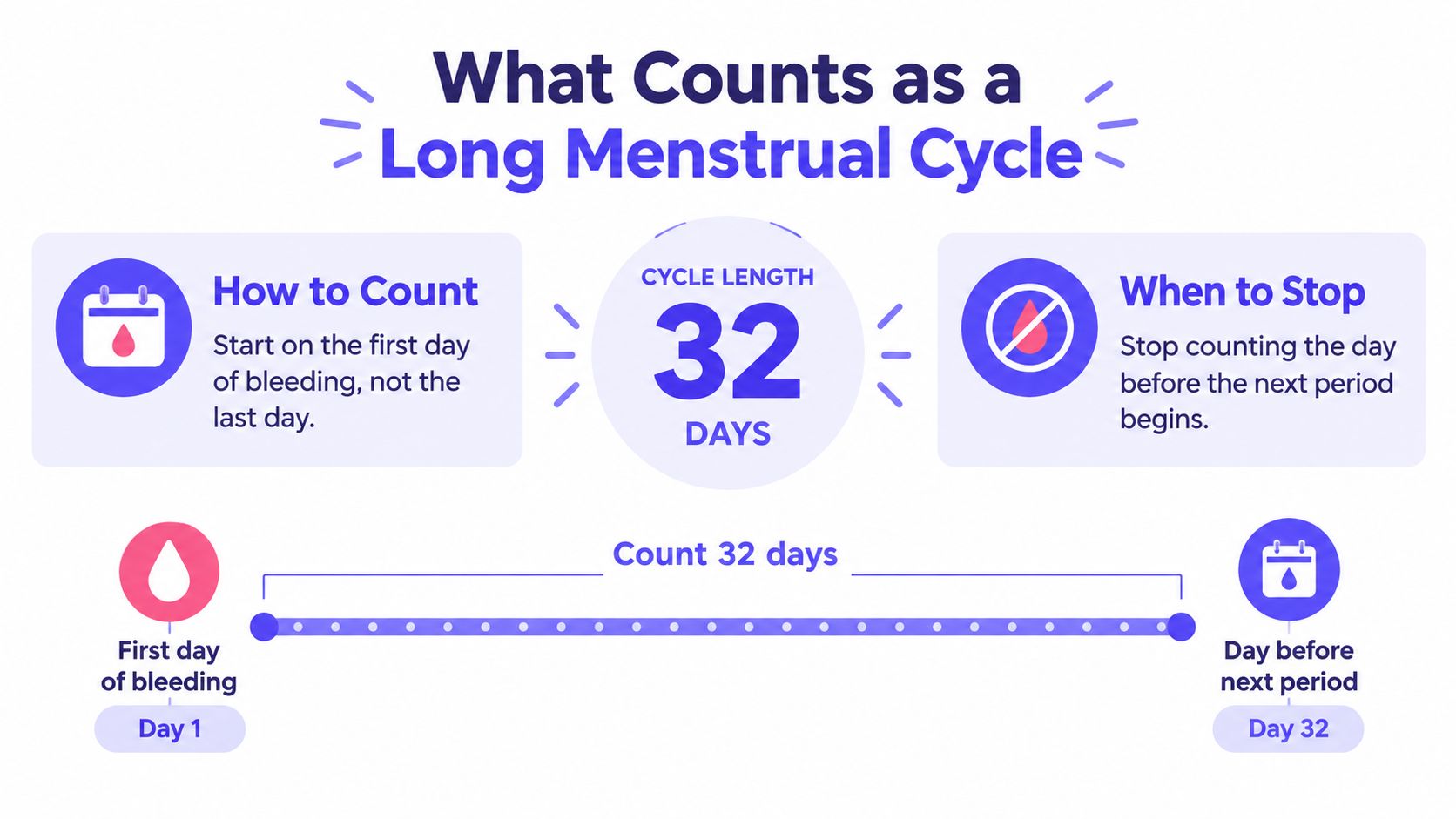
Start on the first day of bleeding that you would call a period, not the last day of the previous one. Stop the day before the next period begins. Day one is flow that needs a pad, tampon, cup, or period underwear, not a streak you notice only when you wipe.
Spotting is where apps and paper calendars split. If you log a pink day as day one, the app shortens the cycle and the handwritten book doesn't. Agree on one rule and keep it.
Worked dates: Bleeding starts March 1 and the next true period starts April 12. Count March 1 through April 11. That is a 42-day cycle. Spotting on April 5 doesn't restart the count unless that spotting is the start of a period.
- Mark day one. Full bleeding, not the tail end of the last period.
- Ignore mid-cycle spots unless they become a period you would track as flow.
- Close the cycle the day before the next day one, then average at least three cycles.
- Compare that average with the 21-35 day span, and note whether one month is the outlier.
A menstrual cycle calculator can hold the dates while you learn the rule. The number you want is a personal baseline: your recent average, not a memory of the cycle you had at 30. Later questions about ovulation and when to call only make sense against that baseline.
Why Ovulation Timing Stretches Cycles
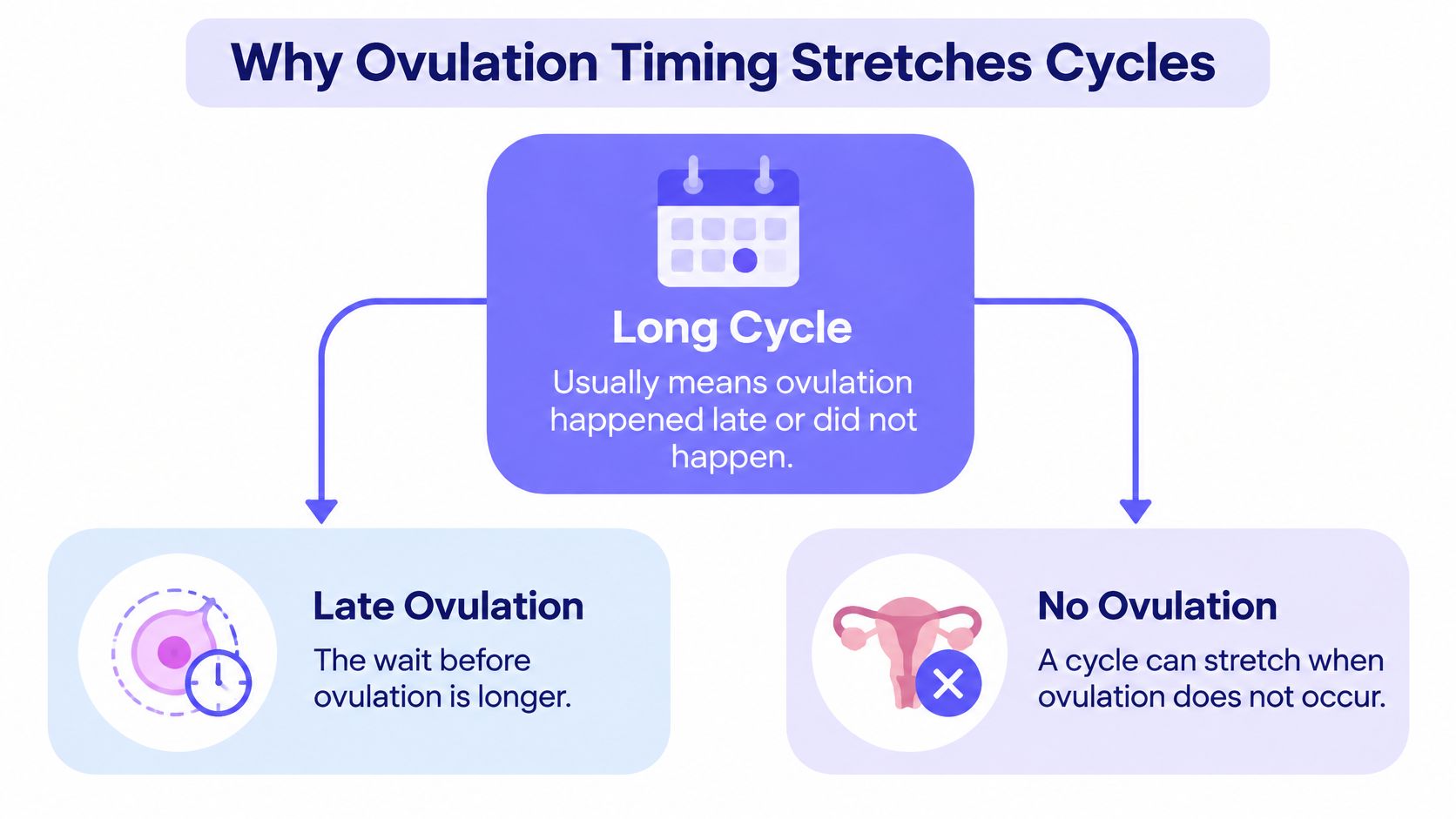
Most long menstrual cycles are not a longer wait after a normal ovulation. They usually mean ovulation happened late, or it didn't happen.
ACOG's practical comparison makes the timing concrete. In a 35-day cycle, ovulation may fall around day 21. In a 28-day cycle, it falls near day 14. The days before ovulation are the stretch. The days after a real ovulation are more stable, because that is when progesterone rises and helps set when bleeding starts. If ovulation is late, the whole interval slides past 35 days. If ovulation doesn't occur, there is no progesterone rise on schedule, and the next bleed can be late or erratic.
What a long cycle is linked with, and what it doesn't prove
Clinical and epidemiological work connects long or irregular cycles with polycystic ovary syndrome, thyroid disease, diabetes, and other ovulatory or endocrine problems. Cycle length alone can't diagnose any of them. It can put them on the question list, next to acne or extra facial hair, fatigue, heat or cold intolerance, and a weight change you didn't plan.
A 2025 review that treats the cycle as a vital sign reported higher associated risks for people with irregular cycles than for people with regular ones: up to a 66% higher risk of type 2 diabetes, up to a 40% higher risk of cardiovascular disease, and a 23% higher risk of obesity-related cancer. The review noted that risk may rise further when cycles run past roughly 35-40 days, as summarized in this cycle-length research summary. Those figures are associations. A long cycle doesn't cause any one disease. Your risk still depends on age, symptoms, body composition, family history, medicines, and an actual diagnosis.
A hormone conversation gets more useful when you bring sleep, mood, weight, and bleeding with the dates, not the dates alone.
Mood shifts in these years are easy to file under "just hormones" and then ignore. If low mood is sticking around, exploring the perimenopause and depression connection is a separate health question from cycle length. For the cycle pattern itself, a plain guide to what perimenopause is helps you see why timing can change without treating every late month as the answer.
When Long Cycles Need a Clinical Check
A newly long cycle in your 40s is not reassuring proof that you've "started perimenopause" and can stop looking. Research on the menopausal transition does describe more variable cycle length, less predictable ovulation, more variable reproductive hormones, and more frequent long cycles. Anovulatory cycles can make endometrial shedding irregular because progesterone from ovulation is absent or delayed. That is a real pattern. It is not a diagnosis you can stamp on a calendar.
Cycle timing alone can't confirm that ovulation was merely late. It can't establish fertility, and it can't rule out pregnancy. A cycle that stops for more than 3 months without an explained cause meets ACOG's threshold for evaluation of amenorrhea, as outlined in guidance on absent periods.
What evaluation can look like
Evaluation also depends on age and on risk factors for endometrial hyperplasia or malignancy. Endometrial assessment is relevant for women 35 or older with suspected anovulatory bleeding, and for people who don't respond to treatment. Possible steps, chosen by a clinician, include pregnancy testing, blood tests, ultrasound, hysteroscopy, or endometrial biopsy. None of that is a home workup.
Mood, sleep, and medicines belong in the same visit. If depression is part of the picture, Medication options for women's depression are a clinical topic, not something a cycle log can settle. Spotting between periods is a different clue from a long gap, and notes on perimenopause spotting between periods help you describe it without folding it into "my cycles are just longer."
| What you notice | What to record | Why it matters | When to seek care |
|---|---|---|---|
| Periods arriving past day 35 | First bleeding day and the length of each of the last three cycles | Separates one late month from a new average | The average stays long, or the swing is new and persistent |
| No bleeding for a long stretch | The last true period and any spotting since | A gap is not the same record as a late period | More than 3 months without an explained cause |
| Symptoms in the same months | Sleep, hot flashes, mood, weight, medicines | Stops the visit from being dates only | Symptoms are new, severe, or getting worse |
| Any chance of pregnancy | Intercourse timing and contraception | Timing can't exclude pregnancy | A test is due, or you are unsure |
The aim is a clear escalation rule. Don't dismiss the change as "just menopause," and don't treat every 36-day month as an emergency.
How Cycle Length Differs from Heavy Bleeding
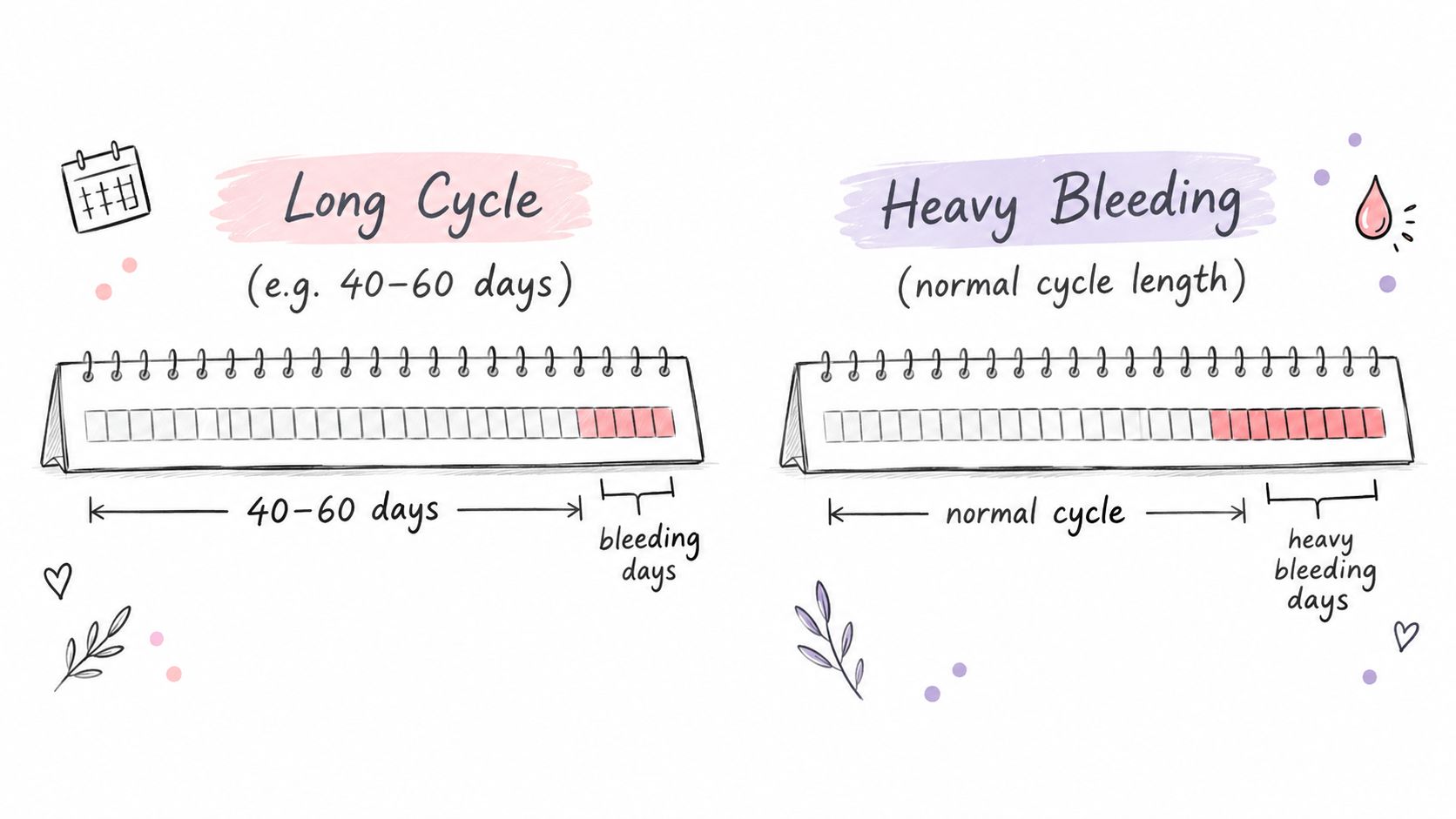
A long gap and a long bleed are different problems. You can go 40-60 days between periods and then bleed in a way that feels familiar for a few days. You can also go that long and then bleed for more than seven days, or change a pad or tampon every one to two hours. Both can happen in the same year. Labeling either one "perimenopause" without the details can hide anemia symptoms, PCOS-like features, diabetes, obesity, or a structural or endometrial problem.
Three calendars, three different next steps
Maya's 48-day gap. Her last three intervals were 46, 51, and 48 days. When bleeding came, it lasted four days and didn't soak through. The story to tell is the gap and any hot flashes, sleep loss, or mood change. The flow itself isn't the alarm.
Renee's heavy week after a long wait. Her periods are also far apart, but day three means hourly changes, and flow continues past a week. A long anovulatory stretch can leave the uterine lining under estrogen without the usual progesterone contrast. That is why the bleed after a long cycle can be prolonged or unusually heavy, and why it needs its own description. ACOG's approach to abnormal uterine bleeding in reproductive-aged women is to record dates, duration, and bleeding type. Evaluation may include pregnancy testing, blood tests, ultrasound, hysteroscopy, or endometrial biopsy, depending on age and symptoms.
A three-month blank. If bleeding has stopped beyond three months without an explained cause, that sits on the amenorrhea path already described, not in a casual "I'll wait another month" note.
Write the bleed and the gap on separate lines. "Forty-five days, then five moderate days" is not the same sentence as "forty-five days, then nine days with hourly changes."
Add hot flashes, sleep disruption, mood, medicines, weight change, and pregnancy risk beside those lines. A clinician can use that story. A single word, irregular, can't.
This short overview is a useful companion if you want the difference between cycle length and bleeding pattern said out loud before you sort your own dates.
▶ PlayHow to Track Cycles and Choose Support
A useful log is small enough that you'll still fill it in on a tired night. Each month, record the first bleeding day, the cycle length, the number of bleeding days, and a plain flow note (light, usual, heavy, or hourly changes). Add one line on sleep, mood, energy, meals, hot flashes, and any weight change. Three or more cycles show whether a 42-day month was a one-off or the start of a new average.
Three ways to keep the record
Paper calendar. A pocket calendar is private and doesn't need a login. You write day one and a few words. It fails when the book stays in a drawer. If you already miss entries, paper won't rescue the pattern.
A basic period tracker. These apps count dates and predict a next period from past intervals. That helps if your only question is "what was my length?" They often ignore metabolic symptoms and menopause symptoms, so the export is a list of dates with no sleep, mood, or hot flashes attached. You'll re-tell that half of the story in the exam room.
An all-in-one symptom log. This is the option that keeps cycles next to the questions a clinician asks. Lila is an AI-powered perimenopause app with a quick daily check-in, a personalized action plan, and one place for symptoms, mood, sleep, energy, meals, and cycles, plus a 24/7 chat-based coach. It doesn't diagnose PCOS, thyroid disease, or endometrial problems. It can make the pattern clearer before you book. A walk-through of how to track your cycle covers the fields worth keeping whether you use paper or an app.
Pick the method you'll still use in week three. An app can prepare the appointment. It doesn't replace one, and it can't prove the cause of a long cycle.
A Practical Next Step After Noticing Change
Do one thing with the current or next period, then decide about care from that record.
- Log day one as soon as true bleeding starts. If you're between periods, log the first day of the last one from memory and correct it if you find the note later.
- Add duration and flow when the bleed ends. Count bleeding days, and say whether you changed protection on a usual schedule or every one to two hours.
- Attach the company it kept. One line each for sleep, mood, energy, meals, hot flashes, and weight. Skip the essay.
If your recent cycles already average more than 35 days, or the bleeding has become heavy or prolonged, that page is what you bring to a clinician. Another month of guessing adds little. If cycles have stopped for more than three months without an explained cause, the next step is evaluation for amenorrhea, including the chance of pregnancy. Don't wait for a "classic" hot flash to make the gap legitimate.
What a week of notes can and can't do
If you want a daily structure while you watch the pattern, a check-in that sits beside sleep, mood, energy, meals, and hot flashes makes a 42-day month easier to see in context. A week of consistent entries won't diagnose you. It will show whether the long gap repeats and which symptoms travel with it. Guides that compare cycle tracking apps are useful only after you know which fields you refuse to drop.
Tracking can prepare a better visit. It can't prove perimenopause, and it can't exclude disease. The decision you can make today is small. Start the record now. Book care if the gap, the bleeding, or the symptoms beside them meet the thresholds already laid out.
Lila is an AI-powered perimenopause app that pairs a quick daily check-in with a personalized action plan, so cycle length sits beside sleep, mood, energy, meals, and hot flashes instead of living on a separate scrap of paper. A 24/7 chat-based coach can help you stay with that record while you decide whether the pattern needs a clinician. If you want that structure for the next few cycles, visit Lila.
Get Lila, your personal coach for perimenopause.
Built for women in their 40s. 24/7 coaching, in your pocket.