
Perimenopause Weight Loss Plan: Weekly Targets and Steps
Build a perimenopause weight loss plan with weekly calorie, protein and exercise targets, body-composition tracking and clear medical checkpoints.
The scale often isn't the story. The Study of Women's Health Across the Nation followed 3,302 midlife women at seven U.S. sites from 1996 and found that body weight generally rose at a steady rate before and during the menopause transition, rather than jumping at menopause. The composition of that weight did change. When the transition began, the rate of fat gain approximately doubled while lean mass began to decline, and those shifts continued until about two years after the final menstrual period. Women gain about 0.5 kg (1.1 lb) a year on average in midlife, and about 20% may gain at least 10 lb during the transition.
A perimenopause weight loss plan should judge waist, strength, and whether the change lasts, not only the morning number. Whether the transition itself slows metabolism is still an open question, not a fate you have to crash-diet around.
Table of Contents
- Daily and Weekly Targets for the Plan
- How to Start the Plan in Five Steps
- Strength Training and Protein to Protect Muscle
- GLP-1 and Hormone Therapy Questions to Settle First
- Sleep and Stress Habits That Affect Fat Loss
- Measures and Tracking That Show Real Progress
- Why Progress Stalls and What to Change
Daily and Weekly Targets for the Plan
Start with numbers you can log for seven days. Treat them as a test rather than a verdict: a perimenopause weight loss plan works better when the first week gives you data to adjust.
| Target | Typical starting range | What to track |
|---|---|---|
| Daily calorie deficit | About 500 kcal below maintenance, about 3,500 kcal a week | Average daily intake from the food log |
| Protein | 1.0 to 1.2 g per kg of body weight per day | Grams per meal, spread across the day |
| Fiber | 25 to 30 g per day | Grams per day from the food log |
| Aerobic activity | 150 minutes of moderate activity per week | Minutes logged per week |
| Strength training | 2 sessions per week covering all major muscle groups | Sessions completed and loads used |
Why the rows matter more than the scale
Fat and muscle can move in opposite directions while the scale barely budges. A smaller waist can be real progress on a flat scale, especially when abdominal and visceral fat creep up even as total weight changes little. Resistance training and enough protein support the lean tissue you are trying to keep. A moderate calorie cut plus aerobic work is what pulls fat down. Sleep, hot flashes, and skipped walks belong in the same log, because they change what you eat the next day.
If you do not know your maintenance intake, estimate it from a week of logged meals and your weight trend. A menopause calorie calculator can give a rough line to test, and a registered dietitian can check the number if you are unsure.
Practical rule: Circle the one row that is furthest from your current week. Change that row first. Leave the others alone until it feels ordinary.
Write your five starting numbers on one page. Mark which row will need the most change: protein at breakfast, a second strength session, or the evening snack that blows the deficit.
How to Start the Plan in Five Steps
A plan that collapses by Friday usually skipped a step on Monday. Give the first month a sequence instead. The British Menopause Society describes a deficit of about 500 kcal/day, roughly 3,500 kcal a week, as a conventional starting point, alongside regular aerobic and strength work. Standard guidance for midlife women pairs about 150 minutes of moderate aerobic activity a week with strength training twice a week. Whether perimenopause slows metabolism beyond what age and muscle loss already explain is still an open question, so treat every target below as a hypothesis your log will confirm or correct rather than a fixed sentence on your body.
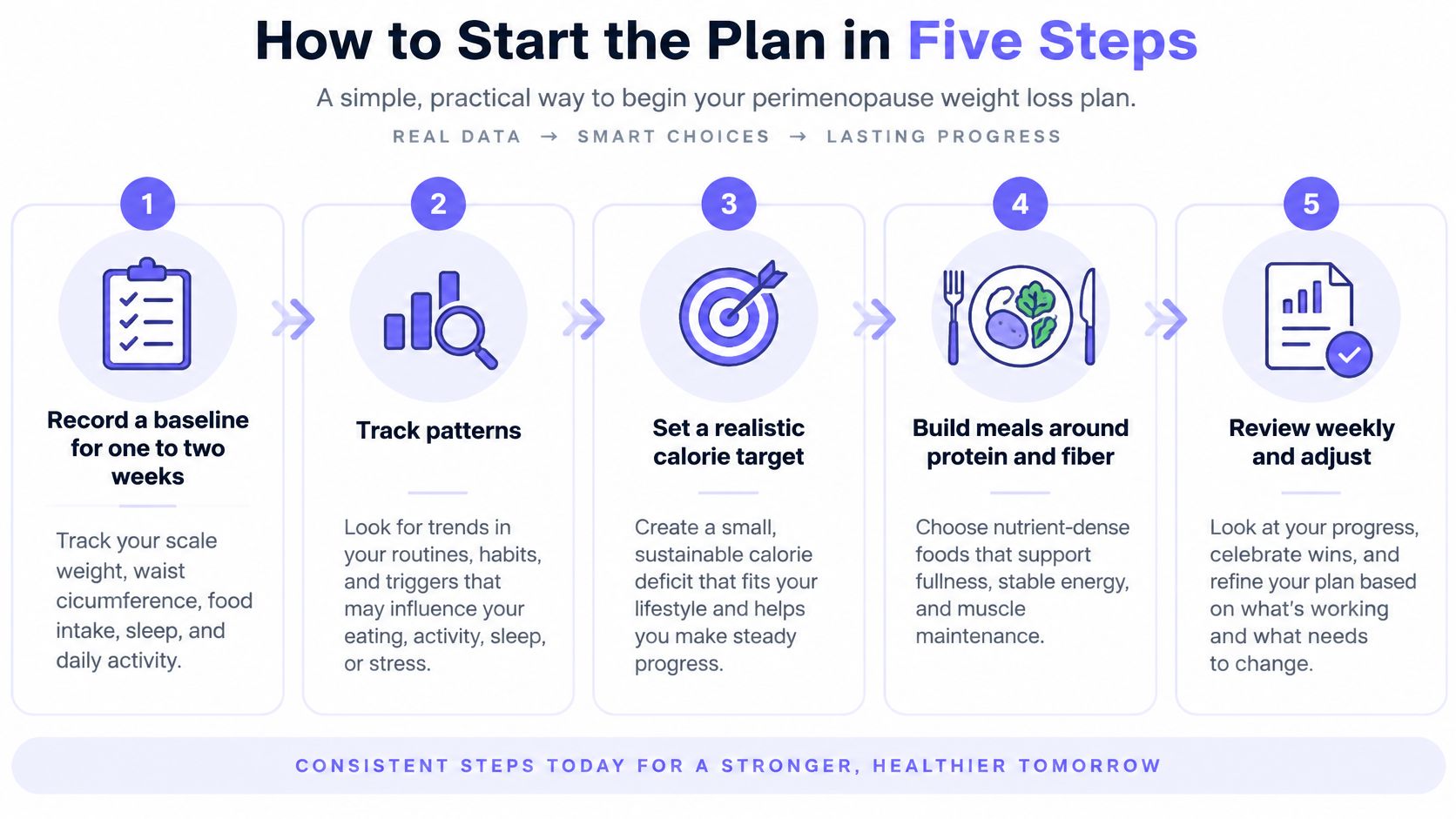
- Record a baseline for one to two weeks. Weigh yourself, measure your waist, and log food, sleep, and steps without changing anything yet. You need a true "before," or the first new habit gets the credit for a week that was already different. The common slip is starting a diet on day one and having nothing to compare.
- Set a moderate calorie target. Use that conventional deficit, not a crash cut. Deeper cuts after a slow first week are the usual overcorrection, and they cost energy you need for training.
- Spread protein and high-fiber carbohydrates across meals. A day that dumps protein into dinner leaves earlier meals with a gap, and those gaps are where grazing shows up. Beans, oats, fruit, and vegetables carry the fiber.
- Add two strength sessions and the walking. Brisk walking or any moderate aerobic work fills the weekly minutes. Cardio alone is the common miss, because it never asks your muscles to stay.
- Review weight and waist every two to four weeks. Change one variable at a time. If you cut calories and add sessions in the same week, you won't know which one helped or which one wiped you out.
A concrete pass through the steps: you weigh 70 kg with a waist of 88 cm. You log two weeks as you are, then set the deficit from that intake, put a protein food and a high-fiber carbohydrate on each plate, and book two full-body sessions beside the walks. At week four you compare waist and the seven-day weight average with week one. One heavy Monday is not a reason to rewrite the plan.
What a sound first month looks like
Waist is steady or edging down. Both strength sessions are in the log. No week is marked by severe fatigue or dizziness. The scale may lag the tape, because training can hold or rebuild lean mass while fat declines. That is a feature of the plan, and it is why the waist measurement and the strength log carry as much weight as the number on the scale.
Hormone therapy is not a weight-loss treatment. Research generally finds it has little to no effect on weight, though some evidence suggests less waist gain among users. Book a doctor visit before you push activity if you have a heart, joint, or metabolic condition, you've been inactive for years, or a GLP-1 or hormone decision is pending. Bring the log. Put the first review on the calendar two to four weeks out, so the plan gets judged on a real interval rather than a single morning.
Strength Training and Protein to Protect Muscle
Two full-body sessions a week are enough to start. One session can be a squat or sit-to-stand, a step-up or leg press, a row, a push-up or press, and a hinge such as a hip bridge. Do 2–3 sets of 8–12 reps. When the last reps feel easy, add a little load next time. That is progressive overload: the work gets slightly harder so muscle has a reason to stay.
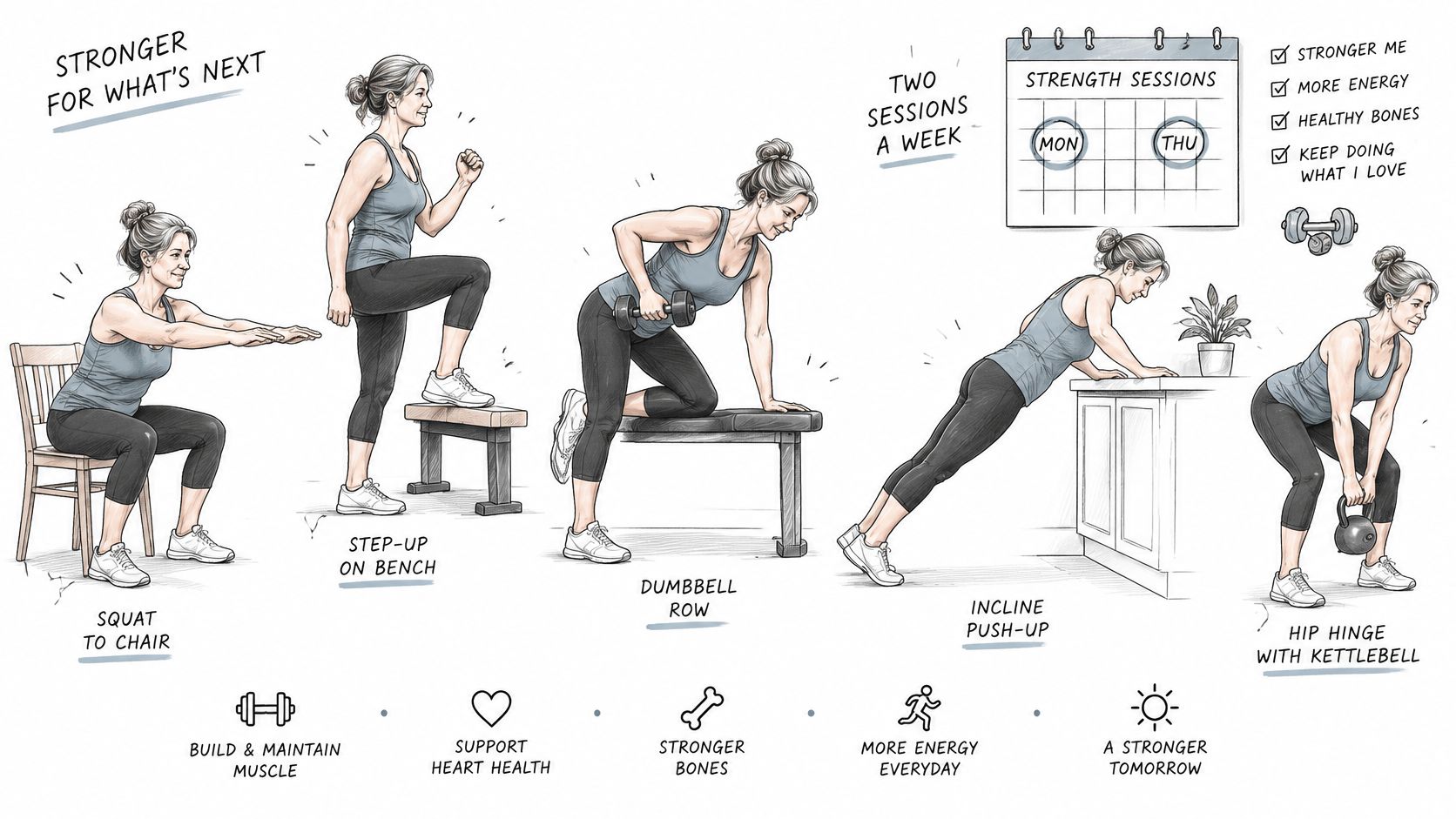
The first eight weeks matter most. That is when a new lifter either keeps the sessions or drifts back to walks only. You are not chasing a personal record. You are giving muscle a weekly signal while calories are a bit lower.
Protein on a 70 kg frame
A 70 kg reader aiming at the daily protein target needs about 70–84 g a day. Split that into roughly 25–30 g at each of three meals. Eggs, Greek yogurt, fish, tofu, and lean meat all work. A breakfast of yogurt and eggs, a lunch with fish or tofu, and a dinner with lean meat or more tofu covers the day without a giant shake. If you want the grams for your own weight, use a protein calculator for women over 40 and then check that each meal holds a share.
Protein alone doesn't protect muscle. Without the two sessions, the extra grams mostly become expensive calories. Some women also look at creatine while they lift. The NZ Supps guide to menopause supplementation walks through how people use it alongside training, which is a better frame than treating any powder as the plan.
If a joint complains, switch that move to a machine, a band, or bodyweight. Stop anything that causes sharp pain. Users who are over 35 or have been inactive for a few years should see a physician before beginning any exercise program. The same visit is the right place if you have a heart, joint, or metabolic condition or an old injury. If a GLP-1 is on the table, settle the questions in the next section before you chase a faster drop.
A short demo helps if the names of the lifts are fuzzy. Watch the pattern, then match it to the five moves above with a load you can control.
▶ PlayGLP-1 and Hormone Therapy Questions to Settle First
Most perimenopause weight-loss content asks whether a GLP-1 drug lowers the scale. The better question is what it does to muscle and bone. A smaller number built partly from lost muscle is not the progress this plan is after; your waist measurement and the weights you can lift tell you more than the scale does here.
A 2025 RAND analysis notes that GLP-1 drugs reduce both fat and muscle mass. Stopping treatment commonly produces weight regain, primarily as fat, which can leave body composition less favorable than when treatment started. The same analysis leaves menopause-specific questions open: bone health, muscle loss, vasomotor symptoms, and interactions with hormone therapy. An open question is a reason to ask, not a reason to wait or to panic.
Protein intake of roughly 1.0–1.2 g/kg/day is a commonly used target for midlife women who are strength training, spread across meals. Protein alone does not preserve muscle without physical activity, which is why the lifting sessions come before the prescription conversation, not after it.
What to take into the appointment
Bring a short list, not a stack of screenshots.
- Drug and dose: Which medication, at what dose, and how fast the dose rises.
- Expected outcome: What loss of weight and of muscle your clinician anticipates, and how fast.
- Bone: Whether a bone density check is due before or during treatment.
- Strength checks: Which lifts you'll log so muscle loss would show up early.
- The stop plan: What happens to food, training, and follow-up when the drug ends.
- What starts first: Protein at each meal and two strength sessions, begun before the first dose if you can.
Hormone therapy still isn't a weight-loss prescription. The open issue is how it might interact with a GLP-1 around symptoms, bone, and waist, and that is a clinician question rather than a social-media one. A fuller walk-through of the drug class sits in this GLP-1 weight loss guide.
Medication decisions belong with your doctor. Lila is not a substitute for medical advice, and you should always consult your doctor about perimenopause symptoms.
While you wait for that visit, the food, walking, and lifting targets still apply. They are the part of body composition you can influence before any prescription starts, and the habits that decide what happens after one ends.
Sleep and Stress Habits That Affect Fat Loss
Hot flashes and night sweats break sleep into pieces. Short sleep makes a calorie deficit feel harsher, and many women eat more the next day without deciding to. Fix the night before you cut the deficit again.
Keep one sleep window. Pick a bedtime and a wake time inside the same hour every day, including weekends. Log hours slept in the same daily check-in as hot flashes. A number you can see beats a vague sense that you "slept badly."
Set the room up for a rough night. Cool the bedroom. Keep water and a fan within reach. On nights when symptoms run worst, skip large meals and alcohol in the three hours before bed. Alcohol in particular can fragment the second half of the night and leave you hungrier at breakfast.
Schedule stress relief the way you schedule workouts. Take a 10-minute walk after your main meal. Do five minutes of slow breathing before lights out. Hold one screen-free hour in the evening. If stress sends you to the cupboard, write that snack in the food log. A pattern you can see is data. A pattern you hide becomes a reason to call yourself inconsistent.
If sleep is broken most nights for several weeks, or mood and energy are sliding, talk with a doctor about treatment before you shrink calories further.
More on nights like these is in this guide to sleep during perimenopause. When the scale stalls later, poor sleep is one of the first causes to check, not an afterthought.
Measures and Tracking That Show Real Progress
A scale alone cannot tell you whether the plan is working. Set a minimum success line of 5% of starting weight over about six months, then judge the result by more than that single number. In one six-month randomized trial, 160 women were randomized and 134 stayed for analysis, and 42.5% of the intervention group lost more than 5% versus 2.5% of controls, using individualized nutrition, scheduled exercise, behavioral monitoring, and regular review. Losing even a modest share of starting weight can improve several of the metabolic abnormalities linked to insulin resistance.
The longer view matters as much as the first loss. Structured lifestyle programs have kept participants' weight close to baseline over several years of follow-up, while comparison groups drifted upward, and waist measurements followed the same pattern. Maintenance is a result in its own right, so give it a row in your tracking.
| Measure | How to record it | Review |
|---|---|---|
| Scale weight | Average of the last 7 days, weighed at the same time each morning | Weekly |
| Waist circumference | Tape at navel level after a normal exhale | Every 2–4 weeks |
| Strength | Load and reps on a squat, row and press | Every 2–4 weeks |
| Sleep and symptoms | Daily check-in of hours slept, hot flashes and night sweats | Weekly summary |
| Adherence | Strength sessions and logged meals completed | Weekly |
| Overall progress | Waist, strength and weight trends read together against the 5% benchmark | About every six months |
The scale works like one gauge on a dashboard. Waist and strength are the readings that confirm what it is doing, because a seven-day weight average can hide fat loss when lean mass is steady or rising. When a week looks flat, check your strength loads and the tape before deciding nothing happened. If waist is shrinking and loads are climbing, the plan is working even when the number refuses to move.
Plans fail in familiar ways: the deficit gets harsh, strength work is thin, follow-up slips, and sleep or symptoms go untreated.
Lila was built with Rebecca R., MSc, RD, a registered dietitian specializing in perimenopause nutrition. The app combines a 24/7 AI nutrition coach, photo meal logging, and symptom tracking in one place, and it links symptoms to logged meals, sleep, alcohol, and HRT doses, which fills the sleep, symptom and adherence rows of the table for you. The same columns work on paper if you would rather keep a notebook.
Why Progress Stalls and What to Change
Three weeks of honest work and a scale that refuses to move is the pattern that pushes people into panic cuts. Before you cut harder, match the stall to its cause.
| Symptom | Likely cause | Adjustment |
|---|---|---|
| Weight flat for three or more weeks, waist also flat | Intake drifting above target | Re-log all food for one week and check portions against the target |
| Weight flat, waist falling, strength rising | Body recomposition under way | Keep the plan unchanged and judge by waist and strength |
| Fatigue, poor sleep or low mood during the deficit | Deficit too aggressive or sleep disruption | Reduce the deficit rather than cut further and address sleep |
| Losing strength or lean mass | Too little protein or no resistance training | Raise protein per meal and add strength sessions |
| Hot flashes or night sweats disrupting sleep | Symptom-driven eating or low daily activity | Review evening meals, alcohol and daily movement, then discuss symptoms with a doctor |
Is metabolism actually slower?
Advice on this splits in two. One side promises an inevitable menopause metabolism slowdown; the other insists hormones change nothing and the answer is to eat less. A 2025 review describes limited research and notes declines in resting and sleeping energy expenditure, activity-related expenditure, and fat oxidation during the transition, while stressing uncertainty about how large those effects are and whether they stand on their own. Some studies find no clear independent effect of hormonal change on resting energy expenditure once age and body composition are accounted for.
Treat the slowdown as an open question rather than a fixed fate.
Aggressive dieting during a stall can worsen fatigue, sleep, mood, and lean-mass loss, the same problems the table above already flags. Adjust food and activity based on what your log shows instead of a presumed metabolic failure. When intake checks out on target, the remaining levers are familiar ones: a shallower deficit, more protein per meal, added strength sessions, or changes to evening meals, alcohol, and daily movement.
Change one variable and give it two to four weeks. If the stall continues and you want a medical look at plateaus, the medical options for weight loss plateaus outline clinician-side next steps. For the food and training side of the same problem, this piece on how to overcome weight loss plateaus stays with habits you can test yourself.
Lila builds a perimenopause nutrition plan from your symptoms, stage, and goals, with calorie and protein targets you can log. Daily check-ins tie hot flashes, sleep, meals, and energy to the same perimenopause weight loss plan you just walked through, so a stall shows up as a pattern instead of a mystery. Visit Lila when you want that plan in one place.
Get Lila, your personal coach for perimenopause.
Built for women in their 40s. 24/7 coaching, in your pocket.
