
Body Odor Before Period: Why It Happens and When to Worry
Body odor before period can be a normal cycle change or a sign of infection. Learn what's normal, what to track and when to see a doctor.

Could a change in your scent be cycle-related, or is it a symptom that needs attention? In a 2006 study published in Ethology, underarm odor was rated most intense during menstruation. That finding doesn't mean everyone notices a change before their period.
A fishy vaginal odor or a persistent change warrants a clinician's assessment rather than an assumption that hormones are responsible. Underarm sweat and skin chemistry are different from vaginal symptoms, so the smell's location and persistence can help guide what to do next.
Table of Contents
- Is Body Odor Before a Period Normal?
- Normal Changes Versus Odor That Needs a Check
- What Drives Odor Changes Across Your Cycle
- When Irregular Periods and Night Sweats Blur the Pattern
- Hygiene and Habit Fixes Matched to the Source
- Track Two Cycles, Then Decide Your Next Step
Is Body Odor Before a Period Normal?
A mild, temporary change can fit a normal cycle pattern. It doesn't mean you're unclean, and it doesn't automatically mean that something is wrong with your hormones.
The clearest distinction is between a measurable difference in collected odor and a change you can notice during everyday life. Researchers can compare samples under controlled conditions, but that doesn't tell us how often someone notices stronger-smelling armpits while getting dressed.
What the odor study actually measured
In a 2006 peer-reviewed study published in Ethology, menstrual-phase underarm odor was rated more intense and less pleasant than follicular-phase odor, with a statistically significant difference in intensity across phases: F(2,530) = 3.57, p = 0.028. Follicular-phase samples were rated least intense and most attractive.
That supports the idea that scent isn't constant across the cycle. It doesn't establish how large the difference feels to the person producing the odor, or prove that everyone develops a noticeable smell before bleeding.
Evidence boundary: Menstruation means the bleeding phase. A finding during menstruation isn't automatically a finding about the days before it.
Why your experience may differ
Your everyday scent reflects more than cycle timing:
- Skin microbiota: The bacteria living on your skin affect how odor develops.
- Clothing and washing: Fabric, retained moisture, laundry habits, and your usual hygiene routine can alter what you notice.
- Daily conditions: Stress, heat, and exercise can make a subtle change more obvious.
- Hormonal contraception: Your hormonal pattern may differ from that of someone who cycles without it.
The useful interpretation of body odor before a period is a possible cycle-linked change in scent intensity or quality, not a universal symptom or a diagnosis. You also don't need to assume every later episode has the same cause.
A repeatable, mild pattern without other symptoms is suitable for tracking. A new, unpleasant, or persistent change deserves a different response, especially when it comes from the vagina rather than the underarms.
Normal Changes Versus Odor That Needs a Check
Match the smell to its location, accompanying symptoms, and whether it settles or persists. Use this table to choose a next step, not to diagnose an infection by scent.
Odor patterns, likely causes and next steps
| Odor pattern and signs | Usually points to | Next step |
|---|---|---|
| Mild armpit smell in the days before bleeding, with no other change | Possible normal cycle-linked change | Track whether it repeats and settles |
| Slightly stronger vaginal scent, without itching or changed discharge | Possible normal scent variation | Arrange a routine check if it persists |
| Fishy odor with thin grey or white discharge, sometimes more noticeable after sex | Possible bacterial vaginosis | See a clinician for testing |
| Itching with thick white discharge and little smell | Possible yeast infection | See a clinician, especially if this is new or uncertain |
| Strong odor with frothy yellow-green discharge | Possible trichomoniasis | See a clinician promptly for testing |
| Foul odor with fever, pelvic pain, or dizziness | Possible serious infection | Seek urgent same-day care; emergency care if severely unwell |
| Odor associated with a retained tampon | Retained object | Remove it if easily reachable; seek prompt help if you can't, and urgent care if unwell |
| A persistent new smell, or a change alongside newly irregular bleeding | A cause that shouldn't be assumed to be hormonal | Book a clinical assessment rather than waiting for a cycle pattern |
A scent change alone is weak evidence. The Ethology experiment involving 12 naturally cycling women used a small, young sample and controlled odor collection, so its observer ratings can't define what every person's everyday scent should be.
Location matters more than the word odor
Underarm odor research doesn't diagnose vaginal conditions. Likewise, a damp groin or sweaty underwear doesn't necessarily mean the odor comes from inside the vagina.
The vulva is the external genital area, while the vagina is internal. Noticing whether the smell is on sweaty skin, a menstrual product, or changed discharge helps you describe the problem clearly.
A guide to what normal vaginal smell can be like can help you identify your baseline, but comparison shouldn't override symptoms. A smell that's ordinary for someone else may still represent a meaningful change for you.
Don't treat every itchy episode as yeast, and don't use leftover antibiotics for an assumed bacterial infection. Different conditions can overlap in appearance, and a clinician may need an examination or swab to choose treatment.
If you suspect a retained tampon, don't probe with tools. If you can't remove it comfortably with your fingers, get help rather than repeatedly trying.
What Drives Odor Changes Across Your Cycle
Say you shower before work, wear your usual blouse, and notice stronger-smelling underarms by the afternoon. It's tempting to conclude that you produced more sweat, but sweat quantity is only part of the explanation.
Think of body odor as a dish prepared in a kitchen. Sweat supplies ingredients, skin bacteria act as cooks, and skin chemistry shapes the recipe. Clothing can act like a lid, holding warmth and moisture close to the skin.

The recipe can change without a dramatic increase in sweat
Bacteria break down substances in skin secretions into odor-producing compounds. You can therefore notice a different smell even when your shirt isn't noticeably wetter.
In a 2023 exploratory Japanese pilot study indexed in PubMed, 12 participants completed testing of 65 skin-emitted volatile organic compounds; at the armpit, five compounds changed significantly during menstruation and three showed marginal changes. Some changing compounds were associated with measured female-hormone levels, offering a plausible connection between hormonal shifts and skin chemistry.
The authors also reported that ketones and fatty acids appeared to increase during menstruation among participants with severe PMS compared with mild PMS. That observation doesn't mean PMS necessarily causes unpleasant body odor.
Timing helps, but it doesn't prove the cause
The late luteal phase is the premenstrual part of the cycle, after ovulation and before bleeding. Menstruation follows it, so a change noticed shortly before bleeding and another noticed during bleeding shouldn't automatically be treated as the same finding.
For help understanding the hormone sequence, cycle tracking with Venus Health Co. offers a visual reference. If your timing shifts, understanding whether your period cycle can change can help you avoid assigning symptoms to an assumed phase.
Meanwhile, the kitchen has other influences. A stressful commute can increase sweating, a warm room can keep clothing damp, and a food or alcohol change may affect scent independently of menstruation.
Detecting a chemical compound isn't the same as proving that people can smell it, dislike it, or notice it in daily life.
The pilot was exploratory. It doesn't establish how common premenstrual odor is across the population, and it can't tell you that each measured compound produces an unpleasant smell.
When Irregular Periods and Night Sweats Blur the Pattern
Say someone notices a sour smell on mornings after waking in damp sleepwear. Her periods have also become unpredictable, so she calls it premenstrual odor even though she can't reliably tell when bleeding will begin.
The assumption to question is that hormones must be making her natural scent worse. During perimenopause, sweating episodes and uncertain cycle timing can make that explanation seem more convincing than it is.
More sweat isn't the same as worse-smelling chemistry
In a University of Tokyo study, researchers identified three axillary volatile compounds that increased around ovulation, and adding them to armpit samples made the samples seem less unpleasant to male participants. The researchers couldn't conclude that these compounds were human pheromones.
That finding challenges the idea that hormone-associated scent changes always move in an unpleasant direction. It also separates intensity from pleasantness: a noticeable smell isn't necessarily a disliked smell.
A change in scent is not a reliable test of hormone levels, ovulation, or perimenopause.
These studies are small and often rely on observers rating samples. They don't directly measure how much distress someone experiences while managing sweat at work or changing bedding at night.
Use sweating episodes as a clue
For the person waking in damp sleepwear, the useful comparison is between sweaty and comfortable periods, not an estimated premenstrual date.
- If odor follows heavy sweating: Notice whether it settles after cooling down, washing, and changing clothes. Moisture and sweat volume may be major contributors.
- If odor remains on dry skin: Consider skin bacteria, product residue, or another local cause. Persistent odor still merits assessment rather than a firm home diagnosis.
- If sleepwear smells but skin doesn't: Laundering and fabric retention may be part of the problem.
This is an observation exercise, not a validated diagnostic test. Guidance on perimenopause night sweats can help you recognize the wider symptom pattern.
For bedtime habit ideas, SleepHabits' a sleep-first approach to hormone balance provides a starting point, but better sleep shouldn't be presented as proof that hormones have been corrected. Avoid detox products, pheromone claims, and supplements promising to balance hormones solely because your scent has changed.
Hygiene and Habit Fixes Matched to the Source
Match the fix to the change you notice, and adjust one habit at a time. If you switch products while the weather also cools, it can be hard to tell which change made a difference.
Use the sweaty-versus-dry comparison to pick a starting point. Keep routine care separate from symptoms that may need clinical assessment, rather than trying to wash those symptoms away.
Odor source and matching fix
| Odor source | Practical fix | When to apply it |
|---|---|---|
| Underarm sweat volume | Apply an aluminium-based antiperspirant to completely dry, intact skin at night | Start before your usual troublesome window and follow the product's application schedule |
| Underarm skin bacteria | Wash gently with mild soap, rinse, and dry thoroughly | During daily washing and after sweaty workouts |
| Trapped heat and moisture | Wear cotton or another breathable fabric; change damp clothing promptly | During the day and after night sweats |
| Vaginal-area odor during bleeding | Change pads or liners regularly; wash the external vulva with water or a mild, unscented cleanser if tolerated | During bleeding; never douche |
| Diet and alcohol | See whether avoiding a suspected trigger, such as garlic, onion, curry, or alcohol, makes a difference | Keep the rest of your routine steady; predictable benefits are not established |
| Hot flashes and night sweats | Use a cool bedroom, removable bedding layers, and moisture-wicking sleepwear | When overnight overheating occurs |
Antiperspirant reduces sweating, while deodorant mainly addresses odor. If wetness is the main concern, check the label for antiperspirant rather than relying on a heavily fragranced deodorant alone.
Avoid applying antiperspirant to freshly shaved or irritated skin. Stop if it causes burning or a rash, and ask a pharmacist or clinician about an option that may be better tolerated.
Clean gently rather than adding more products
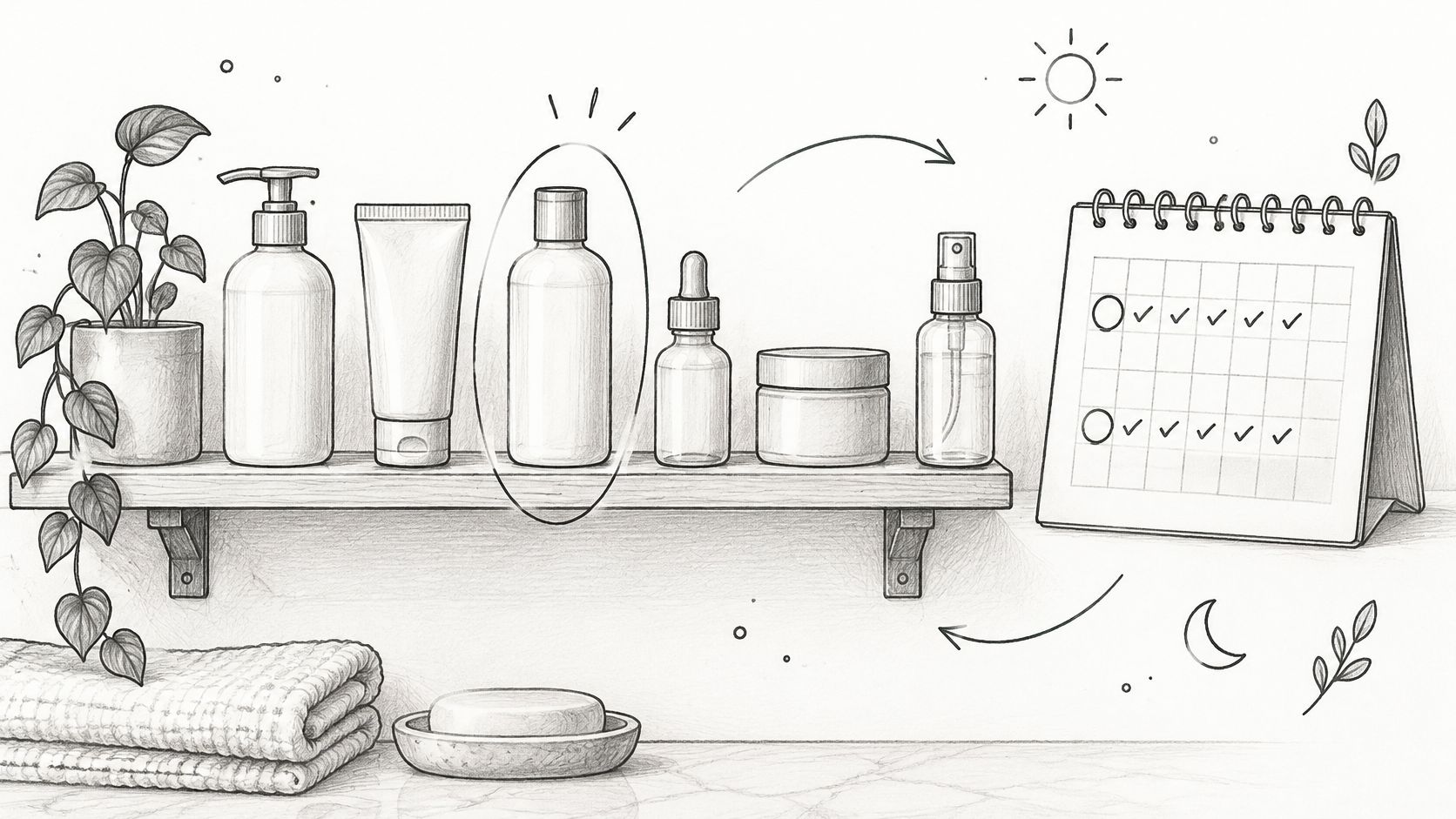
For underarms, choose a cleanser that rinses away without irritation. Aggressive scrubbing is less useful than gentle washing, rinsing, and drying. What makes body wash rinse clean can offer product-selection context, but ordinary sweat does not require a specialised cleanser.
Keep body wash out of the vagina. Avoid vaginal deodorants, fragranced wipes, and scrubbing away your usual scent.
If you are considering products marketed for vaginal balance, first learn how to approach vaginal pH. Odor alone cannot tell you your pH, and changing it without knowing the cause does not replace testing.
An internal cleanse will not address damp clothing or underarm bacteria, and it should not be used in place of assessment for a possible infection. Choose a simple habit that matches the likely source.
Track Two Cycles, Then Decide Your Next Step
A short log can make a vague concern easier to describe. Use a notebook, a phone note, or a tracking app, and keep underarm observations separate from vaginal symptoms.
You can use two cycles as a practical observation period if the change is mild and you have no warning signs. Don't wait to finish tracking before seeking care for concerning symptoms.
Keep the entries brief and consistent
Start a daily record. Continue across two full cycles, or longer if periods are irregular and symptoms remain mild. A guide to how to track your cycle can help you label entries consistently.
Rate underarm and vaginal odor separately using words such as none, mild, noticeable, or strong. These are personal comparison labels, not medical measurements.
Record sweating episodes. Note hot flashes, damp sleepwear, and whether the odor occurred on wet or dry skin. This helps distinguish overnight sweating from a scent change without obvious moisture.
Mark when bleeding begins and when each odor change appears. If cycle timing is uncertain, record the date rather than guessing whether you've ovulated.
Add accompanying symptoms. Note discharge colour and texture, itching, pain, feeling feverish, recent sex, or concern about a retained tampon. Use the “Odor patterns, likely causes and next steps” table to decide whether care should come sooner.
Record changes in sleep, stress, exercise, food, medications, and contraception. Include any new cleanser, antiperspirant, or laundry product so you don't overlook a non-hormonal explanation.
Compare the pattern. A mild change that repeats near the same phase and settles supports a cycle-linked explanation, but doesn't prove it. A persistent or changing symptom needs clinical review.

Alongside paper or phone notes, Lila's app is an option for keeping symptoms, sleep, meals, and cycle entries together. Its chat coach can help organise observations, but it doesn't replace examination or testing.
Track a mild, temporary pattern; seek assessment for a persistent change or the warning signs in the comparison table.
Lila offers daily check-ins and a personalised action plan for managing perimenopausal symptoms. Visit Lila to keep odor changes alongside sweating, sleep, and cycle observations so you have a clearer record to discuss with your clinician.
Get Lila, your personal coach for perimenopause.
Built for women in their 40s. 24/7 coaching, in your pocket.