
Breast Itching and Menopause: Causes and Relief
Breast itching and menopause: why falling estrogen dries breast skin, safe home relief steps, and the red flags that need a doctor's visit.
Most women assume a itchy breast around menopause is just another item on a long list of hormone symptoms, something to be endured with a bra adjustment and a bit of cream. But here's the gap that conventional advice skips: the pattern of the itch, which side it's on and how long it lasts carry more information than the itch itself. Getting that wrong in one direction causes needless worry. Getting it wrong in the other direction delays a check that matters.
Breast itching and menopause do belong together. Declining estrogen changes the skin, and the chest is as exposed to those changes as any part of the body. What isn't true is that menopause explains every itch. Sometimes it's friction and sweat under a bra band. Sometimes it's a new detergent. Occasionally it's a skin condition or a nipple change that needs a clinician's eyes rather than another layer of moisturiser.
The goal here is a calm, specific picture: what's ordinary, why it happens, what to do about it at home, and the exact points at which you stop self-treating and book an appointment.
Table of Contents
- Is Your Breast Itch Menopause or Something Else
- Why Falling Estrogen Makes Breast Skin Itch
- How Common Menopausal Skin Itch Really Is
- Daily Routine to Calm Breast Skin
- Red Flags That Need Prompt Medical Review
- Decide Your Next Step This Week
Is Your Breast Itch Menopause or Something Else
Is your breast itch behaving like dry skin, or does the pattern suggest something your clinician should see? Start with three details: where the itch sits, whether it affects one side or both, and what else you can see or feel alongside it. Those details separate ordinary menopausal dryness from breast changes that need a closer look.
A bilateral, surface-level itch that comes with dry or flaky skin, friction, a new detergent or sweating fits irritation or dermatitis. A persistent one-sided nipple or areolar rash, discharge, swelling, dimpling, skin thickening or a rapidly changing breast has a different pattern. The Cancer Australia guidance on inflammatory breast cancer notes that this uncommon cancer can develop over weeks to months and may cause itching with redness, swelling, heaviness, warmth, tenderness or an orange-peel appearance.
So the reassurance is real, but it needs a route attached. Here's the pattern map.
Breast itch patterns and the next step
| Pattern | Likely cause | Next step |
|---|---|---|
| Both breasts, dry or flaky skin, worse in heat or after a new detergent | Menopausal dryness or irritant contact dermatitis | Remove the irritant and moisturise for two weeks |
| Both breasts, brief itch that moves around and fades after moisturising | Ordinary dry skin | Monitor and keep a symptom log |
| Both breasts, thickened or red patches that do not settle | Eczema or dermatitis | Book a routine visit with a GP or dermatologist |
| One nipple or areola, itch or rash lasting more than two weeks | Needs examination; eczema is possible but Paget disease must be excluded | Book a prompt clinician visit |
| Itch with nipple discharge, a lump, dimpling or bleeding | Needs assessment for a breast disorder | Book a clinician visit as soon as possible |
| Itch with redness, swelling, warmth or orange-peel skin | Possible inflammatory breast cancer (rare) | Seek same-week medical assessment |
The two-week test
Strip back the variables and give your skin a fair chance to show you what it is. Swap out the new detergent or body wash, stop using fabric softener on your bras, moisturise the area daily and change out of damp workout clothes promptly. Do that consistently for two weeks. If the itch has settled, you've found an irritant or dryness pattern and you know how to manage it. If nothing has changed, that's information too, and it's the point to arrange an examination rather than keep experimenting.
So how long is too long? Symptoms that persist, worsen, stay on one side or fail to improve after removing likely irritants warrant medical evaluation, particularly when there's no obvious skin trigger and no month-by-month cycle to explain the timing. Ask yourself which row of the table matches what you're feeling before you read on. That answer shapes everything below.
If a stubborn patch remains unclear, when itching needs a dermatologist can help you think through the signs that point toward specialist care.
Why Falling Estrogen Makes Breast Skin Itch
Healthy skin works like a well-waterproofed jacket. It holds water in, keeps irritants out and cushions the nerve endings underneath. Estrogen helps maintain that barrier by supporting hydration in the epidermis, collagen in the dermis and the skin's water-binding molecules. It also influences how much moisture escapes through the surface. When estrogen becomes erratic in perimenopause and later remains low, that jacket can thin, dry out and become less reliable.
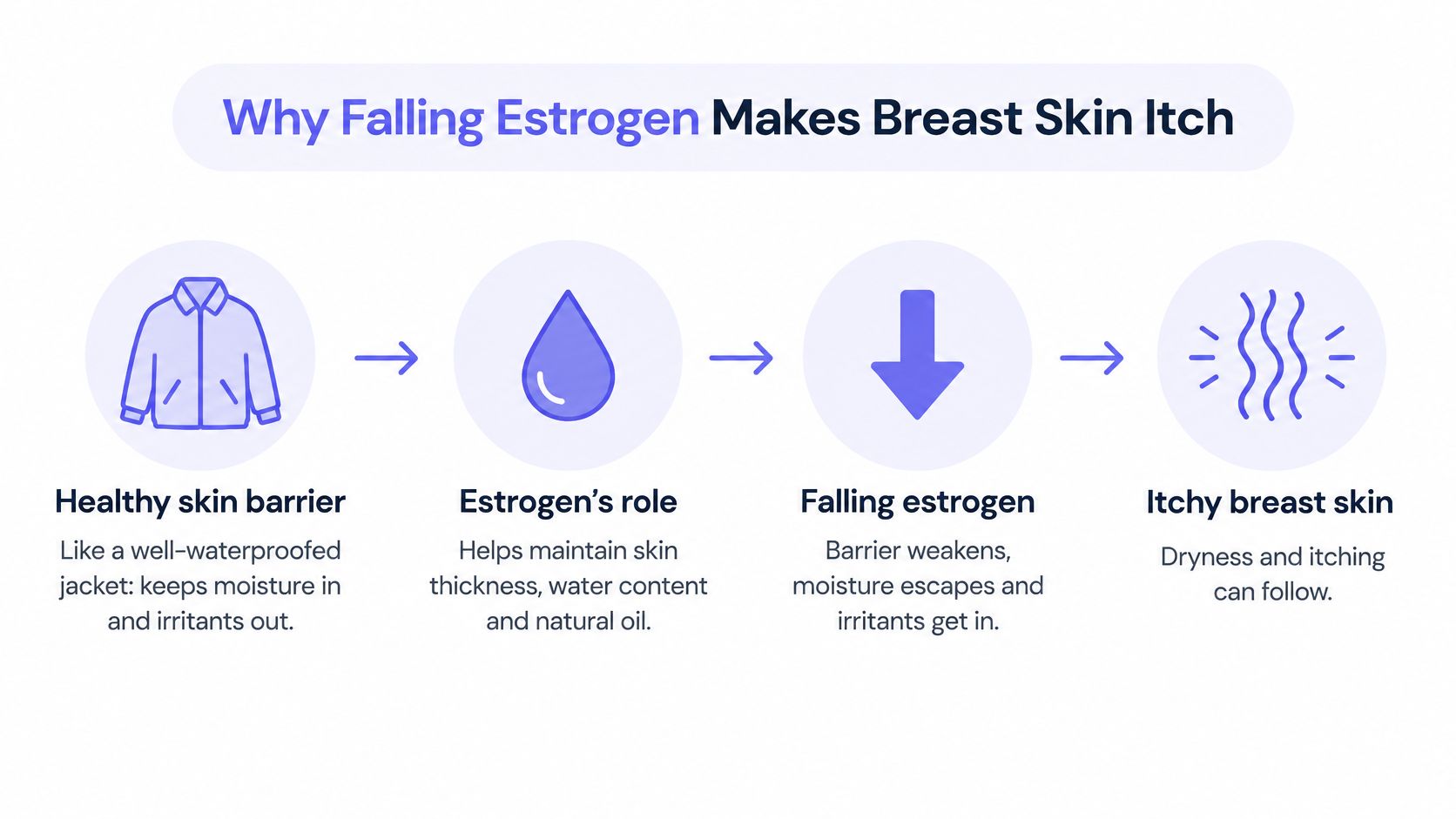
The leak has a name: transepidermal water loss. That means more water passes out through the skin, leaving the barrier less able to do its job. A clinical review of menopause-related skin changes describes this chain, linking low-estrogen states to increased water loss, xerosis and reduced barrier resilience. The same review connects these changes with greater sensitivity to friction, sweat, detergents and fabrics.
Why the chest feels it first
Breast and nipple skin is thin, and it sits in a demanding spot. It folds under the breast and along the bra band, traps sweat, and rubs against fabric for most of the day. A jacket that leaks in one exposed spot will leak fastest where it is folded, damp and pressed.
Once the barrier is compromised, ordinary contact can start to feel like an itch signal. Friction from a strap. Fragrance in a body lotion. Synthetic fabric holding moisture against the skin. None of these may register on resilient skin. On dry, sensitised skin, they can be enough to start the cycle.
The scratch cycle: scratching damages the barrier further, which allows more water out and more irritants in, which makes the itch worse. Breaking that loop matters more than willpower.
This is a plausible mechanism, not a proven single cause. Other skin conditions can produce the same sensation, which is why a response to barrier care is part of the picture rather than a footnote. If you recognise this pattern, the broader hormonal context is covered in the signs of low estrogen.
The practical point is straightforward: repair the barrier first. Treat any itch that does not respond to barrier repair as a reason to look further.
How Common Menopausal Skin Itch Really Is
Skin itching and dryness are common complaints around menopause, but how common is breast itching specifically? The studies below measure general skin symptoms rather than breast itch, so they cannot give a reliable percentage for itchy breasts alone.
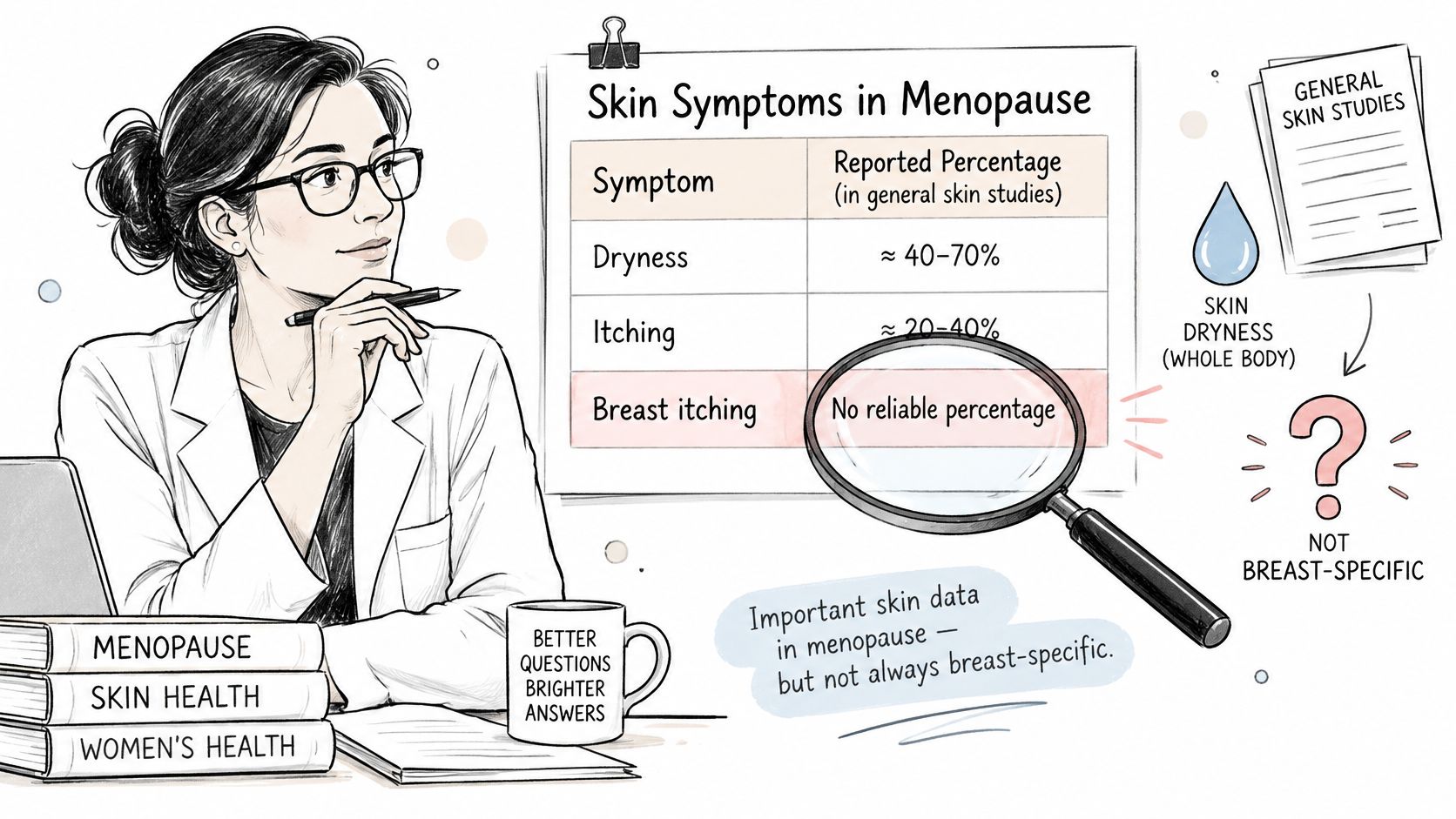
The distinction matters. A figure for itching anywhere on the body cannot tell you whether an itch affecting one breast is related to menopause.
Skin symptoms in menopause studies
| Source and group studied | Skin finding and rate |
|---|---|
| 2025 Post Reproductive Health survey of 50 menopause-clinic patients | 78% reported itchiness; 76% reported dry skin. |
| 2025 cross-sectional study in the Journal of Family Medicine and Primary Care | Xerosis affected 65.5% of postmenopausal patients; senile pruritus affected 1.5%. |
| 2024 National Eczema Society survey of 710 UK women, involving women with menopause and eczema or dry skin | 25% developed eczema for the first time during menopause. |
These figures describe different groups and different questions. The menopause-clinic survey asked about symptoms such as itchiness and dry skin. The cross-sectional study recorded conditions, including xerosis, which means abnormally dry skin, and senile pruritus, a label for itching in older people. Its lower figure for that diagnosis does not mean that itching in general was equally uncommon.
The eczema survey also needs its context: participants already had eczema or dry skin. Its result describes first-time eczema within that group, rather than the chance that any woman will develop eczema during menopause.
The percentages are not interchangeable.
For your own symptoms, the useful distinction is between a widespread pattern and a localised one. Dry, itchy skin affecting several areas, including the chest, can fit menopausal skin changes. That pattern makes dryness a reasonable possibility, but the survey results cannot establish the cause in an individual.
An itch confined to one breast needs its own assessment. Pay attention to where it occurs, whether it affects one side or both, and whether it persists or changes over time. Persistent one-sided symptoms warrant medical examination rather than an assumption that hormones explain them.
▶ PlayIf your symptoms fit the broader dry-skin pattern, menopause itchy skin causes and relief explains body-wide itching in more detail. These studies offer context for that experience, not a diagnosis for a particular breast symptom.
Daily Routine to Calm Breast Skin
Treat the next two weeks as a trial aimed at barrier repair, not scratching. Seven steps, each with the reason it works and the mistake that undoes it.
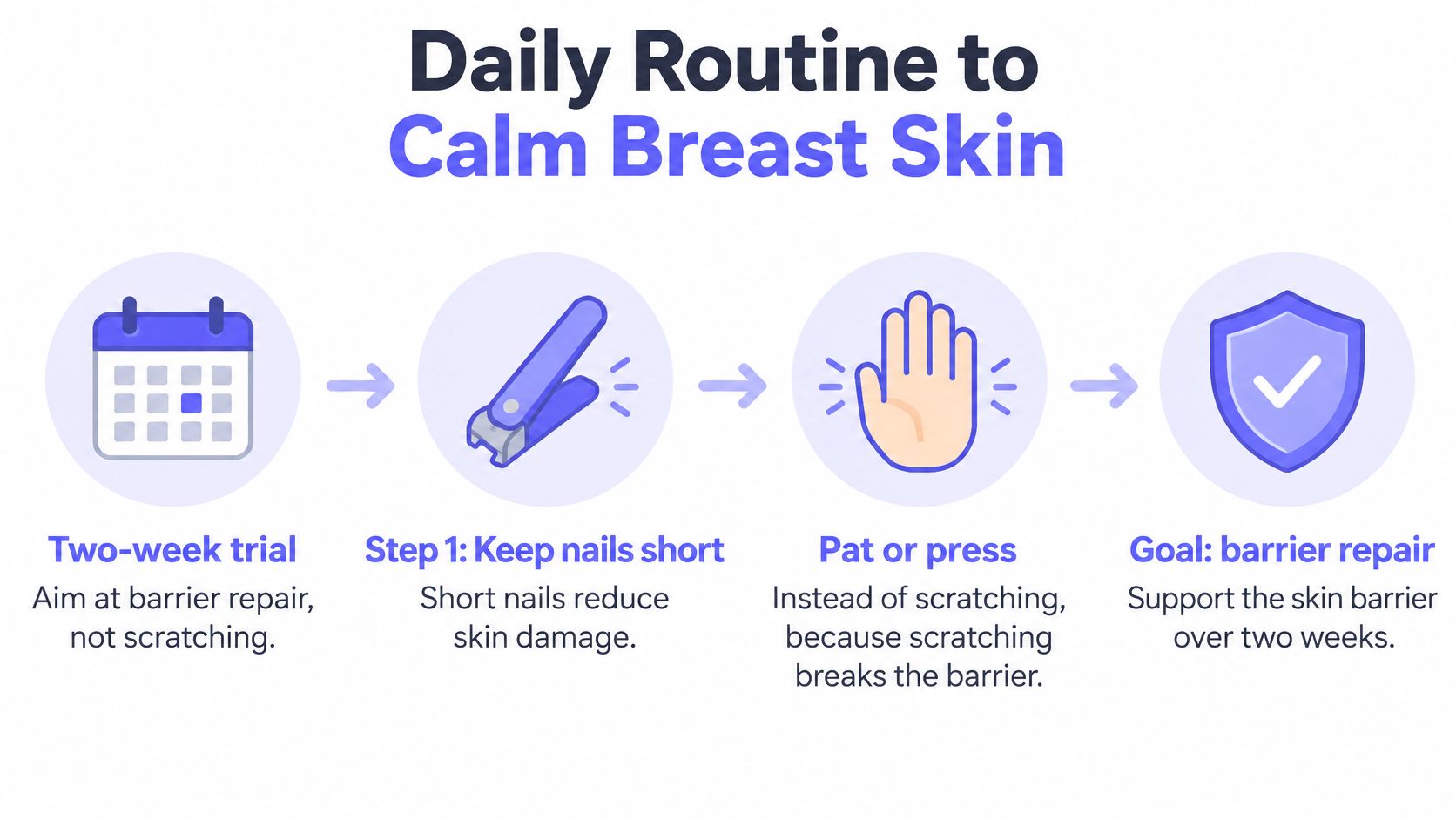
Short nails, pat instead of scratch. Keep nails trimmed and press or pat the skin through fabric when the urge hits. Scratching tears the barrier you're trying to rebuild, and the relief lasts seconds while the damage lasts days.
Lukewarm showers, five to ten minutes. Heat strips the natural oils that are already in short supply. Use a gentle fragrance-free non-soap cleanser rather than shower gel, and pat dry instead of rubbing, because rubbing on damp skin creates the friction that starts the itch.
Emollient within three minutes of drying. Apply a fragrance-free emollient while skin is still slightly damp so it traps water, covering the skin beneath the breasts and along the bra band. Repeat later in the day. The common slip is using a scented body lotion, which adds fragrance on top of an already reactive barrier.
Breathable bras, changed promptly. Choose cotton or moisture-wicking fabrics, ensure the band and cup fit without digging, and change out of damp bras, sports tops and sweaty straps as soon as you can. A supportive bra that fits well reduces fold friction; a tight underwire on fragile skin adds to it.
Fragrance-free detergent, extra rinse. Washing machines leave residue in seams and elastic that sits against your skin all day. Switch to a fragrance-free detergent and run an extra rinse cycle, and skip fabric softener entirely.
Cool compress during a flare. A cool, damp cloth for about ten minutes calms the itch without breaking skin. Never use ice directly, and never hot water, which feels good for a minute and then makes the itch louder.
The mistake that undoes everything: applying hydrocortisone cream to a fold for weeks without advice. Brief use has its place, but long-term steroid use thins skin that's already thin.
- Log it daily for two weeks. Note location, which side, severity and what happened beforehand, from meals and alcohol to sleep and heat. Patterns show up fast in writing and vanish from memory.
At the end of two weeks, reassess. Clearly better means continue the routine, since it's working. Not better, or worse, or anything from the red-flag list below means move to a medical check. A moisturiser with retin-a explains how to layer barrier products if you already use active ingredients, since the two can work against each other.
Red Flags That Need Prompt Medical Review
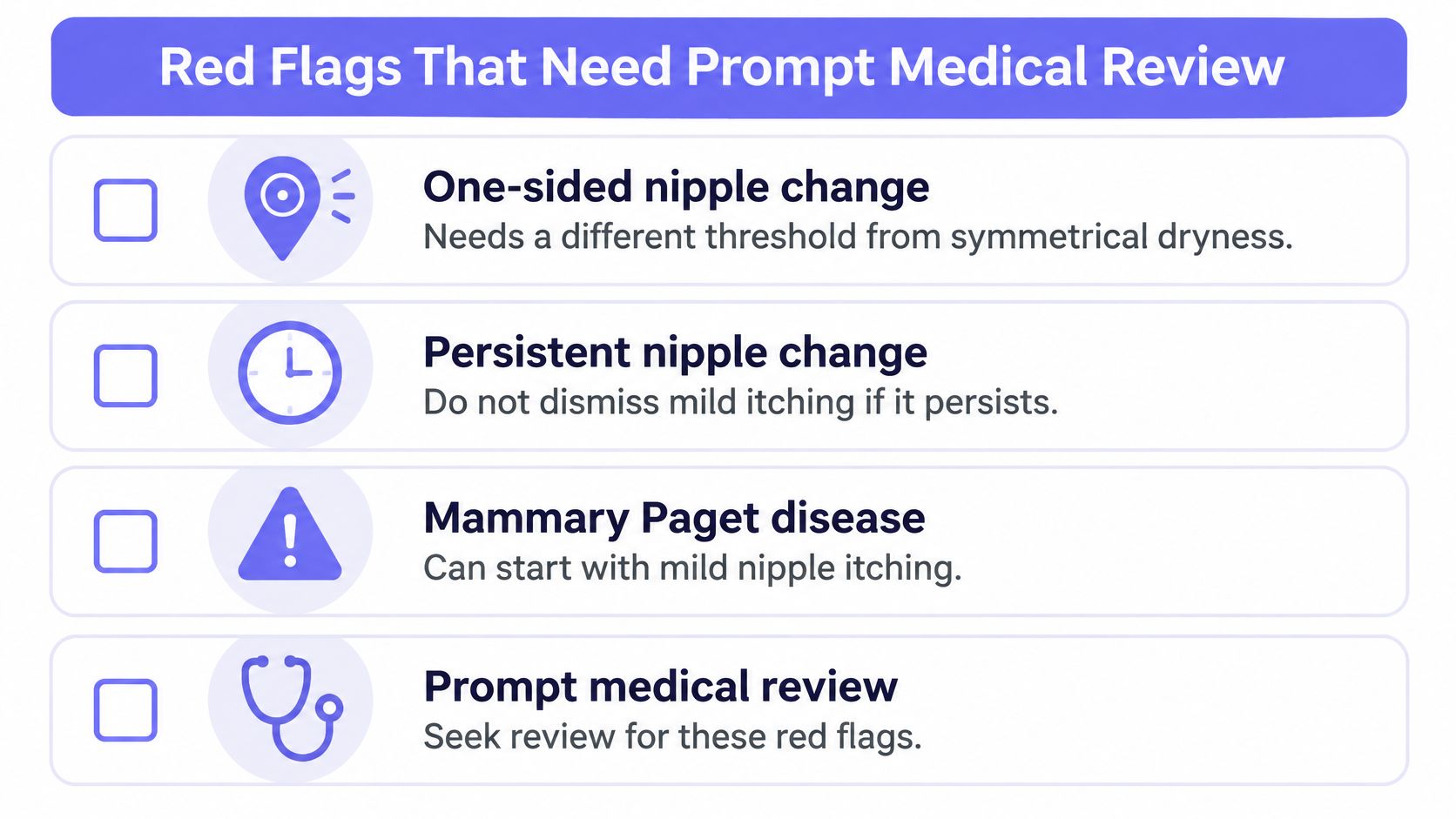
A one-sided or persistent nipple change needs a different threshold from the symmetrical dryness described above. That's not alarmism, it's arithmetic: symmetrical dryness has an obvious explanation, and a single persistent patch does not. Mammary Paget disease can begin with mild nipple itching that looks like eczema, which is precisely why the warning signs deserve a checklist rather than a shrug. The review of nipple change and Paget disease presentation sets out the associated signs: unilateral redness, scaling or crusting, nipple distortion or inversion, ulceration, bleeding, discharge, or a palpable mass.
Check yourself against these, on one side only:
- Redness that isn't mirrored on the other breast
- Scaling or crusting that returns after moisturising
- Nipple inversion or distortion that's new for you
- Ulceration or bleeding of the nipple or areola
- Discharge, especially clear or bloody, from one side
- A lump you can feel, or dimpling when you raise your arm
- Skin thickening, swelling, warmth or an orange-peel texture
The two-week steroid rule
The same review recommends diagnostic imaging and biopsy when an apparently benign nipple change fails to improve after a two-week course of topical corticosteroid. That's the clinically useful line: eczema is usually bilateral and usually responds to appropriate treatment, so a one-sided change that persists despite correct cream deserves examination rather than a repeat prescription and another month of waiting.
One point that catches people out. A normal mammogram or ultrasound does not by itself exclude Paget disease, and further evaluation including MRI or biopsy may be needed when suspicion remains. A reassuring scan is good news, not a finish line.
Bring these to the visit: the date the itch started, which side, phone photos taken along the way, every product you've used, and what you've tried for how long. Clinicians work faster with a timeline.
For context on the pain side of the same question, when to worry about breast pain after menopause covers the patterns that warrant a check.
Decide Your Next Step This Week
Find your row in the pattern table and commit to the matching action now, while it's fresh. If you landed on monitor, put a two-week date in your calendar, run the routine and log the itch daily until you reach it. If you landed on routine visit, book it this week rather than next month. If you landed on prompt or same-week review, call today.
Tracking earns its place because itch almost never arrives alone. Timing, which side, what you ate, alcohol, broken sleep and any hormone therapy dose all shape how skin behaves, and patterns hide in memory. Lila links symptoms to logged meals, sleep, alcohol and HRT doses, so those connections sit in one view instead of five different notes. The app tracks 20+ symptoms in a daily check-in, itching included, and the perimenopause symptom tracker explains how to build a record your doctor can use.
The boundaries matter as much as the feature. Lila is not a substitute for medical advice, and you should always consult your doctor about perimenopause symptoms. Any conversation about HRT, hormone testing or a health condition belongs with your clinician, not an app.
Your visit checklist: onset date, which side, what you've noticed changing, products used, what you've tried and for how long, and two direct questions. Ask whether the change should be examined in person, and whether imaging is needed. Write the answers down.
A clear answer and a clear plan are the goal. Most breast itching at menopause turns out to be skin that needs repairing, and that's a fix you can start tonight. The handful of patterns that don't fit need someone to look, and asking early costs you one appointment.
If you're ready to see your own pattern instead of guessing at it, Lila turns a two-minute daily check-in into a clear record of how itching, sleep, meals, alcohol and hormone therapy line up over time. That record makes a fifteen-minute appointment productive and shows you whether your barrier routine is working. Visit Lila to start tracking breast itching and the symptoms around it this week.
Get Lila, your personal coach for perimenopause.
Built for women in their 40s. 24/7 coaching, in your pocket.