
How to Use a Perimenopause Symptom Tracker
Learn how to set up a perimenopause symptom tracker to log symptoms, identify patterns, and track changes over time. Practical guide with tips.
Up to 80% of women experience vasomotor symptoms such as hot flashes during perimenopause, making a symptom tracker an essential tool for managing this highly variable phase. A useful tracker doesn't just record what happened, it helps you connect symptoms with sleep, meals, stress, cycle timing, and daily routines.
You might recognize the pattern. One morning, you wake after sweating through your clothes, struggle to concentrate at work, and feel unusually irritable. The next day, you sleep better and feel almost like yourself again. Because the symptoms come and go, it's easy to question whether they're connected at all.
They usually are connected, but memory is a poor health-recording system. A perimenopause symptom tracker gives you a timeline, and a timeline lets you move from “I feel awful sometimes” to a more useful picture of when symptoms appear, what accompanies them, and how much they interfere with your life.
The practical aim isn't to create a perfect diary. It's to collect enough consistent information to recognize patterns, test manageable changes, and have a clearer conversation with a healthcare professional when you need one.
Table of Contents
- Why Tracking Matters in Perimenopause
- Choosing Your Tracking Method
- What to Log Daily
- Analyzing Trends Over Time
- Privacy and Data Sharing
- Conclusion Taking Control of Your Health
Why Tracking Matters in Perimenopause
After several weeks of unpredictable periods, a woman may notice night sweats, mental fog, and sudden fatigue without seeing a clear connection. She may attribute each episode to a demanding day, poor sleep, or stress. By the time she speaks with a clinician, the details have often blurred together.
A symptom tracker changes the task from remembering isolated events to examining a sequence. Record the date, symptom, intensity, bleeding pattern, sleep quality, meals, and relevant circumstances. Then compare those entries. A difficult day that follows repeated night waking suggests a different question from fatigue that appears after skipped meals or around changing bleeding patterns.
The tracker does not diagnose the cause. It gives you a practical record for testing reasonable explanations, adjusting routines, and deciding which concerns need clinical attention.
Symptoms change by stage
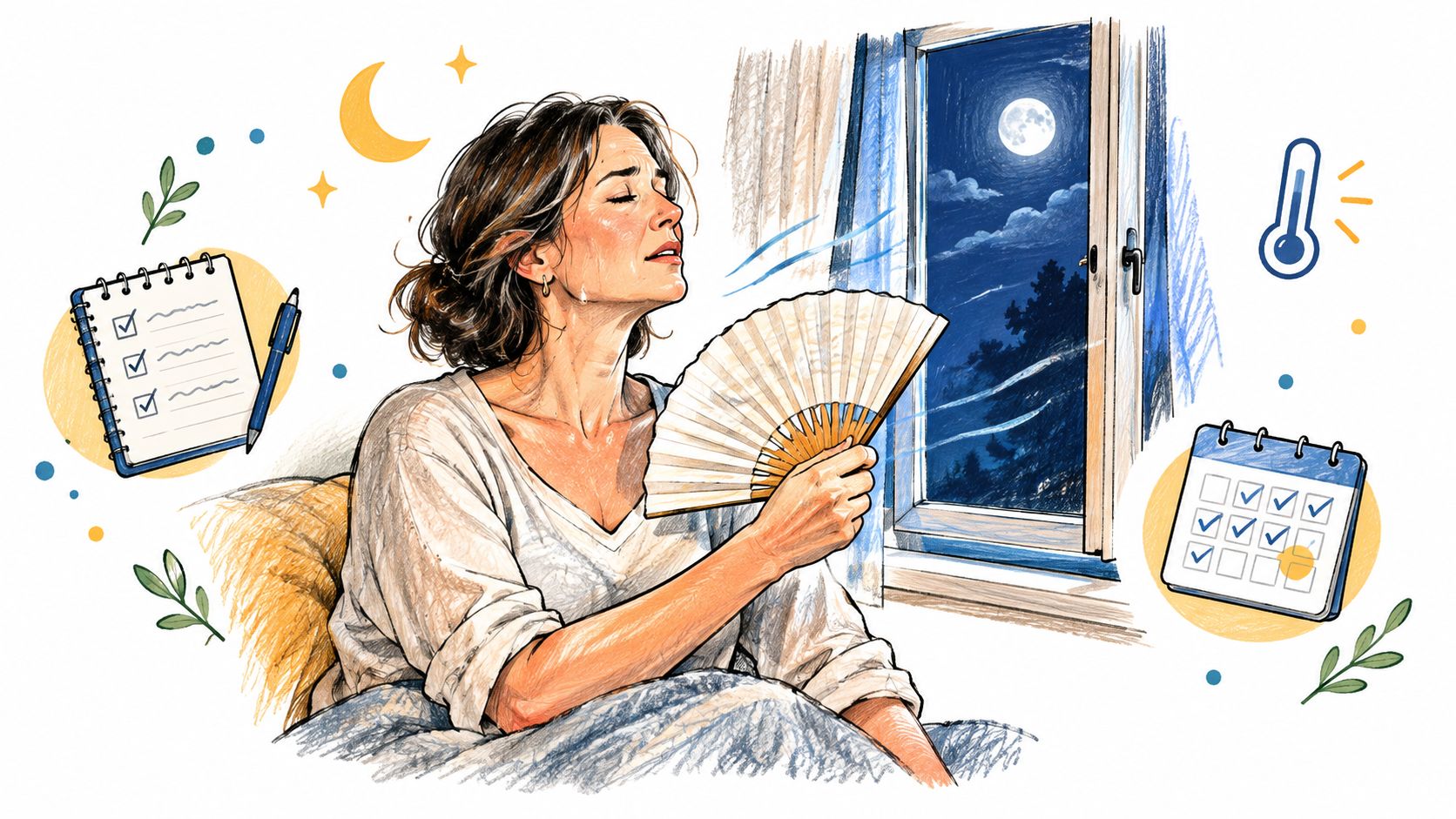
Hot flashes and night sweats, known as vasomotor symptoms, are common during the menopausal transition. A clinical review summarizing findings from the SWAN cohort reported that up to 80% of women experience vasomotor symptoms during perimenopause, with prevalence rising from 39% in the early transition to 67% cumulative prevalence later in the transition. The same review reported bothersome hot flushes increasing from 8.8% in premenopause to 37.3% in late perimenopause, while vaginal dryness had an adjusted prevalence ratio of 2.54 between those stages. (Clinical review of the menopausal transition)
These findings support a practical reason to keep reviewing your entries. A symptom that appears occasionally may become more frequent as the transition progresses. Another may remain linked to a specific circumstance, such as fragmented sleep, a meal pattern, alcohol, heat, or stress. Tracking helps distinguish a changing stage from a modifiable context.
Look for three patterns:
- Cycle variation: Symptoms that cluster around changing bleeding patterns or a recurring phase.
- Contextual triggers: Symptoms that follow poor sleep, a stressful day, a meal, alcohol, heat, or another identifiable factor.
- Persistent burden: Symptoms that continue, worsen, or interfere with work, relationships, exercise, or sleep despite changes in context.
Use a broader perimenopause symptoms guide to identify experiences you may want to monitor. Avoid turning the tracker into an exhaustive checklist. Start with symptoms that affect daily function, create uncertainty, or could change a decision.
Practical rule: Track what changes your decisions. If an entry will not influence what you do, what you discuss with a clinician, or which pattern you are testing, it probably does not need detailed daily recording.
Tracking reduces guesswork
A record cannot prove that one factor caused another. It can show a repeatable sequence that deserves closer attention. Repeated night waking followed by next-day fatigue and irritability is more useful than the general impression that “everything feels worse lately.”
Review your entries with focused questions:
- Do hot flashes occur mainly during the day, at night, or at both times?
- Does poor sleep precede brain fog or low energy?
- Do headaches appear near bleeding, after skipped periods, or without a clear cycle pattern?
- Does vaginal dryness remain occasional, or is it becoming persistent?
- Are symptoms disrupting sleep, work, relationships, or exercise more often?
If concentration becomes difficult, a practical guide to refocusing gently can offer immediate strategies while you examine the pattern. Keep the purpose clear: the tracker should support informed action, not create another daily obligation.
Choosing Your Tracking Method
The best method is the one you'll use when you're tired, busy, or having a difficult day. An app that you abandon after a week provides less useful information than a basic paper record you maintain consistently.
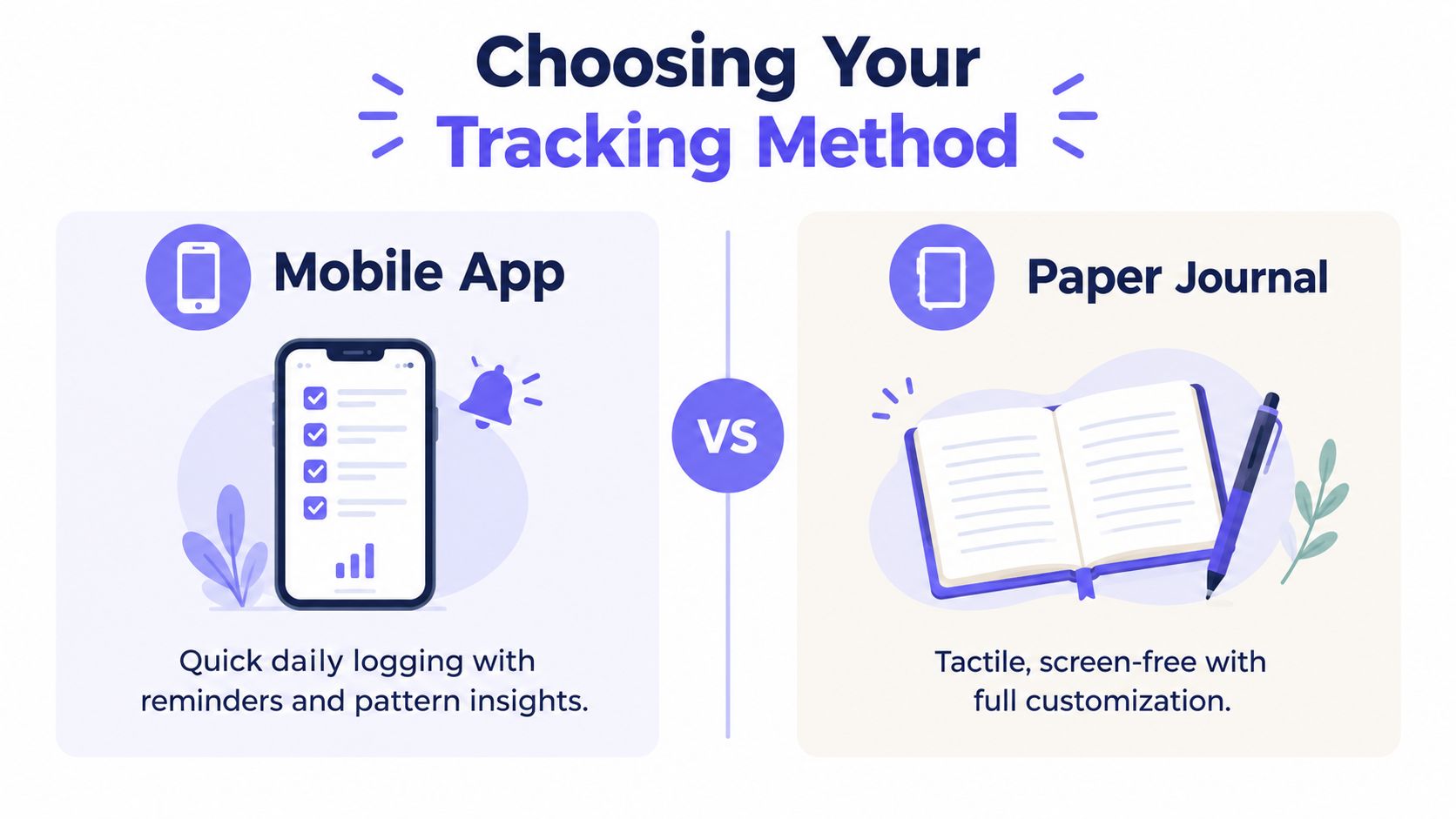
You have two reliable starting points: a digital app or a paper journal. Neither is automatically more accurate. They support different habits and create different trade-offs around convenience, privacy, analysis, and effort.
Choose digital when pattern recognition is the priority
A mobile app works well if you already carry your phone, prefer reminders, or want graphs and searchable history. It can reduce the friction of entering the same information each day and may help you compare symptoms with cycle dates or other context.
Look for practical functions rather than a long list of features:
- Flexible cycle entry: You should be able to record irregular bleeding without forcing your experience into a predictable calendar.
- Custom symptom fields: The app should let you select the symptoms that matter to you, rather than making you complete an exhausting checklist.
- Context tracking: Sleep, mood, energy, meals, movement, and stress are useful additions when they can be logged quickly.
- Readable summaries: A graph is only helpful if you can understand what changed and when.
- Export or sharing options: You may want to show a concise summary to a healthcare professional without handing over every private note.
A digital tracker can also become counterproductive. Frequent notifications may make you feel monitored, streaks can turn missed days into failure, and a visually impressive dashboard may encourage you to collect data without acting on it. Choose an app that supports flexible, low-pressure logging. A menopause symptom tracker app comparison can help you evaluate the features that matter before committing to one.
Choose paper when privacy and reflection matter more
A paper journal gives you full control over what you record. You can use a notebook, a printed grid, or a one-page weekly form. It works especially well if screens feel intrusive or if writing helps you notice how symptoms affect your mood and functioning.
The limitations are just as real. You'll need to create your own categories, remember to bring the journal to appointments, and review the entries manually. Paper also makes it harder to compare several factors quickly, so use simple symbols or a consistent rating system rather than filling pages with long descriptions.
A useful compromise is paper for daily logging and a monthly summary in a secure digital document. That gives you a private, tactile process while preserving a concise record for review. Whatever method you choose, test it for several days and ask whether you can complete it in a few minutes without resentment. If not, simplify it.
What to Log Daily
A tracker becomes useful when it captures both the symptom and its context. “Bad day” isn't enough. Record what happened, how intense it was, when it occurred, and what else was going on.
You don't need a long evening ritual. A brief morning check-in, a quick note after a significant symptom, and a short evening review can create a strong record without making you focus on symptoms all day.
Start with a small core set
Use a consistent scale for severity. You might define none, mild, moderate, and severe, or use a numerical scale that has a clear meaning for you. The specific scale matters less than applying it consistently.
Record the following:
- Hot flashes and night sweats: Note the time, intensity, duration if you can estimate it, and whether the symptom woke you.
- Sleep: Log bedtime, waking time, night waking, perceived sleep quality, and whether you felt restored.
- Mood and mental clarity: Note irritability, anxiety, low mood, concentration difficulty, and word-finding problems when they affect your day.
- Energy and physical symptoms: Include fatigue, headaches, bloating, joint discomfort, breast tenderness, libido changes, and vaginal dryness if relevant.
- Bleeding: Record the first day of full bleeding, spotting, flow changes, and unusual bleeding. Don't force irregular cycles into a prediction that doesn't fit.
- Function: Add one short note about impact, such as “left work early,” “couldn't exercise,” or “managed normal routine.”
This broader approach is more informative than tracking hot flashes alone. A symptom may feel tolerable until you see that it repeatedly interrupts sleep or limits ordinary activities.
Add objective and environmental context
If you use a wearable, record the information you can interpret reliably, such as sleep duration, sleep interruptions, resting heart rate, or another recovery measure provided by the device. Treat wearable data as context, not a diagnosis. A device can detect a change, but it can't explain whether hormones, illness, stress, medication, or another factor caused it.
Meals deserve the same balanced treatment. Don't label foods as universally “good” or “bad.” Note timing and relevant details, such as a late meal, spicy food, caffeine, alcohol, or a day when you ate very little. You're looking for repeated associations in your own record, not a reason to eliminate half your diet after one uncomfortable evening.
A simple daily template might look like this:
| Area | What to record |
|---|---|
| Symptoms | Type, time, severity, and effect on normal activity |
| Cycle | Bleeding, spotting, flow, and notable changes |
| Sleep | Sleep quality, waking, night sweats, and morning energy |
| Context | Meals, caffeine, alcohol, movement, stress, and travel |
| Action | What you tried and whether it helped |
For a wider checklist of possible experiences, use this perimenopause symptoms checklist as a reference, then keep your daily tracker focused. If an entry takes too long, reduce it to your top symptoms and one or two context factors.
Analyzing Trends Over Time
Logging creates raw material. Interpretation is the step that makes it useful.
Review your entries at a regular interval, preferably when you're calm and not in the middle of a symptom flare. Look for repetition rather than dramatic single-day events. One hot flash after a poor night doesn't establish a pattern. Several similar sequences may justify a practical experiment or a clinical discussion.
Use a weekly review question
Choose one question for each review instead of searching for every possible correlation. Examples include:
- Are night sweats followed by lower energy the next day?
- Do headaches cluster around bleeding or appear independently?
- Does sleep change before mood changes?
- Are symptoms more disruptive during weeks with higher stress?
- Did a change in meal timing, caffeine, movement, or bedtime coincide with improvement?
Write a short conclusion in plain language. “Three difficult mornings followed nights with repeated waking” is more useful than “symptoms unpredictable.” Then choose one response. You might adjust your evening routine, protect a consistent bedtime, discuss persistent symptoms with a clinician, or continue observing because the evidence is still unclear.
A two-column comparison can prevent overinterpretation:
| Observation | Reasonable next step |
|---|---|
| A symptom appears once after several unusual factors | Keep logging rather than assigning a cause |
| A symptom repeats after the same context | Test one manageable change while continuing to track |
| A symptom is worsening or affecting function | Prepare a summary for a healthcare appointment |
| Several factors change together | Avoid claiming causation and simplify the next experiment |
Combine self-reported and objective signals
The most informative record often places your experience beside measurable context. For example, you might compare a night-sweat entry with sleep interruption, morning energy, meal timing, and stress. If your wearable shows poor sleep on the same nights that you report night sweats, that strengthens the observation that sleep disruption is part of the problem, even though it doesn't identify the underlying cause.
Recent work is moving toward this multi-signal approach. A 2026 observational study is explicitly examining whether women can learn what improves or worsens menopause symptoms by combining self-reported symptoms with wearable-device data and smartphone tracking. (Study of combined symptom and wearable tracking) That direction reflects a practical reality: a checklist tells you what you felt, while sleep, meals, cycle timing, and physiology provide the surrounding context.
Don't treat correlation as proof. If hot flashes appear after a particular meal twice, that's a reason to keep observing, not a reason to permanently remove the food. If symptoms improve after a new routine, record the change and assess whether the improvement continues.
Turn logs into actions
Evidence from an observational study of 1,900 app users over two months found that greater use of in-app activities, along with symptom and menstrual-period logging, was independently associated with symptom reductions over time. (Observational study of symptom tracking and engagement) The useful lesson is operational: pair logging with a small action and review the outcome.
The study doesn't prove that tracking caused the reductions. Because the participants were already engaged app users, self-selection may have inflated the apparent benefit. Treat the findings as an association, not a guarantee of clinical efficacy.
Cycle context can also clarify timing, but irregular bleeding makes calendar predictions less dependable. Use this guide to tracking your cycle to record what happened rather than relying entirely on forecasted dates.
Interpretation beats accumulation: A smaller record that leads to one sensible decision is more valuable than a large record you never review.
Privacy and Data Sharing
Perimenopause logs can contain intimate information about bleeding, mood, sleep, sexual health, medication, and daily routines. You shouldn't have to choose between useful tracking and surrendering control of that information.
Before entering sensitive details into an app, read its privacy policy. Check what data the service collects, whether it shares information with advertisers or other companies, how long it retains records, whether you can delete your account, and whether you can export your information. A password and a polished interface don't answer those questions.
Decide what belongs in the tracker
You can separate information into three levels:
- Clinical essentials: Dates, symptom severity, bleeding changes, treatments, and effects on daily function.
- Useful context: Sleep, meals, caffeine, alcohol, stress, movement, and wearable observations.
- Private reflections: Relationship concerns, emotional processing, or details you may not want to share with anyone else.
Keeping those categories distinct gives you more control. A healthcare professional usually needs a concise timeline and functional impact, not every sentence you wrote after a difficult night.
If you're comparing services, resources such as the privacy controls from Mesoderm RX can help you think through opt-out choices and data-sharing preferences. Don't assume that every wellness app follows the same practices. Verify the settings yourself and revisit them after updates.
Prepare a focused clinical summary
Bring a summary rather than handing over an unfiltered diary. Include the period covered, your main symptoms, severity or frequency patterns, major changes, actions you tried, and questions you want answered.
A useful appointment summary might say:
- “Night sweating repeatedly disrupted sleep.”
- “Fatigue affected my ability to complete normal activities.”
- “Bleeding became more irregular than my previous pattern.”
- “I tried changing my evening routine and recorded whether sleep changed.”
- “I want to discuss whether this pattern needs further assessment.”
Use exact dates when they matter, but don't turn the appointment into a data presentation. Your clinician's examination, medical history, medications, and judgment remain essential. A tracker supports that process, it doesn't replace it.
Seek medical advice for symptoms that are severe, new, rapidly worsening, or concerning to you. Unusual bleeding, significant pain, chest symptoms, fainting, severe depression, or thoughts of self-harm deserve prompt professional attention rather than prolonged self-tracking.
For information about how one service handles personal information, review Lila's privacy policy before deciding what you're comfortable recording or sharing.
Conclusion Taking Control of Your Health
After two weeks of entries, a tracker should help you make a better decision, not just produce a longer diary. Ask what tends to happen before a symptom, how often it affects you, and which response is reasonable to test. Compare symptoms with sleep quality, cycle timing, meals, stress, or wearable information so the record supports interpretation rather than passive logging.
That approach gives you a more useful view of change. You may see that night waking precedes difficult mornings, that symptoms cluster at certain points in your cycle, or that a routine change is worth observing for another week. A focused record also gives a healthcare professional a clearer account than memory alone, while leaving diagnosis and treatment decisions to clinical assessment.

Keep the system sustainable
Begin with the symptoms that interfere most with daily life. Use the same rating or description each day, then add only the context you can maintain without resentment. A tracker should reduce uncertainty, not create another task you feel guilty about missing.
Review the system as your needs change. Remove fields you never use and add information that could clarify a new concern. If tracking increases anxiety without helping you choose an action, pause and discuss that reaction with a healthcare professional.
Use this five-part loop:
- Notice: Record what happened without judging it.
- Contextualize: Add sleep, cycle timing, meals, stress, or wearable information.
- Review: Look for repeated sequences rather than isolated events.
- Act: Test one reasonable adjustment or prepare a focused clinical question.
- Reassess: Keep, change, or stop the action based on what you observe.
The loop guards against two errors. Passive logging creates pages of entries without guiding a decision. Overconfident interpretation turns one coincidence into a rigid rule. Look for patterns across repeated observations, keep alternative explanations in mind, and involve a clinician when symptoms are concerning or the pattern remains unclear.
Research also supports the use of longer-term tracking. In a US survey of 7,640 women, researchers described perimenopause uncertainty as temporal and argued that longitudinal digital tracking can help women visualize symptom burden, explore relief options, and decide when to consult clinicians. The same source reports that, in a separate US survey of 2,040 women, 22% said they used technology for perimenopause or menopause symptoms, an increase of 5 percentage points from the prior year. Women aged 40 to 49 were three times more likely than women aged 50 and older to track symptoms with a wearable. (Research on longitudinal tracking and perimenopause uncertainty)
A tracker will not make perimenopause predictable. It can make your response more informed by connecting symptoms with context, testing manageable changes, and giving you specific questions to discuss in care.
This video offers another practical perspective on using tracking and planning to understand changing symptoms.
▶ PlayStart with three entries today: your main symptom, your sleep quality, and one relevant context such as cycle timing, a meal, or stress. Continue with the simplest format you can sustain, then review the record before your next healthcare appointment.
Use Lila to bring symptom, mood, sleep, energy, meals, and cycle information into one daily check-in with personalized guidance. Visit Lila to turn your perimenopause tracking into practical next steps you can review and adjust over time.
Get Lila, your personal coach for perimenopause.
Built for women in their 40s. 24/7 coaching, in your pocket.