
How Long Does Menopause Fatigue Last? a Timeline
Wondering how long does menopause fatigue last? Discover the typical timeline, symptoms, and effective relief strategies to help you feel like yourself again.
Menopause-related fatigue usually lasts as long as the broader menopause transition that's driving it. That often means around 4 years on average for perimenopause, and in some women the full transition can stretch to about 8 to 10 years, so fatigue linked to hormone fluctuation, hot flashes, and night sweats may come and go across that whole span.
If you're asking because you're waking up tired, dragging yourself through the afternoon, and wondering whether this is a bad week or your new normal, that question makes sense. Fatigue during menopause can feel confusing because it rarely behaves like ordinary tiredness. It isn't always fixed by a weekend, an earlier bedtime, or more discipline.
The part many people don't get told is this. Menopause fatigue is often not one single symptom with one simple timeline. It's usually the end result of several other things happening at once, such as broken sleep, mood changes, heavy bleeding, or another medical issue that overlaps with midlife. That matters, because the answer to how long does menopause fatigue last is often not "until menopause is over." It's "until the thing causing the fatigue gets better."
Table of Contents
- Why Menopause Fatigue Feels Different
- Understanding Menopause Transition Timelines
- Sleep Disruption and Night Sweats
- Other Factors That Prolong Fatigue
- Practical Strategies for Managing Fatigue
- When to Seek Medical Evaluation
Why Menopause Fatigue Feels Different
A familiar version of this starts. A woman in her late 40s sleeps what looks like a full night, gets up feeling as if she never fully shut down, pushes through work on caffeine and habit, then hits a wall in the middle of the afternoon. She may blame stress, getting older, or poor fitness. But the pattern doesn't quite fit.
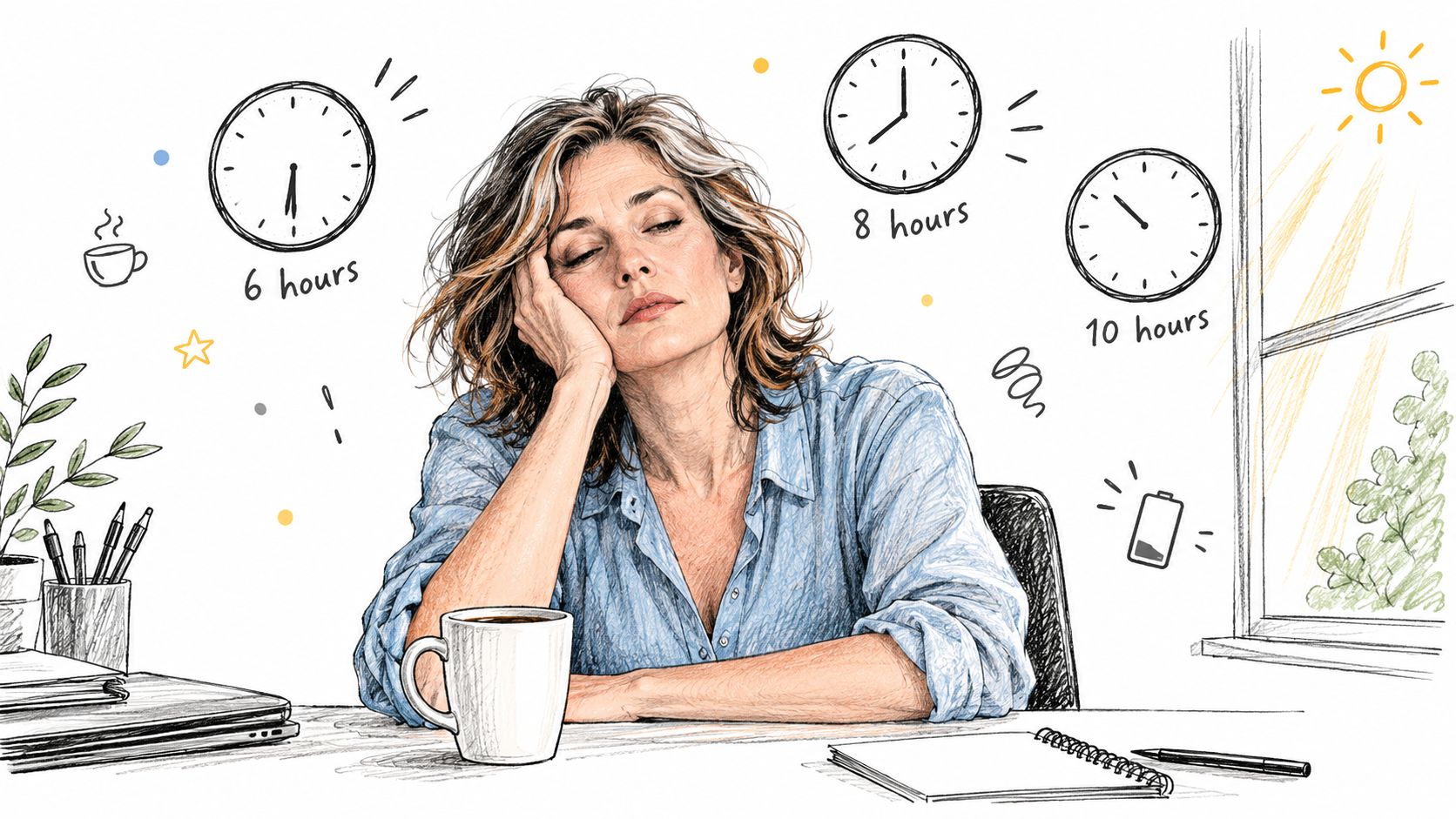
Ordinary tiredness usually makes sense. You slept less, worked more, traveled, got sick, or took on too much. Menopause fatigue often feels less logical than that. Some days you wake up flattened after enough time in bed. Other days your body feels heavy, your brain slow, and your motivation oddly absent even when life is relatively calm.
It often feels bigger than simple sleepiness
Sleepiness is the urge to doze off. Fatigue is broader. It can feel physical, mental, or both. You may still be able to get through your day, but everything costs more effort.
A useful way to think about it is this. Sleepiness is like needing to charge your phone. Fatigue is like the battery, software, and background apps are all acting up at once. You can plug in, but the drain may still continue if the underlying problem isn't addressed.
If you're trying to sort out whether what you're feeling is sleepiness, exhaustion, or both, Lila has a helpful explainer on whether menopause causes sleepiness.
Hormone shifts change the pattern
During perimenopause, estrogen and progesterone don't decline in a neat straight line. They fluctuate. That can affect sleep, temperature regulation, mood, focus, and the sense of physical steadiness you were used to.
Menopause fatigue often isn't a sign that you're doing something wrong. It's often a sign that your body is adapting to a changing hormonal environment.
That doesn't mean hormones explain every exhausted day. It means your body may be less forgiving than it used to be. A stressful week, one hot night, a heavier period, or low mood can have a bigger impact than before.
Many women find it helpful to learn more about natural hormone balance for women because the goal isn't to chase perfect hormones. It's to understand which daily habits support steadier energy when hormones are less predictable.
Why generic advice often falls short
"Sleep more." "Exercise more." "Reduce stress." None of that is wrong, but it's incomplete. If your fatigue is being caused by repeated night waking, low iron from heavy periods, or untreated low mood, broad energy advice won't fully solve it.
That shift in thinking can be a relief. Instead of asking, "Why am I so weak lately?" you can ask, "What is draining my energy right now?" That question usually leads to better answers.
Understanding Menopause Transition Timelines
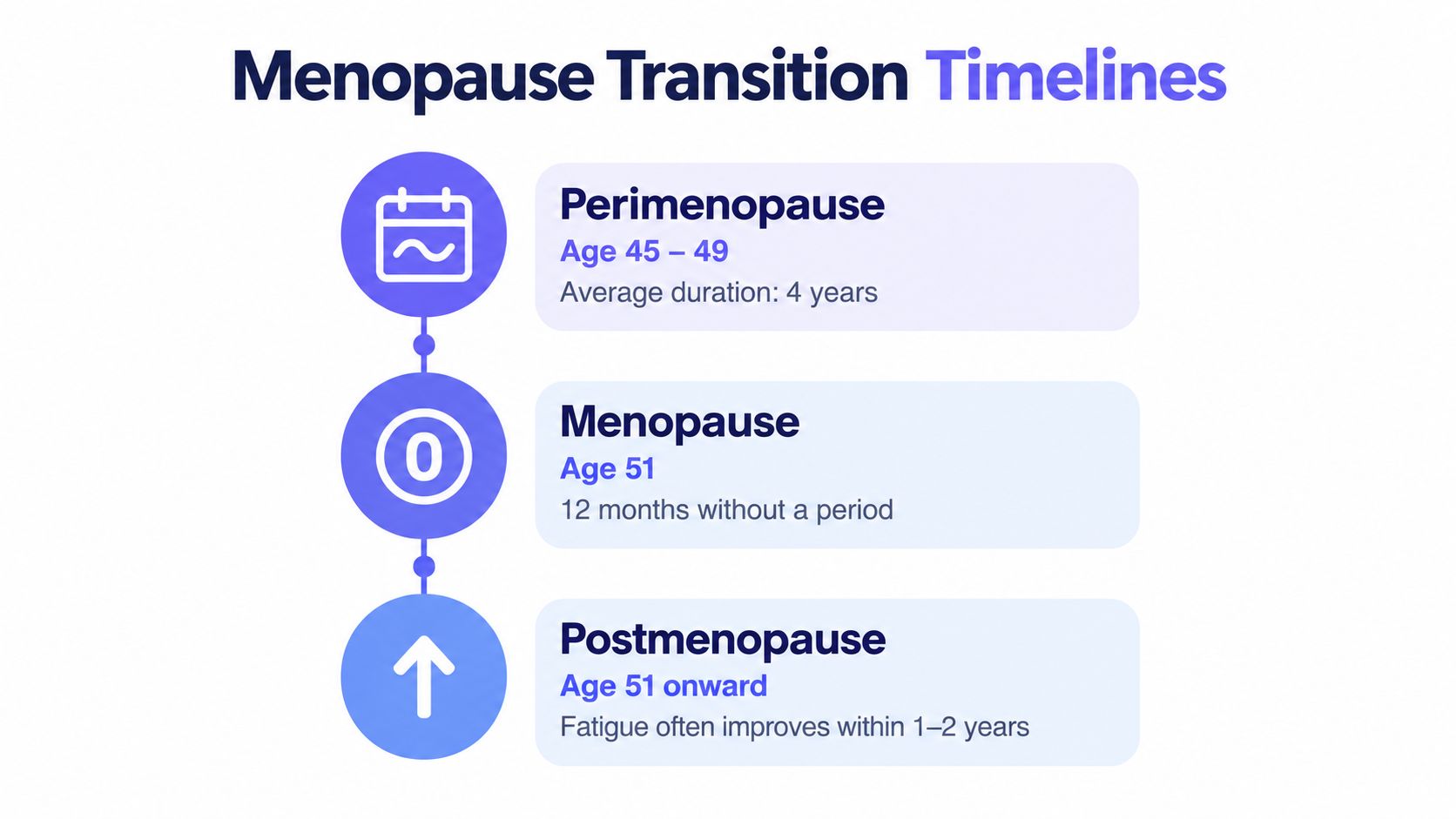
The timeline gets clearer when you stop treating menopause as a single date and start seeing it as a transition with phases. Fatigue often follows those phases rather than obeying one fixed calendar.
The big-picture timeline
A practical framework looks like this:
| Phase | What it means for fatigue |
|---|---|
| Perimenopause | Energy can become erratic because hormone levels fluctuate rather than settle |
| Menopause | This is the point reached after 12 months without a period, not a long stage by itself |
| Postmenopause | Some women improve as symptoms calm down, while others stay tired if another driver continues |
For many women, perimenopause lasts around 4 years on average and the broader transition can extend to about 8 to 10 years in some women, which helps explain why fatigue can linger well beyond the first skipped periods, as summarized in this review on menopause fatigue timelines.
That's why "How long does menopause fatigue last?" doesn't have one clean number. A better version is, "Which part of the transition am I in, and what symptoms are fueling the fatigue?"
Symptoms often start before the final period
One of the most important pieces of timeline data comes from NIH-linked research on vasomotor symptoms such as hot flashes and night sweats. That summary notes these symptoms often begin about 2 years before the final menstrual period, peak in the year after it, and then gradually diminish. It also explains why fatigue can stretch across multiple years rather than disappearing quickly, especially when poor sleep is involved, in this NIH overview of menopausal symptom duration.
So if you feel drained before your periods have fully stopped, that's not unusual. The fatigue timeline often starts before menopause is officially reached.
Why some women feel tired for years
The strongest long-term data come from the SWAN study discussed in an NIH resource on menopause. That research began in 1996 and followed more than 3,000 women. Later analyses found vasomotor symptoms had a median duration of 7.4 years, and 10% to 15% of postmenopausal women experienced them for as long as 15 years in the NIH menopause chapter.
Practical rule: If your fatigue rises and falls with hot flashes, night sweats, and sleep disruption, think in years, not weeks.
If you'd like a fuller overview of timing across stages, Lila also has a useful guide on how long menopause lasts.
Sleep Disruption and Night Sweats
For many women, the main engine behind menopause fatigue isn't a mysterious energy failure. It's repeated sleep interruption.
Fragmented sleep can create all-day exhaustion
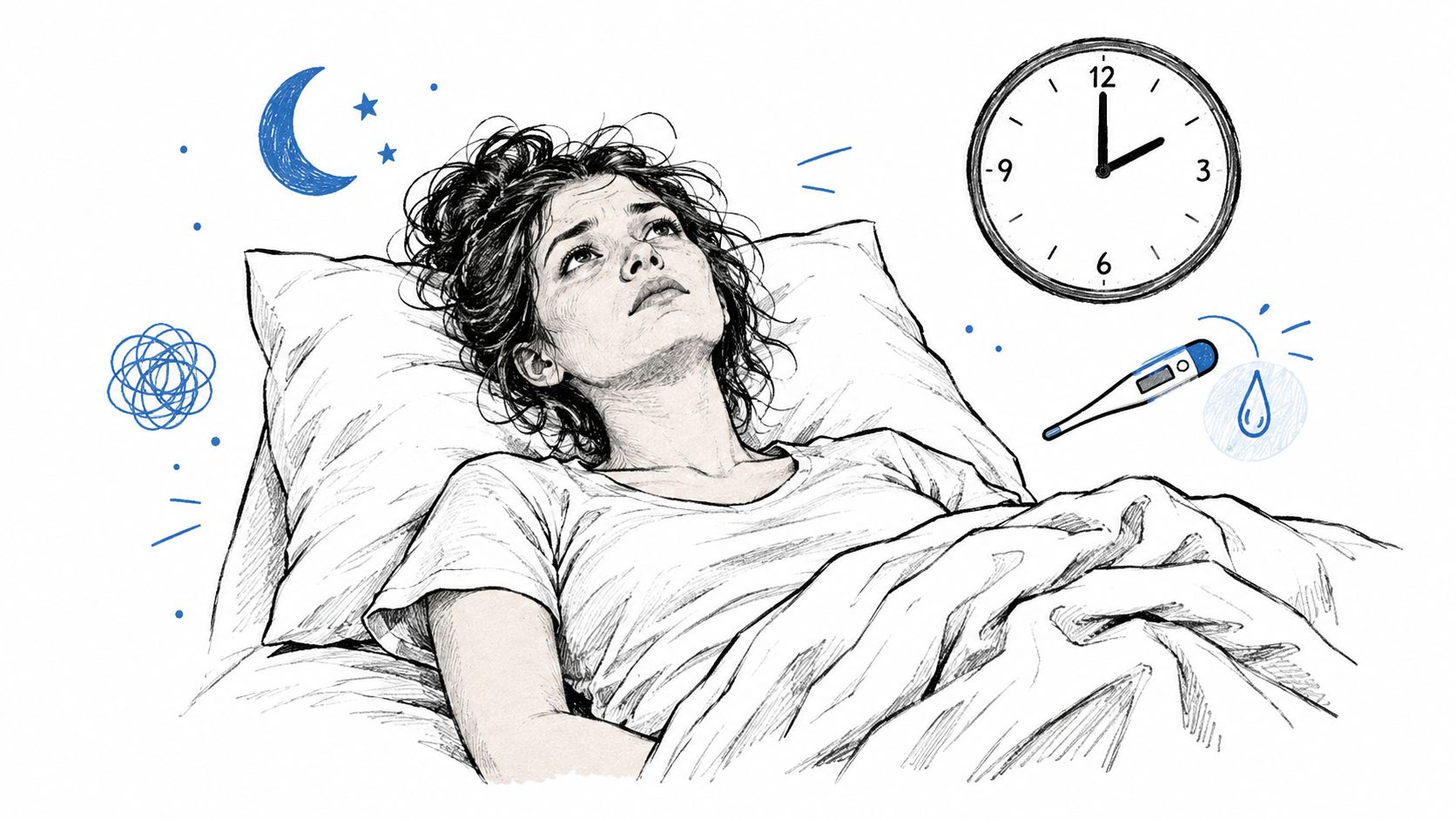
You might technically sleep for enough hours and still wake up depleted if your sleep is broken over and over. Night sweats, feeling suddenly overheated, waking with a racing mind, and then struggling to fall back asleep can leave you with the sensation of having "been in bed" without getting restorative rest.
A large review reported sleep disorders in 16% to 47% of women during perimenopause and 35% to 60% during menopause. In the same review, fatigue showed a strong association with poor sleep quality in perimenopausal women (r = .63), which supports the idea that daytime exhaustion is often secondary to disrupted sleep rather than a separate symptom, as described in this review on sleep and fatigue in menopause.
That pattern matters because it changes the treatment target. If sleep fragmentation is the main problem, improving sleep quality may shorten the fatigue more effectively than waiting for hormones to settle.
How to tell if sleep is the main driver
Look for clues in the pattern, not just the tired feeling itself.
- Night waking: You wake hot, sweaty, or suddenly alert, sometimes several times.
- Morning mismatch: You spent enough time in bed but don't feel restored.
- Afternoon crash: Your worst fatigue lands after lunch or in long meetings, when poor sleep becomes impossible to ignore.
- Irritable and foggy: Sleep fragmentation often shows up as short patience, poor concentration, and feeling emotionally thin.
If that sounds familiar, this guide on sleep disruption in menopause can help you connect the nighttime pattern to your daytime fatigue.
Broken sleep doesn't just make you tired the next day. It can train your body into a cycle of light, vigilant sleep that keeps fatigue going even when hot flashes become less frequent.
What helps when nights are the problem
Cooling the bedroom, reducing triggers that worsen night sweats, and treating insomnia patterns can all help. Some women also need a medical evaluation for untreated sleep apnea, especially if snoring, gasping, or unrefreshing sleep are part of the picture.
If you want a practical walk-through of ways to improve menopause sleep quality, that resource gives a useful overview of what to try when night sweats and insomnia start feeding daytime exhaustion.
Other Factors That Prolong Fatigue
Many women get stuck here. They assume the fatigue must be hormonal because it started during perimenopause, so they wait for menopause to end. But fatigue is often downstream, not standalone.
A recent survey described in a 2026 menopause society press release found that 95% of people self-identifying as perimenopausal reported physical and mental exhaustion, and 93% reported fatigue, underscoring how common these symptoms are during this stage in the survey summary. Common doesn't mean simple, though.
Some causes outlast the transition
Heavy bleeding can drain energy over time, especially when it leads to iron deficiency. Mood changes can make sleep lighter, mornings harder, and motivation lower. Thyroid disease can overlap with menopause so closely that women assume everything is hormonal when it isn't.
Untreated sleep apnea can do the same. So can depression or anxiety. In those cases, the right question isn't only how long does menopause fatigue last. It's what is still causing fatigue after the hormonal shift has partly settled.
A short way to sort the possibilities
Use this comparison as a starting point:
| Pattern | What it may suggest |
|---|---|
| Fatigue plus heavy or erratic periods | Consider blood loss and iron issues |
| Fatigue plus snoring or choking awake | Consider sleep apnea |
| Fatigue plus low mood or loss of interest | Mood symptoms may be a major driver |
| Fatigue plus feeling off in a broader way | Thyroid or another medical issue may be contributing |
If you want to understand one hormonal piece of this puzzle, Lila has a separate article on whether low estrogen causes fatigue.
The most useful mindset shift
Think of fatigue as a dashboard light. The light matters, but the mechanic still has to look under the hood. If the trigger is sleep disruption, treatment should focus there. If the trigger is heavy bleeding, the plan changes. If the trigger is thyroid disease or sleep apnea, waiting for menopause to "finish" won't solve it.
That distinction often makes fatigue feel less scary. It gives you paths to act on.
Practical Strategies for Managing Fatigue
Once you identify the likely driver, management becomes much more concrete. Instead of trying random energy hacks, you match the tool to the mechanism.
Start with pattern tracking
For two or three weeks, track a few basics in one place:
- Sleep pattern: Note bedtime, wake time, and whether you woke hot, anxious, or repeatedly.
- Energy dips: Write down when fatigue hits hardest. Morning, midday, late afternoon, or all day.
- Cycle and bleeding: If you're still bleeding, note heavy days and whether fatigue worsens around them.
- Associated symptoms: Mark hot flashes, mood shifts, headaches, or snoring.
One practical tool can help. Lila lets users log symptoms, sleep, mood, cycles, and energy in the same place, which can make it easier to spot whether fatigue is tracking with poor sleep, bleeding, or another recurring pattern. If you want more ideas, Lila also has a guide to menopause fatigue relief.
Match your strategy to the cause
A targeted plan usually works better than a generic one.
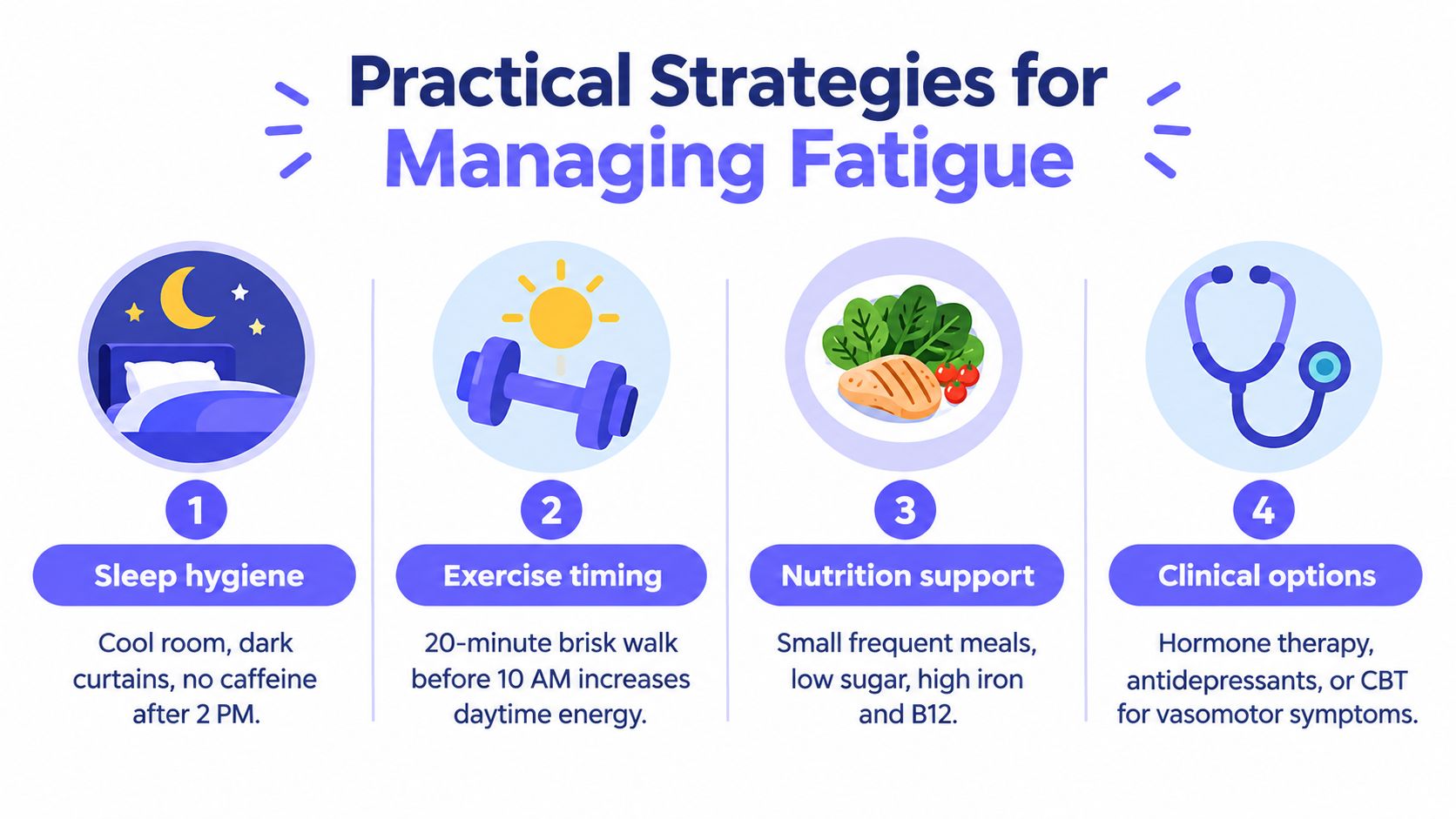
If sleep disruption is front and center, make the bedroom cooler, keep a regular sleep window, and talk with a clinician if snoring, gasping, or severe insomnia are part of the picture. Some women need treatment for vasomotor symptoms. Others need insomnia-specific care.
If heavy bleeding is draining you, don't assume that's something to tolerate. Ask about evaluation for blood loss and iron deficiency. Fatigue from depleted iron stores won't improve much from better bedtime habits alone.
If mood symptoms are running the show, support needs to address both energy and emotional health. Counseling, medication, stress reduction, and better sleep routines can all matter here.
If several causes overlap, combine approaches. That is common in midlife. A woman may have night sweats, low mood from chronic sleep loss, and heavy periods all at once.
A short explainer may also help if you'd rather hear this topic discussed out loud:
▶ PlayKeep your expectations realistic
Improvement is often uneven. Sleep may improve first. Daytime stamina may follow later. If your fatigue has been building for months or years, your body may need time to recover even after the trigger is finally treated.
The goal isn't to power through harder. It's to remove the things that keep draining you.
When to Seek Medical Evaluation
Some fatigue falls within the normal turbulence of perimenopause. Some deserves a closer look. The challenge is knowing the difference.
A useful rule is to seek evaluation when the fatigue becomes hard to explain, hard to function through, or hard to improve with sensible self-care. You don't need to wait until you're completely depleted.
Signs it's time to book an appointment
Consider getting medical help if any of these apply:
- Your fatigue is still intense long after your final period. Independent menopause coverage notes that fatigue can last five to eight years or longer if underlying drivers are untreated, and that the end of menstruation doesn't reliably mark the end of exhaustion, as discussed in this menopause fatigue overview.
- Sleep is repeatedly interrupted and basic sleep changes aren't helping.
- Bleeding is heavy enough that you suspect it may be affecting your energy.
- The pattern doesn't fit. You feel unusually breathless, persistently low, mentally foggy in a new way, or your fatigue has changed suddenly.
What to bring to the visit
A short symptom log is often more useful than trying to remember everything on the spot. Bring notes on:
| Bring this | Why it helps |
|---|---|
| Your fatigue pattern | Helps show whether exhaustion is daily, cyclical, or tied to nights |
| Sleep details | Helps distinguish insomnia, night sweats, or possible sleep apnea |
| Bleeding changes | Helps assess whether heavy periods may be contributing |
| Other symptoms | Helps your clinician think beyond menopause alone |
You can also be direct. Say that you understand menopause can contribute, but you want to rule out other causes if the pattern suggests them.
Don't minimize persistent exhaustion
If you're still exhausted a year after your final period, that doesn't automatically mean something is wrong. But it does mean the fatigue deserves a proper explanation. Sometimes the answer is ongoing vasomotor symptoms. Sometimes it is sleep apnea, iron deficiency, thyroid disease, mood symptoms, or a combination.
You are not overreacting by asking for a fuller evaluation. You're being practical.
If you want help making sense of changing energy, sleep, mood, and cycle patterns, Lila gives you one place to track them and see what may be driving your fatigue. That kind of day-to-day pattern recognition can make it much easier to decide whether you're dealing with a normal transition, a treatable trigger, or a reason to seek more medical support.
Get Lila, your personal coach for perimenopause.
Built for women in their 40s. 24/7 coaching, in your pocket.