
How to Adjust Sleep Schedule in Perimenopause
Learn how to adjust sleep schedule during perimenopause. Discover a phased circadian reset plan to manage hot flashes, night sweats, and fragmented sleep.
You go to bed exhausted, hoping tonight will be different. Then, sometime around 3 a.m., you wake up hot, alert, and irritated, with your mind already running through tomorrow's responsibilities. By morning, you're tired again, wondering whether you should force yourself into an earlier bedtime, sleep later, or abandon the schedule entirely.
Learning how to adjust your sleep schedule during perimenopause requires more than putting your phone away and drinking herbal tea. A changing internal clock can interact with hot flashes, mood changes, and repeated awakenings, so the most useful strategy is usually to anchor your wake time, shift gradually, and control the signals that tell your brain when day and night begin.
Table of Contents
- Why Perimenopause Disrupts Your Circadian Rhythm
- Executing a Phased Sleep Reset Action Plan
- Aligning Light Meals and Exercise with Your Body Clock
- Troubleshooting Night Sweats and Fragmented Sleep
- Sample Schedules for Different Lifestyle Goals
- Tracking Progress and Adapting with Lila
Why Perimenopause Disrupts Your Circadian Rhythm
A disrupted night can feel like a personal failure, but waking hot and anxious isn't evidence that you lack discipline. Perimenopause can affect both circadian timing, the body's internal day-night rhythm, and sleep maintenance, your ability to stay asleep after initially drifting off. Reviews of perimenopausal sleep describe hormonal changes that can alter circadian regulation and worsen fragmented sleep, particularly when vasomotor symptoms such as hot flashes and night sweats interrupt the night (Chronobiology in Medicine review).
That distinction matters. Generic sleep advice often focuses on falling asleep, so it recommends a quieter bedroom, fewer screens, and a relaxing bedtime routine. Those habits can help, but they won't fully solve a pattern in which you fall asleep normally and then wake repeatedly because your temperature regulation, stress response, or hormonal environment has changed. A useful overview of consistent bedtimes, wake times, and light exposure appears in this SouthShore Fine Linens sleep guide, but perimenopause often requires a more symptom-aware approach.
Why sleep maintenance becomes the battleground
Estrogen and progesterone fluctuate during the transition toward menopause. Those changes can influence thermoregulation, mood, and the timing signals that help your brain distinguish biological night from biological day. When a hot flash wakes you, your body may cool down quickly afterward, but your mind can remain activated by discomfort, worry, or the expectation of another awakening.
This is why a woman can follow a sensible bedtime routine and still wake at the same point in the night. The routine supports sleep onset, while the underlying disruption continues to interfere with staying asleep. If you want a deeper explanation of the connection between menopause and disrupted sleep, does menopause cause insomnia offers useful context.
Practical rule: Treat the wake time and the night awakenings as separate problems. A consistent morning signal can stabilize your clock, while symptom management helps protect the sleep you get after bedtime.
The goal isn't to create a perfect night immediately. It's to make your schedule predictable enough that your brain receives the same timing cues repeatedly, while you address the physical symptoms that keep breaking sleep apart.
Executing a Phased Sleep Reset Action Plan
Forcing bedtime earlier in one dramatic jump often creates a frustrating evening. You may get into bed at the desired time, but your circadian system hasn't yet produced enough sleepiness, so you lie awake and begin associating the new bedtime with effort and anxiety.
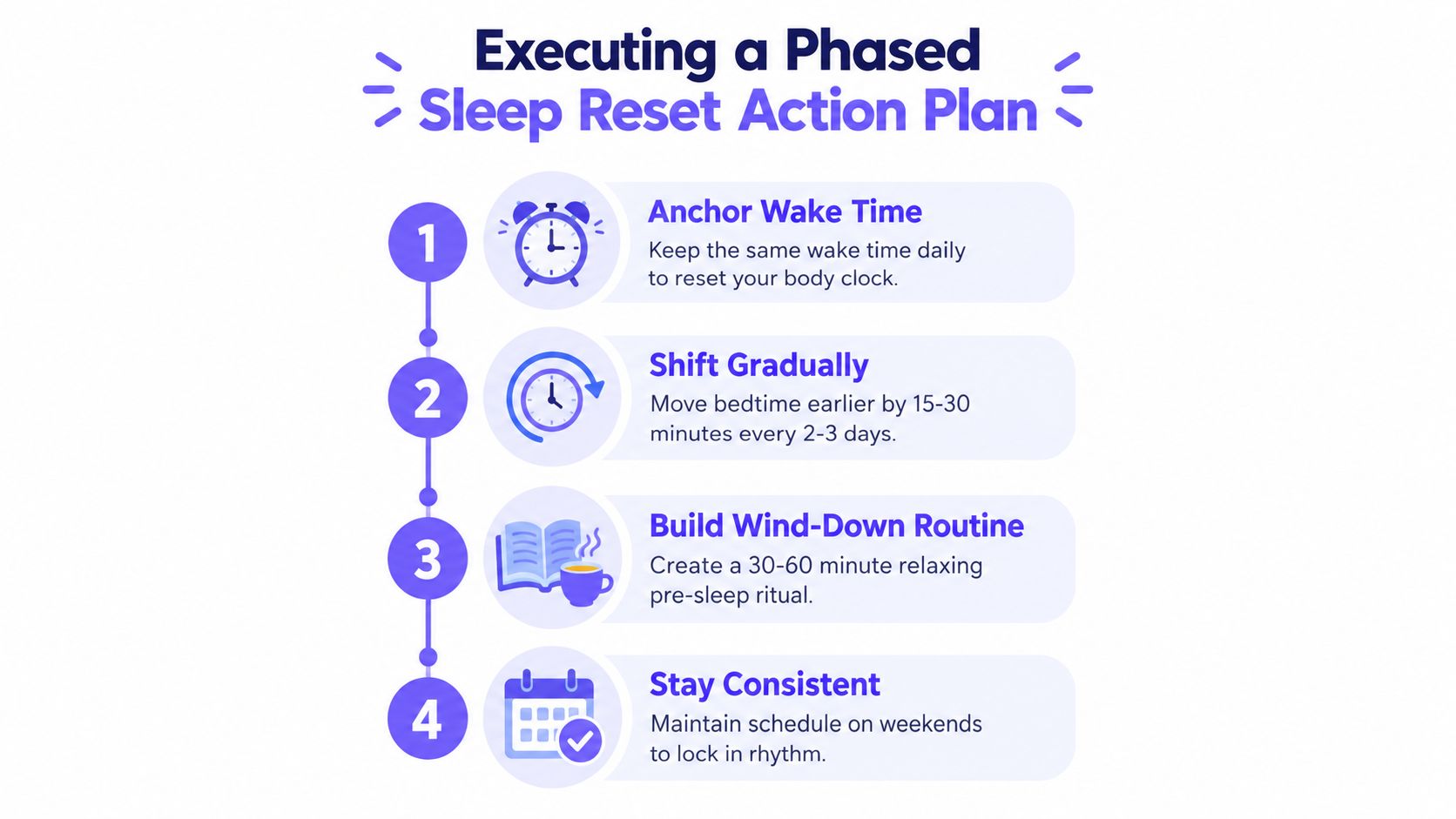
A gradual phase advance is more sustainable. Sleep guidance commonly recommends shifting bedtime and wake time in 15- to 30-minute steps, rather than making a large same-day change (Sleep Foundation guidance). A practical version is to move the schedule every two to three days, allowing your body to experience the new timing before changing it again.
Start with the wake time
Choose a wake time that fits your work, caregiving, and commute demands. Keep it the same every day, including weekends, as consistently as your circumstances allow. The morning wake signal is easier to control than sleep onset, and it gives you a reliable starting point for light exposure, breakfast, movement, and other timing cues.
If you currently wake at 7:30 a.m. and want to wake at 6:30 a.m., don't immediately move both bedtime and wake time by an hour. Begin by waking 15 to 30 minutes earlier, then hold that time for the next few days. Move the bedtime earlier by the same small amount only when you're beginning to feel sleepy at the new target.
Use this framework:
- Choose your anchor. Set the wake time you can maintain most days.
- Move in small increments. Shift bedtime earlier by 15 to 30 minutes every two to three days.
- Keep the morning fixed. Don't compensate for a poor night by sleeping late, unless safety requires recovery sleep.
- Repeat patiently. Continue until the target bedtime feels natural rather than forced.
A historical circadian review summarized by Sudotool's sleep schedule guide describes why aggressive advances can backfire. A one-hour-per-day advance was more effective than a two-hour-per-day jump, while the larger shift made nighttime sleep more difficult. The broader lesson is simple: your body clock responds better to repeated, manageable signals than to a single demand for immediate change.
Use melatonin cautiously
A clinically tested protocol used a three-day ramp involving an earlier wake time, bright light immediately after waking, and 0.5 mg of melatonin taken about five hours before the baseline bedtime on the first day, then progressively earlier on subsequent days. In that study, the combined protocol advanced circadian timing by nearly one hour per day and reduced misalignment (Journal of Clinical Endocrinology & Metabolism study).
That protocol is more intensive than the conservative plan sleepers should start with. Melatonin timing matters, products vary, and medication or health conditions can affect whether it's appropriate. Speak with a clinician or pharmacist before using it, especially if you take other medicines. If you're comparing melatonin with supplements, this resource on magnesium for sleep tonight can help you understand the distinction without treating either option as a substitute for schedule consistency.
For a practical wind-down structure, see this guide to a bedtime routine for better sleep. The routine should make the new bedtime easier, not become another demanding project.
Aligning Light Meals and Exercise with Your Body Clock
Once your wake time has a stable place in the day, your environment needs to reinforce it. Light is the strongest everyday timing cue, but meals and movement also help your body recognize when the active part of the day begins and when it should prepare for rest.
Make morning light your first signal
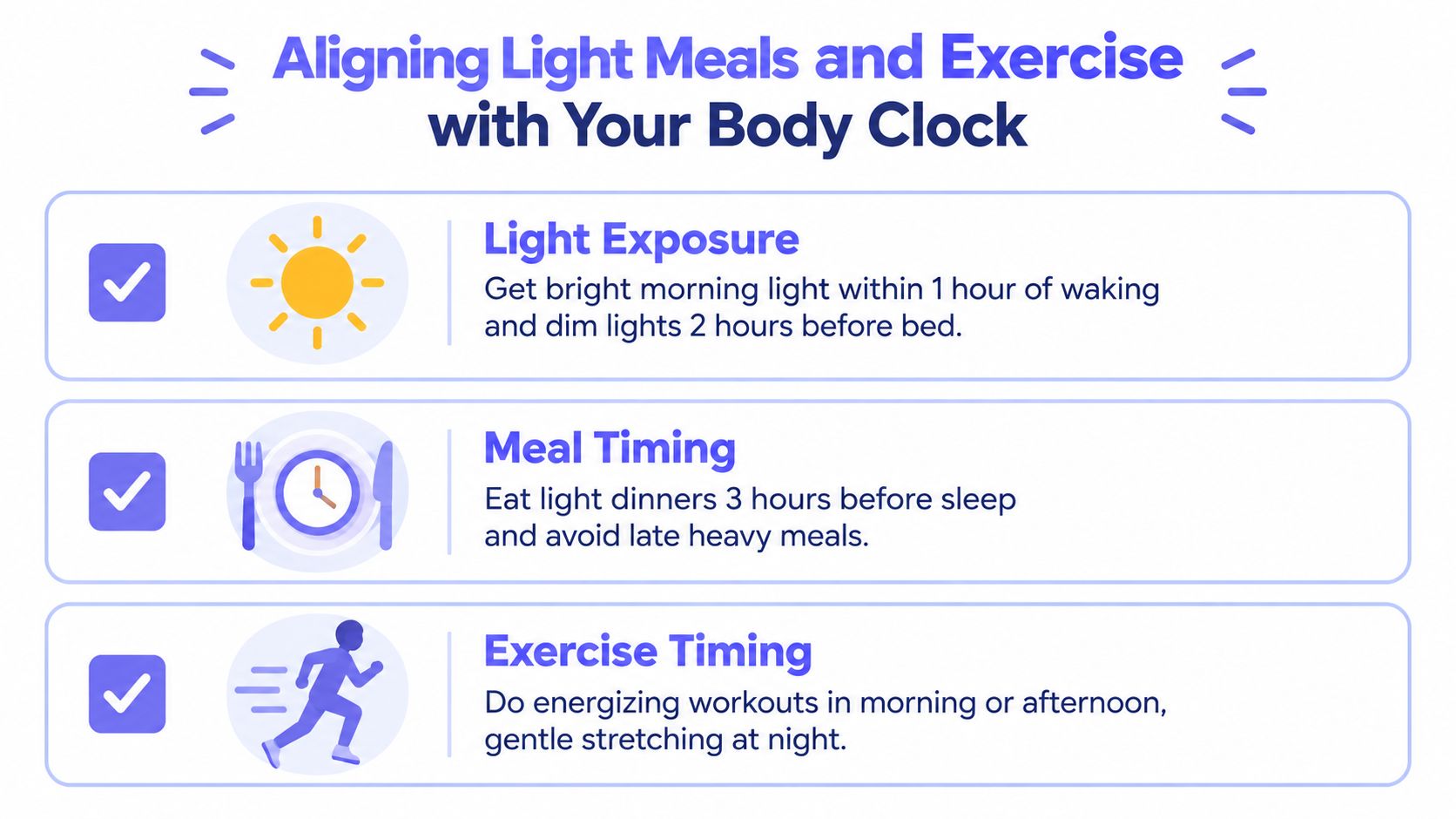
Get outdoor light soon after waking whenever possible. Open curtains, step outside with your coffee, or take a brief morning walk. If darkness, weather, mobility, or safety makes outdoor light difficult, ask a clinician whether a light-therapy device is suitable for you.
Morning light tells the brain that the biological day has begun. Evening brightness sends a different message, so lower household lighting as bedtime approaches and reduce bright screen exposure. The CDC recommends turning off electronic devices at least 30 minutes before bed and keeping the same sleep and wake schedule every day (CDC sleep guidance).
The timing of light matters more than getting “enough” light. Bright morning exposure supports an earlier rhythm, while strong light late at night can make it harder for your body to feel ready for sleep.
Let meals support the shift
Eat your first meal at a reasonably consistent point after waking, then place dinner early enough that digestion isn't competing with sleep. A lighter evening meal may feel more comfortable than a heavy one close to bedtime, especially if reflux, bloating, or night sweats already disturb your rest.
You don't need a rigid food timetable. The useful principle is to avoid turning late evening into a second dinner period. If hunger is genuine, choose something familiar and easy to digest rather than treating food as a reward for surviving another difficult day.
Schedule movement before your wind-down
Use energizing exercise in the morning or afternoon when possible. Walking, resistance training, cycling, or another activity that raises alertness can strengthen the contrast between your active day and your quieter evening.
Late, vigorous exercise doesn't disrupt everyone, but it can leave some people warm, alert, or physiologically activated near bedtime. Reserve evening movement for gentle stretching, mobility work, or a relaxed walk. For more detail on the relationship between movement and rest, explore the importance of fitness and sleep.
If you prefer a visual routine, the video below demonstrates how to connect everyday timing habits with sleep support.
▶ PlayTroubleshooting Night Sweats and Fragmented Sleep
A consistent schedule can't guarantee an uninterrupted night. That assumption causes unnecessary discouragement, particularly for women whose main obstacle is a hot flash rather than an inconsistent bedtime.
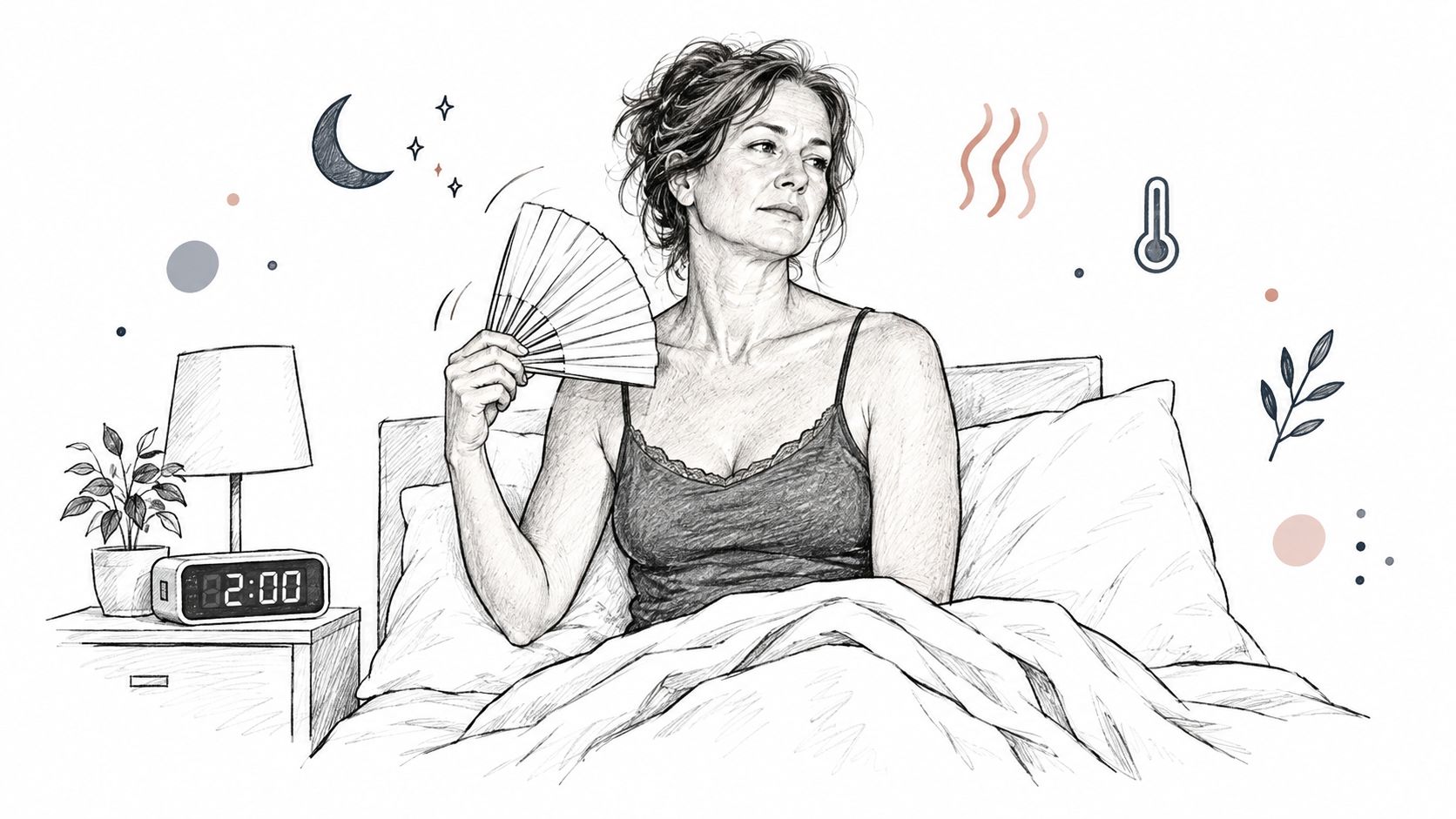
Your job is to reduce the disruption and return to your schedule, not to prevent every awakening through perfect behavior. Keep the bedroom comfortably cool, choose breathable sleepwear, and use bedding that can be removed or layered without a major disturbance. Place water, a fan, and a spare top within easy reach so you don't need to search through a dark room while overheated.
Make the awakening less stimulating
When a hot flash wakes you, avoid turning the episode into a full morning. Keep lights low, don't check the time repeatedly, and leave your phone out of reach. If you're awake and increasingly frustrated, sit somewhere dim and quiet until sleepiness returns, then go back to bed.
The goal isn't to force sleep. Pressure raises alertness, and clock-watching gives your mind a new problem to solve. A calm, repetitive response teaches your brain that an awakening is temporary rather than the beginning of an active period.
Protect the next morning
A difficult night doesn't automatically require a full schedule reset. Get up at your planned time if you can do so safely, use your normal morning light routine, and avoid moving bedtime dramatically earlier that evening. Sleeping late can reduce sleep pressure and make the following night more difficult.
Caregiving, illness, and work demands sometimes make the planned wake time impossible. In those cases, choose the least disruptive adjustment. Recover enough to function safely, then return to the anchor at the next realistic opportunity rather than shifting your entire routine in response to one night.
When symptoms need medical attention: Repeated night sweats, severe insomnia, loud snoring, gasping, breathlessness, or overwhelming daytime sleepiness deserve clinical evaluation. Schedule work with a healthcare professional rather than assuming every sleep problem is simply perimenopause.
Symptom-focused strategies can complement the schedule work. This guide on how to reduce hot flashes at night may help you identify additional cooling and nighttime adjustments. If hot flashes are frequent or newly severe, discuss treatment options with a qualified clinician.
Sample Schedules for Different Lifestyle Goals
A schedule should fit your life closely enough that you can repeat it. The right template depends on whether your priority is earlier productivity, flexibility around work and caregiving, or fewer disruptions from heat and night sweats.
The times below are examples, not prescriptions. Shift them to match your obligations while keeping the order of signals consistent.
| Schedule Profile | Morning Light Window | Caffeine Cut-Off | Last Meal Time |
|---|---|---|---|
| Early Riser | Soon after a 6:00 a.m. wake time | Early afternoon | Around 6:30 p.m. |
| Shift Worker or Caregiver | After the main waking period | Several hours before planned sleep | Several hours before planned sleep |
| Hot Flash Manager | Soon after the chosen wake time | Earlier in the day if sensitive | A lighter meal well before bed |
The early riser
Wake at 6:00 a.m., drink water, and get outdoor light soon afterward. Eat breakfast during the first part of your morning, schedule demanding work and exercise earlier in the day, and finish caffeine by early afternoon if it affects your sleep.
Aim for dinner around 6:30 p.m., then begin lowering household light during the evening. Start a quiet wind-down with reading, stretching, or a shower, and keep the bedroom cool before your planned bedtime.
This profile works well when morning commitments are fixed. Its trade-off is that an early bedtime can feel socially restrictive, so protect the schedule without treating occasional events as failure.
The shift worker or caregiver
Choose a primary sleep window based on when you can reliably protect several hours of rest. Wake at the same point relative to that sleep period when possible, expose yourself to bright light after waking, and keep meals aligned with your active period rather than eating heavily just before sleep.
If a child, partner, or work call interrupts the plan, return to the usual sequence at the next wake period. A flexible schedule still needs anchors. Without them, every late shift or caregiving demand can push the rhythm later.
The trade-off is that this profile may require more compromise. Aim for repeatable timing cues rather than an idealized bedtime that your household can't support.
The hot flash manager
Start by protecting the night environment. Wake at a consistent time, seek morning light, and place exercise earlier in the day. Choose breathable layers, prepare cooling supplies before bed, and finish dinner early enough to avoid going to bed uncomfortably full or warm.
Keep the evening routine deliberately quiet. If an awakening occurs, use the low-stimulation response described earlier, then resume the schedule the following morning.
This profile prioritizes sleep continuity and symptom recovery over an aggressive bedtime advance. If your bedtime is already reasonable but repeated heat-related awakenings dominate the night, changing the bedtime may be less useful than addressing temperature, treatment options, and the response to awakenings.
Tracking Progress and Adapting with Lila
Sleep improvement becomes easier to interpret when you track more than bedtime and wake time. Record whether you woke hot, how long you felt awake, your morning energy, mood, exercise, meal timing, and cycle-related changes. Patterns often become clearer when symptoms sit beside sleep data rather than in a separate notebook.
Use a simple daily check-in:
- Sleep timing: Note when you went to bed, when you woke, and whether the wake time stayed anchored.
- Night disruption: Record hot flashes, night sweats, anxiety, pain, or other reasons for waking.
- Daytime response: Track energy, mood, concentration, and exercise tolerance.
- Context: Add unusual meals, late light exposure, illness, travel, or caregiving demands.
An app can reduce the friction of keeping those observations together. Lila combines symptom, mood, sleep, energy, meal, and cycle tracking with a chat-based coach that provides ongoing guidance. Its symptom tracker can help you compare fragmented sleep with the symptoms and daily choices surrounding it.

Don't judge the plan by one night. Look for whether your wake time is becoming more predictable, whether returning to sleep feels easier, and whether certain evening patterns consistently precede hotter or more fragmented nights. If symptoms remain intense, bring your notes to a healthcare professional so treatment decisions reflect your actual experience.
Use Lila to track sleep timing alongside hot flashes, mood, energy, meals, and cycle changes, then use its personalized guidance to refine your daily plan. Visit Lila and start building a circadian routine that works with your perimenopausal symptoms, not against them.
Get Lila, your personal coach for perimenopause.
Built for women in their 40s. 24/7 coaching, in your pocket.