
Magnesium Night Sweats
Explore the evidence on magnesium night sweats. Learn about mechanisms, forms, dosing, and practical strategies to manage nighttime symptoms effectively.

You wake up in the middle of the night with damp hair, soaked sleepwear, and sheets that feel cold against your skin. You change clothes, open a window, and return to bed, only to wake again later. By morning, you may be asking the same question many other women ask: could magnesium help with night sweats, or is it only useful for sleep?
The answer depends on which problem you're trying to solve. Magnesium might support relaxation and sleep quality, but that isn't the same as treating the temperature surge that causes a hot flash or night sweat. Understanding the difference can help you choose a sensible experiment instead of expecting one supplement to solve every part of a disrupted night.
Table of Contents
- Why Night Sweats Keep You Awake
- How Magnesium Influences Temperature and Sleep
- Choosing the Right Magnesium Form
- What the Evidence Shows
- Safety, Interactions, and Realistic Expectations
- Building a Complete Night Sweat Strategy
- Tracking Progress with Lila
Why Night Sweats Keep You Awake
Night sweats aren't just “bad sleep.” Insomnia usually describes difficulty falling asleep, staying asleep, or returning to sleep after waking. Night sweats are a physical event that can interrupt sleep by making you overheated, damp, uncomfortable, and alert. You may then develop a second problem, difficulty sleeping after the sweating episode has passed.
For someone in perimenopause or menopause, the trigger may involve changing estrogen levels and the hypothalamus, the brain region involved in temperature regulation. Think of the hypothalamus as a thermostat with a comfort range. When that range becomes more sensitive, a small internal or external temperature change may prompt blood vessels near the skin to widen and sweating to begin, even when the room is not hot.
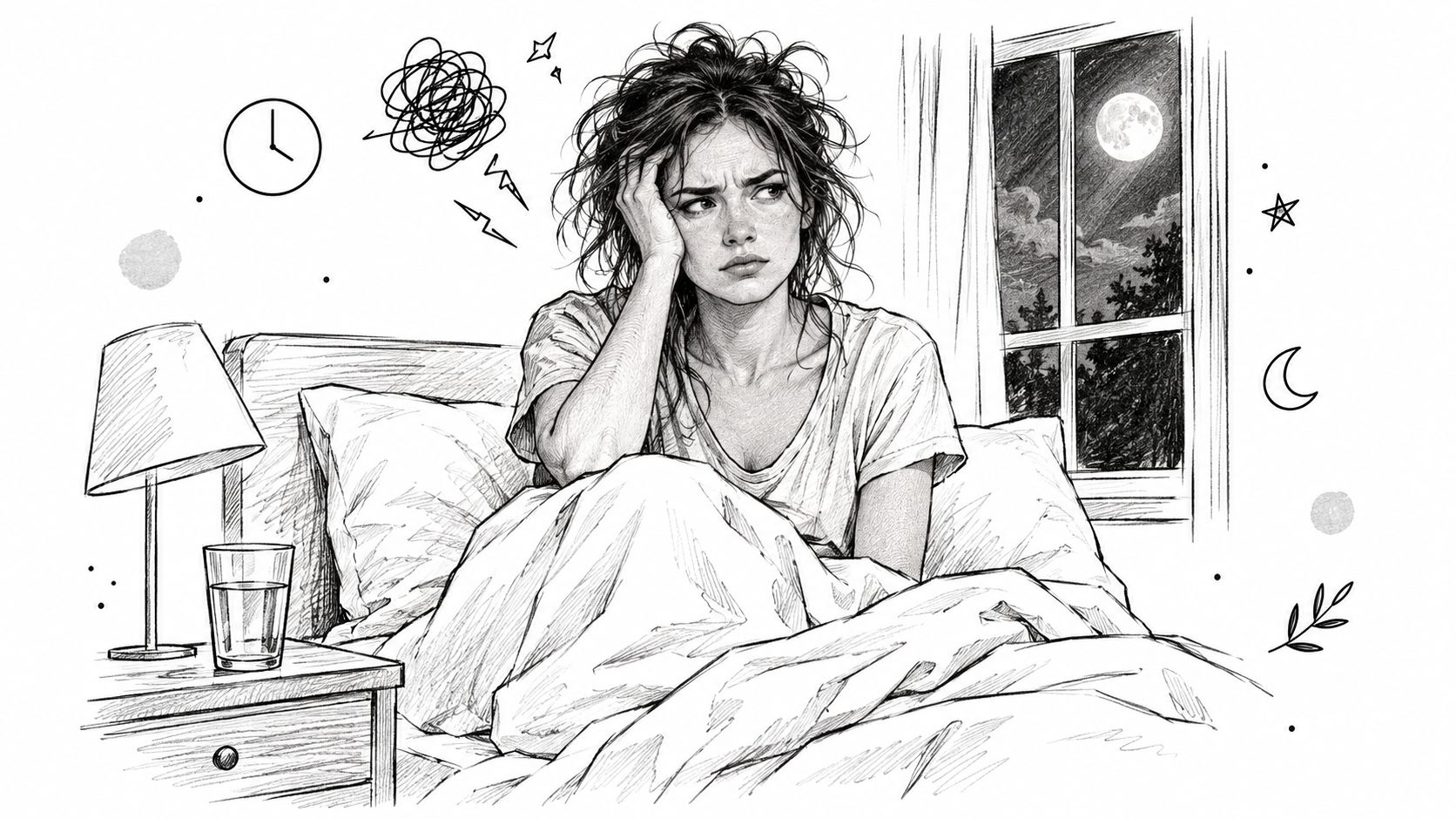
The symptom and the sleep problem are connected
Consider two different nights. On the first, you lie awake for an hour because your thoughts are racing, but your body stays comfortably cool. On the second, you fall asleep easily, then wake drenched and spend the rest of the night trying to cool down and get comfortable. Both nights produce fatigue, but they call for different strategies.
That distinction matters because magnesium may be more relevant to relaxation, sleep onset, or sleep maintenance than to the vasomotor event itself. If sweating is the main reason you wake, improving general sleep support may not remove the underlying trigger.
Repeated sweating can also create a frustrating cycle. You wake to change your clothes or bedding, become more alert, and then worry about whether the episode will happen again. A hot bedroom, heavy bedding, alcohol, caffeine, stress, or anxiety may add to the discomfort. Simple bedroom adjustments for better sleep can reduce the environmental burden, but they won't necessarily address hormonally driven temperature changes.
Why generic sleep advice can miss the mark
A consistent bedtime, dimmer evening light, and a calming routine can help someone who struggles to fall asleep. They don't directly stop a hot flash that begins after sleep. Likewise, magnesium might help you feel calmer at bedtime while leaving the frequency of sweating unchanged.
A practical guide to sleeping better during perimenopause can be useful when several symptoms overlap. The key is to identify what wakes you: difficulty becoming sleepy, repeated mental arousal, a physical sweat episode, or a combination.
Practical rule: Treat the symptom that starts the disruption, not only the fatigue that follows it.
Night sweats also have causes beyond menopause. Illness, medication effects, anxiety, a warm sleep environment, and other health conditions can produce nighttime sweating. If episodes are persistent, severe, or accompanied by other concerning symptoms, a clinician can help identify the cause before you begin treating them as a magnesium problem.
How Magnesium Influences Temperature and Sleep
You may take magnesium at night hoping to stop waking in damp sheets, then find that you fall asleep more comfortably while the sweating continues. That outcome makes sense once three separate goals are distinguished: falling asleep, staying asleep, and reducing vasomotor symptoms. Magnesium may affect the first two without reliably treating the third.
Magnesium supports nerve and muscle function throughout the body. Supplement marketing commonly presents it as a sleep aid, but that association rests on biological mechanisms rather than trials showing that it prevents night sweats. It can support conditions that make sleep easier without acting as an internal cooling system.
Magnesium supports inhibitory signaling, including GABA-related pathways, which can lower nervous-system activation before bed. It also contributes to normal muscle relaxation and nerve function. These effects may help someone settle when evening tension keeps the body alert. They do not establish magnesium as a direct treatment for sweating.
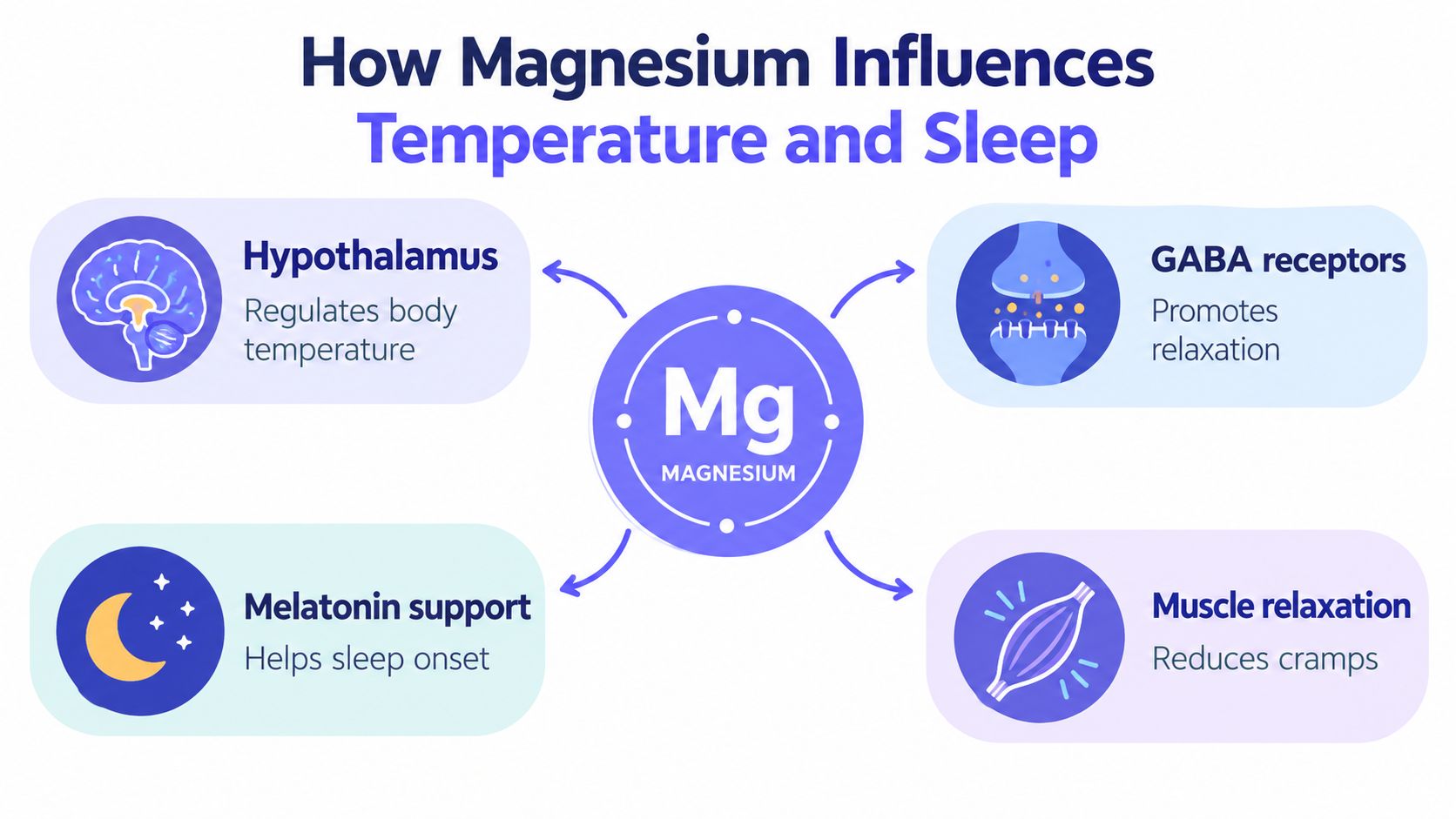
Three questions that shouldn't be combined
Can magnesium help you fall asleep? It may support relaxation for some people, particularly when nervous-system tension or inadequate magnesium intake contributes to difficulty settling. The available reasoning does not justify treating it as a guaranteed sleep-onset aid.
Can magnesium help you stay asleep? Possibly, depending on what causes the waking. Someone who wakes because of restlessness may find relaxation support useful. Someone awakened by a vasomotor episode may sleep more easily after returning to bed, while the supplement leaves the underlying sweat episode unchanged.
Can magnesium reduce hot flashes or night sweats? This requires clinical evidence, not only a plausible mechanism. Research has been mixed and has more often examined hot flashes than night sweats specifically. For a fuller picture of magnesium during the menopause transition, see this guide to magnesium for menopause relief.
Sweating also affects magnesium balance because the body loses some magnesium in sweat. A medical review describes daily losses and higher losses per liter of sweat in hot, humid conditions. Heavy sweating may therefore increase the relevance of magnesium status, but it does not show that replacing magnesium will stop the sweating.
Why temperature regulation remains uncertain
The hypothalamus coordinates temperature responses. Magnesium may support calmer nervous-system activity and a smoother transition into sleep, yet its presence does not override a menopause-related change in that system. It has not been established as a direct blocker of the blood-vessel widening and sweating involved in a vasomotor episode.
Environmental changes can still improve comfort. Learning how mattress cooling technology for hot sleepers works may help you choose a cooler sleep surface when sweating occurs. That adjustment addresses heat around the body, not the hormonal trigger inside it.
▶ PlayThe realistic expectation is indirect benefit. Magnesium may make relaxation easier, support sleep onset, or help you return to sleep after waking. It should not be presented as a proven temperature-control treatment.
Choosing the Right Magnesium Form
The label on a magnesium product tells you more than the word “magnesium.” Different forms pair the mineral with different compounds, which can affect tolerance and how the product is used. The most appropriate choice depends on your main goal, your digestion, your medications, and advice from a healthcare professional.
Magnesium oxide has been used in clinical research on hot flashes, but it can be harder on the digestive system and may loosen stools. Glycinate is often selected by people who want a gentler option for an evening routine. Citrate may be useful when constipation is also a concern, although its laxative effect can be unwelcome if your digestion is sensitive. Threonate receives attention for brain-related claims, but evidence that it treats night sweats directly is still lacking.
| Form | Absorption | Best For | Common Side Effects |
|---|---|---|---|
| Magnesium oxide | Often considered less well absorbed than several other forms | General supplementation when recommended, or products also intended to support bowel regularity | Diarrhea, abdominal discomfort |
| Magnesium glycinate | Generally chosen for its tolerability | People prioritizing an evening relaxation routine or who have digestive sensitivity | Possible digestive upset, individual intolerance |
| Magnesium citrate | Absorbed differently from oxide and commonly used in bowel-focused products | People who also need help with constipation | Loose stools, cramping |
| Magnesium threonate | Marketed for nervous-system and cognitive support | People discussing a brain-focused supplement approach with a clinician | Cost and digestive effects vary by product |
The table is a decision aid, not a ranking. No form has been proven to treat night sweats directly. A comparison of magnesium glycinate and citrate during menopause can help you think through form-specific tradeoffs, but your personal health history still matters more than marketing language.
A cautious way to test tolerance
Start with the product label and avoid combining multiple magnesium products without professional guidance. Taking more isn't automatically better, and higher oral amounts can produce gastrointestinal problems. The hot-flash trial data discussed later also used doses that shouldn't be copied casually.
Take notes on the form, timing, amount listed as elemental magnesium, bowel changes, sleep onset, nighttime awakenings, and sweating. If diarrhea appears, the product isn't a good fit at that amount. If you have kidney disease, take prescription medication, or are pregnant, ask a clinician or pharmacist before supplementing.
A useful decision framework is simple:
- Sleep onset: Focus on whether you feel calmer and fall asleep more easily.
- Sleep maintenance: Track awakenings and how quickly you return to sleep.
- Night sweats: Track sweating separately, because improved sleep doesn't prove fewer vasomotor episodes.
- Digestive sensitivity: Prioritize tolerability over a larger serving.
- Constipation: Citrate may have a different practical role, but it may also cause loose stools.
What the Evidence Shows
A small 2011 pilot phase II trial offers the clearest positive signal. It followed 25 women after breast cancer treatment who took magnesium oxide at 400 mg nightly for two weeks, increasing to 800 mg if needed. Average hot-flash frequency fell from 52.2 per week to 27.7 per week, a 41.4% reduction, while abnormal sweating severity fell by 49.2% (National Cancer Institute summary).
The result suggests a possible effect on vasomotor symptoms, but it does not establish magnesium as a dependable treatment for night sweats. The participants were a specific clinical population, the study was a pilot, and the symptoms included hot flashes and abnormal sweating rather than night sweats alone. A small positive study can point to a possibility without answering whether the same result applies broadly.
A later double-blind, placebo-controlled trial produced a different result. Postmenopausal women with a breast-cancer history received magnesium oxide at 800 mg per day and 1,200 mg per day. Hot-flash scores and frequencies were similar to placebo, and the authors concluded that the findings did not support magnesium oxide for hot flashes (PubMed trial report). The magnesium groups also reported more diarrhea and less constipation, showing how higher oral amounts can limit practical use.
For a closer look at the form often discussed for evening use, see this overview of magnesium glycinate benefits. The pilot used magnesium oxide, so its findings should not automatically be transferred to every magnesium product.
Why the findings differ
The studies varied in population, formulation, dose, symptom pattern, and design. Someone whose sleep is interrupted by evening tension may notice easier sleep onset, while someone experiencing intense vasomotor episodes may notice no change in sweating. Those are different outcomes, not contradictory experiences.
A clinical review of magnesium and hot flashes provides a closer account of the pilot study and supports a cautious conclusion: magnesium has been examined for vasomotor symptoms, but the overall evidence remains inconclusive.
Direct research on night sweats is the main gap. Existing discussions describe the evidence as limited or indirect, with more support for possible relaxation or sleep benefits than for reducing sweating itself (GoodRx overview of night sweats).
Magnesium may be reasonable as a sleep-support experiment. It is not an established treatment for menopause-related night sweats.
Track the outcome you want to change. Easier sleep onset, fewer awakenings, and fewer drenched awakenings answer separate questions, so improvement in one does not prove improvement in the others.
Safety, Interactions, and Realistic Expectations
Magnesium is a nutrient, but supplements can still cause problems. Larger oral amounts commonly upset the digestive system, leading to loose stools or diarrhea. The higher-dose trial described in the research section also showed that tolerance can limit continued use. Keep a short note of bowel changes beside your sleep and sweat log, so you can separate a supplement effect from unrelated symptoms.
Medication timing also matters. Magnesium can reduce the absorption of some antibiotics and bisphosphonates, so ask a pharmacist how much time to leave between them. Reduced kidney function calls for extra caution because the kidneys remove excess magnesium from the body. Seek medical advice before starting a supplement if you have kidney disease or take several medicines.
Could magnesium cause night sweats?
Night sweating is not an established common side effect of magnesium supplements, and current evidence does not prove that magnesium causes it. Timing can still make the connection seem clear. If sweating starts after you add a product, review other changes too, such as alcohol, caffeine, stress, bedroom temperature, medication, illness, or menstrual and menopausal symptoms.
Change one major variable at a time. Use the product as directed, record sleep onset, awakenings, sweat intensity, bowel changes, and next-day function, and stop if you develop significant digestive effects or other concerning symptoms. A clinician can help determine whether the timing suggests a reaction or coincidence.
Don't copy research doses casually
Amounts used in clinical studies belonged to specific research protocols. They are not universal instructions for supplements. Follow the label and ask a healthcare professional whether magnesium is appropriate for you, especially before increasing the amount or combining different forms.
Set realistic expectations. Magnesium may support sleep onset for some people, while sleep maintenance and vasomotor symptoms, such as heat episodes and sweating, are separate questions. An easier time falling asleep does not show that the supplement will prevent awakenings or reduce night sweats.
If sweating remains severe, worsens, or occurs with fever, unexplained weight loss, swollen lymph nodes, or unusual fatigue, seek medical evaluation instead of increasing magnesium.
Building a Complete Night Sweat Strategy
Magnesium works best as one part of a night-sweat plan, not as the entire solution. First reduce the physical disruption, then assess three separate questions: does magnesium help you fall asleep, stay asleep, or reduce heat episodes and sweating? These outcomes overlap, but improvement in one does not prove improvement in the others. Breathable sleepwear, lighter bedding, airflow, and dry clothes beside the bed can make an episode easier to manage.
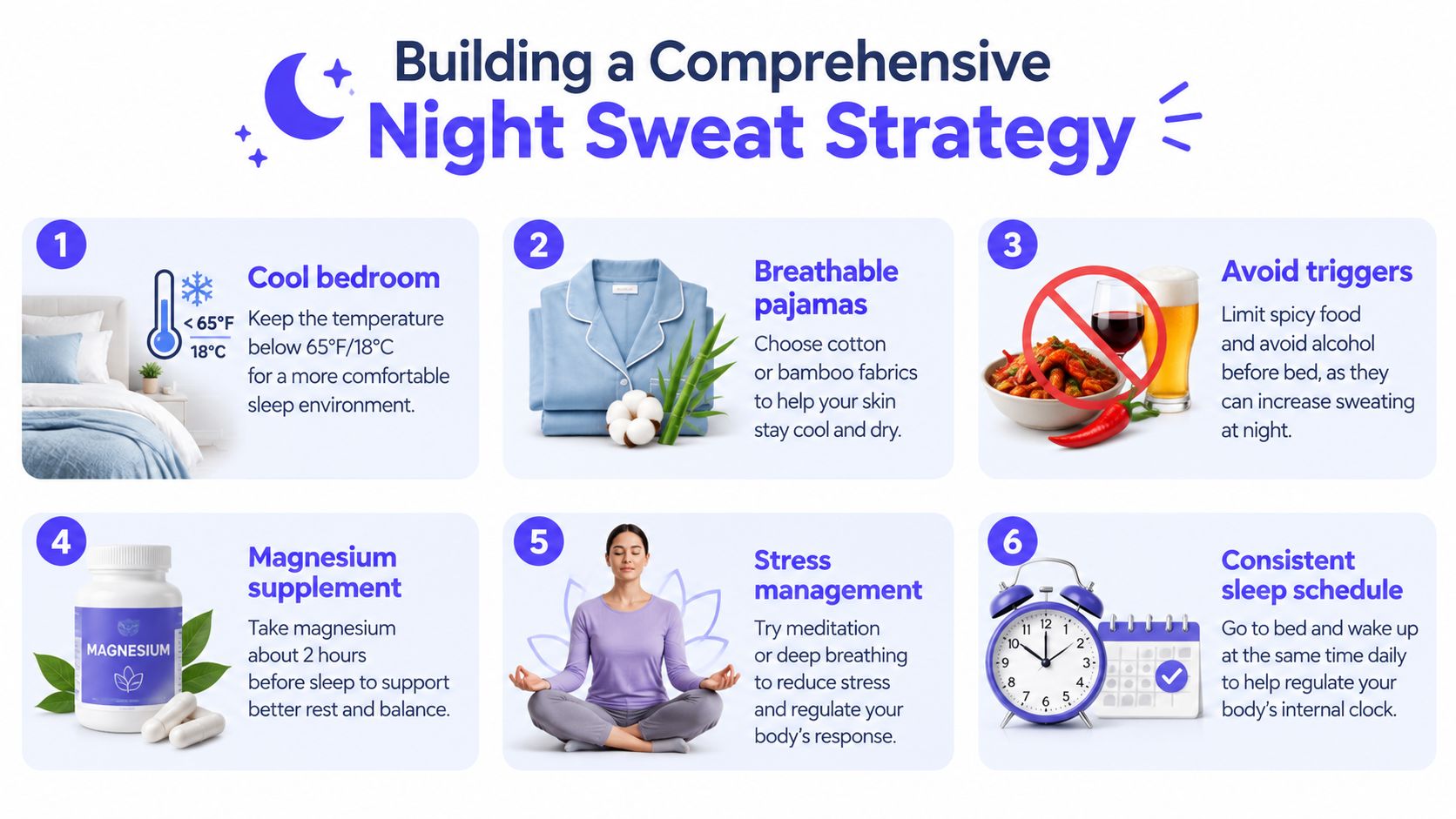
Build the routine around your triggers
Alcohol, caffeine, spicy food, stress, and a warm bedroom can all become part of the pattern. Change one factor at a time so the result is easier to interpret. Slow breathing or meditation may also help if tension keeps you alert after sweating wakes you.
A practical evening plan might look like this:
- Cool the room and bed. Use airflow and bedding that release heat and moisture.
- Choose breathable layers. Keep spare sleepwear within reach for a quick change.
- Review evening triggers. Record alcohol, caffeine, heavy meals, spicy foods, and stress.
- Use magnesium only if appropriate. Treat it as a monitored sleep-support trial, not a guaranteed treatment for sweating.
- Protect the sleep schedule. Keep bedtime and wake time reasonably consistent.
- Escalate when needed. Persistent or unusual night sweats require clinical assessment.
Sleep disruption can also have physical contributors, including breathing problems or jaw tension. Resources such as tongue tie therapy solutions explain why airway and structural factors may deserve attention when sleep remains poor. This does not make the resource a treatment for menopause-related sweating. It shows why a supplement may address only one piece of the problem.
If vasomotor symptoms are the main concern, ask a healthcare professional about treatments designed for heat episodes and sweating. Magnesium may support sleep onset for some people, while sleep maintenance and temperature symptoms require separate evaluation.
Tracking Progress with Lila
Track the symptom that matters most. Each morning, record whether you woke sweating, how intense the episode was, how long it took to return to sleep, your overall sleep quality, next-day energy, evening stress, food and drink triggers, and whether you took magnesium. Looking at patterns over time is more useful than judging one difficult night.
A symptom diary or perimenopause symptom-tracking routine can help separate sleep-onset changes from sleep-maintenance changes and sweating changes. Lila can bring symptoms, mood, sleep, energy, meals, and cycles into one tracking system, with a chat-based coach for personalized guidance. Use the record to decide whether to continue, adjust, or discuss another approach with a clinician.

Lila offers daily symptom check-ins, personalized action planning, and tracking for sleep, sweating, mood, energy, meals, and cycles. If you're testing magnesium as part of a broader night-sweat strategy, Lila can help you spot patterns and choose your next step with clearer information.
Get Lila, your personal coach for perimenopause.
Built for women in their 40s. 24/7 coaching, in your pocket.