Menopause Hot Flashes Relief: A Practical 2026 Guide
Find real menopause hot flashes relief with this practical 2026 guide. Learn lifestyle, medication, and tracking strategies that actually work for women 40+.
You're halfway through a work meeting when heat rushes up your neck, your face flushes, and sweat gathers under your collar. You try to keep talking while calculating whether anyone else has noticed. By bedtime, the same problem wakes you again, leaving you tired, irritable, and unsure whether you should change your routine, ask about hormones, or just endure it.
Menopause hot flashes relief shouldn't be measured only by counting episodes. The useful question is whether you're sleeping better, functioning at work, feeling less anxious, and recovering faster when a flash happens. The right plan combines tracking, practical comfort measures, behavioral tools, and medical treatment when symptoms are moderate, severe, or persistent.
Table of Contents
- What Hot Flashes Actually Are and Why Relief Is Personal
- The Five Most Useful Lifestyle Changes You Can Start This Week
- Medical Options from Hormone Therapy to Non-Hormonal Prescriptions
- Choosing the Right Path for Your Body and Health History
- Tracking What Works So You Are Not Guessing
- Common Mistakes That Keep Women Stuck and a 30-Day Action Plan
- When to See a Clinician and Questions Worth Asking
What Hot Flashes Actually Are and Why Relief Is Personal
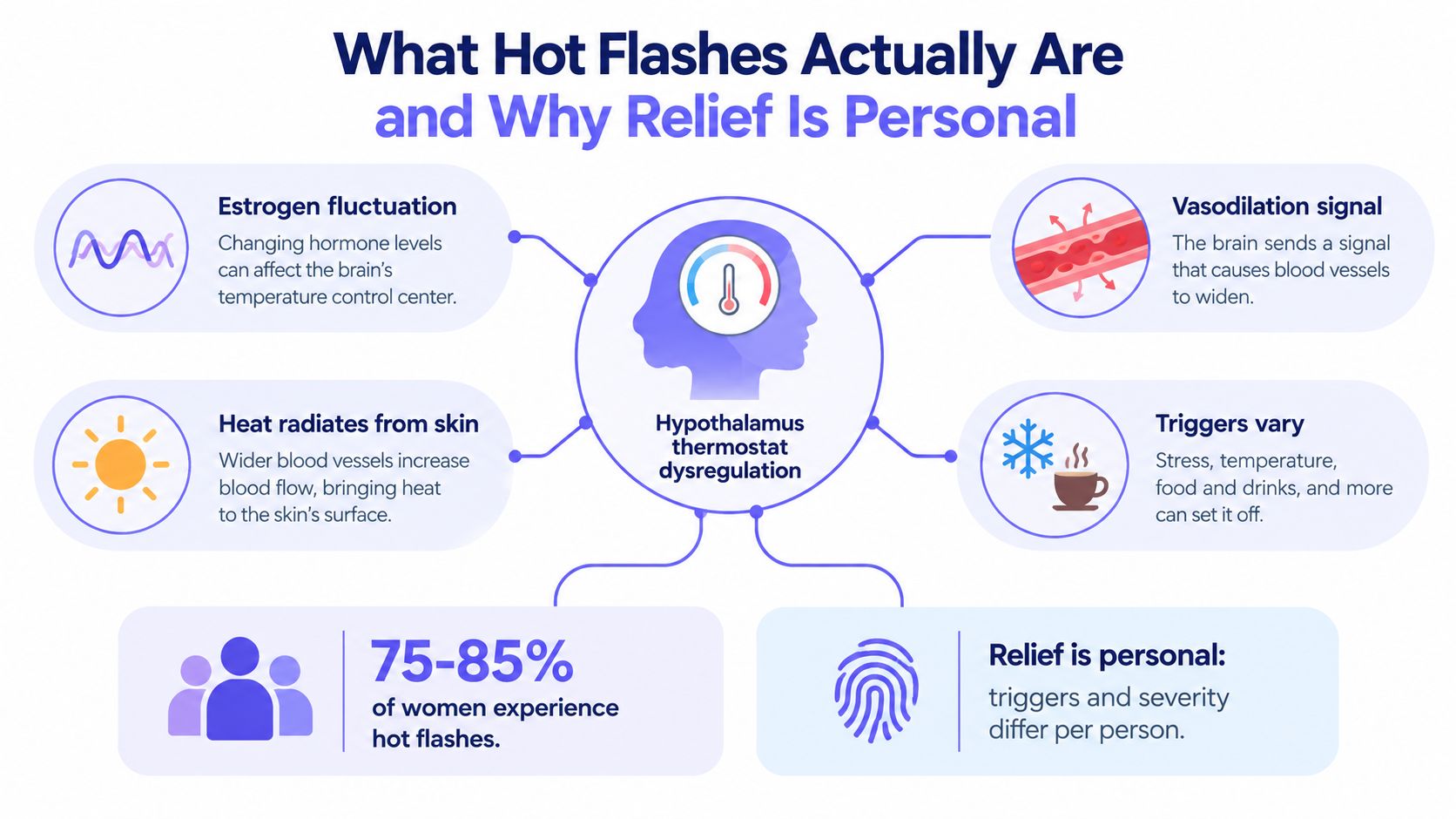
A hot flash begins in the brain, not in the skin. The hypothalamus acts as the body's temperature-control center. As estrogen fluctuates during perimenopause and menopause, the hypothalamus can become unusually sensitive to small changes in body temperature. It then sends signals that widen blood vessels near the skin and activate sweating, creating the sudden wave of heat, flushing, and perspiration many women recognize.
Hot flashes are among the most common menopause symptoms globally. Reviews estimate that they affect about 75% to 85% of women, while a clinical review estimates that 60% to 80% of menopausal women experience bothersome vasomotor symptoms within the first seven years after onset (clinical review of menopause hot flashes). That combination of frequency and persistence matters. You're not failing to cope with an unusual symptom, and you don't have to wait passively for it to disappear.
Count less, measure function more
Relief has two parts:
- Frequency: How often do flashes occur during the day or night?
- Bothersomeness: How much do they interrupt sleep, concentration, confidence, mood, or daily plans?
Those measures can move separately. Mindfulness-based approaches, for example, may make flashes feel less distressing and improve sleep, stress, anxiety, and quality of life without changing their intensity, according to NCCIH's menopause symptom guidance. A lower episode count is useful, but it isn't the whole outcome.
Your triggers may also be different from your sister's or colleague's. Alcohol, caffeine, stress, warm rooms, poor sleep, tight clothing, and certain foods can worsen symptoms for some women and do nothing for others. That's why a personalized record is more useful than a universal prohibition list. Start with the practical explanation in why menopause causes hot flashes, then test your own patterns rather than assuming every trigger applies to you.
The Five Most Useful Lifestyle Changes You Can Start This Week
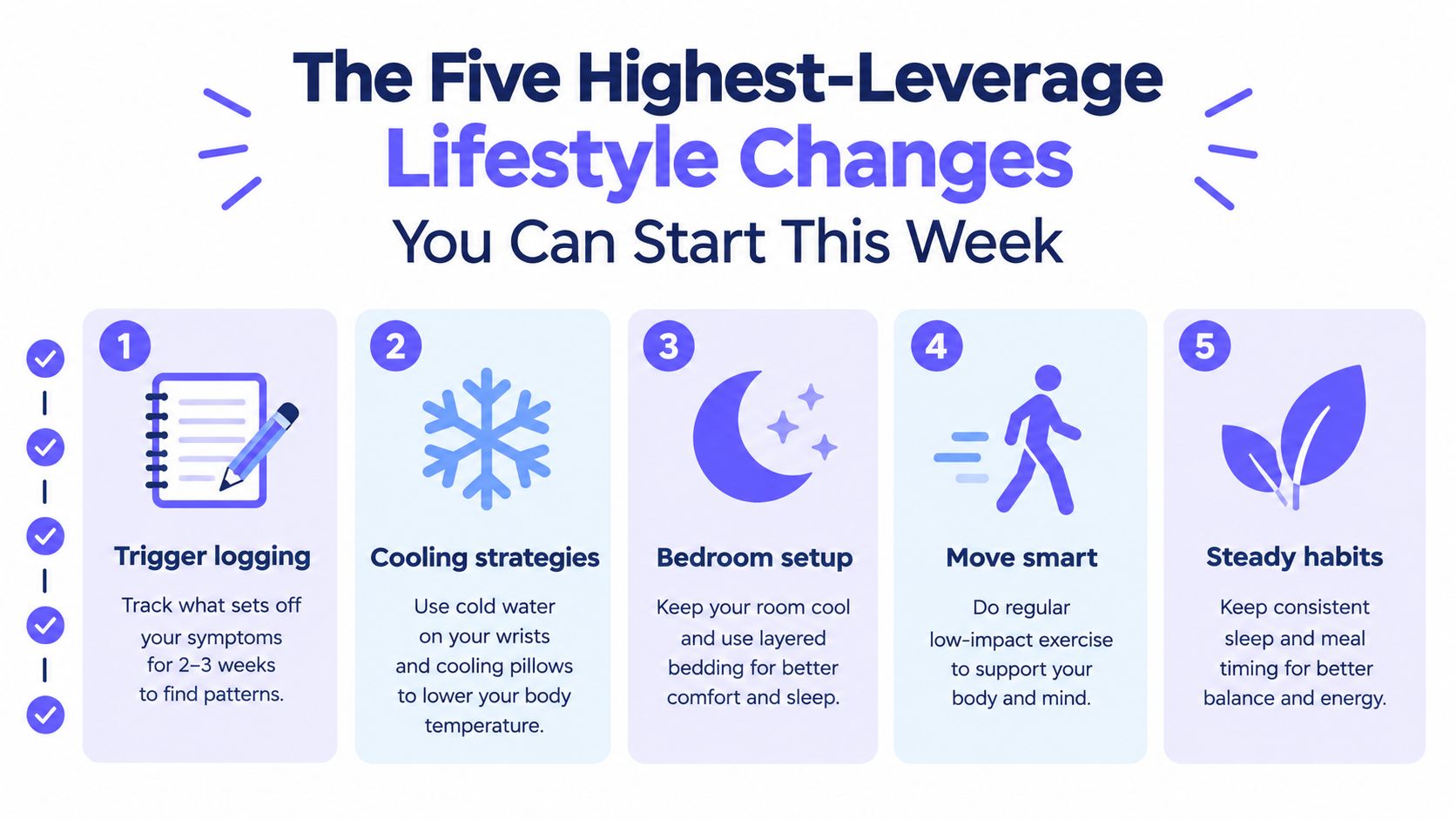
Lifestyle changes can make hot flashes less disruptive, especially when you target comfort, recovery, and sleep. Cooling tools, breathable clothing, trigger testing, and sleep protection are sensible first steps. They are not reliable replacements for medical treatment when symptoms are seriously affecting your life.
1. Log before you eliminate
Track symptoms for two to three weeks before making sweeping changes. In an app such as Lila, record the time, setting, food and drink beforehand, stress level, sleep quality, and whether the flash interrupted your activity. This baseline keeps you from blaming the last thing you ate.
Record both episode count and a one-to-ten bothersomeness score. A brief flash during a quiet evening is different from one that wakes you, soaks your clothes, or derails a presentation. Review the app after several days and prioritize changes that improve function, not just the number of episodes.
2. Build a cooling response
Keep cold water nearby, place a fan near your desk or bed, and cool your wrists or the back of your neck during an episode. Cooling pillows and breathable bedding can improve comfort even when they do not change flash frequency.
Measure the minutes until you can return to normal activity, then enter that recovery time in Lila. A faster return to work, conversation, or sleep is meaningful progress. For more practical ideas, read this guide to manage menopause hot flashes naturally.
3. Dress for adjustment, not appearance
Choose breathable layers that you can remove quickly. Natural or moisture-managing fabrics, open collars, and a spare top at work can reduce the panic that intensifies a flash. Keep an extra layer beside the bed instead of using heavy bedding that traps heat.
Log whether a clothing change lowers your bothersomeness score or shortens your cooling time. If the score stays the same, change the strategy rather than adding more clothing rules.
4. Practice paced breathing
During a flash, slow your breathing instead of bracing against the heat. Try roughly six to eight breaths per minute, with a gentle inhale and a longer, relaxed exhale. This does not correct estrogen fluctuation, but it can reduce the stress response that makes the episode feel more alarming.
Use Lila to record distress, heart-racing sensations, and whether you return to sleep more easily after breathing practice. Judge this method by those outcomes. It is a behavioral tool, not a promise that every flash will stop.
5. Protect sleep aggressively
Night sweats need their own plan. Keep the room cool, use layered bedding, make damp-clothing changes easy, and protect a consistent wind-down routine. If a particular food or drink repeatedly precedes a difficult night, test removing that item instead of eliminating everything at once. This guide to foods that may trigger hot flashes can help you choose candidates without turning meals into guesswork.
Record sleep quality, night wakings, and next-day energy in the app. If flashes continue but you stop losing sleep, count that as real relief. If lifestyle changes improve recovery but not sleep or daily function, discuss hormonal or non-hormonal treatment with a clinician rather than treating persistence as a personal failure.
▶ PlayCooling tactics and steady routines are useful starting points. They should support your care plan, not determine whether you deserve prescription treatment.
Medical Options from Hormone Therapy to Non-Hormonal Prescriptions
For healthy women near menopause without contraindications, menopausal hormone therapy is the most effective established treatment for vasomotor symptoms. Randomized trials summarized in a BMJ review reported that oral conjugated equine estrogen and transdermal estradiol reduced hot flashes by 70% to 95% (BMJ review of menopause treatment). The usual clinical principle is to start with a low dose and increase only when needed, rather than assuming more medication is automatically better.
Women without a uterus generally use estrogen alone. Women with a uterus usually need estrogen plus a progestogen to reduce the risk of endometrial hyperplasia. Hormone therapy isn't appropriate for everyone, particularly people with relevant histories such as breast cancer, stroke, venous thromboembolism, coronary artery disease, active liver disease, unexplained vaginal bleeding, or thrombophilic disorders. A clinician should review those risks before treatment (clinical guidance on hormone therapy).
Hot flash medications compared
| Treatment | Typical efficacy | Time to effect | Best for | Key caveats |
|---|---|---|---|---|
| Menopausal hormone therapy | 70% to 95% reduction in trials | Often assessed during early follow-up | Strong relief for appropriate candidates | Requires review of cancer, clotting, cardiovascular, liver, and bleeding history |
| SSRIs and SNRIs | SSRIs and venlafaxine produced an absolute reduction of 19% to 60% versus placebo in an older review | Usually assessed after initiation and titration | People who cannot or don't want hormones, especially with mood symptoms | Nausea, sleep changes, sexual side effects, and interactions can occur |
| Gabapentin | Reduced frequency by 54% and composite scores by 31% to 51% versus placebo in randomized trials | Dose is commonly adjusted gradually | Night symptoms or people who may benefit from a sedating option | Drowsiness, dizziness, and balance problems can occur |
| Fezolinetant | Evidence-supported nonhormonal option | Follow the prescribing plan and review response | People seeking a nonhormonal, neurokinin-targeted treatment | Requires clinician review, including medication and liver considerations |
| Clonidine | Reduced hot flashes by 15% to 20% in an older review | Assessed after starting treatment | Selected patients who may tolerate its profile | Dizziness, dry mouth, and blood-pressure effects can limit use |
The North American Menopause Society lists cognitive behavioral therapy, clinical hypnosis, SSRIs, SNRIs, gabapentin, and fezolinetant among evidence-based nonhormonal options. Oxybutynin also appears in evidence-supported guidance. These treatments generally offer less powerful relief than estrogen, but that doesn't make them second-rate when hormones are unsuitable or unwanted.
Don't spend heavily on a supplement just because it's marketed as “natural.” Evidence for products such as black cohosh and evening primrose is weak or inconsistent, and supplements can interact with medicines. If you're comparing menopause care with broader wellness services, a longevity treatments overview may provide context, but it shouldn't replace a menopause-focused medication discussion. For a plain-language explanation of the hormonal route, read what hormone therapy for menopause involves.
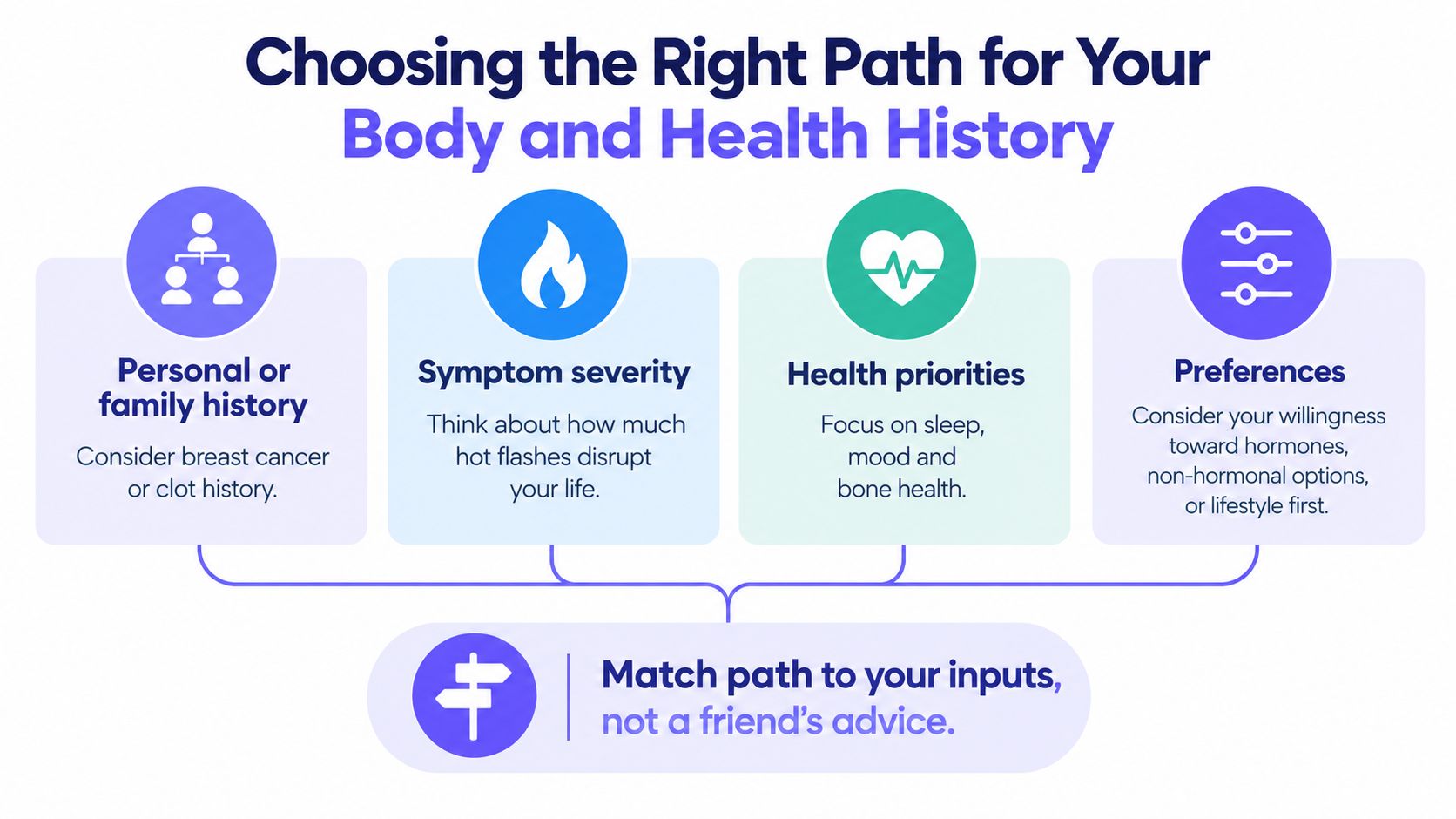
Choosing the Right Path for Your Body and Health History
Don't choose treatment because a friend swears by it. Choose it by matching the treatment's strengths and risks to your history, symptom pattern, and priorities.
Start with four decision inputs
First, review your personal and family history. A personal history of breast or another estrogen-sensitive cancer, clotting problems, stroke, heart disease, liver disease, or unexplained bleeding can change whether systemic estrogen is appropriate. Family history matters too, but it isn't the same as personal history. Ask a clinician to interpret both rather than making the decision from an online checklist.
Second, consider where you are in the menopause transition. Women who are near menopause and have no contraindications often discuss hormone therapy because it provides the strongest established relief. If you're further from your final period, or your medical history is complex, the balance may shift toward nonhormonal medication or behavioral treatment.
Third, identify the symptom doing the most damage. If night sweats are destroying sleep, discuss options that address nighttime symptoms directly. If anxiety or low mood rises alongside hot flashes, an SSRI or SNRI may address more than one problem. If you mainly need to feel calmer during episodes, cognitive behavioral therapy, paced breathing, or clinical hypnosis may be useful additions.
Fourth, state your preferences clearly. You're allowed to want hormones, avoid hormones, start with behavioral tools, or combine approaches. The decision should reflect your priorities, not a culture-war argument about menopause care.
Schedule a clinical assessment promptly for sudden severe headaches with visual flashes, chest pain, a marked blood-pressure concern, unexplained weight loss, or hot flashes beginning before age 40. Bring three questions: What is most likely causing my symptoms? Which treatment gives me the best benefit-risk balance? How will we measure whether it's working?
A symptom record can make that appointment more productive. The menopause test and symptom guide can also help you organize what you've noticed, but no home tool can replace an evaluation when symptoms are unusual or severe.
Tracking What Works So You Are Not Guessing
Tracking isn't busywork. It's how you distinguish a treatment that improves your life from one that merely produces a smaller number on paper.
Record these items each day:
- Bothersomeness: Rate the worst flash on a one-to-ten scale.
- Frequency: Note daytime episodes and night sweats separately.
- Sleep: Record sleep quality and the number of times you woke.
- Mood and energy: Use a simple consistent rating.
- Context: Add food, alcohol, caffeine, stress, room temperature, and exercise when relevant.
- Interventions: Record what you tried, including prescribed medication and dose.
An app such as Lila can centralize symptoms, mood, sleep, energy, meals, and cycles, then provide a daily check-in and personalized action plan. Review the pattern weekly instead of reacting to one bad night. You may discover that a change improves recovery time before it changes frequency, or that a recurring food, drink, stressful event, or warm environment predicts a difficult night.

A useful two-week pattern
Suppose your log shows that flashes remain frequent, but your average bothersomeness falls after paced breathing. You also notice that night wakings cluster after alcohol and that your next-day mood is worse when sleep is interrupted. That gives you a much stronger clinical conversation than “I think it's getting worse.”
Bring the record to your appointment and ask whether the priority should be reducing episodes, protecting sleep, improving mood, or combining those goals. Use the practical approach in how to track perimenopause symptoms to keep the record consistent.
Common Mistakes That Keep Women Stuck and a 30-Day Action Plan
Waiting it out is not a treatment plan. Hot flashes can remain bothersome for years, and persistent sleep disruption can affect concentration, mood, work, and relationships. You deserve an approach that produces evidence about what helps.
Four habits that delay progress
- Underdosing or abandoning the plan too quickly: Hormone therapy should be individualized and titrated with a clinician. Nonhormonal medicines may also need gradual adjustment for tolerability, so don't change the dose or stop abruptly without advice.
- Quitting before you can judge the treatment: Early side effects may not represent the final balance, while some benefits require an adequate trial. Ask your prescriber when to review the response.
- Chasing daytime counts while ignoring sleep: Seven daytime flashes with repeated night waking may be more damaging than a higher count that doesn't interrupt sleep. Track function, not just frequency.
- Changing everything at once: If you start several supplements, eliminate multiple foods, change exercise, and begin a prescription simultaneously, you won't know what helped or caused a problem.
A focused 30-day plan
Week one, establish your baseline. Record frequency, bothersomeness, sleep, mood, likely triggers, and current interventions. Don't overhaul your routine yet.
Week two, test your top three suspected triggers. Change one meaningful variable at a time where possible, and record whether the result affects frequency, recovery, or sleep.
Week three, add one behavioral technique. Use paced breathing during episodes or a structured wind-down routine at night. Measure bothersomeness and night wakings, not just the number of flashes.
Week four, review the pattern and decide whether to escalate. If symptoms remain disruptive, take your record to a clinician and discuss hormone therapy, nonhormonal medication, or a combined approach. Keep the data in one place so you can see whether the plan is improving the life you're trying to get back.
When to See a Clinician and Questions Worth Asking
Book an appointment instead of self-managing when hot flashes begin before age 40, persist into later life, escalate suddenly, or repeatedly disrupt sleep. Chest pain, palpitations that feel concerning, unexplained weight loss, or any bleeding after menopause also deserve medical attention. Night sweats that repeatedly break your sleep are enough reason to seek help, even if you don't have another warning sign.
A menopause-literate clinician should be willing to discuss:
- Which evaluation or baseline tests are appropriate for my symptoms and history?
- Am I a candidate for menopausal hormone therapy given my personal and family history?
- If hormones are suitable, which dose and delivery route make sense?
- When should we assess whether the treatment is reducing my symptoms?
- Which nonhormonal options fit if hormones aren't appropriate or I don't want them?
- What should I do if breakthrough flashes continue?
- When should we review the plan, and what symptoms should prompt an earlier visit?
Bring specific observations, not a vague account of a difficult month. Export your symptom data from your tracking app during the 48 hours before the appointment, then highlight the worst sleep nights, the highest bothersomeness ratings, and any repeated trigger pattern. Real records help you and your clinician decide whether the next step should be a medication change, a behavioral intervention, or a broader evaluation.
Use Lila to record hot flashes, bothersomeness, sleep, mood, meals, and daily habits in one place while following a personalized action plan. Start tracking today, review your patterns weekly, and take that evidence into a focused conversation with your clinician.
Get Lila, your personal coach for perimenopause.
Built for women in their 40s. 24/7 coaching, in your pocket.