
Menopause Sleep Aid Guide: 4 Weeks to Better Nights
Tossing at 3 a.m.? This menopause sleep aid guide compares CBT-I, supplements and HRT, with a 4-week plan and red flags for when to see a doctor.
Cognitive behavioral therapy for insomnia is the best-evidenced menopause sleep aid: mean insomnia severity improved by 9.9 points with telephone CBT-I versus 4.7 points with menopause education, and 70% of women reached the no-insomnia range by week 8. The two moves most articles skip are a short trial of magnesium glycinate for restless, light sleep and a real screen for sleep apnea before any sedating antihistamine.
You already own the purple PM bottle. You still wake wired, the next day feels borrowed, and another “natural” capsule is not a plan. A menopause sleep aid works only when it matches the mechanism. Hot flashes, a brain trained to stay alert in bed, and obstructed breathing can all look like ordinary insomnia, and each one needs a different fix.
Table of Contents
- Why Menopause Disrupts Sleep
- Menopause Sleep Aids Compared
- Red Flags That Need a Doctor
- Your Four-Week Sleep Reset Plan
- Daily Timing and Sleep Hygiene Fixes
- Supplements Worth Trying and When to Take Them
- Track Your Progress and Start Tonight
Why Menopause Disrupts Sleep
It's 3 a.m. The alarm is still hours away, the sheet under your back is damp, and your mind is already writing tomorrow's list. That night is common enough to count. A 2023 systematic review and meta-analysis of 41 studies found that 51.6% of postmenopausal women experienced a sleep disorder (95% confidence interval 44.6%–58.5%), per the PMC review of midlife sleep. Insomnia affected 37.6% of perimenopausal women in that review.
The shortfall starts before the last period. Those U.S. figures show 56.0% of perimenopausal women slept fewer than seven hours a day, versus 32.5% of premenopausal women, and 38.0% reported sleep disruption with no hot flashes at all. Falling estrogen and progesterone loosen the brain's thermostat and lighten deep sleep. Repeated wake-ups then teach the bed to mean alertness, even on a cool night. If sweats are the main trigger, start with the cooling steps in our guide to beating menopause night sweats.
CBT-I is the menopause sleep aid with the strongest track record, used alone or with one targeted supplement, and the plan should start by ruling out sleep apnea. What follows is an options table, a four-week reset, timing and supplements, red flags, and a way to tell whether any of it is working.
Menopause Sleep Aids Compared
Match the aid to the mechanism, not the bottle label. Read the row that fits the night you have, then give that choice its full window before you switch.
| Option | Best for | Time to benefit | Evidence | Key caution |
|---|---|---|---|---|
| CBT-I program (6-8 sessions) | Chronic trouble falling or staying asleep | 2-4 weeks, full benefit by 6-8 weeks | Strong; guideline first-line | Requires consistency; seek a menopause-aware provider or app |
| Cooling and sleep hygiene | Night sweats and mild disruption | Days to 2 weeks | Moderate, supportive | Rarely fixes chronic insomnia alone |
| Magnesium glycinate | Restlessness and light, fragmented sleep | 1-2 weeks | Modest | Oxide is poorly absorbed; review with kidney disease |
| Melatonin (low dose) | Trouble falling asleep, shifted rhythm | 1-2 weeks | Limited in menopause | Short-term use; brand quality varies |
| Hormone therapy (estrogen with or without progesterone) | Sleep lost to hot flashes and night sweats | 2-4 weeks | Strong for vasomotor-driven loss | Individualized; not a universal insomnia treatment |
| Prescription sleep medication | Short-term rescue when CBT-I is delayed or insufficient | First nights | Moderate; CBT-I preferred first | Lowest dose, shortest duration; falls and confusion risk in older adults |
| Sleep apnea treatment (e.g., CPAP) | Snoring, gasping, morning headaches, unrefreshing sleep | Weeks to months | Strong | Frequently missed in midlife women |
How to choose one primary aid
If the wake-up is a heat surge, cooling plus a clinician conversation about hormone therapy targets the cause. Hormone therapy can improve sleep when hot flashes or night sweats are the mechanism, but it is not a universal insomnia treatment, and adding progesterone only to aid sleep may be inappropriate. Our explainer on hormone therapy for menopause covers who that conversation is for.
If you lie awake for long stretches with a racing mind, CBT-I is the first-line treatment international guidelines recommend, and it commonly needs 6–8 weeks, according to the British Menopause Society tools for clinicians. A systematic review in that guidance covered 24 randomized trials, including 17 quantitative studies and 2,125 women. Indirect comparisons suggested CBT-I improved sleep about as much as Z-drugs and more than antidepressants or estrogen, though that does not prove it wins for every woman. Menopause-specific CBT can help when vasomotor symptoms drive the disturbance. Benefits can also fade by three months after a brief CBT course, so plan a maintenance habit, not a one-off class.
Restlessness and choppy, light sleep are where magnesium glycinate earns a one-to-two-week trial. Don't quit a behavioral plan on day three. Early nights often feel worse while sleep drive rebuilds.
Sedating antihistamines in PM formulas are missing from this table on purpose. They make you drowsy, they don't restore deep sleep or stop a temperature surge, and they can hide pauses in breathing. Most women do best with CBT-I as the base, plus one or two add-ons from the table. A prescription is a short, risk-screened bridge when therapy is delayed or not enough, not the plan itself.
Pick one primary row, run the four-week reset beside it, and re-check at two weeks. If nothing has moved, the mechanism was probably wrong.
Red Flags That Need a Doctor
The same miserable night can come from hot flashes, learned wakefulness, medication effects, anxiety, restless legs, or obstructive sleep apnea. Those problems need different fixes, and midlife apnea is missed often because women are handed another sleep aid instead of a breathing question. Post-menopausal status raises apnea risk, and night sweats or hot flashes may travel with that risk. Weight gain can worsen apnea, and weight loss can improve it, as the 2025 VA/DoD insomnia and apnea guideline frames in its screening discussion. Sedating antihistamines may mask the cause. A consumer tracker can show fragmentation. It cannot diagnose apnea.
| What you notice | Possible cause | What to do |
|---|---|---|
| Loud snoring, gasping, witnessed breathing pauses, morning headaches | Obstructive sleep apnea | Ask for a sleep evaluation; risk rises after menopause |
| Trouble falling or staying asleep 3+ nights a week for 3+ months | Chronic insomnia | Request CBT-I, the guideline first-line treatment |
| Waking drenched from hot flashes most nights | Vasomotor symptoms | Discuss HRT or nonhormonal options with a clinician |
| Creeping, twitchy legs at night that ease with movement | Restless legs syndrome | Medical review, including iron and ferritin checks |
| Falling asleep while driving or struggling to stay awake at work | Severe sleep disorder | Same-week appointment; stop driving when drowsy |
| Nightly reliance on antihistamines or leftover sleeping pills | Masked cause or dependence risk | Medication review with a defined target and stop date |
How to walk the rows
Snoring, gasping, witnessed pauses, morning headaches, or sleep that never refreshes points to apnea, including quieter upper-airway resistance. The Pain and Sleep Therapy Center guide is a useful primer on those subtler symptoms before you book. Ask for a sleep evaluation rather than another melatonin bottle. Treating apnea can matter more for daytime function and cardiometabolic health than any supplement.
Creeping, twitchy legs that settle when you move suggest restless legs. Ask for iron and ferritin, not only a sedative. Sleeplessness on three or more nights a week for three months is chronic insomnia. Request CBT-I.
If a clinician offers a pill while you wait for therapy, treat it as a bridge. The American Academy of Sleep Medicine pharmacologic guidance backs the lowest effective dose for the shortest feasible duration, with CBT-I as the primary intervention for chronic insomnia. For sleep-maintenance insomnia, that guidance suggests suvorexant, with trial-level evidence of about 25 additional minutes less wake after sleep onset versus placebo (95% CI 18–33 minutes). Don't take it after a high-fat meal, which can delay onset, and flag next-day somnolence, dizziness, sleep paralysis, hallucinations, or a narcolepsy history. Z-drugs and benzodiazepines need extra caution in older adults because of confusion, falls, complex sleep behaviors, and dependence. I would not continue them past about three months without a fresh risk review. Define a target, such as fewer long awakenings, plus a stop date.
The 2025 VA/DoD guideline names artificial intelligence as an emerging area for screening insomnia, obstructive sleep apnea, or both. That supports bounded triage, not an app that prescribes. Lila is not a substitute for medical advice, and you should still talk with your doctor about these symptoms.
Bring two to four weeks of sleep and symptom logs, every medication and supplement, and three questions: Could this be apnea? Do I meet criteria for CBT-I? If we use a medicine, what is the stop date?
Your Four-Week Sleep Reset Plan
This is phase one of CBT-I, not a weekend tidy-up of your bedroom. Keep the fixed wake time and the diary through week 8 before you judge the whole plan.
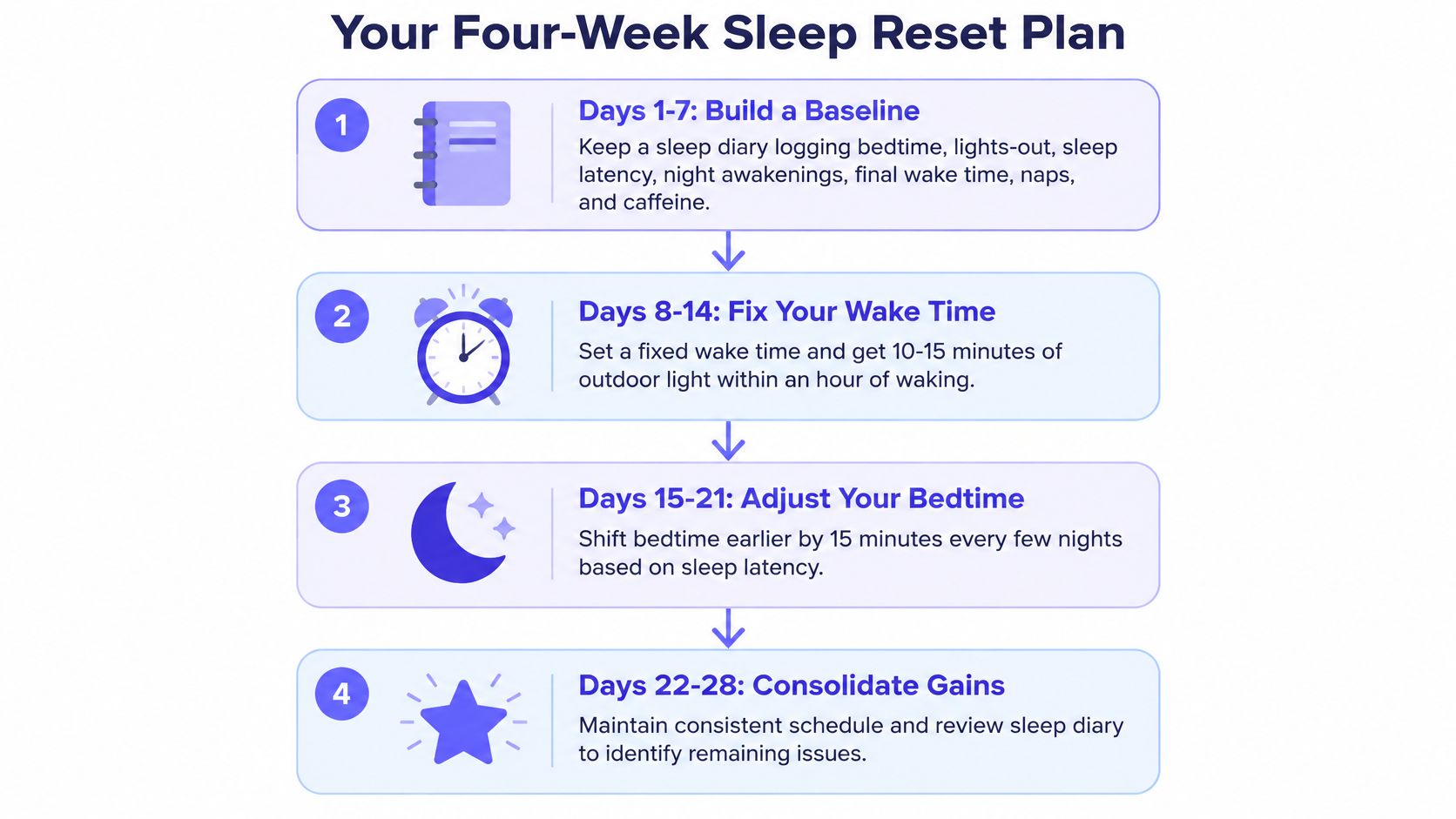
- Days 1–7, build a baseline. Log bedtime, lights-out, how long it takes to fall asleep, awakenings, final wake time, out-of-bed time, naps, caffeine, alcohol, hot flashes, and any sleep medicine. A wearable can sit beside the diary. It should not replace it. You need the pattern, not a perfect score.
- Lock one wake time. Hold it seven days a week, within about 30 minutes, including weekends. A moving wake time keeps the sleep drive fuzzy, so the bedtime fight never ends.
- Score severity once. Use a 0–28 Insomnia Severity Index style checklist and write the number down. You will compare against it, not against how hopeful you feel.
- Week 2, match time in bed to real sleep. Average the diary's total sleep and set your window to that average, and don't go below about 5.5 hours. If you average six hours, 11:30 p.m. to 6:30 a.m. is a fair start. Extra time in bed rehearses wakefulness.
- Use stimulus control the same week. Go to bed only when sleepy. If you're awake more than about 20 minutes, leave the bed, keep lights dim, and do something dull until drowsy. The bed stays paired with sleep, not with problem-solving.
- Week 3, calm the system. Take a 30–60 minute wind-down, try paced breathing near six breaths a minute, and park worries in an earlier “worry time.” Rewrite “I'll be useless tomorrow” into “I'll be tired, and I've handled tired days before.”
- Week 4, re-score. If the index and the diary improved, add 15–30 minutes in bed. If they didn't, run the red-flag list before you add another supplement.
What “better” looked like in a trial
In a randomized trial of telephone-delivered CBT-I, mean Insomnia Severity Index improvement at 8 weeks was 9.9 points versus 4.7 points with menopause education, a between-group difference of 5.2 points (95% CI −6.1 to −3.3; P<0.001), reported in the PMC report of that trial. The share reaching the “no insomnia” range was 70% versus 24% at week 8. Sleep latency, wake after sleep onset, sleep efficiency, and sleep-quality scores moved too.
Practical rule: Generic sleep tips without a fixed wake time, a tighter time in bed, and a reassessment at two to four weeks rarely fix menopausal insomnia.
A newer menopause-specific CBT trial in that same report found 69% of participants had ISI scores of 0–7 after treatment versus 30% with menopause education, with overall attrition of 21%. The four weeks here are the first half. Full benefit usually needs the 6–8 week arc, so don't declare failure at day 10. If week 4 is flat, check apnea, restless legs, and medication effects before you keep restricting sleep on your own.
Daily Timing and Sleep Hygiene Fixes
Hygiene supports the reset. It almost never replaces it. Use the day as a schedule, not a personality overhaul.
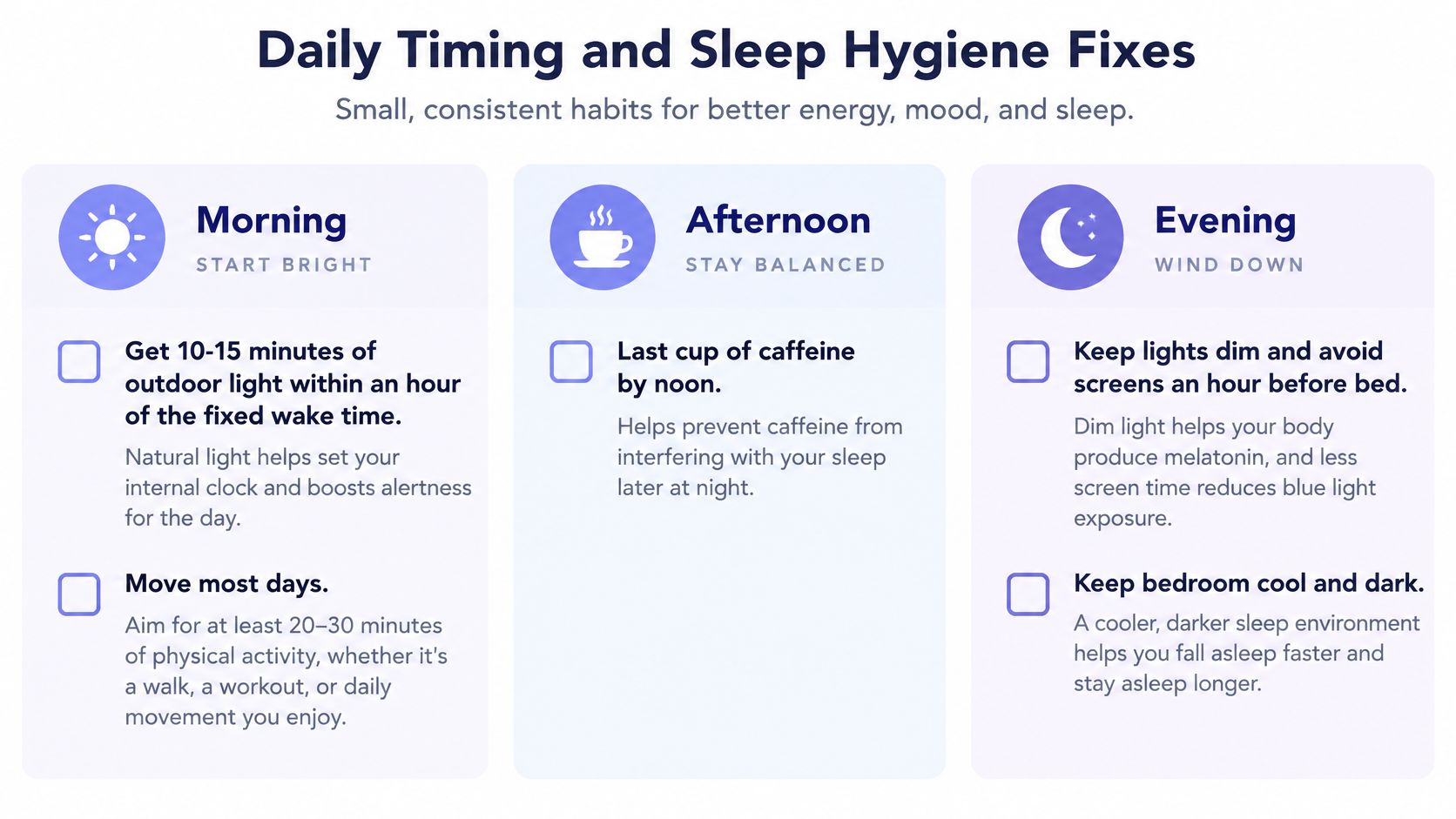
Morning
- Get outdoor light fast. Spend 10–15 minutes outside within an hour of your fixed wake time, even if it's cloudy. That light anchors the clock estrogen no longer steadies as well.
- Move on most days. A walk counts. Save the hard session for earlier, not for the hour before bed.
Afternoon
- Cut caffeine by noon. Its half-life runs about five to six hours, so a 3 p.m. latte is still in your system at lights-out.
- Cap naps. Keep them to 20–30 minutes and finish before 3 p.m. A long late nap spends the sleep drive you need at night.
Build the evening half of this into a short bedtime routine for better sleep so it isn't a new decision every night.
Evening and the bedroom
Finish vigorous workouts at least three hours before bed. Eat dinner at least three hours before bed, and notice personal trigger meals such as spicy food or refined carbs without protein. Stop alcohol three to four hours before bed. It sedates you, then fragments sleep and can set off night sweats. Alternate with water.
Keep the room near 18°C (about 65°F). Run a fan or a cooling mattress pad. Use layered, moisture-wicking bedding you can throw off without a full remake of the bed. For the wind-down hour, dim the lights, park the phone charger outside the bedroom, and take a warm shower that ends cooler so your core temperature can drop.
A short demo of how clinicians frame these habits sits here if you want the sequence in motion.
▶ PlayKeep a night-waking kit within reach: a light cotton robe, cool water, and a note that a hot-flash wave usually passes in about ten minutes. Getting up to “fix” every flush trains a longer awakening.
Hygiene is necessary in menopause, and it is rarely sufficient. Pair the cool room and the caffeine cutoff with the behavioral plan, or you will keep rearranging pillows.
Supplements Worth Trying and When to Take Them
Add one supplement at a time, give it two weeks, and log it against the sleep diary. If you start three capsules on Monday, you won't know which one changed Tuesday.
| Supplement | Best for | Evidence | Cautions |
|---|---|---|---|
| Magnesium glycinate | Light sleep, restlessness, leg discomfort | Modest | Soft stools at high doses; review with kidney disease |
| Melatonin | Trouble falling asleep | Limited in menopause | Short-term use; brand potency varies; possible grogginess |
| L-theanine | Racing mind at bedtime | Small studies | Mild; check with other medications |
| Valerian root | Difficulty falling asleep | Weak and mixed | Avoid with liver issues or sedatives |
Walk the rows before you buy
Magnesium glycinate, 200–400 mg, one to two hours before bed. This is the first trial I would run for twitchy, light sleep. Glycinate is better absorbed and easier on the gut than cheap oxide. Take it with the wind-down hour so the timing is boring and repeatable. Skip it, or get clearance first, if you have kidney disease.
Melatonin, 0.5–3 mg, 30–60 minutes before bed. Use it for trouble falling asleep or a shifted clock, not for 3 a.m. heat wakes. Menopause-specific evidence is limited, and bottle potency is uneven, so stay at the low end for two weeks. If the problem is staying asleep, an earlier dose won't patch the second half of the night.
L-theanine, 100–200 mg in the evening. Small studies point to a calmer onset when the mind is loud. It's mild. Still check it against blood pressure pills and other sedating products.
Valerian stays last. Evidence is weak and mixed. Avoid it with liver problems or anything else that sedates. If glycinate or low-dose melatonin did nothing in two honest weeks, valerian is unlikely to be the missing piece.
Clear any supplement with your clinician if you take thyroid medication or a blood thinner. Sedating PM antihistamines stay off this list. They mask symptoms, including breathing trouble, and they don't rebuild sleep drive. If you want a simpler filter for labels and forms, use our notes on how to choose supplements before the cart fills up.
Track Your Progress and Start Tonight
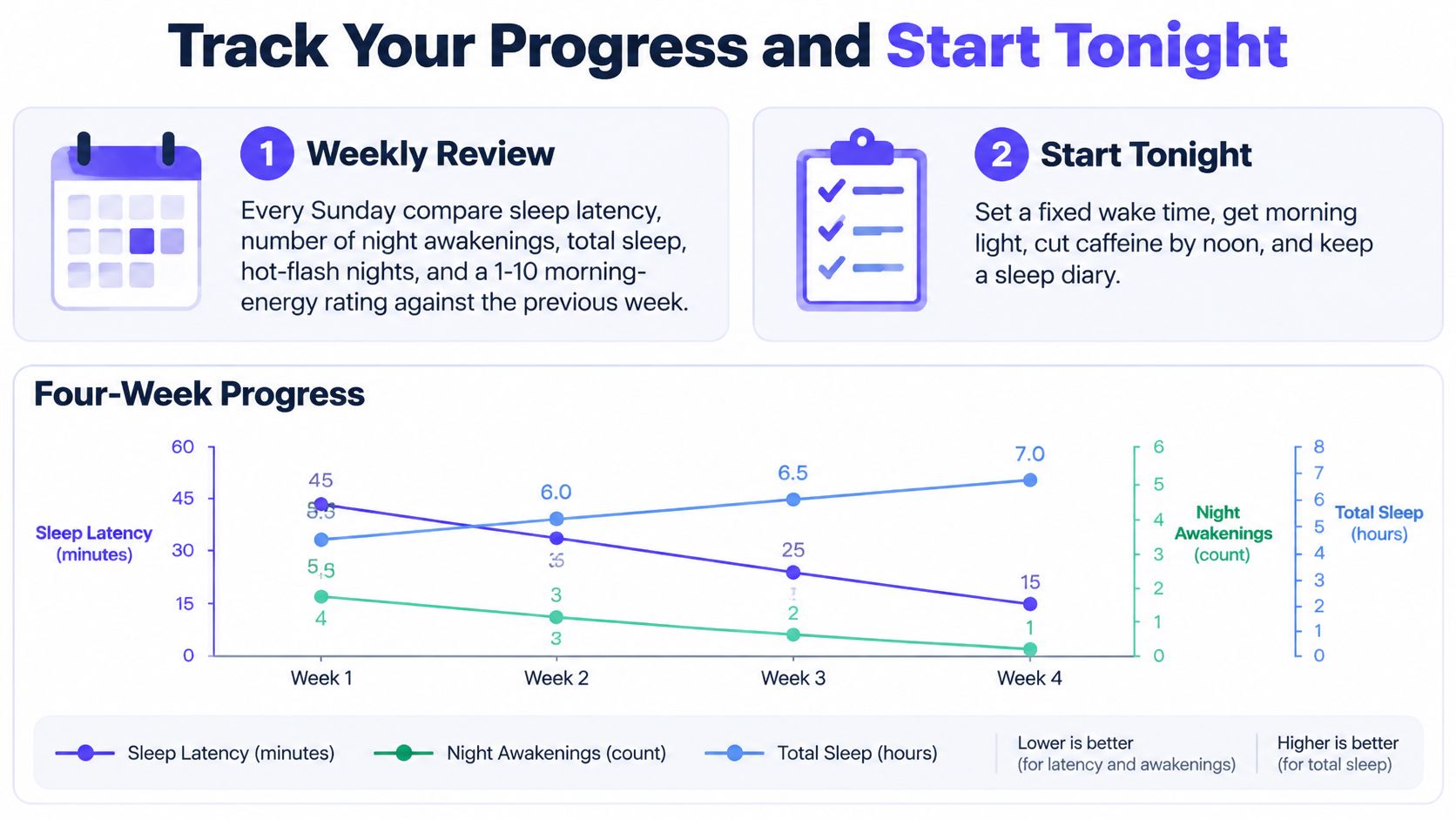
A plan you don't review is a mood. Make Sunday the review, and change one variable at a time.
The Sunday loop
Compare this week with last week on five lines: sleep latency, number of night awakenings, total sleep, hot-flash nights, and a 1–10 morning-energy rating. Re-score the insomnia index every two weeks, not every bad morning. If latency dropped but sweats didn't, don't add a second supplement. Adjust the cooling or the clinical question. If both latency and awakenings fell, add 15 minutes in bed and leave everything else alone.
An app makes that loop shorter than a spreadsheet. Setup takes 2 minutes: you share symptoms, goals, and stage, and Lila builds a perimenopause nutrition plan. Daily check-ins track 20+ symptoms, including hot flashes, night sweats, sleep quality, mood, anxiety, energy, brain fog, and the rest of the midlife list. The app links symptoms to logged meals, sleep, alcohol, and HRT doses, and it combines a 24/7 AI nutrition coach, photo meal logging, and symptom tracking in one place. Log in under two minutes, review on Sunday, and move a single lever. A perimenopause symptom tracker walkthrough shows how to keep the log useful instead of obsessive.
Start tonight
- Set the wake alarm now, including Saturday.
- Move the phone charger to another room before you're tired enough to negotiate.
- Open the diary or the app and log tonight's first row, even if the night goes badly.
- Cool the bedroom if you pick only one hygiene fix. For most readers that's the highest-payoff change before any capsule.
If any red-flag row fits you, book the medical visit first. Otherwise start the four-week plan tonight and judge it at the two-week mark, then again at week 8. If gains slip after that, restart the diary for one week and repeat the fixed wake time and the time-in-bed step. A short course fades when the schedule fades. I would rather rerun week 2 than restock a PM antihistamine.
Lila is built for the nights this menopause sleep aid plan is about: a two-minute check-in for sleep, night sweats, mood, meals, and alcohol, plus a coach that helps you change one habit at a time. It won't replace CBT-I or a sleep study, and it will show you whether the week improved. Visit Lila and set the wake alarm before tonight's wind-down.
Get Lila, your personal coach for perimenopause.
Built for women in their 40s. 24/7 coaching, in your pocket.