
Perimenopause Anxiety Symptoms What They Feel Like and Why
Learn perimenopause anxiety symptoms, why they spike in midlife, how they progress, and how to track and ease them with practical daily strategies.
You're folding laundry, answering a work message, and thinking about nothing dramatic when your body suddenly acts like something is wrong. Your chest feels tight. Your thoughts speed up. You replay a small conversation from earlier and feel strangely unsettled by it. By bedtime, you're exhausted but wired.
For many women in their 40s, this is the moment anxiety starts to feel unfamiliar. Not the old kind tied to a deadline, a sick child, or a major life event. This version can feel more physical, more random, and harder to reason with. That can be unnerving, especially if no one has told you that hormonal changes may be part of the picture.
Table of Contents
- Introduction to Perimenopause Anxiety Symptoms
- Understanding What Perimenopause Anxiety Feels Like
- Why Hormones Sleep and Inflammation Drive Anxiety
- How Anxiety Symptoms Change Across the Transition
- When to Seek Support for Anxiety Symptoms
- Practical Ways to Track and Ease Daily Anxiety
- Taking Control of Your Calm in Perimenopause
Introduction to Perimenopause Anxiety Symptoms
A common story goes like this. A woman who has handled stress well for years suddenly feels jumpy before bed, irritable in traffic, or wide awake after a night sweat. She tells herself she's just overwhelmed. Then it happens again. And again. The pattern starts to matter.
That pattern is why perimenopause anxiety symptoms deserve attention. Anxiety during the menopausal transition isn't rare or imaginary. Clinical research has shown that anxiety symptoms are measurable during this stage, and they often rise as women move into the transition. If you're still sorting out whether you're in perimenopause, this guide to what perimenopause is can help put the broader hormonal shift into context.
Why this can feel so confusing
Perimenopause doesn't always announce itself with obvious cycle changes first. Sometimes the first thing a woman notices is a shorter fuse, a sudden sense of dread, or nights that feel strangely restless. Because anxiety is often framed as purely emotional, women can miss the body-based clues that point to a hormonal link.
Anxiety during perimenopause often works like a signal, not a character flaw.
That distinction matters. When you treat anxiety as information, you stop arguing with yourself and start looking for patterns. Did it follow a bad night of sleep? Did it show up with flushing, sweating, or a racing heart? Did it cluster around certain parts of your cycle?
A calmer way to think about it
Instead of asking, “What's wrong with me?” it helps to ask, “What is my body reacting to?” That shift changes everything.
Many readers get stuck here, so let's simplify it. Perimenopause anxiety often behaves like a signal loop. Hormones fluctuate. Sleep gets disrupted. Hot flashes or internal heat spikes make your nervous system feel alarmed. Then the brain interprets those sensations as danger, which can intensify the anxiety.
You don't need to diagnose yourself from one rough week. You do need to notice whether your symptoms repeat in a recognizable pattern. That's often the clearest first step.
Understanding What Perimenopause Anxiety Feels Like
Perimenopause anxiety doesn't look the same in everyone. Some women feel classic worry. Others feel irritated, overstimulated, or physically revved up without a clear reason. The most useful way to understand it is to think of your nervous system as a home alarm that has become extra sensitive. The toaster goes off, and the alarm acts like someone broke a window.
A visual can help organize the symptom picture:
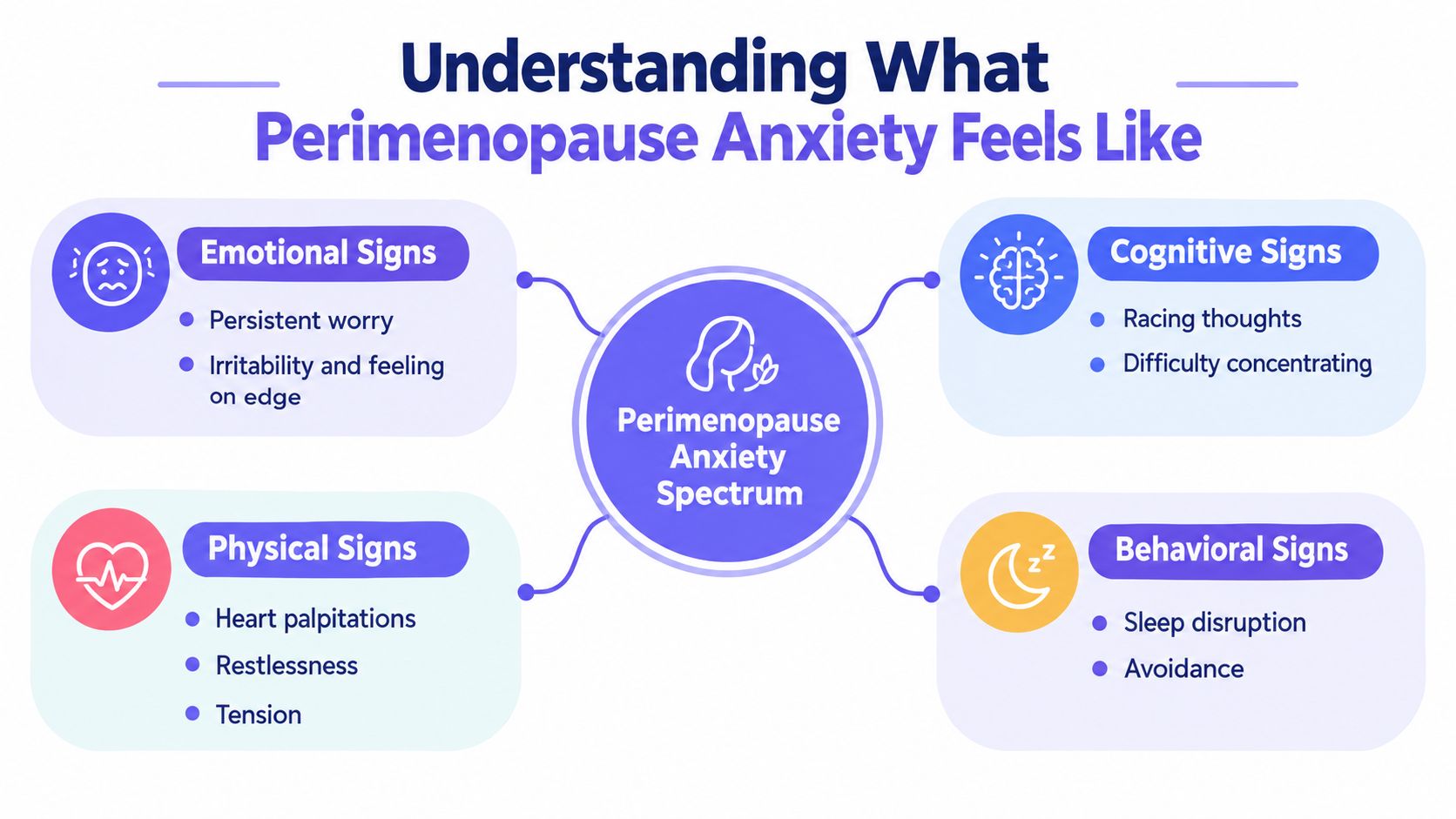
A 2016 NIH-hosted study of perimenopausal women reported that anxiety prevalence during perimenopause was 12.62%, with symptoms mostly mild. The same study found 11.11% mild, 1.32% moderate, and 0.19% severe symptoms, which helps explain why many women feel “not terrible, but not like myself either” rather than constantly overwhelmed (NIH-hosted study on perimenopausal anxiety prevalence).
Emotional signs
These are often the easiest to recognize, but not always the easiest to name.
- Persistent worry that lingers longer than it used to, even when the trigger is small
- Irritability that feels out of proportion, especially when noise, mess, or interruptions pile up
- Feeling on edge even during ordinary parts of the day
- A sense of dread that seems to appear without a clear cause
A lot of women expect anxiety to feel like obvious panic. Sometimes it does. Often it's subtler and more constant, like a low electrical hum in the background.
Cognitive signs
This is the part many women mistake for “just stress” or “brain fog.”
| Symptom area | What it may feel like in daily life |
|---|---|
| Racing thoughts | Your mind keeps looping through tasks, worries, or conversations |
| Difficulty concentrating | You read the same email twice and still don't absorb it |
| Mental overload | Small decisions suddenly feel strangely hard |
| Hypervigilance | You keep scanning for what might go wrong next |
When the brain feels overstimulated, concentration often drops. Then the drop in concentration can make you more anxious. That can create a frustrating cycle.
Physical and behavioral signs
Sometimes the body speaks first.
- Heart palpitations or a pounding feeling that can seem to come out of nowhere
- Chest tightness or body tension that makes it hard to relax
- Restlessness such as pacing, fidgeting, or feeling unable to settle
- Sleep disruption including waking in the night and then feeling mentally “on”
Practical rule: If your anxiety keeps showing up with physical symptoms, especially sleep disruption or body heat changes, track the pattern before you dismiss it as random stress.
Mild symptoms are common, but mild doesn't mean unimportant. If a symptom repeats, it's worth noticing.
Why Hormones Sleep and Inflammation Drive Anxiety
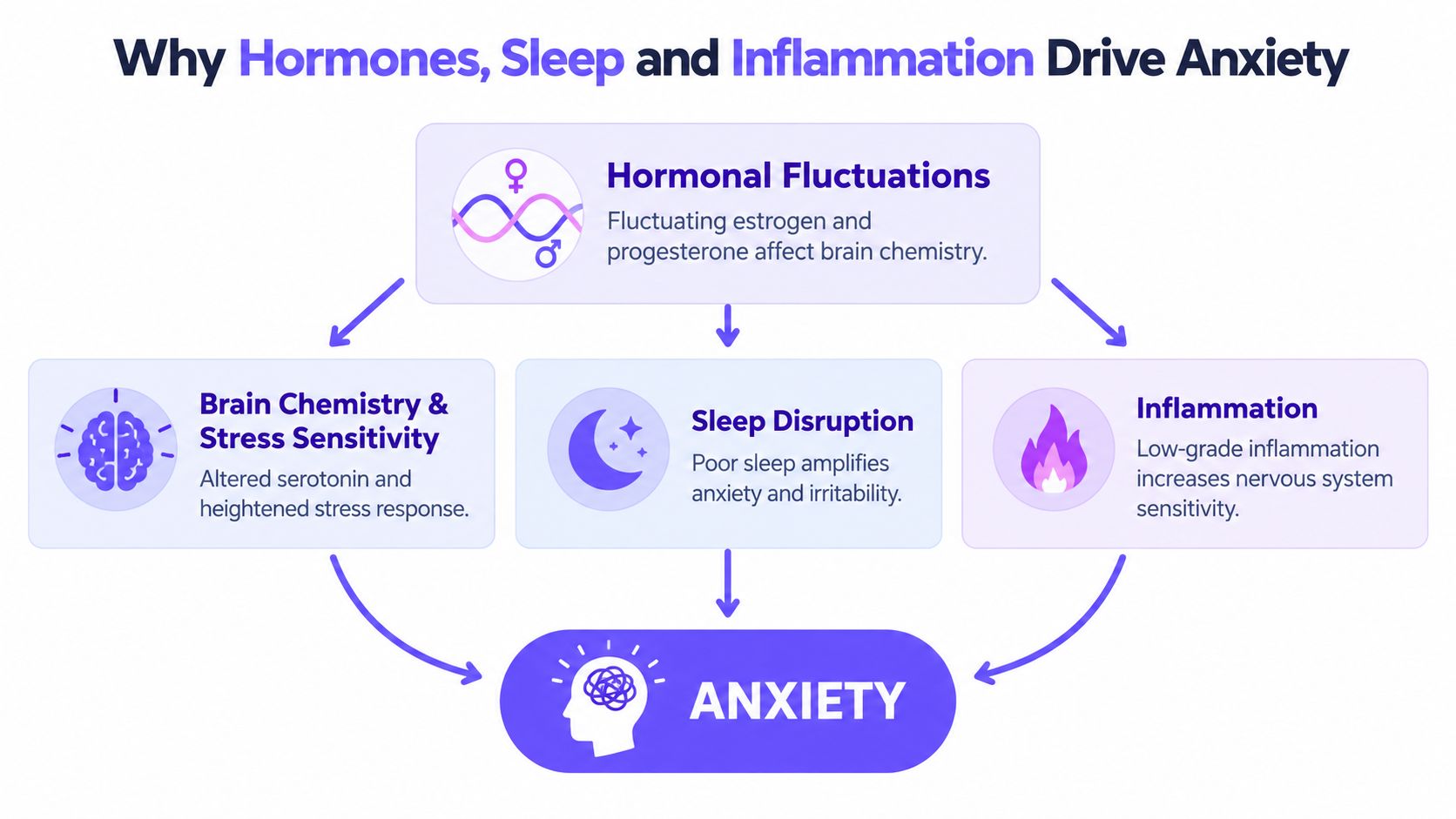
The fastest way to understand perimenopausal anxiety is to stop thinking of it as a single mood problem. It's usually a feedback loop. Hormonal shifts can lower your sense of steadiness. Poor sleep makes your brain less resilient the next day. Vasomotor symptoms, such as hot flashes or night sweats, can jolt the nervous system. Then anxiety rises in response to all of it.
This overview helps make that chain easier to see:
Hormones change the sensitivity setting
Think of estrogen and progesterone like part of your body's internal thermostat and brake system. During perimenopause, the settings can become less predictable. That doesn't mean every anxious day is caused by hormones alone. It means hormonal fluctuation can make the whole system more reactive.
For some women, that shows up as increased sensitivity to ordinary stress. For others, it feels more physical than emotional. They don't just worry more. They startle more easily, sleep more lightly, and recover more slowly from a rough night.
Sleep and vasomotor symptoms can create a loop
This is one of the clearest places where research lines up with what women describe in real life. In one clinical study, anxiety prevalence was 58% and vasomotor symptoms were 73%, and anxiety sensitivity remained a significant predictor of how troublesome vasomotor symptoms felt even after adjustment for other factors (clinical study on anxiety sensitivity and vasomotor symptoms).
That matters because it points to a two-way loop:
- A hot flash or night sweat wakes you up
- Your body feels startled and activated
- Your mind interprets that activation as danger or distress
- You struggle to fall back asleep
- The next day, your nervous system is more fragile
That's why many women say, “I can handle stress during the day, but at night everything feels bigger.”
A short primer on stress hormones can also help if you're wondering how body stress and hormone shifts overlap. This guide on how to test for cortisol levels gives useful background.
Here's a brief video that explains related hormonal changes in a simple format:
▶ PlayWhere inflammation and life stress fit in
Inflammation is often discussed in broad terms, but the practical point is simple. When the body is under strain, the nervous system can become easier to provoke. That doesn't create anxiety from nothing. It can amplify a system that is already more sensitive because of hormonal transition and disrupted sleep.
A few common amplifiers include:
- Fragmented sleep from night waking
- Skipping meals or erratic eating that leaves you feeling shaky
- High ongoing stress from caregiving, work, or family strain
- Reduced recovery time because midlife often asks a lot from women all at once
When women say, “I don't feel like myself,” they're often describing a nervous system that has less buffer than it used to.
The key takeaway is not that everything is hormonal. It's that hormones, sleep, and body stress often interact.
How Anxiety Symptoms Change Across the Transition
Anxiety in midlife often feels random when you're living through it. Zoom out, and a stage pattern appears. The menopausal transition has phases, and anxiety symptoms often shift with them rather than staying the same from start to finish.
This timeline captures the general arc:
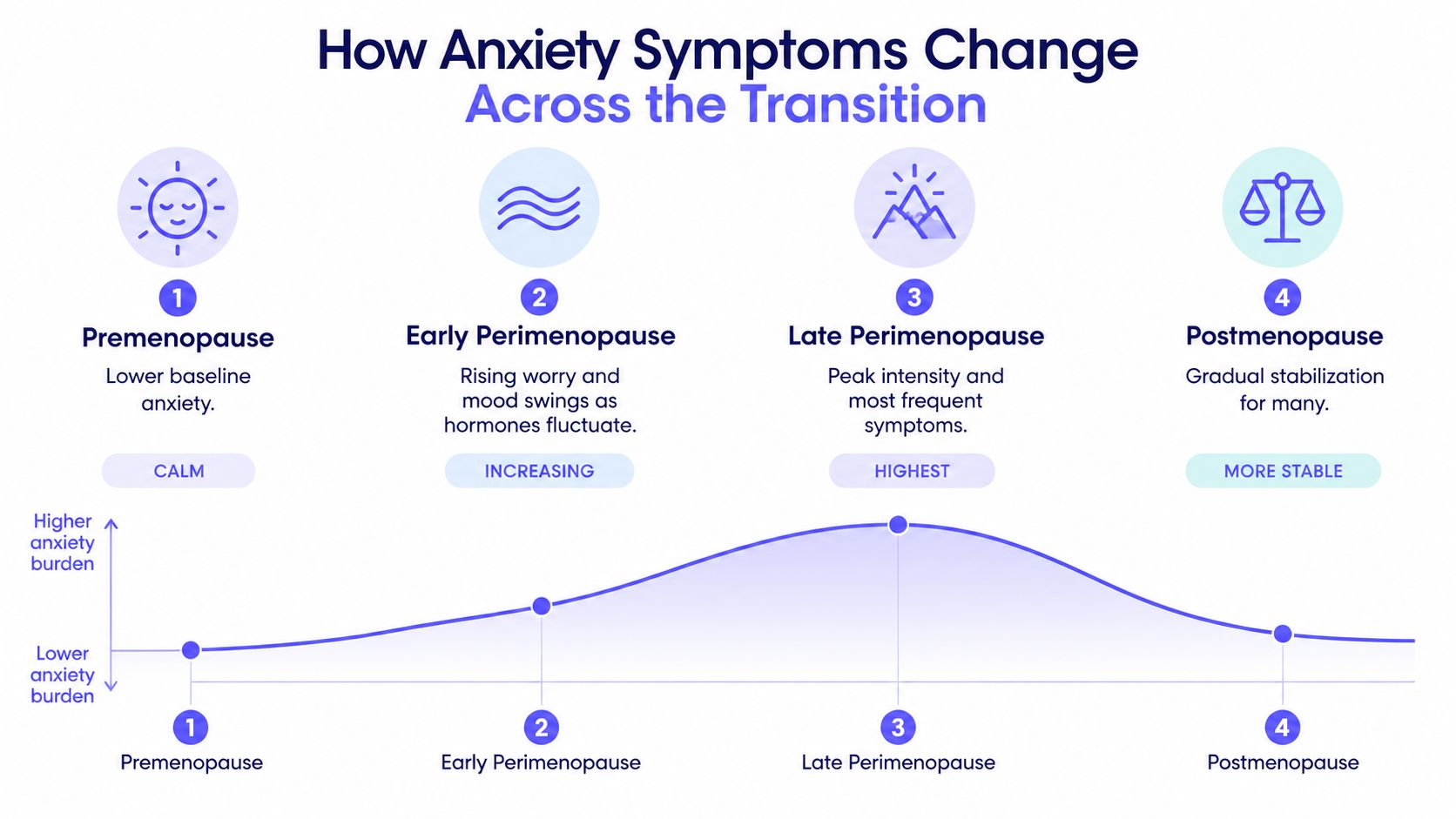
A large longitudinal cohort found high anxiety symptoms in 15.6% of premenopausal visits, 20.7% of early perimenopausal visits, and 20.2% of late perimenopausal visits, before easing to 18.1% after menopause and 15.5% when hormone therapy was used (longitudinal cohort on anxiety across menopause stages). In the same study, women with low baseline anxiety were significantly more likely to report high anxiety during early or late perimenopause than when premenopausal, with adjusted odds ratios of 1.56 to 1.61.
What this looks like by stage
| Stage | Typical pattern |
|---|---|
| Premenopause | Anxiety may still happen, but the baseline is often steadier |
| Early perimenopause | Symptoms often rise as cycles and hormonal signals become less predictable |
| Late perimenopause | Many women notice the most disruptive combination of sleep changes, body heat shifts, and emotional reactivity |
| Postmenopause | Some easing is common once the constant fluctuation settles, though experiences vary |
This doesn't mean every woman follows the same curve. Some feel a sharp early change. Others notice a slower build. But it does support a useful idea: symptoms are often stage-linked, not evidence that you are permanently becoming an anxious person.
Why early recognition helps
Women often lose time trying to decide whether their symptoms “count.” If you know anxiety commonly rises during early and late perimenopause, you can stop waiting for the experience to become dramatic before paying attention.
That's also where broader life context matters. Major midlife shifts, such as caregiving, career change, grief, or changing family roles, can layer onto hormonal transition. If you're also navigating bigger emotional shifts, this piece on thriving through life transitions offers grounded mental health support.
If you're trying to place yourself on the timeline, this guide to the stages of perimenopause can help match symptom patterns to the transition phase you may be in.
When to Seek Support for Anxiety Symptoms
Some anxiety is common in perimenopause. Some anxiety deserves prompt support. The challenge is knowing the difference without minimizing yourself or catastrophizing every symptom.
This image captures that decision point well:
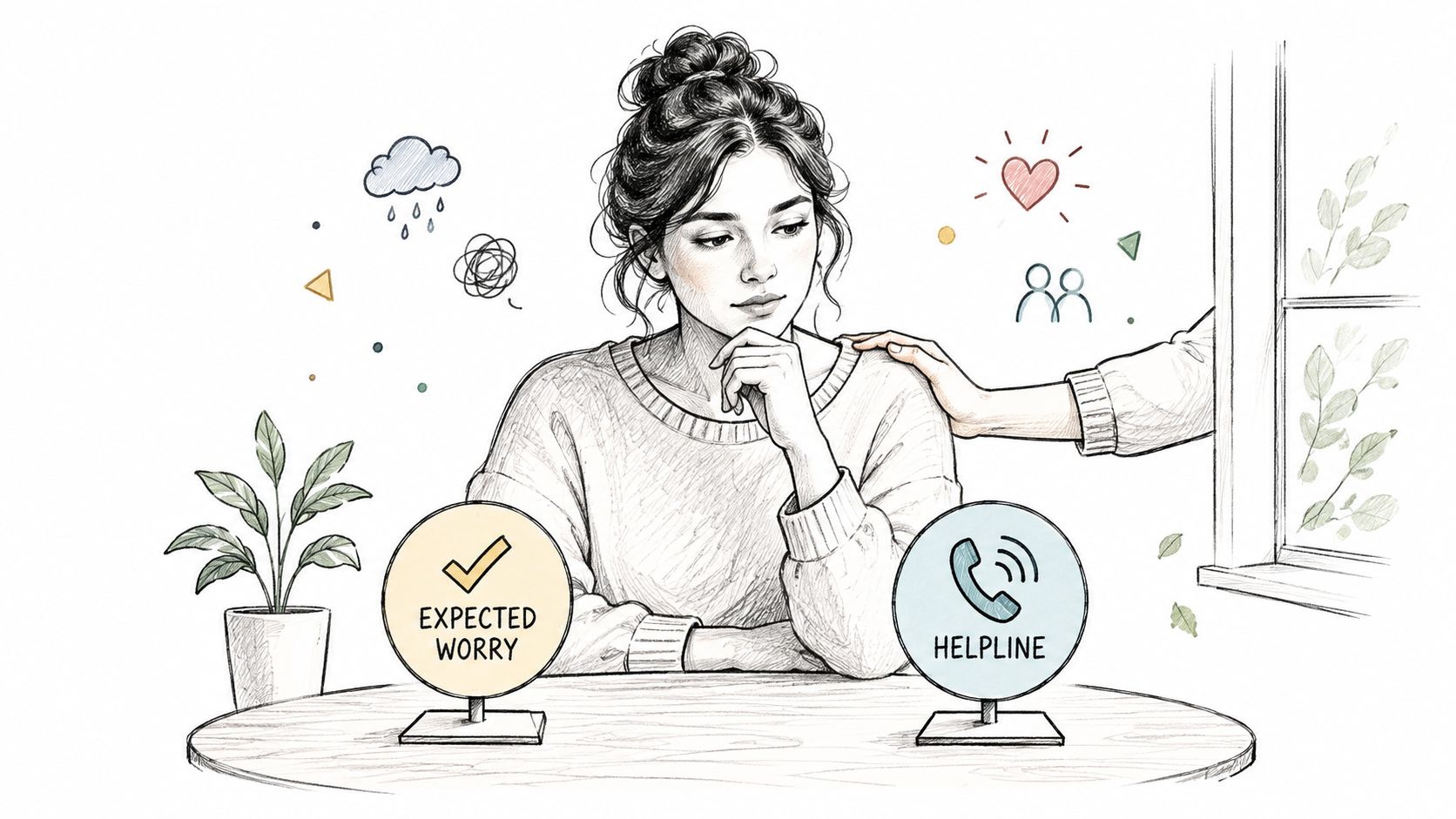
Signs it's time to check in with a clinician
Use function as your guide. Anxiety needs more attention when it starts running your schedule, your sleep, or your sense of safety.
- It disrupts daily life if you're avoiding errands, meetings, driving, or social plans because of symptoms
- Sleep is breaking down when you're waking anxious night after night and not recovering
- Physical symptoms feel intense or new such as pounding heart, chest tightness, dizziness, or a sense of panic
- Mood symptoms are stacking up when anxiety shows up alongside persistent low mood, hopelessness, or feeling emotionally flat
- You don't feel in control of the episodes especially if they arrive suddenly and feel frightening
If what you're experiencing seems more like surges of panic than steady worry, this guide on panic attacks in perimenopause may help you sort out the pattern.
Seek support because you want clearer answers, not because you've failed to cope.
What to bring to the appointment
A rushed visit is easier when you arrive with a short symptom record.
Bring notes on:
- Timing of anxiety symptoms across the month
- Sleep changes including waking times and whether you had night sweats or heat surges
- Physical signs like palpitations, flushing, shaking, or stomach upset
- Cycle changes if you're still having periods
- Impact on work, relationships, or daily tasks
A short list works better than a long story. Think: dates, patterns, and what made a day better or worse.
Practical Ways to Track and Ease Daily Anxiety
When anxiety feels slippery, tracking gives it edges. You stop relying on memory and start collecting useful clues. The goal isn't to monitor yourself all day. It's to build a small habit that helps you spot what your body is trying to tell you.
Try a one minute evening check in
Keep it simple. Each evening, jot down a few items in your notes app, a paper journal, or a symptom tracker.
Record:
- Mood with a few words like calm, edgy, teary, irritated, or wired
- Sleep setup from the night before, including wake-ups
- Body symptoms such as hot flashes, palpitations, tension, headache, or restlessness
- Cycle context if relevant
- What helped such as a walk, protein at lunch, less caffeine, or an earlier bedtime
After a couple of weeks, many women notice they don't have “random” anxiety at all. They have patterned anxiety.
Review patterns weekly, not hourly
Hourly self-scanning usually makes anxiety louder. Weekly review makes it clearer.
A good weekly check looks like this:
- Circle repeat days when anxiety was strongest
- Look for pairings such as poor sleep plus irritability, or night sweats plus next-day dread
- Choose one small experiment for the next week, like reducing late caffeine or adding a wind-down routine
Small shift, big payoff: The most useful tracker is the one you'll actually use for more than three days.
Daily supports that often help
Not every tool works for every woman, so think in experiments, not rules.
- Breathing on purpose can help when your body feels revved. A longer exhale often settles physical activation faster than trying to “think positive.”
- Consistent meals matter more than many women realize. Feeling shaky, underfed, or overcaffeinated can mimic anxiety or intensify it.
- Movement can discharge restlessness. This doesn't need to be a hard workout. A walk after dinner counts.
- Social contact helps regulate the nervous system. A text exchange, a short call, or time with someone steady can be surprisingly grounding.
If you want digital support, compare features carefully. Some women prefer a general mental health tool, while others want symptom and cycle context too. Lists like ThriveXDNA's anxiety app picks can help you see the differences. For perimenopause-specific tracking, how to track perimenopause symptoms gives a practical starting framework.
One option in this category is Lila, which combines a daily check-in with tracking for mood, sleep, energy, symptoms, meals, and cycles, plus a chat-based coach. For women trying to connect anxiety with the rest of the perimenopause picture, having those signals in one place can make patterns easier to see.
Taking Control of Your Calm in Perimenopause
Perimenopause anxiety symptoms often make more sense once you stop treating them like isolated emotional events. They tend to reflect a loop. Hormonal fluctuation can raise sensitivity. Sleep disruption weakens resilience. Vasomotor symptoms can jolt the body into alarm. Then anxiety builds on top of that physical activation.
That doesn't mean every anxious feeling is caused by perimenopause. It does mean your symptoms may be more predictable than they seem.
Three useful next steps for this week
- Track for seven days with simple notes on mood, sleep, body symptoms, and cycle timing
- Pick one stabilizer such as a consistent bedtime, less late caffeine, or an evening walk
- Bring data, not just distress if you talk with a clinician, coach, or therapist
The most reassuring truth here is that patterns can be seen before they can be changed. Once you notice your own loop, you can make decisions based on evidence from your life, not guesses made on a hard day.
You don't need perfect tracking. You need enough information to understand what your body is repeating. That's often the moment things start to feel less scary and more manageable.
Lila helps women make sense of perimenopause with a quick daily check-in, symptom and cycle tracking, and a personalized plan that connects mood, sleep, energy, and body changes in one place. If anxiety has started to feel unpredictable, Lila can help you spot your patterns and take practical next steps with more clarity.
Get Lila, your personal coach for perimenopause.
Built for women in their 40s. 24/7 coaching, in your pocket.