
Perimenopause Weight Gain Treatment: What Actually Works
Perimenopause weight gain treatment that works: diet, strength training, sleep, tracking and when to see a doctor about hormones.
Fat mass tends to increase and lean mass to decline during the menopause transition, with these changes continuing for a time after the final menstrual period. That shift changes how perimenopause weight gain treatment should be judged. The scale may stay nearly steady while body composition changes.
For women in their 40s and 50s, a familiar eating routine can coincide with a tighter waistband and less muscle. Changes in body composition, activity and sleep can all affect weight, but the scale alone cannot show where fat is stored or how much muscle is being maintained.
A useful plan separates three questions: what nutrition and training can achieve, what progress to track beyond body weight, and what hormone therapy or GLP-1 medicines may contribute. Each has a different role, and neither medication replaces the need to assess body composition and overall health.
Table of Contents
- Why Perimenopause Weight Gain Shows Up as Fat Redistribution
- Which Lever Moves Weight Most in the Trial Data
- How to Build Your Weekly Treatment Plan
- Tracking Progress Beyond the Scale
- Sleep, Stress and Hot-Flash Tips That Support Fat Loss
- When Hormone Therapy and GLP-1s Enter the Plan
- Book a Clinician Visit Before You Change Your Treatment
Why Perimenopause Weight Gain Shows Up as Fat Redistribution
Estrogen does more than run the menstrual cycle. It influences where the body parks fat and how readily muscle responds to training and protein. As levels fall across the transition, fat shifts toward the abdomen and the visceral depots around the organs, while the muscle you carried easily at 42 gets harder to hold at 52. Across studies, women gain roughly 5 to 7 pounds (2 to 3 kilograms) on average during the transition, with enormous individual variation, so a woman who gains twelve pounds and a woman who gains two are both inside the normal range (JCI Insight).
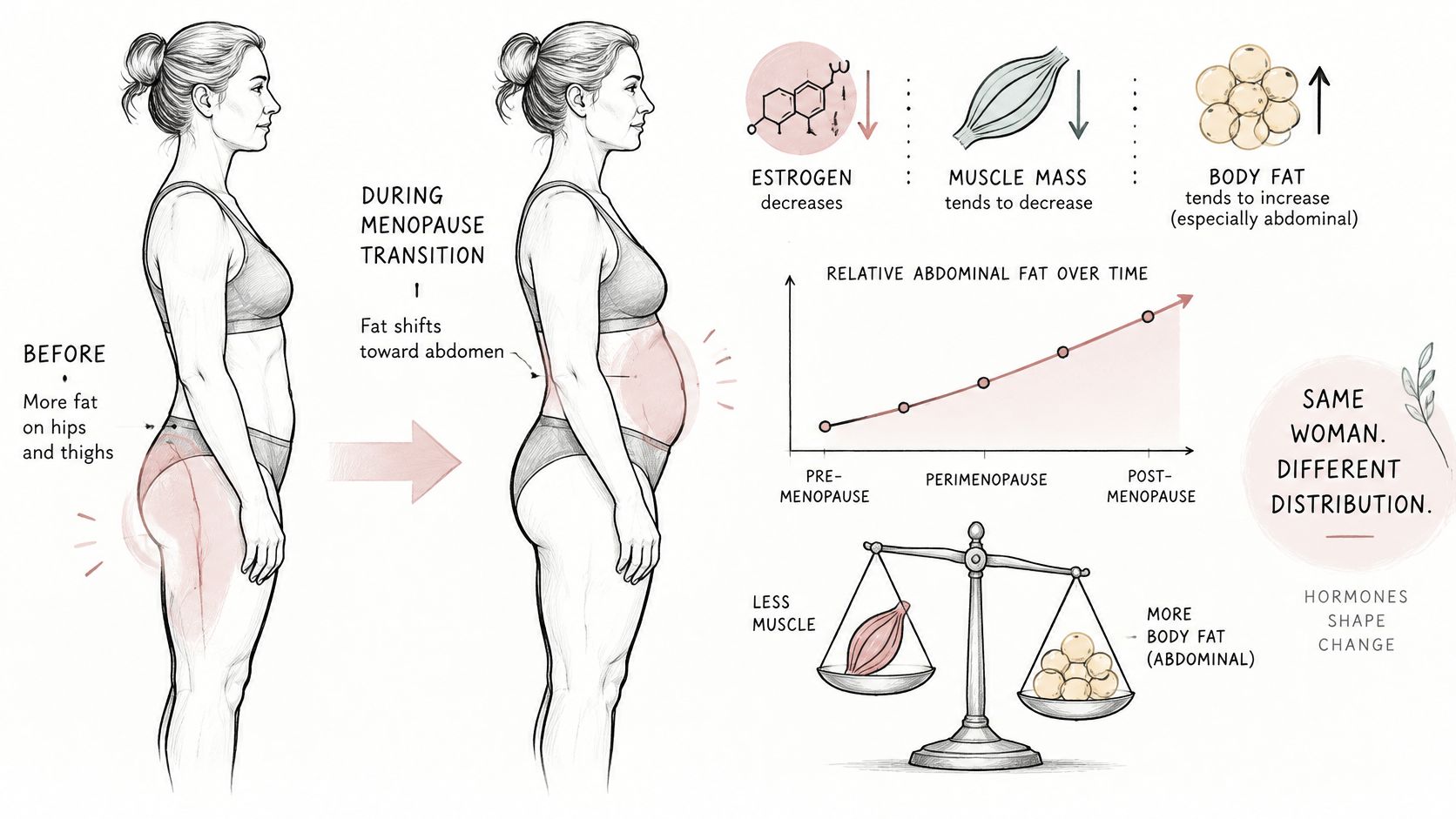
Here's the pattern that gets missed in a fifteen-minute appointment. Say a woman holds 150 pounds for a full year. Her waist goes from 32 to 34 inches, her 30-second chair stand count drops from 14 to 11, and she wakes three nights a week at 3 a.m. Her chart says stable weight. Her body says fat in, muscle out, sleep fragmented. That trade is the one that moves insulin resistance, blood pressure, cholesterol and bone density, and the scale can't see any of it.
What the scale hides: the same weight with a bigger waist and weaker legs is a worse metabolic position than the same weight with a smaller waist and stronger legs, even though the number on the floor never changed.
That's the working rule for everything that follows: judge progress by waist circumference, strength and body composition alongside weight, never by weight alone.
Three checks to run this week
- Waist at the navel. A soft tape, relaxed exhale, no shirt tucked in. Record it once and date it. This is your baseline for abdominal fat, the depot that shifts most in perimenopause.
- A 30-second chair stand. Arms crossed over your chest, stand and sit as many times as you safely can in 30 seconds. Write the number down. It's a repeatable proxy for leg strength and lean mass you can retest monthly.
- Night waking count. Note how many times you wake and roughly when. Two weeks of this tells you whether sleep is a driver or a bystander in your appetite and cravings.
If you want the physiology in more depth, our guide to body composition changes in perimenopause walks through what's happening at the tissue level and why the tape measure earns its place next to the scale.
Which Lever Moves Weight Most in the Trial Data
A 12-month randomized trial compared a reduced-calorie diet, moderate-to-vigorous aerobic exercise, both combined, and a control group in 439 postmenopausal women aged 50 to 75 with a BMI above 25 (trial report on PubMed Central). The results show how much each approach changed body weight.
| Intervention | Mean weight change (12 months) | What It Adds |
|---|---|---|
| Reduced-calorie diet | -10.8% | The largest single change in weight |
| Moderate-to-vigorous aerobic exercise | -3.3% | Fitness benefits and a smaller change in weight |
| Diet plus exercise combined | -11.9% | The largest overall change, with diet and activity together |
| Control group | -0.6% | Little change without an intervention |
Diet produced more weight loss than aerobic exercise alone in this trial. Combining diet and exercise led to the greatest average reduction, though the difference from diet alone was modest. These results concern the scale, not the full body-composition picture. Exercise can support fitness and muscle retention, outcomes that weight change alone does not measure.
Weight loss also shifted sex-hormone concentrations in the trial. That makes weight management relevant to health, not just appearance, but the result does not establish that a particular amount of weight loss is necessary or appropriate for every woman.
Where the protocol has to bend
Calorie targets need individual review when diabetes, a history of disordered eating, thyroid disease or weight-affecting medications are involved. A very low-calorie approach may be inappropriate in those circumstances. For women considering a low-carbohydrate diet, what human studies show about ketones can help explain the appetite question, but no macronutrient arrangement cancels out an energy surplus.
Resistance training addresses a different part of the goal: maintaining strength and lean tissue while losing weight. A perimenopause strength-training guide outlines ways to get started at home with bands and bodyweight.
Decision rule: A calorie deficit drives weight loss; resistance training supports strength and lean tissue during that loss. Choose a sustainable eating approach, then include both aerobic activity and strength work where appropriate.
How to Build Your Weekly Treatment Plan
A plan that survives contact with a real week looks dull on paper. That's the point. Seven steps, in the order I'd sequence them, with the reason each one earns its place and the slip that most often undoes it.
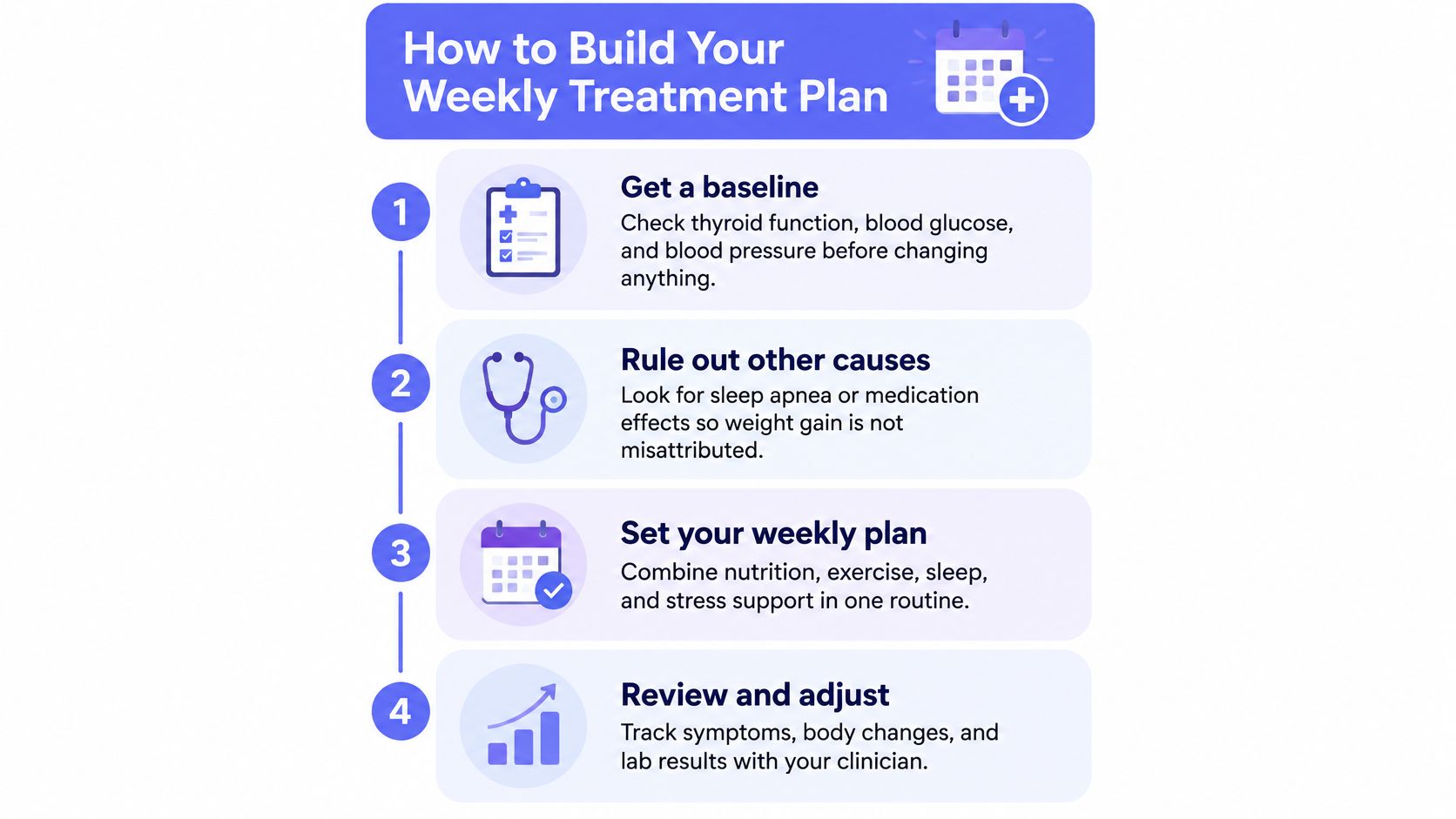
Get a baseline before you change a thing. Ask for thyroid function, fasting glucose or A1c, and a blood pressure reading, and raise sleep apnea and any medication that lists weight gain as a side effect. The reason is that hypothyroidism, sleep apnea and several common prescriptions produce a weight pattern that looks identical to perimenopause. The slip is skipping this and spending eight months fighting a hormone problem you don't have.
Set a moderate deficit, not a crash. Agree on a daily calorie target with your clinician that you can hold on a Tuesday in February. Deep cuts cost muscle, and muscle is the tissue you're trying hardest to keep. The slip is panicking after a bad week and dropping to 1,000 calories, which predictably rebounds.
Anchor protein at every meal. A palm-sized portion at breakfast, lunch and dinner, so roughly a hand's worth of eggs, Greek yogurt, fish, chicken, tofu or beans each time. Protein preserves lean mass as weight comes off and blunts mid-morning snacking. The slip is coffee and a muffin at 7 a.m. and wondering why 10:30 feels like a crisis.
Lift two or three times a week. Bodyweight squats, wall push-ups, banded rows, two sets of 10 to 12 reps each, stopping two reps short of failure. This is the stimulus that tells your body to keep muscle while the deficit runs. The slip is doing only cardio, which burns calories and leaves strength untouched.
Build aerobic activity toward 1,000 to 1,500 kilocalories a week. That range comes from the 4.5-year Women's Healthy Lifestyle Project randomized clinical trial, where women eating around 1,300 kilocalories a day and completing that volume of programmed moderate-intensity aerobic activity reduced waist circumference and fat mass while maintaining fat-free mass (PMC). Add everyday movement on top, such as a ten-minute walk after meals. The slip is two heroic weekend sessions and nothing from Monday to Friday.
Fix a sleep window. Same lights-out and same wake time, bedroom cool, phone charging in another room. Short sleep raises hunger and makes training feel twice as hard, so it belongs in the plan rather than on the guilt list. The slip is treating bedtime as the flexible part of the day.
Log for two weeks. Meals, sleep, symptoms, alcohol, in a notebook or an app. The record is what turns "I think dairy bothers me" into a pattern you can show a clinician. The slip is trusting memory, which is reliably wrong about portion sizes and night waking.
If you want the structure built for you rather than assembled from scratch, setup takes two minutes: you share your symptoms, goals and stage, and Lila builds a perimenopause nutrition plan from there. Our protocols are overseen by Rebecca Rumsey, MSc, RD, our perimenopause nutrition lead. The full framework sits in our perimenopause weight loss plan if you'd rather read it end to end first.
A good first fortnight looks unremarkable: a weight trend that's flat or drifting gently down, a dated waist measurement on file, protein at breakfast most mornings, two strength sessions done, and sleep beginning to consolidate.
Tracking Progress Beyond the Scale
Body weight can sit still for months while waist circumference climbs and muscle quality falls. That's the redistribution pattern in plain sight, and it's why a single weekly weigh-in is a poor report card.
Read weight as a seven-day average, taken the same morning each week, because single readings swing with salt, cycle stage and a late dinner. Measure your waist once a month at the navel and date it. Retest the chair stand monthly, because a falling count is the earliest signal that you're losing lean mass while the scale flatters you. If you have access to a body composition scan or a bioelectrical scale, use the same device every time and compare trends, never readings from two different machines.
| Measure | How Often | What It Shows |
|---|---|---|
| Body weight | Weekly, same morning | Trend over time, not daily noise |
| Waist circumference | Monthly, at the navel | Abdominal fat the scale can miss |
| 30-second chair stand test | Monthly | Strength and lean-mass retention |
| Fat mass and fat-free mass | Every 3 months, same device | Body composition change |
| Symptoms and sleep | Daily check-in | Whether hot flashes and night waking are easing |
| Meals and alcohol | Daily log | Patterns linked to symptoms, bloating and cravings |
The symptom column does real work. If hot flashes and 3 a.m. wake-ups are easing, you're sleeping better, and better sleep usually means fewer late-night raids on the cupboard. That chain is worth watching directly instead of assuming it.
The last row catches what people under-report: the two glasses of wine that reliably precede a night sweat, or the late dinner that shows up as bloating the next morning. Two weeks of honest entries beats six months of good intentions.
Practical rule: if the scale is flat for four weeks while your waist shrinks and your chair stand count rises, the plan is working. Don't change it because the number didn't move.
Sleep, Stress and Hot-Flash Tips That Support Fat Loss
None of these tips burn many calories on their own. Together they decide whether you can hold a deficit without white-knuckling it, because broken sleep and hot flashes are what turn an ordinary appetite into an evening of grazing.
- Fix a lights-out time, not just a bedtime. Aim for the same window every night, say 10:30 p.m., with the room cool and a fan on. Fragmented sleep raises hunger hormones and makes training feel like a chore, so the sleep fix protects the food plan.
- Move the alcohol earlier or drop the second glass. Alcohol worsens night sweats and shortens deep sleep for many women. Swap the refill at dinner for sparkling water with lime and see what the 3 a.m. wake-up does over a week.
- Take ten minutes after dinner before the kitchen closes. A slow walk around the block or paced breathing on the sofa lowers the stress response that drives cravings. The timing matters more than the technique.
- Note which meals land before a hot flash or a bloated morning. A food log finds these links faster than memory, and it's often a specific trigger rather than a whole food group.
- Put protein at breakfast. Greek yogurt with berries instead of a muffin changes the shape of the whole morning. You'll notice it as a quieter 10:30 rather than a dramatic event.
- On bad-symptom days, cut intensity, not movement. A 20-minute walk still counts toward your weekly aerobic target. Skipping the walk entirely is what breaks the streak.
Sleep is the lever most women underestimate, and it's the one with the fastest payoff. One app store reviewer put it this way: > "I managed to get better nights with fewer hot flashes in the first week.", Lea S., App Store
Our guide to sleeping better during perimenopause covers the cooling, timing and caffeine details in more depth.
For a hard week, protect two things and let everything else slide: your sleep window and your protein target. Those two carry the plan when nothing else is going right.
When Hormone Therapy and GLP-1s Enter the Plan
Hormone therapy gets presented in a lot of consumer content as the answer to menopause weight gain. It isn't, and the distinction matters for anyone deciding where to spend their effort and money.
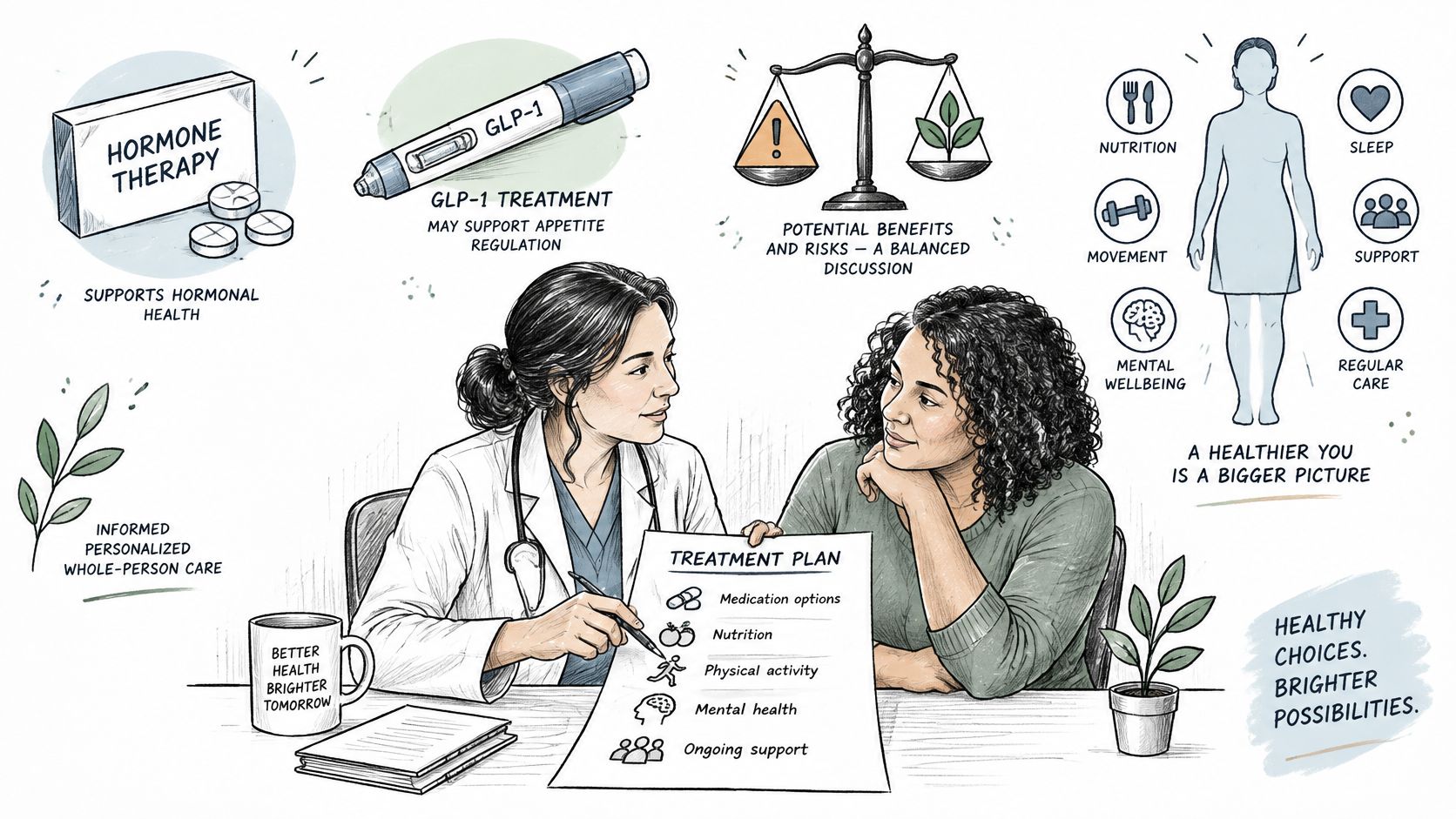
A clinical review reports that a Cochrane analysis of 28 randomized trials involving 28,559 women found no evidence that estrogen or combined estrogen-progestogen therapy prevents menopause-related weight gain or produces additional weight loss (review in PMC). What it may do is limit central fat accumulation and preserve body composition, while easing night sweats and sleep disruption that indirectly make eating well and moving more possible. Those are real benefits. They just aren't weight loss, so the decision belongs with symptoms and overall risk, not the scale.
GLP-1 medicines are a different conversation. Trial averages run roughly 8 to 10% weight loss for liraglutide, about 15% for semaglutide, and up to 20% for tirzepatide (clinical review in Climacteric). Direct evidence in perimenopausal women who also use hormone therapy is thinner than the internet suggests. One retrospective cohort found semaglutide users on hormone therapy lost 11.6% of body weight by 15 months versus 9.7% among nonusers, and an observational design like that can't establish that hormone therapy caused the gap.
The hormone therapy plus GLP-1 question
A 2025 real-world study of 120 postmenopausal women found that those using tirzepatide plus menopausal hormone therapy lost 17% of body weight over a median 18 months, compared with 14% among those using tirzepatide alone, as published by the Endocrine Society. Promising, and still not a reason to add a prescription for weight purposes alone. Larger randomized work has to confirm it.
Before starting any of these medicines, get answers to four questions: is it appropriate before menopause is complete, how will muscle be protected during rapid loss, what happens after you stop, and how will bone health, glucose and body composition be monitored along the way. Our guide to GLP-1 weight loss in perimenopause covers the monitoring schedule.
If you want a clinician's framing of how hormone therapy fits alongside weight treatment, this short video is a useful primer before your appointment.
▶ PlaySome symptoms warrant a prompt visit rather than a wait-and-see approach: rapid unexplained weight gain, new swelling, persistent fatigue, low mood that doesn't lift, or heavy or irregular bleeding. Bring your log to that appointment, because two weeks of dated entries is more useful than a recollection.
Book a Clinician Visit Before You Change Your Treatment
The single next move is an appointment, not another supplement. Book it, and bring four weeks of weight, waist and symptom data, a list of every medication you take, and anything else in the mix: hormone therapy, supplements, weight-loss medicines, sleep aids. That stack of information is what turns a vague conversation into a plan.
Ask specifically for thyroid function, fasting glucose or A1c, and blood pressure. Raise sleep symptoms directly, since apnea is common in midlife and produces weight gain, fatigue and low mood that get misread as hormones. If hormone therapy or a GLP-1 medicine is on the table, ask what bone health monitoring looks like before you start.
- What to bring: four weeks of weekly weights, monthly waist measurements, chair stand counts, and a symptom and sleep log.
- What to ask: which of my symptoms are hormonal, which need their own workup, and what will we measure at twelve weeks?
- What to flag: anything rapid, new, or paired with swelling, fatigue or bleeding changes.
Lila is one optional tool for the middle step. The daily check-ins and meal logging keep weight, waist, symptoms, sleep and alcohol in one place, so the record is ready when you sit down with your clinician. Our protocols are nutrition guidance, and for medical questions such as HRT, prescriptions or any health condition, we'll always point you to your doctor. Lila was built with Rebecca R., MSc, RD, a registered dietitian specializing in perimenopause nutrition, and it isn't a substitute for medical advice.
Set a twelve-week checkpoint with yourself. If waist, strength and sleep haven't moved by then, that's information, not failure. Ask for the plan to be reviewed rather than abandoned.
A plan you can keep for a year beats an aggressive one you abandon in six weeks.
Lila turns the plan in this guide into something you can run on a Wednesday: a two-minute setup where you share your symptoms, goals and stage, then daily check-ins that track weight, waist, sleep, hot flashes and the meals that set them off, with a 24/7 coach keeping you accountable between appointments. It's built for the middle ground this article describes, where food, training and sleep do most of the work and medical decisions stay with your clinician. Start at Lila and bring the log to your next appointment.
Get Lila, your personal coach for perimenopause.
Built for women in their 40s. 24/7 coaching, in your pocket.
