
Treatment for Menopausal Fatigue: What Actually Works
Learn which treatment for menopausal fatigue fits your cause: CBT-I, exercise, blood tests, hormone options and when to see a doctor.
You've had breakfast, answered a few messages, and already feel as though you've used up your energy for the day. At night, you're exhausted but awake, or you sleep through and still get up feeling unrefreshed. It's tempting to blame hormones and look for something that will give you a boost.
Effective treatment for menopausal fatigue starts with identifying what's draining you. Night sweats, insomnia, depression, anemia, thyroid disease, and sleep apnea call for different treatments. You don't need to fix everything at once, but you do need a plan that matches the cause rather than another supplement chosen on guesswork.
Table of Contents
- Find the Driver Behind Your Fatigue
- Compare Treatments by What Drives Your Fatigue
- Fix Sleep First With a Six-Week CBT-I Plan
- Build an Exercise Plan Your Energy Can Handle
- Nutrition and Daily Pacing That Protect Your Energy
- Track Progress Against Measures That Matter
- Book Your First Clinician Visit This Week
Find the Driver Behind Your Fatigue
Fatigue is a symptom, not a diagnosis. Menopause may be part of the explanation, but it shouldn't stop your clinician from checking for other conditions. This clinical review of menopause-related sleep disturbance emphasizes evaluating coexisting sleep disorders and medical contributors rather than attributing daytime exhaustion to hormonal changes alone.
Use your pattern of tiredness to organize the conversation. These are possibilities to investigate, not diagnoses you can make from symptoms.
Fatigue patterns, likely drivers and first checks
| Pattern you notice | Likely driver | First check or step | Escalate when |
|---|---|---|---|
| Tired after night sweats or repeated waking | Vasomotor sleep disruption | Log hot-flash timing and wake-ups | Sweats repeatedly soak bedding, or you're dizzy on standing |
| Trouble falling or staying asleep, unrefreshed on waking | Insomnia | Start a sleep diary and discuss CBT-I | Sleep difficulties persist or impair daily functioning |
| Low mood, loss of interest, constant worry | Depression or anxiety | Clinician screening for both | Any thoughts of self-harm need urgent help |
| Heavy periods, pale skin, breathless on stairs | Anemia | Discuss a blood count and ferritin test | Ongoing heavy bleeding needs prompt review |
| Loud snoring, gasping, daytime sleepiness | Sleep apnea | Ask about a sleep-study referral | You're falling asleep while driving |
| Cold intolerance, weight change, dry skin | Thyroid disease | Discuss a TSH blood test | Symptoms are worsening or interfering with daily life |
Separate exhaustion from sleepiness
Feeling physically depleted isn't quite the same as struggling to stay awake. Tell your clinician whether you lack stamina, could fall asleep unintentionally, feel mentally slowed, or experience a mixture. That distinction helps guide the assessment.
Night sweats followed by wakefulness suggest a different starting point from lying awake without feeling hot. Similarly, low motivation alongside loss of pleasure deserves a mood assessment, not an instruction to exercise harder.
Heavy bleeding makes a blood count and iron assessment worth discussing. Cold intolerance and dry skin warrant a different conversation; this guide to hypothyroidism and menopause can help you organize overlapping symptoms.
Bring the full context
Check whether tiredness began after a new medicine or a dose change. Bring prescription medicines, over-the-counter sleep aids, antihistamines, and supplements to the review rather than stopping them yourself.
For background before an appointment, ProMD Health Bethesda's a patient guide to hormone wellness can help you prepare questions about hormonal symptoms. It doesn't replace an assessment of persistent fatigue.
Practical rule: If fatigue is persistent, disproportionate, or limiting ordinary activities, book a medical review before experimenting with supplements or restrictive diets.
Don't drive when you're struggling to stay awake. Chest pain, severe breathlessness, fainting, or immediate risk of self-harm requires urgent help rather than a routine menopause appointment.
Compare Treatments by What Drives Your Fatigue
Fatigue treatments compared by fit, evidence and timing
| Treatment | Best fit | Evidence for fatigue | Time to judge | Clinician involvement |
|---|---|---|---|---|
| CBT-I | Insomnia-driven fatigue, with or without hot flashes | First-line for insomnia; can improve daytime fatigue | After completing the structured course | Clinician or appropriately qualified program |
| Menopause hormone therapy | Night sweats disrupting sleep | Better perceived sleep; objective improvements less consistent | At an agreed treatment review | Individual benefit and risk assessment required |
| Nonhormonal vasomotor treatments | Disruptive hot flashes when hormones are unsuitable or unwanted | Targets a potential cause of interrupted sleep | Medication-specific review | Prescribing clinician |
| Sleep apnea assessment and treatment | Snoring, gasping, daytime sleepiness | Addresses confirmed apnea, not menopause itself | After treatment is established and reviewed | Sleep assessment and follow-up |
| Exercise program | Reduced conditioning, poor sleep, low mood | Supportive; no single exercise type proven best | After a consistent, tolerable trial | Seek clearance for relevant health concerns |
| Correcting anemia or thyroid disease | Confirmed abnormalities | Treats an identified medical contributor | Symptom review alongside repeat tests | Diagnosis and treatment monitoring required |
| Testosterone for fatigue | Not recommended | Not an evidence-based fatigue treatment | Not applicable | Don't use for this purpose |
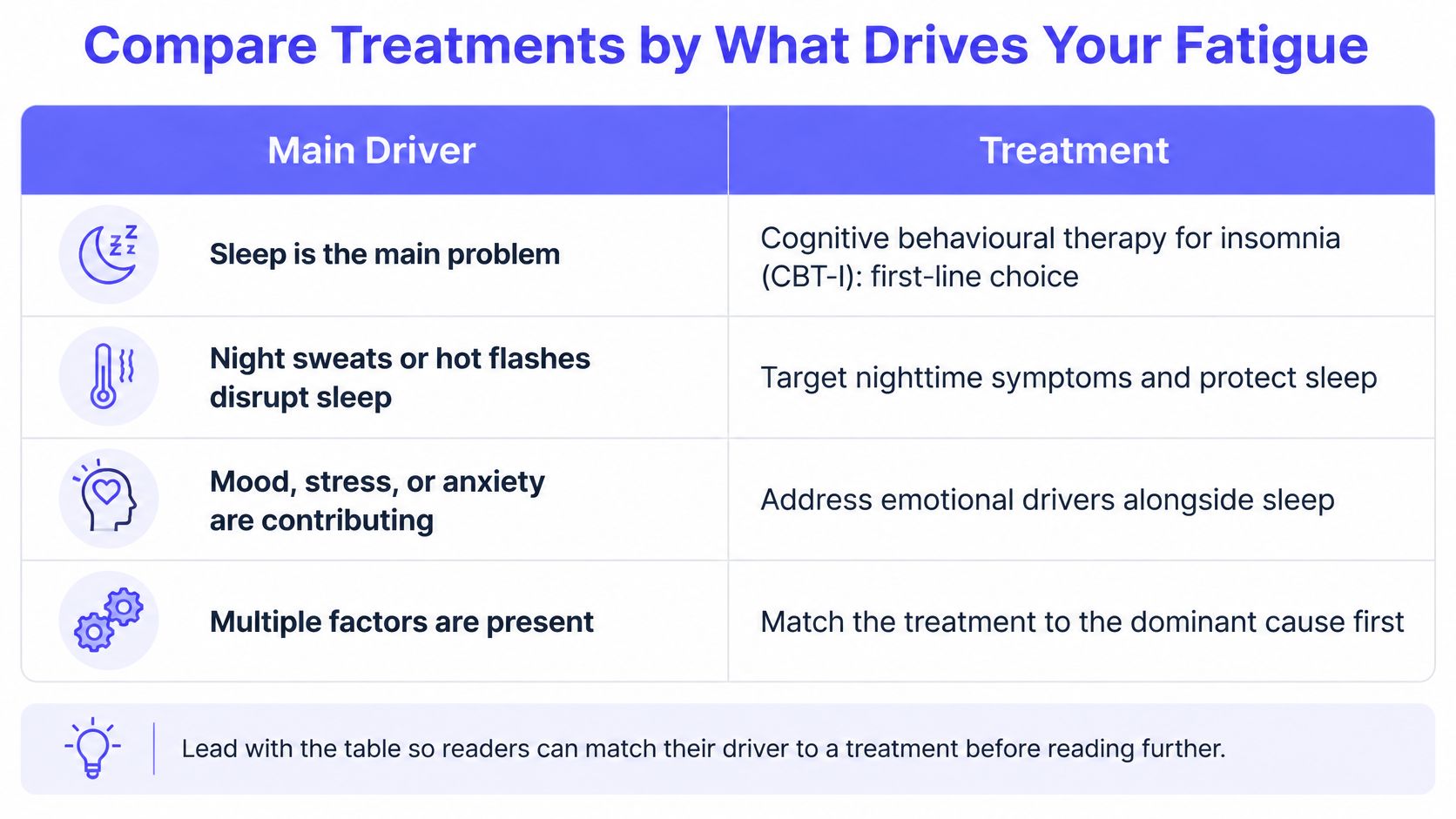
The central distinction is treating insomnia versus treating the symptoms that interrupt sleep. The British Menopause Society's sleep-disturbance guidance describes CBT-I as first-line care, with benefits commonly emerging after 6–8 weeks, while hormone therapy improves perceived sleep more consistently than objective sleep measurements.
This visual summarizes how the main driver changes the treatment choice.
When hormones fit and when they don't
If night sweats repeatedly wake you, menopause hormone therapy may address an important contributor. But if you're exhausted without disruptive hot flashes, HRT isn't a dependable general energy treatment. Feeling more rested and objectively sleeping longer aren't interchangeable outcomes.
NICE's menopause recommendations support discussing menopause-specific CBT for sleep problems and depressive symptoms, alongside individualized treatment decisions. Your medical history, treatment preferences, contraindications, and the symptoms you want to improve all matter.
Nonhormonal treatments can be appropriate when vasomotor symptoms are the target and hormones aren't suitable or preferred. Ask about expected benefits, side effects, interactions, and what would justify changing treatment.
Match the review to the treatment
Before starting, write down a baseline: what can't you comfortably do now, and what would meaningful improvement look like? Agree on a reassessment date rather than continuing indefinitely because a treatment might eventually help.
If you want to explore perimenopause care options, Sunridge Medical's overview can help frame questions for a consultation. Always talk to your doctor about HRT, hormone testing, or any health condition.
Some women need combined treatment. Night sweats may respond to menopause treatment while established insomnia still needs CBT-I. Testosterone, meanwhile, shouldn't be offered as an energy booster; its evidence-based indication is hypoactive sexual desire disorder, not fatigue.
Fix Sleep First With a Six-Week CBT-I Plan
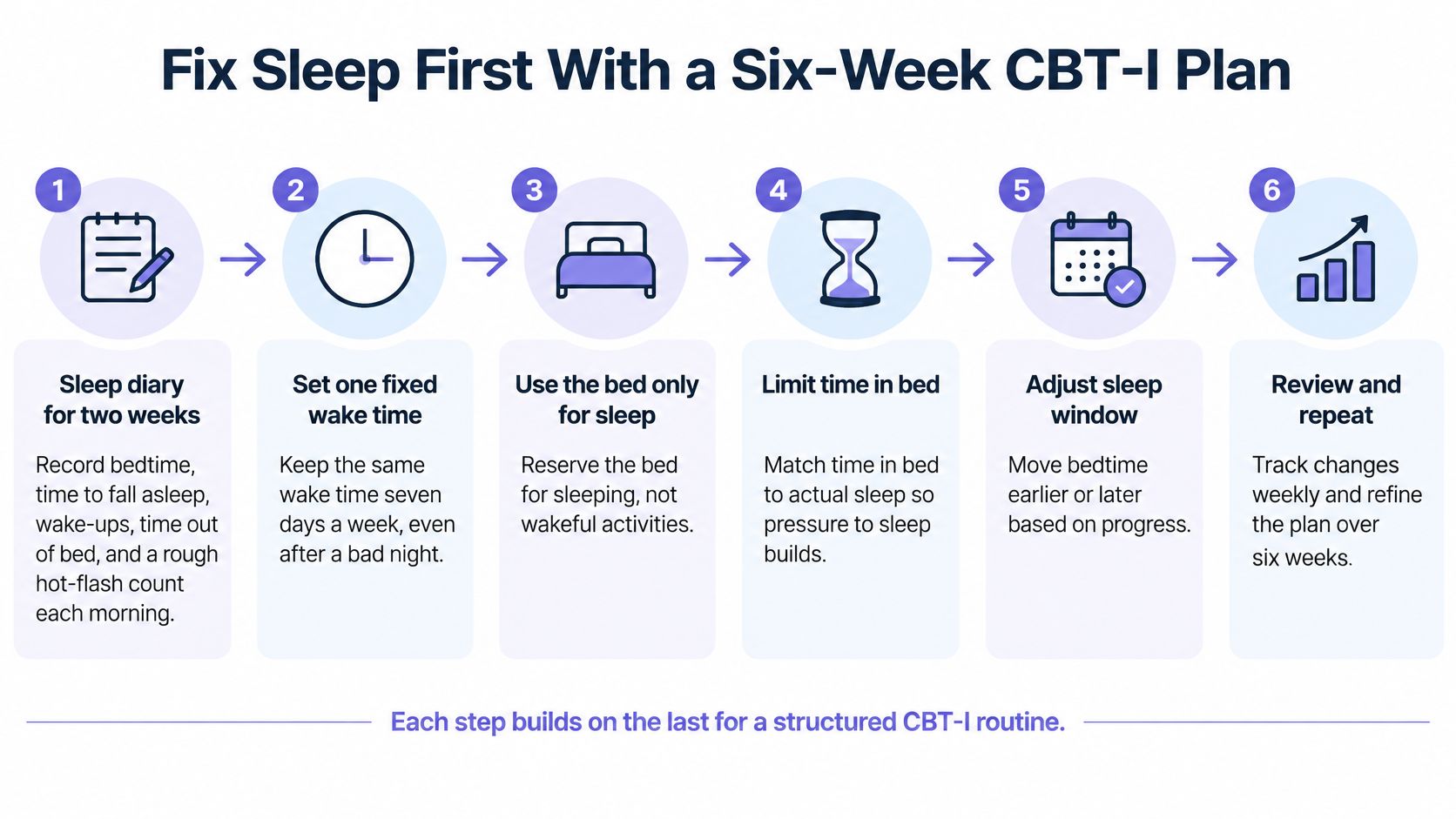
CBT-I is a structured treatment, not just better bedtime habits. It combines behavioral changes with work on the thoughts and habits that maintain insomnia. In a randomized study of 88 women described in Medscape's report on menopause-related insomnia treatment, CBT-I and sleep-restriction therapy reduced insomnia and fatigue, with the more durable insomnia benefit from CBT-I at 6 months.
Use the following as an outline to discuss with a qualified practitioner, not a prescription to cut your sleep aggressively.
Build the routine without making yourself unsafe
Record your starting pattern. Keep a diary of bedtime, estimated time asleep, awakenings, getting-up time, and night sweats. The common slip is tracking only a bad night, which gives an incomplete picture.
Choose a consistent wake time. Keep it steady across the week so your schedule becomes predictable. The slip is compensating for every difficult night by repeatedly moving your morning later.
Reconnect the bed with sleep. If you're awake and becoming frustrated, get up for a quiet activity in dim light and return when sleepy. Don't turn the break into work, scrolling, or clock-watching.
Adjust time in bed with supervision. Your practitioner may use sleep compression or restriction based on the diary, then adjust the sleep window as you improve. Cutting too hard can worsen daytime impairment, so report increasing sleepiness promptly.
Work on sleep-related worry. Write down the feared outcome, then examine it against your actual sleep and daytime functioning. The slip is trying to force positive thinking rather than developing a balanced, believable response.
Practice a repeatable wind-down. Try slow breathing or progressive muscle relaxation before bed, then review both sleep and daytime fatigue with your practitioner. Don't treat a soothing routine as a substitute for the rest of CBT-I.
For help recognizing patterns around sleep disruption during menopause, distinguish awakenings caused by heat from wakefulness that continues after you've cooled down.
The accompanying video offers another format for exploring the topic.
▶ PlayBetter sleep without better daytime functioning is a reason to reassess the fatigue, not to keep tightening your sleep schedule.
Build an Exercise Plan Your Energy Can Handle
Exercise can support recovery, but it isn't a guaranteed fatigue cure. A 2024 overview of 17 systematic reviews, covering 80 unique primary studies and 8,983 participants, found the strongest exercise evidence base for yoga's effects on overall menopausal symptoms, while aerobic findings were mixed and evidence for resistance training was limited.
The reviewers couldn't recommend a single exercise type over another. That matters because improvements in total menopausal symptoms don't prove that a particular workout directly treats unexplained exhaustion.
Build around recovery, not ambition
Choose a manageable mixture rather than searching for the perfect class:
- Aerobic movement: Walk or cycle at an effort that still allows conversation. Finish feeling that you could have done a little more.
- Strength work: Use chair squats, wall push-ups, resistance-band rows, or light weights, with recovery between sessions.
- Lower-energy days: Substitute gentle yoga, mobility work, or an easier walk instead of forcing the original workout.
- Progression: Add duration or resistance only when your current routine doesn't leave you noticeably worse afterward.
A menopause workout plan can help organize these choices, but your starting point should reflect what you can recover from now, not what you managed before fatigue began.
Judge the next day too
Say you start walking after dinner and add brief strength sessions when you feel rested. Better sleep or easier stair climbing may appear before you describe yourself as energetic. Those are useful outcomes, even if the afternoon slump hasn't disappeared.
The opposite pattern needs attention. If each session leaves you unusually depleted into the following day, reduce the load and discuss the response with your clinician. Don't repeatedly push through marked deterioration on the assumption that more exercise must help.
Recovery check: A useful program makes ordinary life more manageable. It shouldn't consume the energy you need for work, meals, and basic self-care.
Avoid the extremes of sudden hard training and abandoning all movement. Exercise works best here as a monitored support strategy alongside treatment of the condition driving fatigue.
Nutrition and Daily Pacing That Protect Your Energy
Start with meals you can repeat when you're tired. Include a protein food at breakfast and other meals, pair carbohydrate foods with protein or fiber, and avoid letting a busy day turn into skipped lunch followed by an oversized evening meal.
These are practical experiments, not a cure for menopausal fatigue. Notice whether your afternoon slump follows a particular meal pattern, whether evening alcohol coincides with worse sleep, or whether late caffeine leaves you alert at bedtime. Change the suspected trigger rather than cutting out whole food groups.
Make food easier before making it stricter
- Breakfast: Try oats with Greek yogurt and berries, or eggs with wholegrain toast.
- Lunch: Combine lentils or beans with vegetables and a satisfying carbohydrate, rather than relying on coffee and snacks.
- Evening: Keep an easy backup meal available, such as frozen vegetables with tofu, fish, or beans and microwaveable grains.
- Drinks: Experiment with an alcohol-free evening and earlier caffeine, recording how you sleep rather than assuming either change will solve everything.
A practical menopause diet plan should fit your appetite, budget, and medical needs. Ask a clinician or registered dietitian to tailor changes if you have diabetes, kidney disease, or medicines affected by food.
Our perimenopause nutrition lead, Rebecca Rumsey, MSc, RD, is a Registered Dietitian. Nutrition guidance can help you organize meals, but it shouldn't be used to explain away unexplained breathlessness, bleeding, or persistent exhaustion.
Spend energy deliberately
Schedule demanding tasks during your better hours, and split large jobs into smaller pieces. Pause before you're completely depleted rather than treating rest as something you earn only after finishing everything.
A copyable day might include a prepared breakfast, a proper lunch, a comfortable walk if tolerated, and an evening meal that doesn't require extensive cooking. Keep the wind-down simple enough to repeat on a difficult day.
Don't start iron or other supplements solely because you're tired. Ask what deficiency or clinical indication you're treating, and how you'll know the supplement is needed.
Track Progress Against Measures That Matter
A single difficult afternoon can make a useful treatment feel pointless. A small, consistent record is more informative than trying to remember whether this week felt better than the last.
Use a journal, spreadsheet, or app you'll open. The important part is recording the same measures in a similar way.
Progress measures, how to record them and what improvement looks like
| Measure | How to record it | Check frequency | Sign it is working |
|---|---|---|---|
| Energy rating | Use the same personal scale, with clear low and high anchors | Daily, reviewed weekly | Sustained improvement across several weeks |
| Sleep efficiency | Hours asleep divided by hours in bed, from your sleep diary | Weekly | More consolidated sleep without worsening daytime sleepiness |
| Night sweats | Count awakenings caused by sweating | Nightly | Fewer disrupted nights |
| Daytime sleepiness | Epworth Sleepiness Scale | At baseline and agreed reviews | Score falling alongside safer daytime alertness |
| Mood | Short validated depression and anxiety screen | At clinician-agreed intervals | Stable or improving scores |
| Activity | Aerobic activity and completed strength sessions | Weekly | Consistency without repeated crashes |
Add a real-life outcome
Include something that matters outside the diary: finishing a grocery shop without needing to lie down, concentrating through a meeting, or preparing dinner comfortably. Better numbers are useful only if they correspond to safer, more manageable days.
Keep context brief. Note a medication change, illness, unusually demanding workday, or disrupted night, but don't turn tracking into another exhausting task.
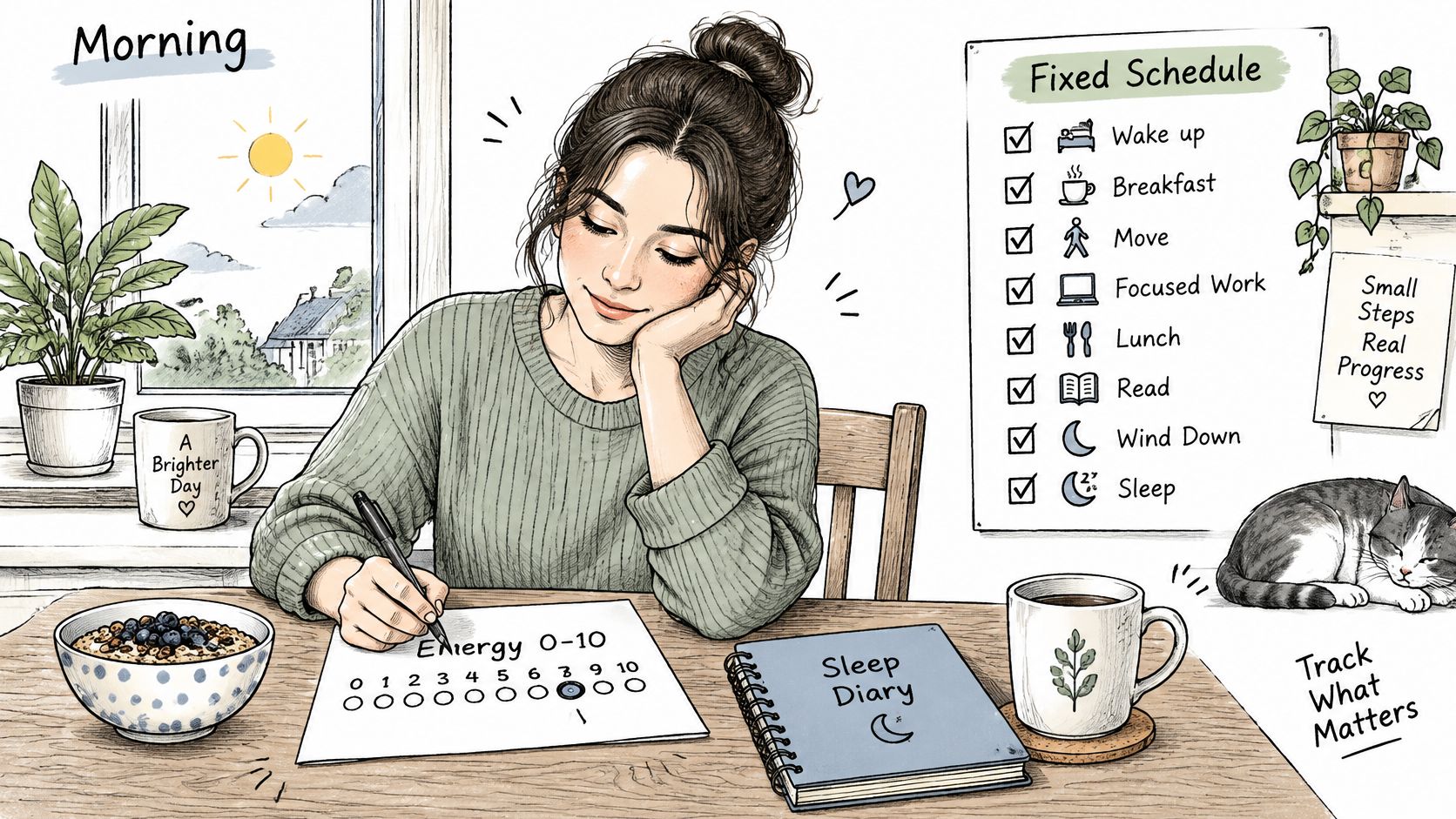
A simple morning entry can keep the record manageable.
Interpret trends, not isolated scores
We bring symptoms, sleep, mood, energy, and meals together in Lila, with a 24/7 chat-based coach that can support consistent check-ins. Whatever tool you choose, take a concise summary to your appointment rather than expecting your clinician to interpret an unfiltered archive.
Improvement doesn't require every measure to move together. Fewer night sweats with unchanged exhaustion may mean the vasomotor treatment is helping but another contributor remains.
If nothing improves by the agreed review, don't change several treatments simultaneously. Bring the record back and ask whether the diagnosis, treatment fit, dose, adherence, or side effects need reconsideration.
Book Your First Clinician Visit This Week
You don't need a perfect symptom diary before asking for help. Book the appointment now, then collect whatever information you can before you attend. Fatigue that interferes with your daily life deserves assessment even if you're unsure whether menopause is involved.
A focused visit is more useful than arriving with the single description that you're tired all the time. Prepare a short written agenda so the most important concerns don't get lost.
Bring questions that lead to decisions
- Name your main limitations: Describe the symptoms disrupting your life most, when they began, and what you can no longer do comfortably.
- Show the pattern: Bring sleep notes, night-sweat records, mood observations, and your energy log, even if they're incomplete.
- Ask about targeted testing: Discuss a blood count, ferritin, thyroid testing, or sleep-apnea assessment when your symptoms suggest them. Not everyone needs every test.
- Review medicines: Include anything started or changed around the time fatigue appeared, including nonprescription products.
- Agree on the treatment target: Ask whether the priority is insomnia, vasomotor symptoms, mood, a confirmed deficiency, or another medical condition.
- Set the next review: Establish when to return, what improvement to expect, and which symptoms should prompt earlier contact.
A comprehensive health assessment can help frame the broader discussion. The aim isn't to collect tests indiscriminately; it's to investigate plausible causes and avoid repeatedly treating the wrong one.
Leave with a clear next step
Before the appointment ends, make sure you know what to start, what to monitor, and whom to contact if you feel worse. Ask whether a proposed treatment could itself cause sedation or affect your ability to drive.
Lila isn't a substitute for medical advice, and you should always consult your doctor about perimenopause symptoms. Supportive habits can begin alongside assessment, but they shouldn't become a reason to postpone it.
Today, book the visit and write down your most disruptive symptom. Then choose a manageable starting action, such as keeping tomorrow's wake time consistent or recording how rested you feel on waking.
Visit Lila for a perimenopause nutrition plan alongside meal logging and symptom tracking to support your fatigue-care routine. Setup takes 2 minutes: share your symptoms, goals, and stage, then use your plan and check-ins to organize practical changes alongside your clinician's care.
Get Lila, your personal coach for perimenopause.
Built for women in their 40s. 24/7 coaching, in your pocket.