
Why Menopause Weight Gain Happens and What to Do
Discover why menopause weight gain happens, from hormones to muscle loss, and get clinician-aligned strategies to manage weight, sleep, and metabolism
You're standing in front of your closet, pulling on jeans that fit last season. The zipper closes, but barely, and the waistband digs in by midmorning. You haven't changed how you eat. You haven't quit moving. Yet your middle feels different, your sleep is broken, and the scale offers no useful explanation. That confusion is where most women start when they ask why menopause weight gain happens.
Table of Contents
- The Closet Moment That Raises the Question
- What Hormones, Sleep, and Stress Are Really Doing
- The Transition Report Card in Numbers
- How Body Composition Quietly Reshapes Your Day
- Five Clinician-Aligned Habits That Move the Needle
- When to Consider HRT and a Medical Review
- Tracking Progress With Waist, Strength, and Daily Data
- A Calmer Way to Think About Midlife Weight
The Closet Moment That Raises the Question
The jeans are the clue, not the scale. Many women in their 40s and 50s notice tighter waistbands, softer arms, and less muscle definition while their weight barely budges. Others see the number creep up slowly and assume they've lost discipline. Both experiences can be true at once, because four separate stories are unfolding in parallel.
Four Stories Running at the Same Time
Think of your body as telling four stories instead of one. The scale story is total weight, which often changes slowly and steadily with aging. The fat location story is where new fat settles, increasingly around your abdomen rather than your hips and thighs.
The muscle story is how much lean tissue you're keeping, since muscle supports strength and daily calorie burn. The metabolism story is how much energy you spend at rest and during ordinary activity. When you lump all four together, you chase the wrong target and miss what's shifting.
Scale weight is one signal among four, not the verdict.
That reframe changes the questions you ask. Instead of wondering why you can't eat less, you start asking whether you're protecting muscle, whether your waist is changing, and whether poor sleep is driving appetite the next day. Instead of judging a single weigh in, you look for patterns across weeks.
By the end of this guide, you'll have a plain English model of the biology and a clinician aligned plan you can start this week. You'll know which numbers matter, which habits address the right lever, and when a medical review makes sense. You don't need a stricter diet. You need a clearer map.
What Hormones, Sleep, and Stress Are Really Doing
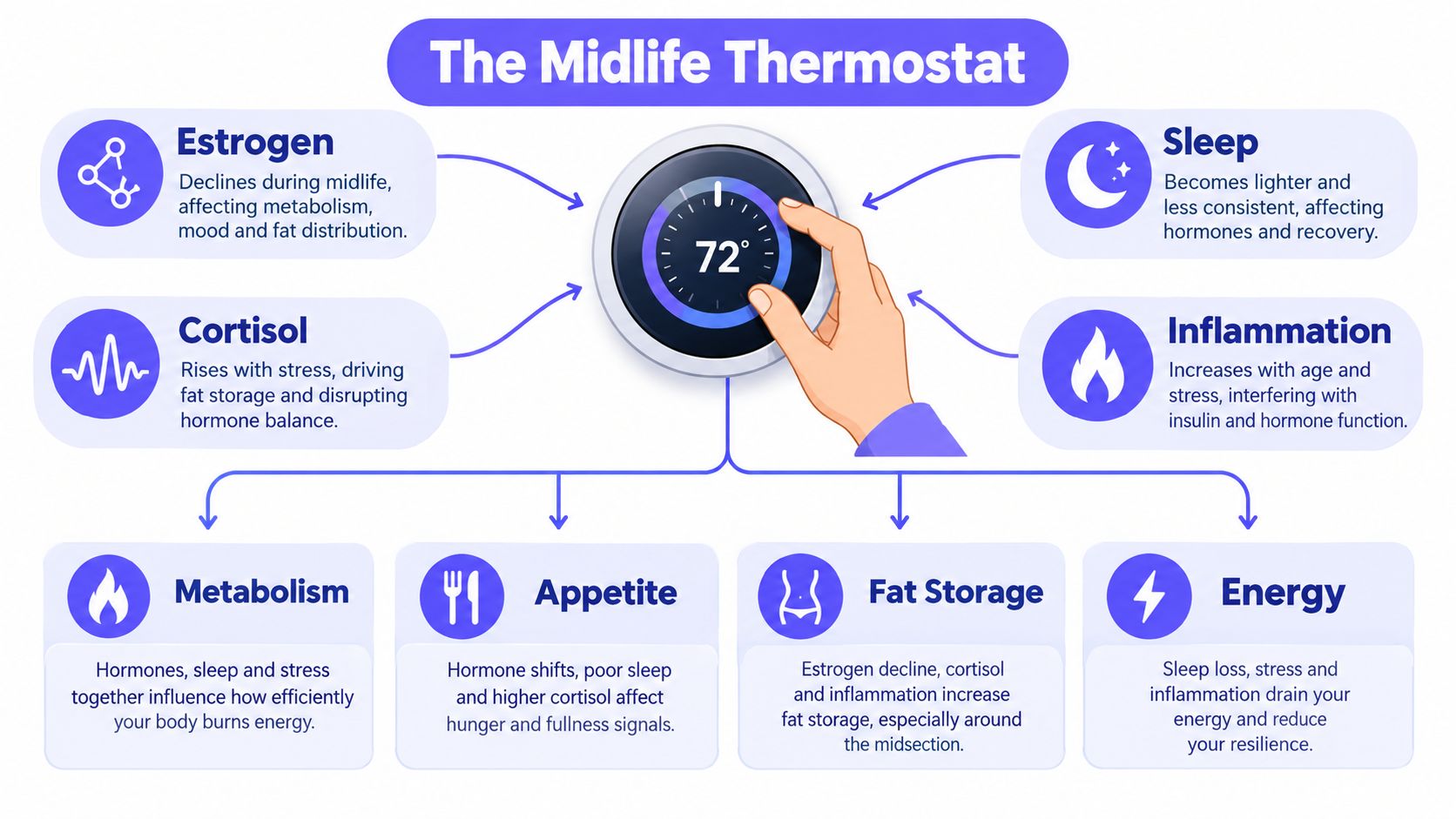
A helpful analogy is a household thermostat being recalibrated while you're still living in the house. For years, estrogen helped set the temperature for fat storage, appetite, and energy use. During perimenopause, that setting fluctuates, then settles lower. Other systems notice the change and adjust around it, sometimes clumsily.
The diagram below shows how four inputs converge on the same shared levers.
Estrogen Changes the Storage Instructions
Declining estrogen doesn't add fat everywhere. A major review links reduced estrogen with increased total and visceral fat, altered energy expenditure, and changes in spontaneous activity, as described in research on estrogen decline and visceral fat redistribution. Visceral fat sits deep in the abdomen around your organs. It's metabolically active and associated with insulin resistance and cardiometabolic risk, which is why location matters more than a small change in total weight.
You feel this as a belly that appears even though your legs look similar. You may also notice energy dips after meals, because poorer insulin sensitivity makes glucose handling less smooth. That's the thermostat favoring storage in a new place, not a sudden failure of willpower.
Sleep, Cortisol, and Inflammation Turn the Same Dial
Hot flashes and night sweats fragment sleep, and fragmented sleep raises next day hunger and cravings. The 3 a.m. wake up becomes the afternoon sugar search. If that's familiar, practical strategies in guidance on sleeping better during perimenopause can help you protect the night so the day feels steadier.
Stress adds another turn of the dial. Cortisol, your main stress hormone, favors abdominal storage and can increase appetite when stress is chronic. Low grade inflammation, often tied to visceral fat itself, nudges insulin resistance further. These aren't separate problems. They're four hands on one thermostat, all pushing fat storage, appetite, and energy in the same direction.
That's why broad, sustainable menopause weight gain lifestyle changes tend to work better than a single fix aimed at calories alone. Sleep, movement, food quality, and stress care each ease a different hand off the dial.
The Transition Report Card in Numbers
Numbers help when they're translated into what you'd notice. The Study of Women's Health Across the Nation, known as SWAN, followed midlife women over time instead of taking a single snapshot. Its pattern separates gradual aging from the menopause transition itself, which is the distinction most women are missing.
Before the transition, average fat mass gain was about 0.25 kg per year, and during the transition it accelerated to 0.45 kg per year, according to SWAN longitudinal body composition findings. Across roughly 3.5 years, that added up to about 1.6 kg of fat, a 6% cumulative increase in fat mass. Lean mass began to decline during the same window, and these changes continued until about two years after the final menstrual period.
Why the Scale Looks Calm While Your Waist Changes
Weight itself didn't suddenly jump at menopause in that cohort. Average weight gain during the transition was about 0.25 kg per year, and the overall trajectory eventually flattened after menopause. In other words, fat replaced lean tissue faster than total weight rose. You can weigh nearly the same and still need a larger waistband.
Other longitudinal evidence shows the same central shift. A review summarizing SWAN data reported annual weight increased by about 0.6% and waist circumference by approximately 1% among 543 women aged 42 to 52, as detailed in a review of central adiposity during the menopause transition. Lean mass rose about 0.2% per year before the transition, then declined about 0.2% per year during it.
| Stage | Body Weight | Fat Mass | Lean Mass | Waist Circumference |
|---|---|---|---|---|
| Pre-menopause | Slow, steady rise with aging | Slower annual gain | Stable or slightly rising | Slower change |
| During transition | About 0.25 kg per year on average | Faster gain, about 0.45 kg per year | Begins to decline | Rises faster than weight |
| Post-menopause | Trajectory eventually flattens | Gain slows after about two years past final period | Decline slows | Central pattern persists |
Read the table as a substitution story, not a sudden weight explosion. Fat gain speeds up, muscle slips, and the waist reflects both. That's also why understanding what metabolic health actually means matters more than hitting an old scale number. Metabolic health captures glucose control, blood pressure, lipids, and waist, the markers visceral fat influences most.
Practical rule: If your weight is stable but your waist is rising, your body composition is changing, and that change deserves attention.
How Body Composition Quietly Reshapes Your Day
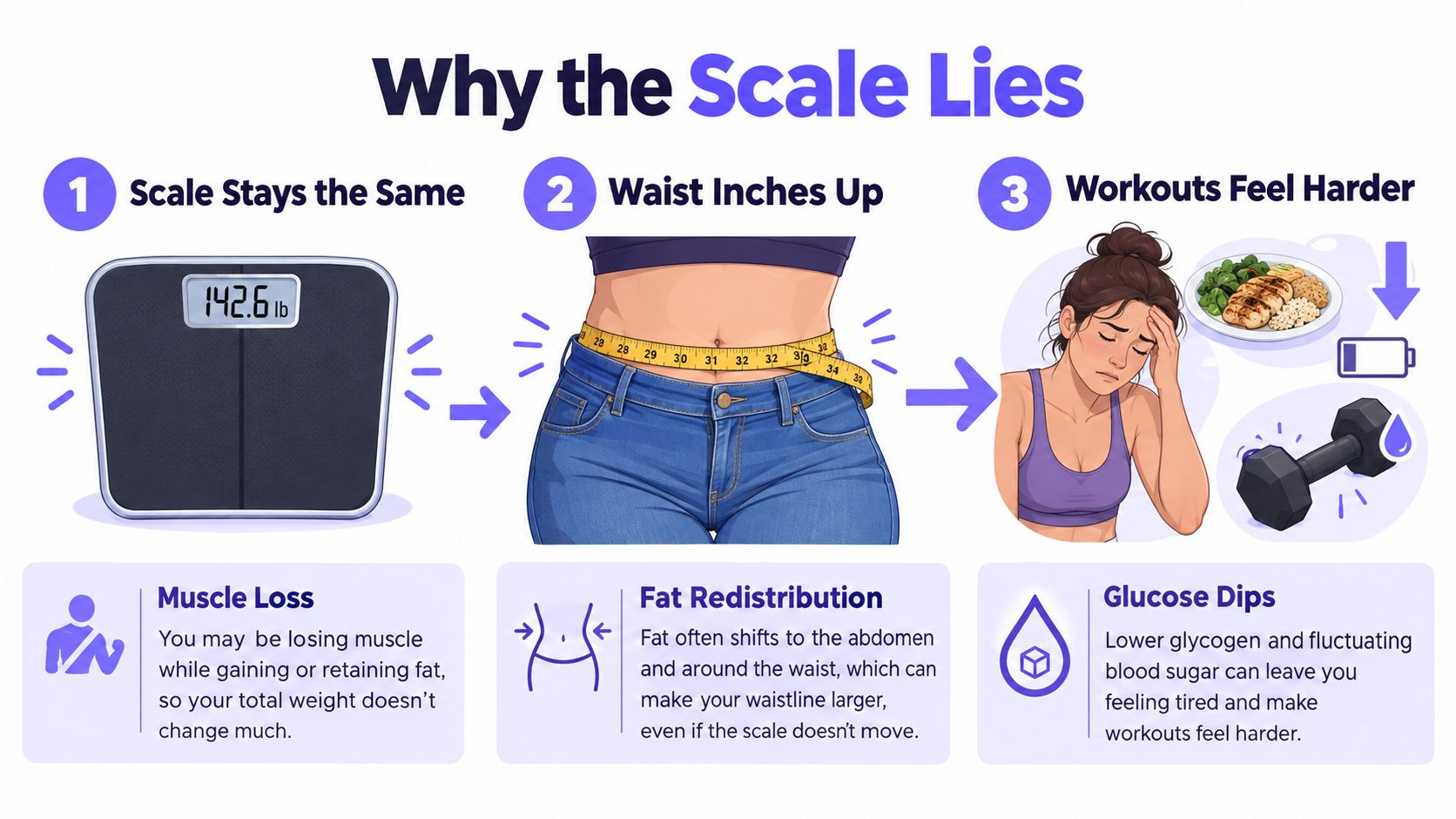
Body composition explains ordinary moments that feel mysterious. Jeans tighten at the waist while the scale stays put because fat has moved centrally and muscle has thinned elsewhere. A familiar workout feels draining because you have less lean tissue doing the work. You feel sleepy after lunch because glucose rises and falls less smoothly when insulin sensitivity drops.
The visual below connects those three familiar experiences to their biological reasons.
The Small Daily Energy Gap
In a longitudinal comparison, women who underwent natural menopause lost approximately 3.0 kg of fat free mass versus 0.5 kg in women who remained premenopausal, and their resting metabolic rate fell by about 103 kcal per day versus 8 kcal per day, according to a controlled study of energy balance at menopause. Leisure time physical activity also declined by roughly 127 kcal per day in that group. They gained about 2.5 kg of fat and showed increased fasting insulin.
Translate that into daily life. You burn a little less at rest because muscle is metabolically active tissue. You move a little less, often because sleep is poor, joints ache, or life is busy. If your eating stays exactly the same, a modest surplus appears without any obvious overeating. No single meal caused it. The gap is quiet and cumulative.
What to Watch Instead of Daily Weigh Ins
Daily weight swings mostly reflect water, bowel timing, and yesterday's salt. They tell you almost nothing about visceral fat or muscle. A truer weekly picture comes from measures tied to the four stories.
- Waist circumference: Measured the same way each time, it tracks central fat better than weight alone.
- Strength: Reps, resistance, or how a familiar weight feels show whether lean tissue is holding.
- Sleep quality: Wake ups, night sweats, and morning energy predict appetite and activity the next day.
- Post meal energy: Repeated crashes after similar meals can flag glucose patterns worth discussing.
The goalposts shift accordingly. You're not trying to eat as little as possible. You're trying to rebuild lean tissue, keep fat from settling centrally, and align energy intake with a body that now spends a bit less. That shift sets up habits that work with the biology instead of fighting it.
Five Clinician-Aligned Habits That Move the Needle
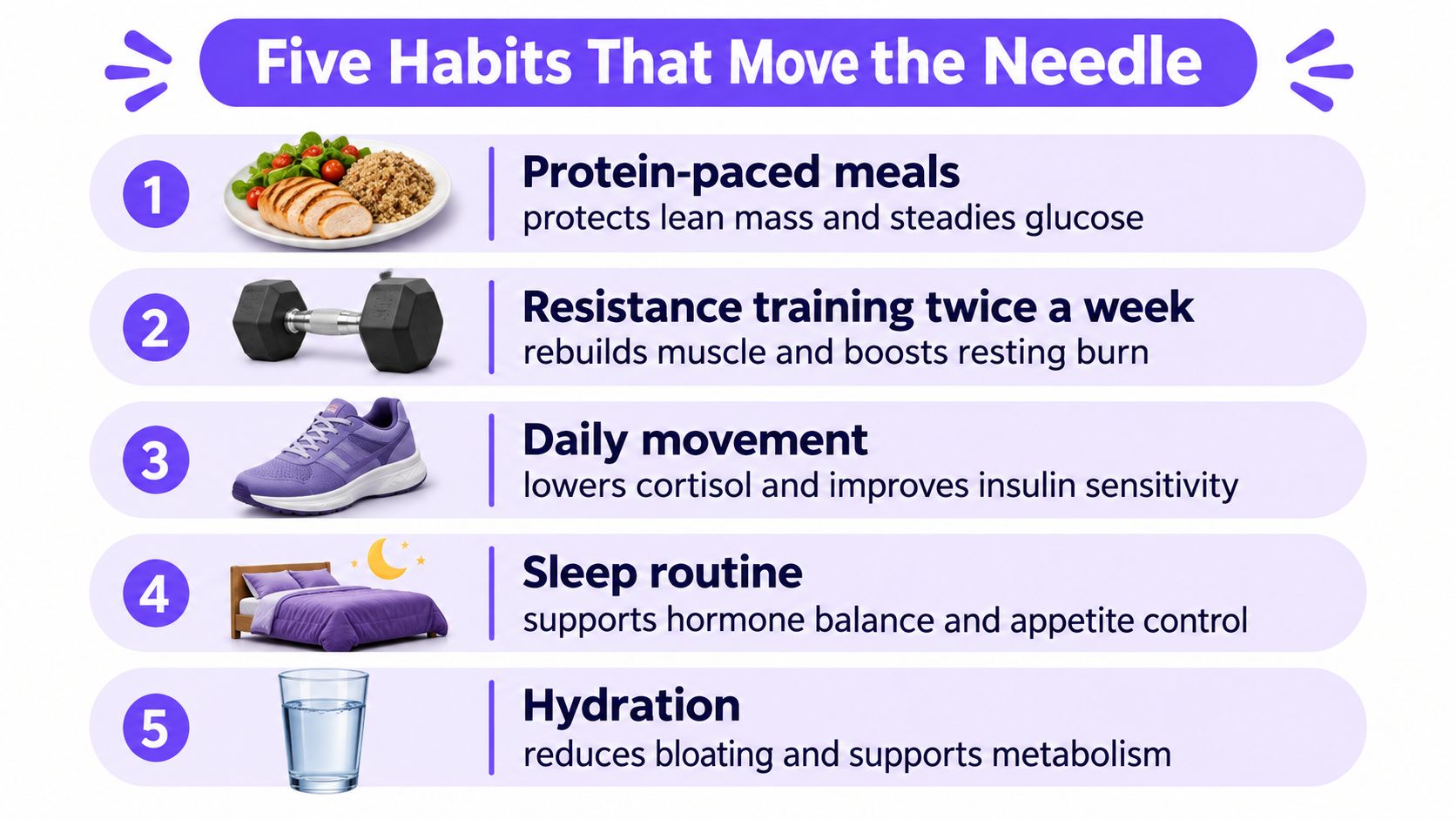
These five habits work as layers, not as a strict plan you pass or fail. Pick the layer that feels most doable, practice it until it's ordinary, then add the next. Each one targets a specific lever from the thermostat model, so progress in one area supports the others.
The summary below shows the five layers at a glance before you choose your starting point.
Protein and Resistance Training Protect the Muscle Story
Protein paced meals give your muscles the building material they need and help steady glucose. Anchor each meal with a clear protein source such as Greek yogurt, eggs, fish, tofu, lentils, or chicken, rather than letting protein appear only at dinner. A realistic start is upgrading breakfast, since many women under eat protein early and then feel ravenous later.
Protein alone can't preserve muscle without a signal to keep it. Progressive resistance training provides that signal by asking muscles to work against gradually increasing challenge. If you're unsure where to begin, a beginner friendly approach to strength training in perimenopause shows how to start safely at home or in a gym. Twice weekly sessions covering major muscle groups, using dumbbells, bands, machines, or body weight, are enough to begin. Track the weight and reps so progressive means something specific, not just tiring.
Sleep, Stress, and Glucose Aware Eating
Treat sleep as a metabolic intervention, not a luxury. Keep a consistent wake time, make the bedroom cool and dark, and give yourself a wind down that doesn't involve scrolling in bed. Better sleep won't melt fat by itself, but it makes appetite, mood, and next day movement far easier to manage.
Stress care works the same lever from another angle. A short walk after a tense meeting, slow breathing before meals, or a yoga session you enjoy can lower the urge to snack for relief. You're not aiming for a stress free life. You're building a reliable off ramp so cortisol doesn't stay high all evening.
Glucose aware eating ties the layers together. Build meals around fiber rich vegetables, protein, and healthy fats, and place larger carbohydrate portions earlier or around activity if that suits your routine. Eat slowly enough to notice fullness. Notice which meals leave you steady for hours and which trigger a crash and craving cycle, then repeat the steady ones more often.
The video below offers a visual walkthrough you can revisit while building your first week.
▶ PlayCompounding is the point. One better breakfast improves afternoon energy. One strength session improves sleep that night. Small layers, repeated, address muscle, appetite, and insulin sensitivity together, which is why they outperform short bursts of aggressive restriction.
When to Consider HRT and a Medical Review
Hormone therapy often enters this conversation with unrealistic expectations. It may influence fat distribution and insulin resistance in some circumstances, but it is not a weight loss treatment, a distinction emphasized in International Menopause Society guidance on menopause and body weight. That guidance also notes estrogen loss is a major contributor to increased abdominal adiposity, even though menopause isn't necessarily responsible for faster overall weight gain. Aging drives much of the scale story. Menopause shapes where fat goes.
Symptoms That Warrant a Conversation
Book a review if hot flashes or night sweats regularly wreck your sleep, mood shifts feel persistent, cycles have changed markedly, or your waist is rising alongside higher blood pressure readings. Bring a short symptom log rather than relying on memory. Note sleep quality, flash frequency, medications, and any new fatigue, hair changes, or unexplained weight shifts, since thyroid problems and other conditions can overlap with menopause symptoms.
If you're weighing treatment options, start by learning what hormone therapy for menopause involves so you can discuss benefits, risks, and timing with your own clinician. Suitability depends on your history, age, time since menopause, and personal risk factors. No article can make that call for you.
What a Thorough Review Usually Covers
- Blood pressure and waist: Simple measures that reflect cardiometabolic risk tied to visceral fat.
- Glucose or HbA1c and lipids: Clinically appropriate checks for insulin resistance and cholesterol changes.
- Thyroid function and medication review: Both can affect energy, weight, and sleep.
- Sleep and mood screening: Poor sleep and low mood change appetite, activity, and adherence to any plan.
Some women also ask about newer weight related medicines. If that is part of your discussion, balanced information on GLP-1 therapy for menopausal women can help you prepare questions about eligibility, side effects, and muscle preservation. Whatever you and your clinician decide, the habits above remain the foundation, because medication decisions work best alongside protein, resistance training, and sleep care, not instead of them.
Tracking Progress With Waist, Strength, and Daily Data
Good tracking matches the biology. You're following four stories, so your log should reflect waist, strength, sleep, and symptoms, not calories alone. Keep it light enough to sustain on a busy Tuesday, or you'll abandon it by Friday.
A Simple Weekly Rhythm
Measure your waist once a week, in the morning, standing relaxed, with the tape at navel level and snug but not compressing the skin. Record the number without judgment and look at the trend over a month. You can also check proportions with a waist to hip ratio calculator if you want a second reference point. Weigh yourself less often, perhaps weekly, and treat it as background data.
Log strength sessions by exercise, weight, and reps so you can see progression. Add a one line sleep note and a brief mood or energy rating each morning. If you're still cycling, note cycle day or symptoms, because perimenopause stage changes water retention, appetite, and sleep in ways that can look like fat gain on a single day.
For women who want objective body composition data beyond tape and scale, options such as DEXA body composition testing in Liverpool illustrate how lean mass and fat mass can be measured directly. Most women don't need frequent scans, but an occasional objective check can confirm whether training and protein are protecting muscle.
A daily check in tool can connect symptoms to habits. Lila offers an AI guided daily check in alongside logging for symptoms, meals, mood, sleep, energy, and cycles, so patterns become visible in one place rather than scattered across notes. Used consistently, that kind of record also makes clinician visits more productive, because you arrive with trends instead of vague impressions.
The dashboard view below shows how symptoms, sleep, meals, and trends can sit together.

Review your data every few weeks, not every hour. Ask three questions. Is my waist trend stable or rising? Is my strength holding or improving? Are my worst appetite days following my worst sleep nights? Those answers tell you which habit layer to strengthen next.
A Calmer Way to Think About Midlife Weight
The goal isn't to force your body back to a number from a decade ago. It's to protect metabolic health, strength, and energy through the transition and beyond. When you separate scale weight from fat location, muscle, and energy expenditure, the path forward stops feeling like punishment and starts feeling like maintenance of tissue that matters.
Start with a four week experiment you can complete.
- One protein habit: Anchor breakfast with a clear protein source every day.
- One strength commitment: Schedule two progressive resistance sessions each week.
- One sleep anchor: Keep the same wake time and a cool, dark bedroom.
- One tracking tool: Log waist weekly and sleep, mood, and workouts briefly each day.
Reassess after four weeks using waist, strength, sleep, and energy, not a single weigh in. Adjust one layer at a time. Knowledge plus steady daily data makes midlife feel manageable again, because you can finally see which story is changing and respond to that story directly.
If your waist, sleep, and strength are telling different stories, Lila can help you track them together with a quick daily check in, symptom and habit logging, and a personalized plan built for perimenopause and menopause. Visit Lila to turn the four story framework in this guide into a simple routine you can follow, review, and share with your clinician.
Get Lila, your personal coach for perimenopause.
Built for women in their 40s. 24/7 coaching, in your pocket.
