Are Hot Flashes More Common at Night? What Studies Show
Are hot flashes more common at night? Studies show similar day and night counts, but night episodes wake you more. Learn the evidence and sleep fixes.
No, hot flashes aren't more common at night for everyone: in a 2016 study, symptomatic women reported a median of 3.8 episodes per night and 3.6 per day, with a strong day-to-night correlation of 0.74. Nighttime flashes are common, but they don't consistently outnumber daytime episodes.
That small difference in the group medians doesn't predict what any one person will experience. Some women have more flashes during the day; others notice a larger share at night. And even a similar number of episodes can feel much harder to manage when it breaks up sleep.
Table of Contents
- Are Hot Flashes More Common at Night
- Why Night Sweats Feel Worse Than Daytime Flashes
- How Sleep Stages Shape Nighttime Hot Flashes
- When Night Sweats Are Not Just Menopause
- Sleep Habits That Ease Nighttime Hot Flashes
- How to Choose Tracking and Support
- What to Do After a Rough Night
Are Hot Flashes More Common at Night
In a 2016 study, 69% of participants developed hot flashes. Among women with symptoms, the median self-reported frequency was 3.8 episodes per night and 3.6 per day. Those group medians are close, so they do not show that everyone has more flashes at night. (The study in the Journal of Clinical Endocrinology & Metabolism)
Daytime and nighttime reports also tended to move together: the study found a Spearman correlation of 0.74. In other words, women who reported more flashes during the day generally reported more at night, too. That pattern describes an association across participants, not a rule for each person.
A group average can't describe every night
Individual patterns differed. Some women reported most of their episodes during the day, while others had a larger share at night. Objective monitoring recorded a median of 3 hot flashes per night, with an interquartile range of 1.5–4.0. This is a separate way to measure nighttime episodes, not a prediction of what any one woman will experience.
Counts can also miss flashes that happen during sleep. A person may not wake fully or remember every episode, much like a brief sound that fades before morning. For that reason, a diary of remembered flashes and objective monitoring may offer different views of the same night.
Attention shapes what stays in memory, too. A daytime task or conversation can compete with the sensation; in a quiet bedroom, a warm surge may be harder to overlook. A flash that wakes someone can stand out the next morning, even if nighttime episodes are not reliably more frequent.
| Measure | Finding |
|---|---|
| Participants who developed hot flashes | 69% |
| Median self-reported frequency | 3.8 episodes per night and 3.6 per day |
| Relationship between daytime and nighttime frequency | Spearman correlation of 0.74 |
| Median objectively monitored nighttime frequency | 3 episodes, interquartile range 1.5–4.0 |
To understand your own pattern, record when you notice episodes without assuming night is automatically the busiest period. Menopause-related temperature changes are one possible cause; read why menopause can cause hot flashes. If you are exploring options for support, you can browse menopause support at Supplemynts.
Why Night Sweats Feel Worse Than Daytime Flashes
The same number of hot flashes can take a greater toll at night because an episode may interrupt sleep. Think of sleep as an unbroken stretch of road: an awakening breaks that stretch, and getting back to sleep can take time. The count alone does not show how rested you feel.
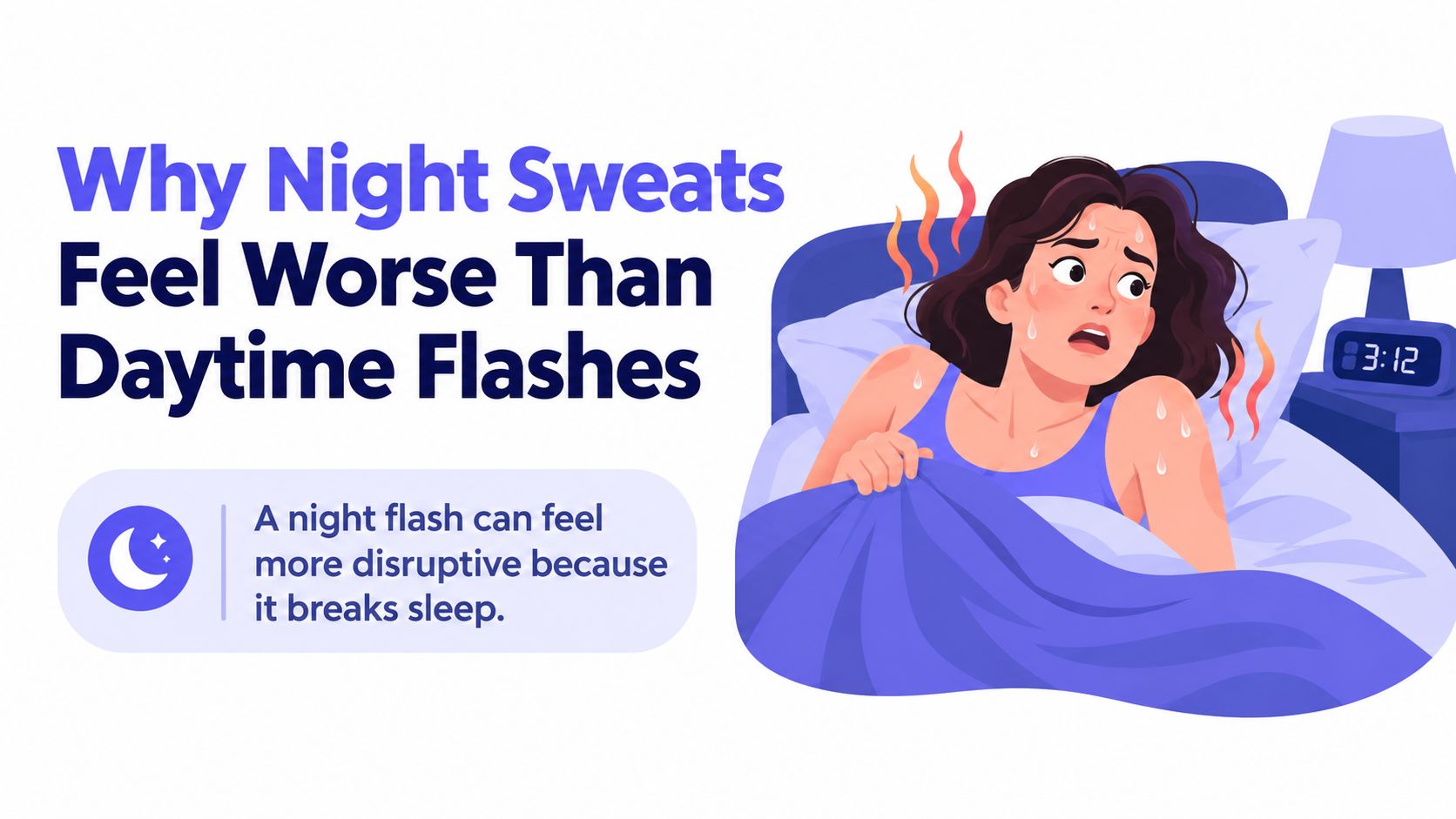
In a study of 168 midlife women with at least one objectively measured nighttime hot flash, actigraphy-recorded wake episodes coincided with 78% of objective hot flashes. Women were 5.31 times more likely to wake during or just after a flash than during the preceding comparison period. The 95% confidence interval was 4.46–6.33. (Research on nocturnal hot flashes and sleep disruption)
When one interruption shapes the whole night
In physiological research involving perimenopausal women, hot-flash-related wake time accounted for about 27% of wake time after sleep onset. This helps distinguish episode frequency from sleep impact: even if flashes are not more frequent at night, those that coincide with waking can fragment rest. A review linked nighttime vasomotor symptoms with frequent awakenings and difficulty maintaining sleep.
The effects can feel like a chain reaction. A flash wakes you, and settling back in may take time. You may then feel tired or less able to manage the next day, so the night feels harder than the episode count suggests.
Practical rule: Track awakenings as well as flashes. Note how often you wake and how you feel the next day.
How much sleep and daytime functioning are affected can be a more useful measure of severity than the number of flashes alone. For more on how hot flashes can interfere with rest, read about menopause and sleep disruption.
How Sleep Stages Shape Nighttime Hot Flashes
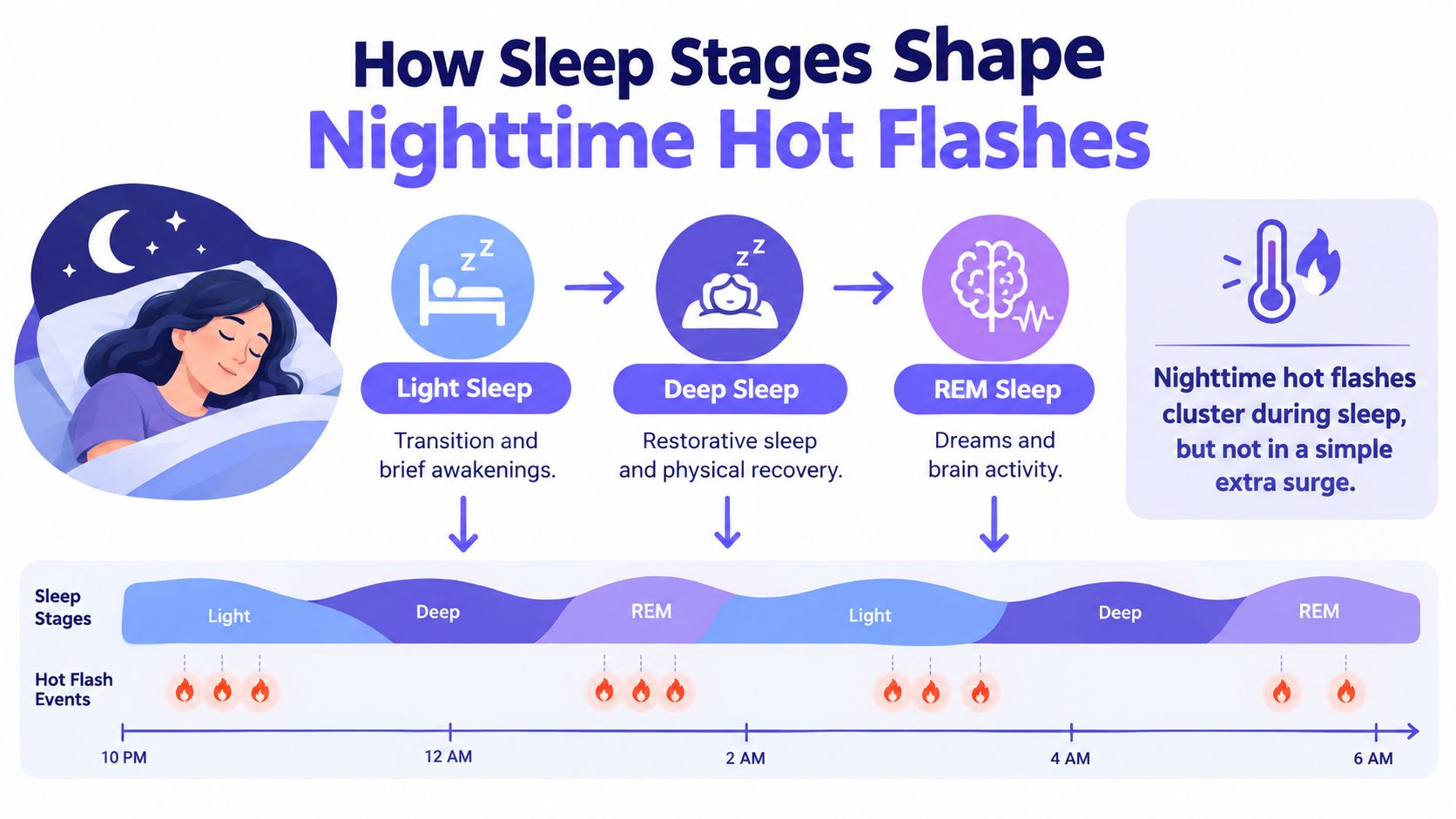
A night with hot flashes does not necessarily mean your body produced more episodes because it was dark. In a controlled overnight study, researchers recorded an average of 3.4 objectively measured episodes per night. After accounting for time spent in each sleep stage, 51.0% occurred during wakefulness and 18.8% during stage N1 sleep. (The polysomnography study of hot flashes during sleep)
Notice whether the flash woke you
A flash can feel sudden because it happens close to waking. In the study, 66% of episodes occurred within five minutes of an awakening, and 80% began just before or during the awakening. This timing links hot flashes closely with changes in sleep and arousal, rather than showing a clear increase in episodes across the whole night. (The polysomnography study)
Sleep also changes how the body regulates temperature. Around shifts between sleep states, temperature changes may feel more disruptive, like a small disturbance in a quiet room. That does not mean your body is producing more flashes throughout the night.
To make a sleep diary more informative, separate what woke you from what you noticed while awake:
- Woke me: You remember a flash bringing you out of sleep.
- Noticed without waking: You felt warmth or sweating but do not recall being awakened by it.
This distinction can reveal why a night felt difficult even when you remember few episodes. A cool bedroom, breathable bedding, and reducing personal evening triggers such as alcohol may help. Treatment for vasomotor symptoms is another option to discuss with a clinician. For more context, read about how menopause can disrupt sleep.
▶ PlayWhen Night Sweats Are Not Just Menopause
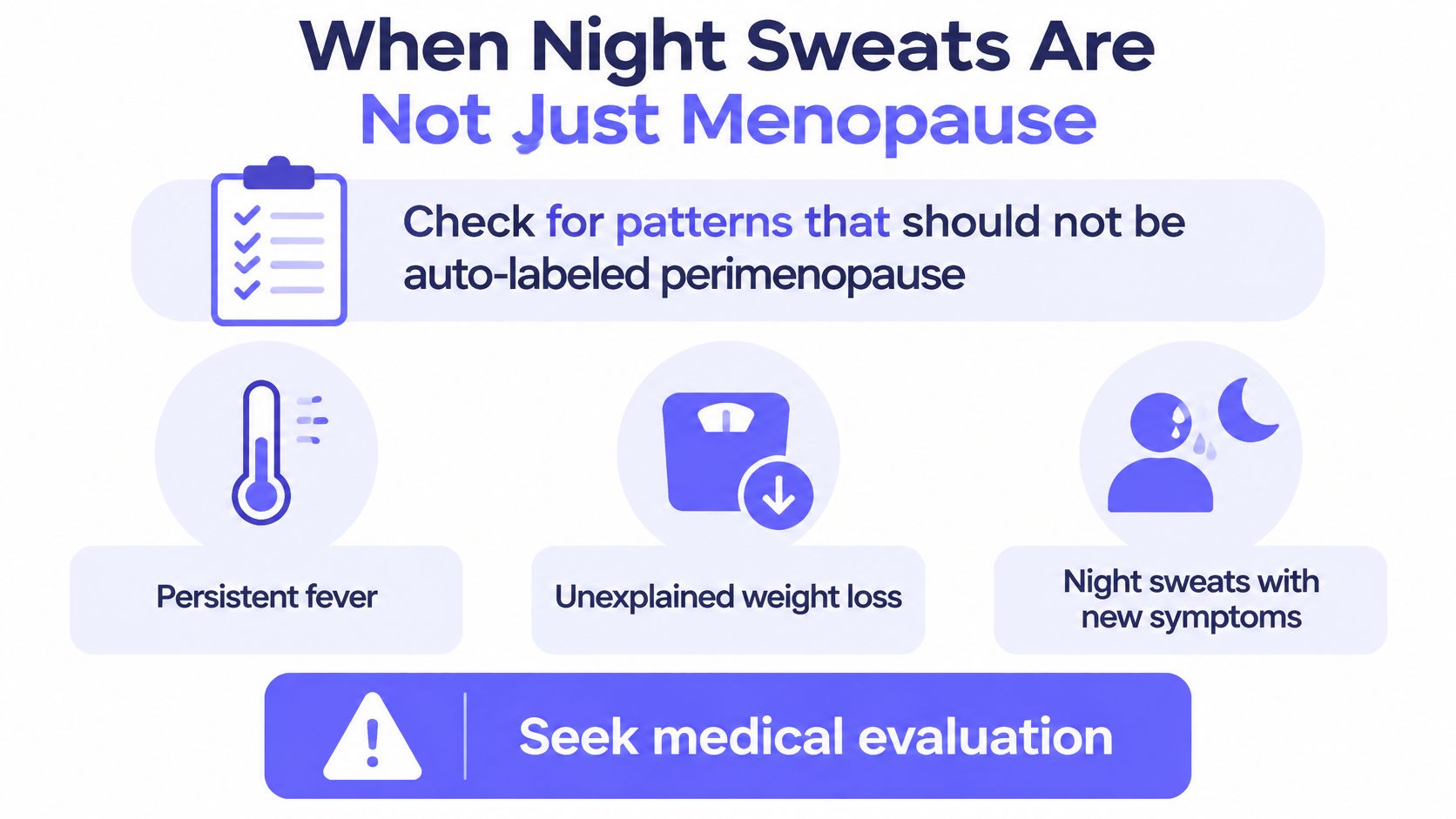
Menopause is a common cause of night sweats, but a new or changing pattern can have other explanations. Medication effects, thyroid disease, infections, mood disorders, obesity, and reflux are among the possibilities. Less commonly, night sweats may occur with conditions such as lymphoma, carcinoid syndrome, pheochromocytoma, or systemic mastocytosis. (Cleveland Clinic guidance on night sweats)
Look at the whole pattern, not one symptom
Night sweats alone don't point to a serious condition. Contact a clinician if they persist, feel unusually severe, or occur alongside fever, unexplained weight loss, palpitations, episodes of high blood pressure, or diarrhea and flushing. Sweats that begin well outside the menopause transition are also worth discussing with a healthcare professional.
A familiar warm surge that follows your usual pattern differs from a new, drenching pattern with fever. Neither tells you the cause by itself. Together, new symptoms can give you a clearer reason to seek assessment rather than assume menopause is responsible.
Hot flashes may start before the final menstrual period and continue for years, so timing alone can't confirm or rule out perimenopause. If you're unsure how to describe a new pattern, a night sweats cause checker can help organize what you've noticed. It cannot replace a clinical assessment.
Keep a record of how often the sweats happen, how severe they feel, your medicines, menstrual status, related symptoms, and how sleep is affected. These details give a clinician a fuller picture if the pattern persists, seems unusual, or comes with other symptoms.
Sleep Habits That Ease Nighttime Hot Flashes
A comfortable bedroom may not stop a hot flash, but it can make returning to sleep easier. Nighttime flashes are not necessarily more frequent than daytime ones, yet they can be closely tied to waking. A modest episode count can still go with substantial sleep disruption: research links greater evening hot-flash severity with longer time to fall asleep, and more frequent nighttime episodes with poorer sleep quality that same night. (Research on hot flashes, sleep, and symptom reporting)
Make the room easier to sleep in
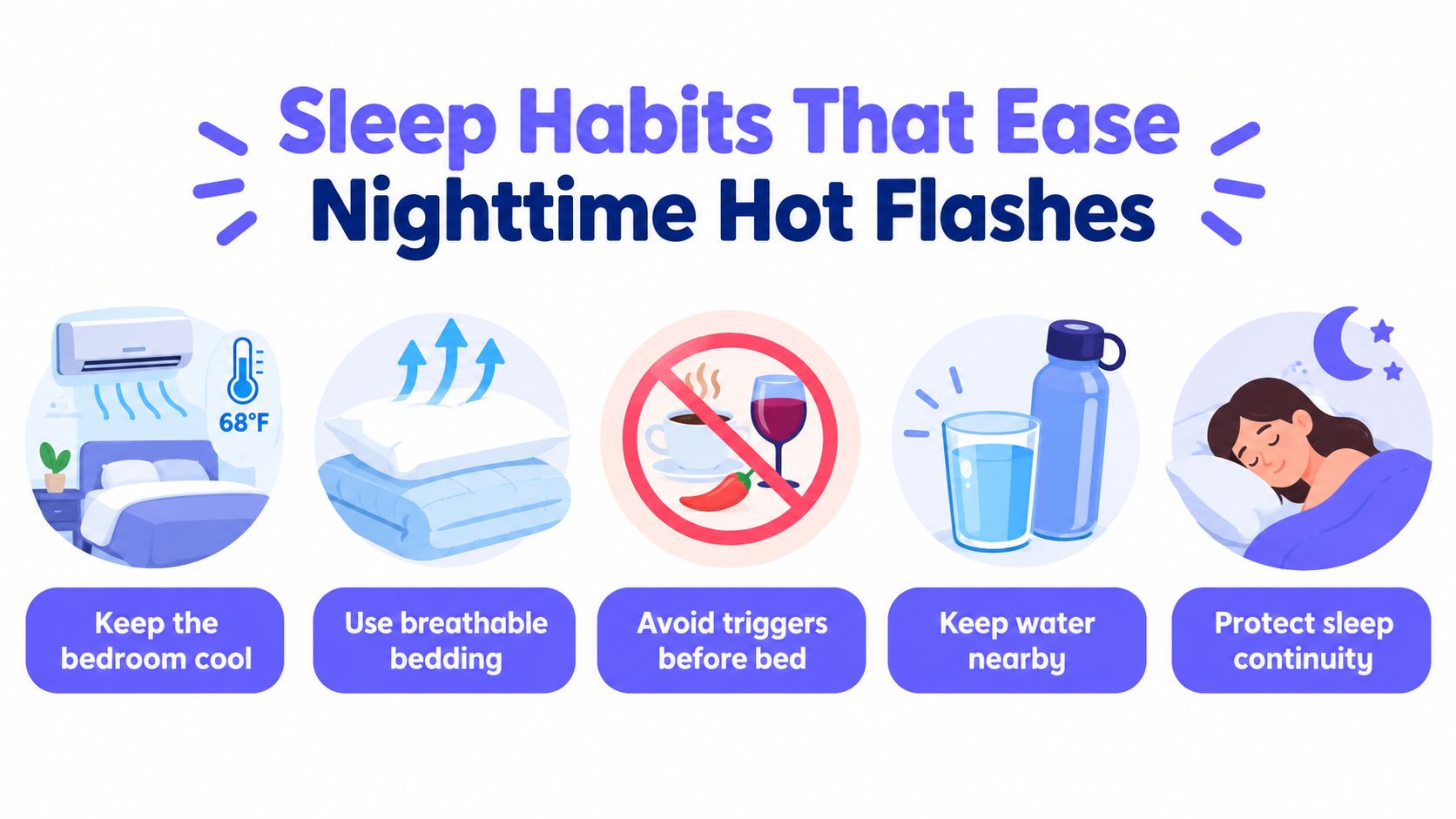
Keep the bedroom cool if that feels comfortable, and try breathable bedding and sleepwear. Keep water nearby if you tend to wake sweaty. These changes are like adjusting the setting around an interruption: they may make the night more comfortable, but they cannot guarantee fewer flashes.
Notice which evening habits seem to affect your sleep. If alcohol appears to come before a difficult night, change that one habit and observe what happens. The effect can differ from person to person, so treat the result as a clue, not a test you can pass or fail. Caffeine may also be worth observing; this guide to caffeine and hot flashes offers context for considering it as a possible personal trigger.
Episode counts alone can miss the part that matters most in bed. Note when a flash occurs, whether it wakes you, how long you take to fall asleep again, and how your energy or mood feels the next day. A brief, consistent record is easier to interpret than several changes made at once.
If sweats remain severe or persistent, or the pattern feels unusual, check in with a clinician. Bedroom adjustments can support comfort, while assessment can help address symptoms that need more attention.
How to Choose Tracking and Support
A tracker is most useful when it helps connect what happens at night with how you feel the next day. Episode counts alone are like a head count: they show how many flashes you noticed, but not whether one woke you or left you tired. Separate sleep and cycle apps can capture more detail, though the information may be scattered. A combined tracker puts those details side by side, with regular check-ins as the trade-off.
| Tracking option | Useful for | Possible drawback |
|---|---|---|
| Paper note with episode counts | Keeping a quick record | May not show awakenings or next-day effects |
| Separate sleep and cycle apps | Tracking different parts of your routine | Information can be scattered |
| One combined tracker | Comparing symptoms with sleep and daily context | Takes regular check-ins to stay useful |
Choose details that answer your question
Start with the details that clarify your main concern. If you're trying to understand sleep disruption, record whether a flash woke you and how long it took to fall asleep again. Add the timing, next-day mood and energy, possible personal triggers, and cycle context if they're relevant. You don't need a perfect diary. A steady record is easier to discuss with a clinician than scattered recollections.
Lila is an AI-powered perimenopause app that combines daily check-ins with a personalized action plan for symptoms such as hot flashes, sleep disruption, bloating, mood changes, and weight gain. It brings symptom, mood, sleep, energy, meal, and cycle tracking together, with a chat-based coach for personalized guidance and accountability. Learn about Lila's tracking and support features
Choose paper for a simple record, separate apps if that setup already works for you, or a combined tracker to keep symptoms and sleep together. The best fit is the one you can use consistently. An app can organize observations, but it cannot replace medical care when night sweats are new, persistent, or paired with concerning symptoms.
What to Do After a Rough Night
After a broken night, the first useful step is to note what you remember before details fade. Did a hot flash wake you, or did you notice it after waking for another reason? Record how long it took to fall asleep again and how your energy and mood feel today. The episode count is only part of the picture; whether a flash interrupted sleep can matter more to your next day.
If this pattern is familiar and you have no fever, unexplained weight loss, or other concerning symptoms, try one evening adjustment. For example, make the room cooler or avoid a personal trigger, then keep your usual tracking method. Changing one thing at a time is like adjusting one dial: it makes it easier to notice what may have helped, without promising a cure.
New or drenching sweats, especially with other symptoms, call for clinical assessment rather than another round of experiments. Bring notes on timing, severity, medicines, menstrual status, associated symptoms, and sleep impact.
A daily check-in in Lila is one way to keep hot flashes, sleep, and next-day energy together. Focus on whether a flash disrupted sleep, not on achieving a perfect count. That distinction can help you decide what to try next or explain the night clearly to a clinician.
Get Lila, your personal coach for perimenopause.
Built for women in their 40s. 24/7 coaching, in your pocket.