
Are Weighted Vests Good? Benefits, Risks and Safe Use
Are weighted vests good for fat loss, bones and midlife health? See what the evidence shows, the risks and safe starting weights.
A weighted vest is a modest add-on to structured exercise, not a stand-alone fat-loss or bone-building tool. Pairing one with training cut body-fat mass by an average of 2.67 kg versus usual activity, and only about 0.73 kg more than the same exercise without a vest.
The advice you keep hearing treats the vest as a shortcut. Wear it through the day, walk the dog in it, and fat and bone will both improve. That story skips the comparison that matters. A vest is good for a specific outcome, next to a specific alternative. Extra load on a walk you already take is not the same thing as a progressive strength plan, and it is not the same thing as dieting while hoping the vest saves your hip.
Most of the encouraging signals show up when people train on purpose. Casual wear, all-day wear, and high-impact circuits do not earn the same verdict. Find your goal in the table below, then read the section that matches it. Any row marked not proven or avoid is a reason to read the caveats in full before you spend money.
Table of Contents
- Whether Weighted Vests Are Good for Your Goal
- What a Vest Adds to Exercise for Fat and Bone
- Where Vest Benefits Stop During Weight Loss
- How Much Harder Walking With a Vest Feels
- Who Midlife Women May Benefit Most
- Who Should Avoid Vests and How to Check Fit
- Start Light and Progress Only If Form Holds
Whether Weighted Vests Are Good for Your Goal
A weighted vest is not just “good” or “bad.” Its value depends on the outcome and the comparison: walking with a vest versus walking without one, or structured exercise with a vest versus usual activity. Calorie cost, fat loss, bone outcomes, balance, and high-impact training each need a separate verdict.
| Goal | What the evidence shows | Verdict |
|---|---|---|
| Burn more calories on walks | Energy cost was about 7% higher in overweight, sedentary walkers, with the increase varying by walking speed | Modest helper |
| Lose body fat | With exercise, fat-mass loss averaged 2.67 kg versus usual activity, and about 0.73 kg more than exercise alone | Helpful only with exercise |
| Lose weight by wearing it all day | Adults aged 60–85 lost about the same weight with or without a vest | Not effective alone |
| Protect hip bone during weight loss | A 12-month trial found no prevention of hip bone loss | Not proven |
| Build bone density | Exercise combined with a vest showed effects at the femoral neck and lumbar spine | Promising with structured exercise |
| Improve balance | A nine-month program in postmenopausal women paired a vest with lower-body strength or jumping and reported lateral stability gains | Supportive with structured training |
| Run or jump with a vest | Experts advise against high-impact use without clinician assessment | Avoid unsupervised |
The clearest pattern is that positive findings come from planned exercise. Wearing a vest through ordinary daily activities has not shown the same value, and a vest has not been shown to protect hip bone during weight loss. Those are different goals from increasing the effort of a walk or improving balance through training.
Research coverage describes a six-week treadmill study in which participants who walked with a weighted vest improved balance and strength. The finding supports a possible role for the vest in balance-focused exercise, but it does not establish that casual walking improves bone or balance. A separate nine-month program in postmenopausal women paired a vest with lower-body strength or jumping and reported gains in lean mass, strength, power, and lateral stability. The NPR's look at the weighted-vest trend covers the shorter treadmill study; it should not be treated as evidence that every vest routine produces the same results.
A session can feel harder and use more energy without proving a lasting change in bone density. That outcome depends on an adequately loaded, progressive program, not merely wearing a vest on occasional walks. Choose based on the goal: use a vest as a possible training aid, not as a universal shortcut.
What a Vest Adds to Exercise for Fat and Bone
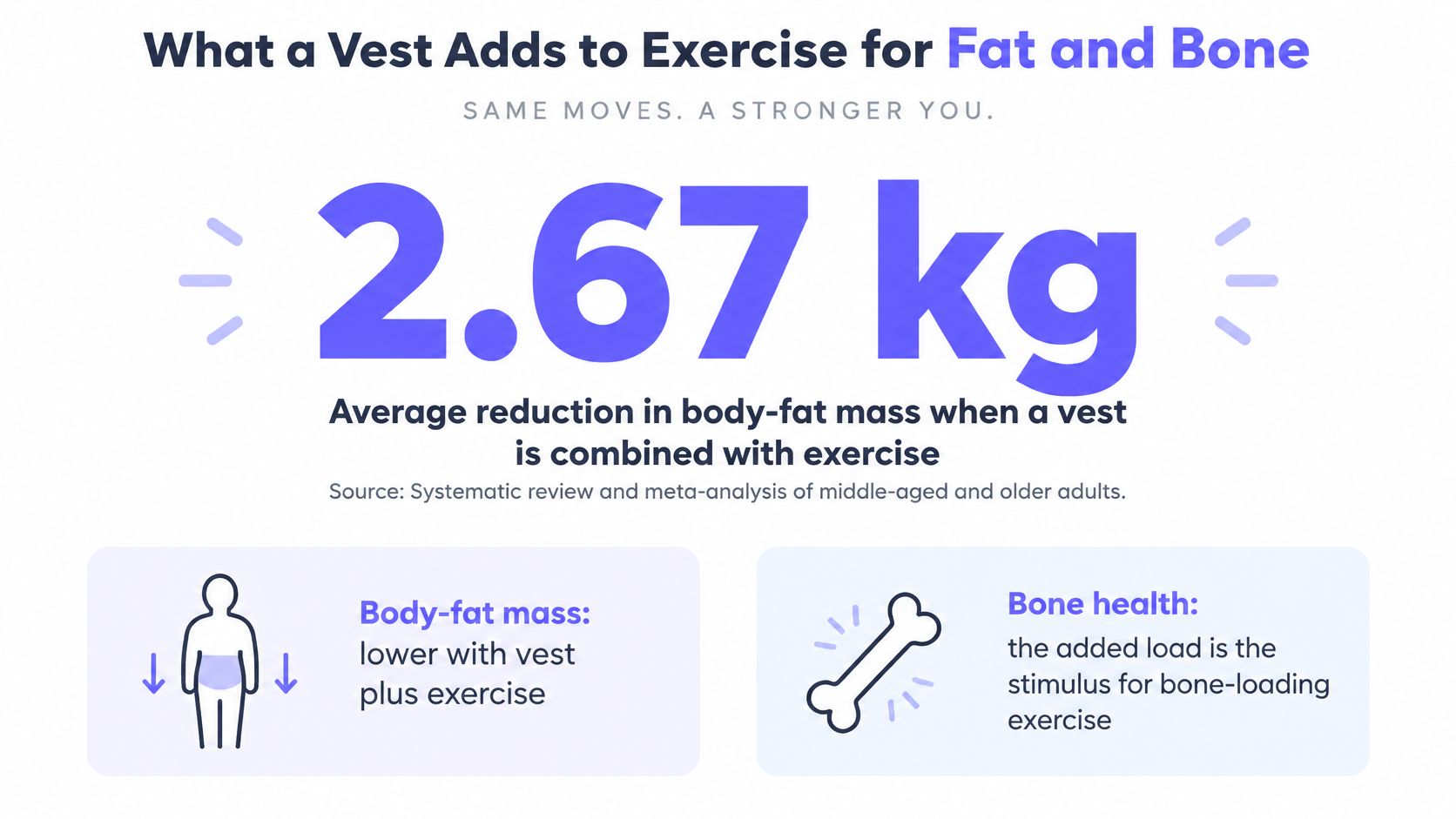
A systematic review and meta-analysis in middle-aged and older adults is the cleanest fat-and-bone comparison we have. Combining a weighted vest with exercise reduced body-fat mass by an average of 2.67 kg compared with usual activity. Set against exercise without a vest, the extra fat-mass reduction was about 0.73 kg.
What those bone numbers mean over months
The same review found better bone mineral density when vest use was combined with exercise. The standardized effect size was 0.59 at the femoral neck and 0.73 at the lumbar spine. Those are program-level effects, not a change you would notice after a few weeks of heavier walks. A moderate effect across a training block can matter for midlife bone, and it still is not a dramatic rebuild.
Think of the vest as a backpack on a hike you already take. It makes the same route harder, so muscle and bone get a bigger ask. It does not change the route. If the route is "I sat more and ate the same," the backpack does not invent a training plan.
What actually moves the result
The review's signal tracks structured exercise, where the vest raises external load and makes walking or resistance movements more demanding. It is not proof that wearing a vest through chores produces substantial fat loss or stronger bones.
Results depend on four things:
- Activity type: structured walking or resistance movements, not passive wear.
- Vest load: enough to raise demand, not so much that form collapses.
- Adherence over months: the pooled gains come from programs, not a weekend trial.
- Health status: joints, balance, and bone risk change how much load is useful.
For women in midlife, that frames the vest as a possible adjunct to progressive strength training and weight-bearing work, not a replacement for either. If bone is the reason you are shopping, start with strength training for bone density and add a vest only after that plan exists. Expect modest, layered gains in fat and bone, and only then.
Where Vest Benefits Stop During Weight Loss
A weighted vest did not prevent hip bone loss during substantial weight loss in older adults with obesity. In the 12-month randomized trial, researchers assigned 150 participants, and 133 (89%) finished. Participants lost approximately 10% of their starting body weight. Those in the vest group wore it during waking hours, for at least eight hours a day.
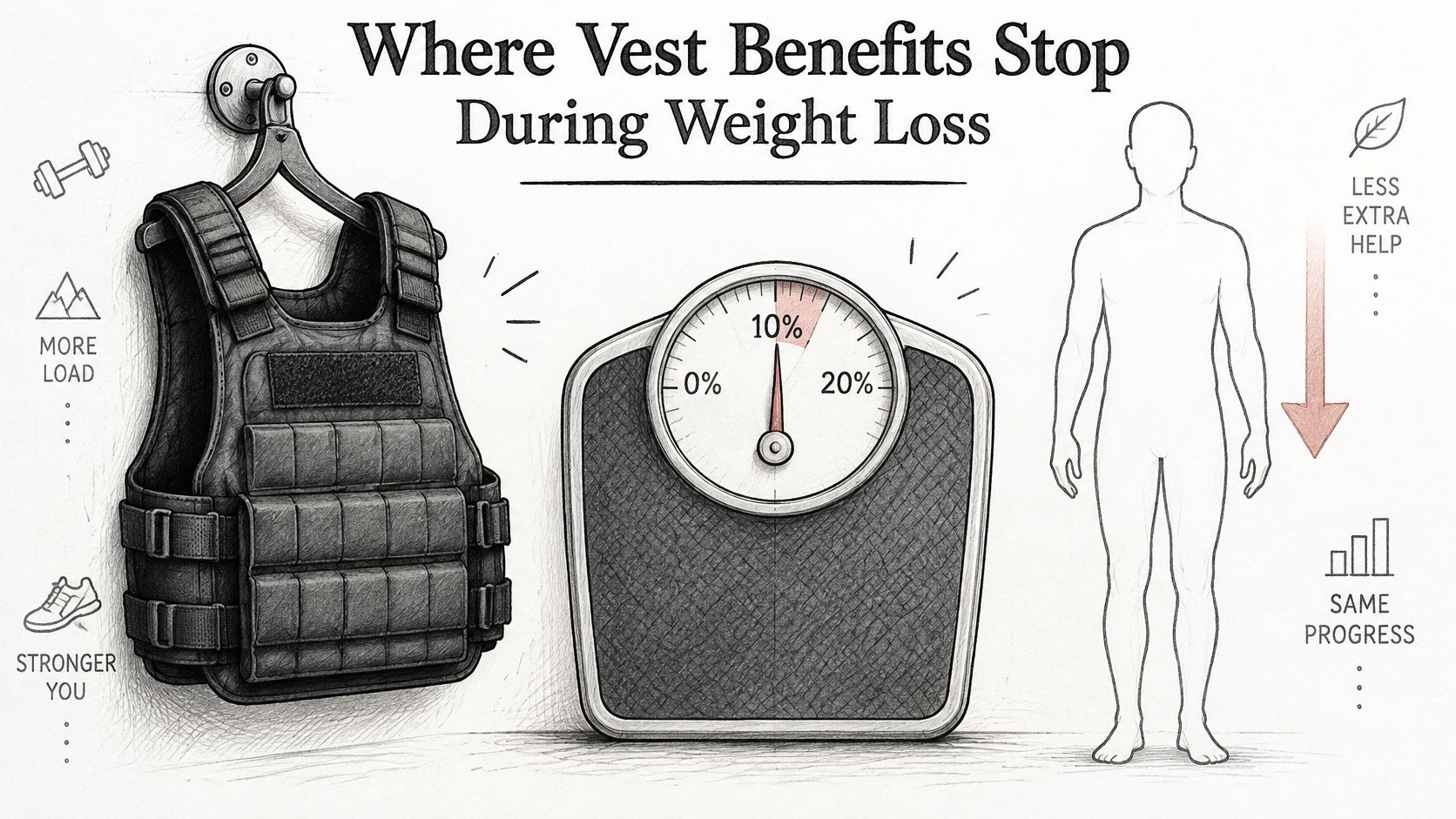
The trial's published results reported hip bone loss of roughly 1.2% to 1.9% across the intervention groups. They found no meaningful difference between calorie restriction alone, calorie restriction with strength training, and calorie restriction with weighted-vest use. In this comparison, the vest did not preserve hip bone better than the other approaches. The major osteoporosis guidance discusses uncertainty around fracture prevention and bone-density improvement; it does not establish whether a vest prevents bone loss during weight loss.
Why midlife women should care
Weight loss can coincide with falling estrogen, so some women in perimenopause or after menopause are trying to reduce fat while also considering hip health. The trial's result sets a boundary: added vest wear did not stop hip bone loss during weight reduction. That finding concerns bone, not every possible vest outcome. It does not show that a vest cannot make exercise more demanding or help with muscle and balance in other settings.
Practical rule: Do not rely on daily vest wear to protect bone while dieting. The trial did not show that it prevented hip bone loss.
People with osteoporosis, a prior spinal fracture, spine surgery, or high fracture risk should seek professional guidance before using a vest. Bone protection during weight loss requires a broader approach than merely adding load to daily wear.
What researchers are still testing
In 2025, the University of Colorado Anschutz Medical Campus reported a $7 million National Institutes of Health-funded BEACON study comparing bone-health strategies. The study includes resistance exercise with and without a weighted vest, as well as osteoporosis medication and nutrition counseling, according to the university's research news. This design treats the vest as one part of a broader comparison; it does not yet establish that the vest preserves bone during weight loss.
For fat loss, bone, or balance, the relevant question is what the vest adds compared with the exercise itself. The trial does not show that wearing one can substitute for progressive resistance work. See resistance training for weight loss for how strength work fits into a weight-loss plan.
How Much Harder Walking With a Vest Feels
A vest's effect depends on the task. In overweight or mildly obese sedentary adults, treadmill walking with a vest increased energy expenditure by about 7% on average. The increase ranged from 6.1% at 4.0 km/h to 9.7% at 5.5 km/h, according to a laboratory report on vest walking. That is a modest change in calorie use, not a doubling of the workout, and it does not establish a separate fat-loss benefit.
A different walking protocol tested fixed vest weights of 20 lb for men and 14 lb for women. Those are absolute loads, not percentages of body weight, so they should not be treated as a general prescription. Physiological demand increased on a 10% treadmill incline, while level ground and a 5% incline showed no significant increase. The report found no change in gait variables.
| Condition | Reported effect | What it means |
|---|---|---|
| Treadmill walking, 4.0 km/h, overweight sedentary adults | About +6.1% energy expenditure | Modest increase at a slower pace |
| Treadmill walking, 5.5 km/h, overweight sedentary adults | About +9.7% energy expenditure | Larger increase at a brisker pace |
| Level ground, tested fixed vest loads | No significant increase in demand | No measurable increase under this protocol |
| 5% incline, tested fixed vest loads | No significant increase in demand | No measurable increase at this grade |
| 10% incline, tested fixed vest loads | Physiological demand increased; gait unchanged | More demand during controlled walking |
What the walking results do and do not show
Pace and incline matter to the result. The treadmill trial found a larger energy-expenditure increase at the faster walking speed, while the separate incline protocol found higher physiological demand only at the steepest tested grade. These findings do not establish that increasing pace or incline will produce the same response for everyone, or that the added effort leads to greater fat loss.
Running, jumping, and high-impact circuits were not tested in these walking protocols. Their effects cannot be inferred from the walking results. Keep the comparison specific: the evidence here concerns walking effort and energy expenditure, not bone density, balance, or the safety of loaded impact exercise.
The measured calorie increase was modest. Use a vest only if it keeps your walking stride and alignment comfortable, and stop if your form changes.
People with neck or back disorders, balance problems, cardiovascular or pulmonary disease, or a prior lower-limb injury should seek clinical guidance before adding a vest. If your only goal is to increase daily steps, building a pedometer habit may be a more direct option than adding load on flat pavement.
Who Midlife Women May Benefit Most
A weighted vest is not a general-purpose menopause tool. Its value depends on the outcome: it adds load during movement, but that does not establish extra fat loss, better balance, or bone gains for every user.
For women in their 40s and 50s, the evidence is limited. A 2024 study of 52 women aged 60–79 reported increases in thoracic-spine bone mineral density and total lean body mass among participants who used weighted vests alongside a high-protein diet, as EatingWell reported. Those participants were older than midlife, so their results do not prove the same effects for women in perimenopause.
What changes when estrogen falls
As estrogen declines, lean mass can decrease and fat distribution can shift, even when body weight changes little. For someone focused on muscle and bone, a vest may add resistance to familiar work, such as brisk walking or step-ups. It is one option alongside strength training, adequate protein, and impact exercise when impact is appropriate.
A 55-year-old who already does goblet squats and rows twice a week could add a light vest to step-ups and walks she already performs. The vest increases the load on those movements; her resistance-training exercises remain part of the routine. Whether that added load improves fat or bone outcomes for women her age remains uncertain.
A repeatable menopause workout plan can help organize strength and walking sessions around a specific goal. Choose the vest for added resistance during suitable movement, not as a shortcut to weight loss or a proven balance intervention.
Who Should Avoid Vests and How to Check Fit
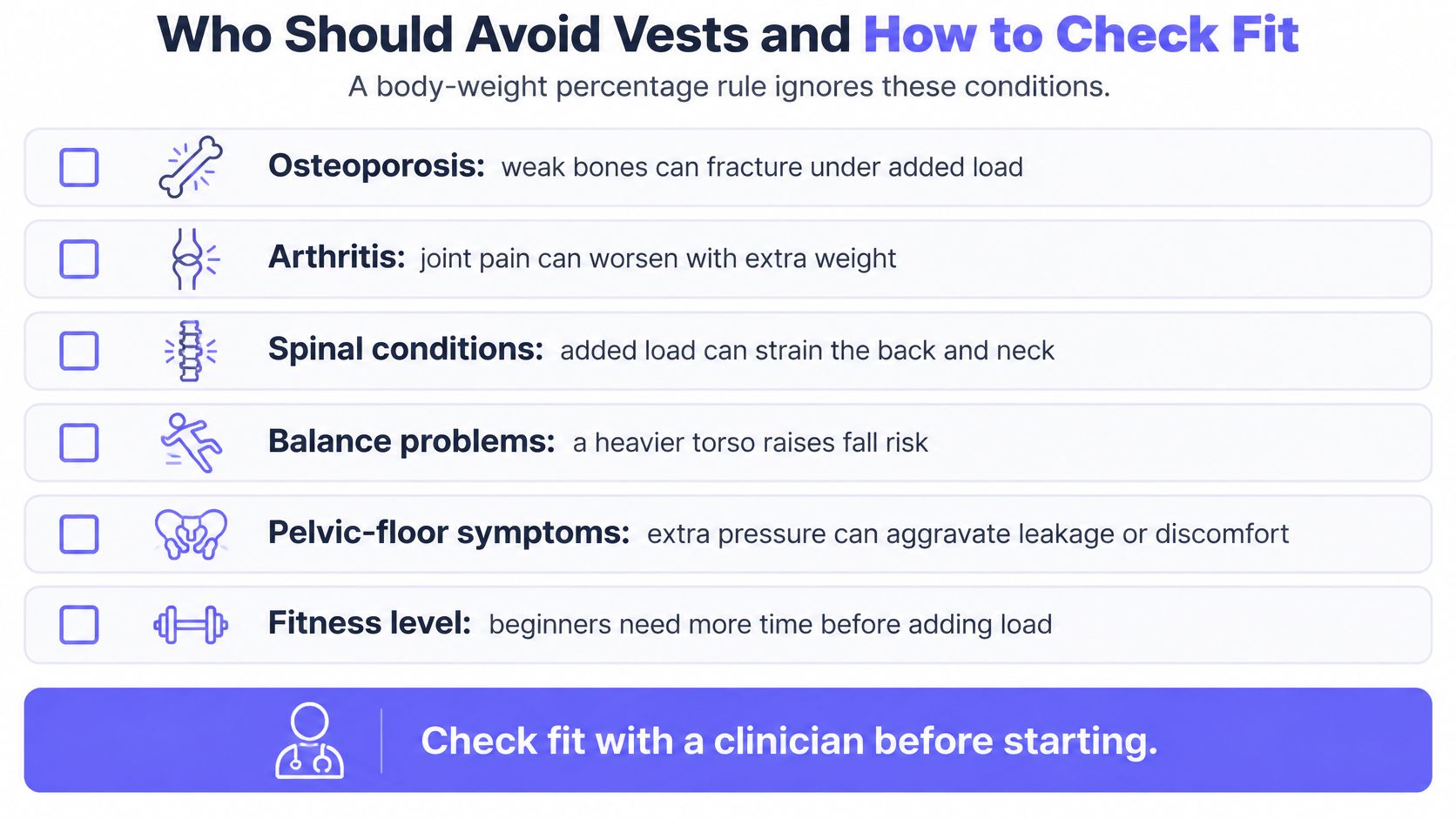
A percentage-of-body-weight rule is the risk most shopping guides skip. It ignores osteoporosis, arthritis, spinal conditions, balance, pelvic-floor symptoms, fitness level, and whether the vest shifts while you move.
Clinical guidance on weighted vests flags three hazards that are about movement quality, not only "too many kilos."
- Breathing: an overly tight vest can restrict it.
- Posture: a poorly distributed load can pull you into a slouch.
- Falls: added weight raises fall risk on stairs and uneven ground.
Running, jumping, and other high-impact work need a clinician or therapist to assess you first. That matters for midlife women who may have new joint pain, shakier balance, old injuries, or bone loss without a formal diagnosis yet.
This short briefing walks through how added torso load changes balance and why fit comes before progression.
▶ PlayWho needs clearance first
Get medical clearance, or skip unsupervised use, if you have severe osteoporosis, fractures, a prior spinal fracture or spine surgery, significant back or joint disease, balance problems, recent surgery, or a cardiopulmonary condition.
A screen you can run before you progress
- Walk without pain and without a changed gait.
- Balance stays steady on flat ground and on a curb or stair you already use.
- Breathing stays open. You can talk in full sentences.
- The fit is snug and not compressive. Shoulders do not round forward.
- On a short walk the vest does not bounce or slide.
- First exposures stay short and low-impact.
Fail any of those and the vest is not appropriate yet, no matter what percent of body weight the label suggests. Exercises to avoid during menopause are a useful cross-check when impact and spinal load are already on your list of concerns.
Start Light and Progress Only If Form Holds
A vest load is a training adjustment, not a weight-loss shortcut. Treat 10% of body weight as an upper limit for someone who has passed the relevant checks, not a goal. A conservative starting example is 5% of body weight, with gradual increases only while posture, gait, and recovery remain normal. For a 70-kg person, that means starting around 3.5 kg and staying at or below 7 kg. The report on weighted-vest research does not establish a specific starting load.
| Body weight | Start at 5% | Ceiling at 10% |
|---|---|---|
| 50 kg | 2.5 kg | 5 kg |
| 60 kg | 3 kg | 6 kg |
| 70 kg | 3.5 kg | 7 kg |
| 80 kg | 4 kg | 8 kg |
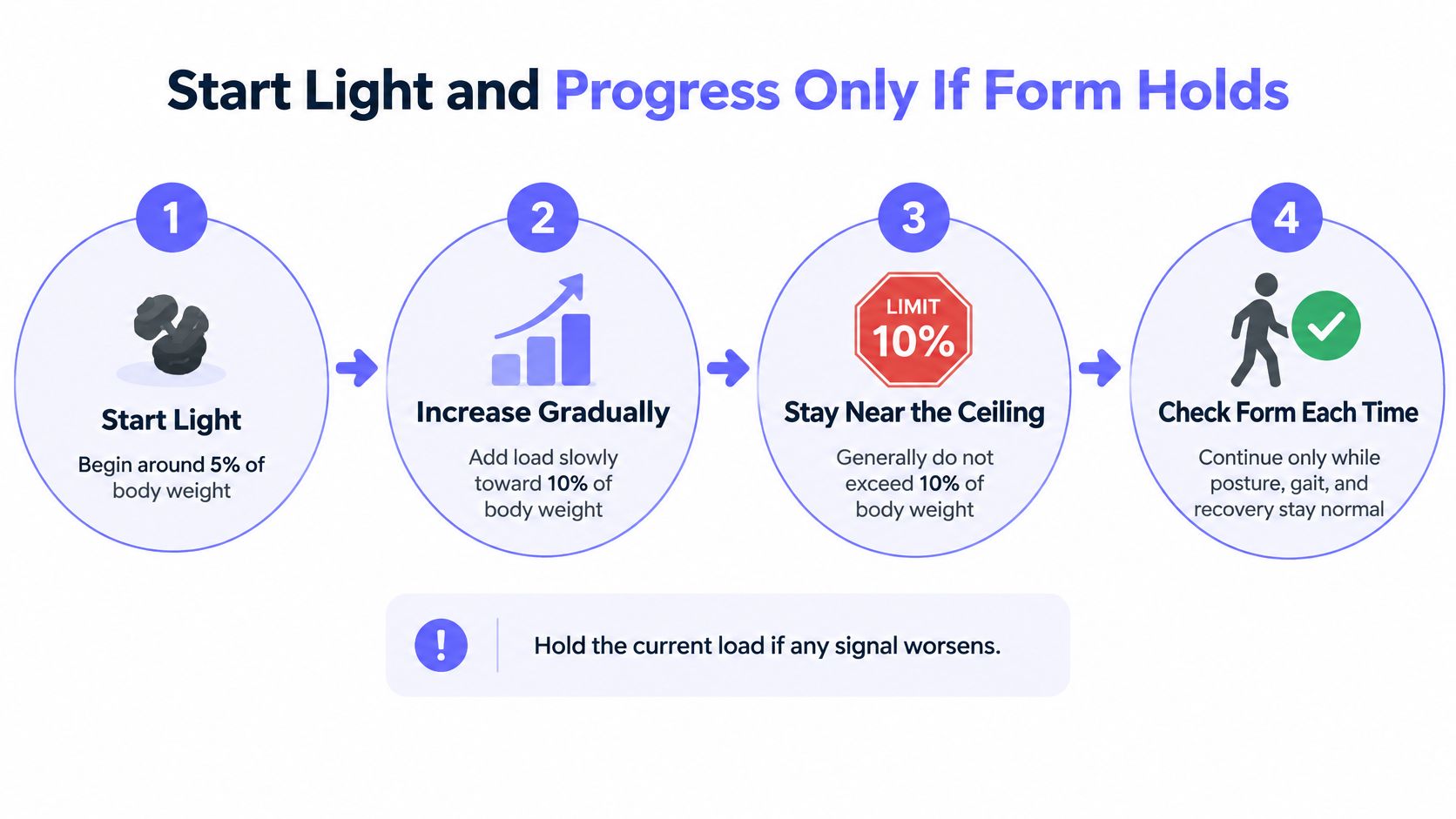
The table gives starting points, not required loads. How much benefit a vest adds depends on the task: a heavier load increases the demand of walking or strength work, but it does not establish a separate fat-loss or bone benefit. In adults aged 60–85, wearing a vest during the most active parts of the day produced approximately the same weight loss as not wearing one, with similar age-related bone-density loss. The vest increases loading and energy demand only while worn. If food intake and total activity stay unchanged, the extra energy use may not be enough to change body mass.
How to progress without chasing the ceiling
- Address any concerns raised in the previous section with a clinician.
- Choose one low-impact task, such as level walking, a modest incline, or familiar lower-body strength work.
- Begin near 5% of body weight with short sessions.
- After each session, check posture, gait, and breathing.
- Increase the load in small steps only if recovery remains normal, and stay at or below 10%.
- Reduce the load or stop if you lean forward, slouch, develop joint or back pain, or remain sore after the session.
Too much load can shift stress toward the knees, hips, spine, and feet without improving the quality of the exercise. Record the load, sleep, energy, and symptoms once a week so a worsening pattern is easier to spot.
Buy a vest only if it fits the checks and you already follow a progressive strength plan. Otherwise, skip it. A vest adjusts the demand of exercise you already do; it does not provide a training program on its own.
Get Lila, your personal coach for perimenopause.
Built for women in their 40s. 24/7 coaching, in your pocket.