
Resistance Training for Weight Loss in Menopause Guide
Discover how resistance training for weight loss helps women in perimenopause preserve muscle, burn fat and feel stronger with a safe, step-by-step plan.
You've cut back on food, added more walking, and still find your waistline unpredictable. Some weeks, the scale barely changes. Other weeks, your clothes fit differently even though the number looks stubborn. In perimenopause and menopause, that mismatch can feel discouraging, but it often reflects a change in body composition, not a failure of effort.
Resistance training for weight loss works best when you stop treating lifting as a huge calorie-burning event and start using it as a muscle-preservation anchor. Nutrition creates the conditions for fat loss. Strength training helps you hold on to the lean tissue that supports strength, function, and a more useful measure of progress.
Table of Contents
- Why Resistance Training Matters for Weight Loss in Perimenopause
- How to Prepare Safely and Support Recovery
- Your Weekly Resistance Training Plan for Beginners and Beyond
- Progression Guidelines and Minimum Effective Dose
- Integrating Nutrition Sleep and Daily Habits for Better Results
- Tracking Progress and Staying Consistent With App Support
Why Resistance Training Matters for Weight Loss in Perimenopause
A common pattern among women I coach in their 40s and 50s looks like this: more cardio, smaller meals, less energy, and no satisfying change in the mirror. The instinct is usually to add another workout or cut food further. That approach can leave you tired without addressing the tissue you most need to protect.
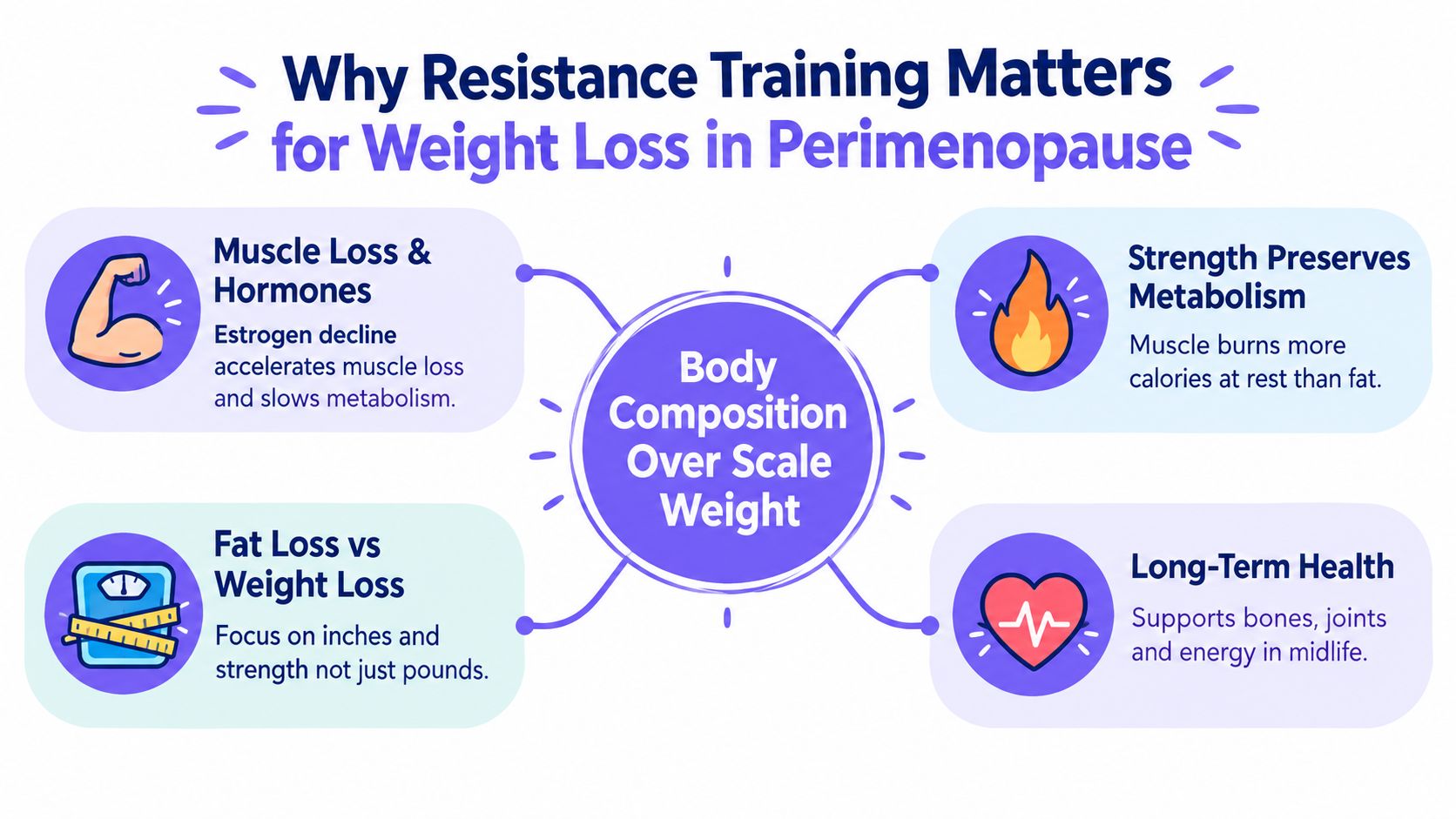
Hormonal changes during the menopause transition can make muscle preservation more important. The evidence summarized in a 2025 systematic review and meta-analysis found that adding resistance exercise to diet-induced weight loss did not significantly change total body mass compared with diet alone. The between-group difference was −0.32 kg, with p=0.35. Yet resistance exercise protected fat-free mass, increased fat-mass loss, and improved muscular strength, as reported in the published systematic review.
The scale is only one measurement
Body weight combines fat, muscle, water, food volume, and other tissues. Menopause-related changes in sleep, stress, appetite, and fluid balance can make the scale particularly noisy. A smaller waist, better-fitting clothes, stronger legs, and easier stair climbing may tell you more about the result of your plan than a single weigh-in.
A 2022 meta-analysis of 58 studies found that resistance training paired with caloric restriction produced some of the largest body-composition changes in adults with overweight or obesity. Body-fat percentage fell by 3.8%, whole-body fat mass dropped by 5.3 kg, and body weight decreased by 5.3 kg, with the confidence intervals reported in the full meta-analysis. The same analysis showed that resistance-based programs improved lean mass by about 0.8 kg when included within broader exercise approaches.
The practical takeaway: lifting alone isn't a reliable substitute for a calorie-controlled eating pattern. It is the training method that helps make weight loss more favorable to your body composition.
That distinction matters if you're researching why it's hard to lose weight after 40. You don't need to chase exhaustion. You need a repeatable plan that gives your muscles a reason to stay, while nutrition supplies an appropriate energy deficit.
For broader lifestyle ideas, XO's menopause support strategies can complement a strength-focused approach. Your target is not just a lighter body. It's a body that remains capable, strong, and supported as your hormones change.
How to Prepare Safely and Support Recovery
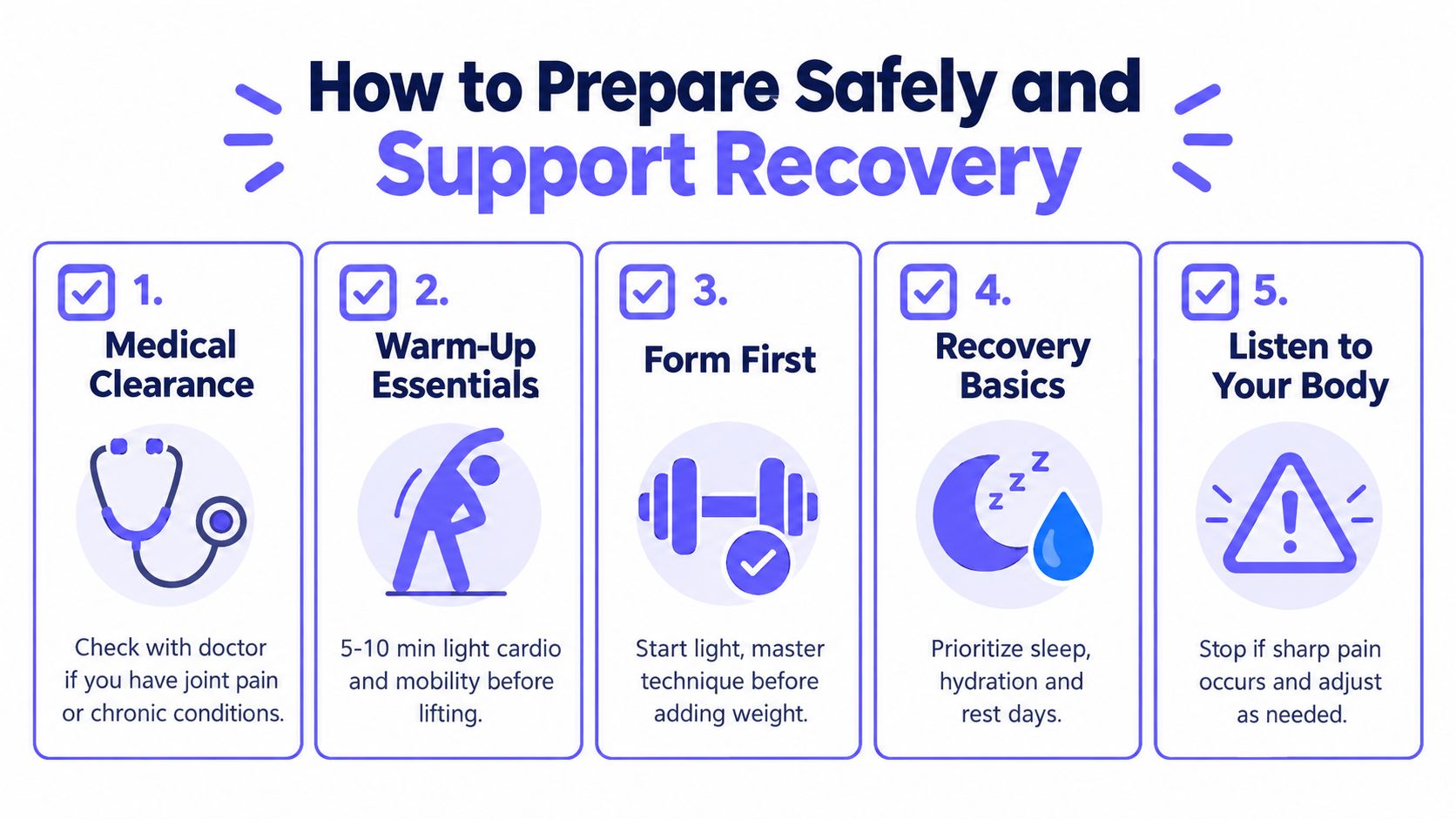
Resistance training is adaptable, but preparation determines whether it becomes a sustainable habit or another short-lived challenge. Before choosing exercises, consider your health history, current symptoms, joint comfort, and recovery capacity. A medical professional should guide you if you have unexplained chest pain, uncontrolled blood pressure, significant osteoporosis, a recent injury, persistent joint swelling, or a chronic condition that affects exercise tolerance.
Pelvic floor symptoms deserve practical attention rather than embarrassment. Urine leakage, pelvic heaviness, pain, or pressure during lifting can signal that you need modified breathing, lighter loads, different positions, or advice from a pelvic health physiotherapist. Sharp pain is not a normal sign of an effective set.
Use a readiness check
Your training plan should flex with the day. Poor sleep, night sweats, a heavy symptom load, or unusual fatigue doesn't automatically mean you must skip exercise, but it may call for less weight, fewer sets, longer rests, or a gentle mobility session.
Use this quick check before training:
- Symptoms: Can you move comfortably, without new or worsening pain?
- Energy: Do you have enough capacity for controlled effort, even if you don't feel highly motivated?
- Joints: Can you perform the intended range of motion without pinching or instability?
- Breathing: Can you brace gently and breathe without straining or bearing down excessively?
- Environment: Do you have stable footwear, enough space, and equipment you can control?
Warm up with easy movement and mobility that matches the session. A few minutes of walking, cycling, marching, hip movements, shoulder circles, and lighter practice sets can prepare you better than aggressive stretching. Keep the first working set deliberately easy so you can assess how your joints and coordination feel.
Recovery is part of the dose
Muscle adapts between sessions, not only during them. Protect sleep with a regular wind-down routine, a cooler bedroom if hot flashes disturb you, and a consistent wake time where possible. Hydration supports normal exercise tolerance, while rest days give irritated joints and fatigued muscles time to settle.
Don't force a planned workout after a poor night's sleep just to protect your schedule. Reduce the session and preserve consistency. Guidance on science-backed workout recovery strategies can help you build recovery into the week instead of treating it as an afterthought.
Stop for sharp pain, dizziness, unusual breathlessness, or symptoms that feel medically concerning. Modify discomfort caused by effort, but don't negotiate with warning signs.
Your Weekly Resistance Training Plan for Beginners and Beyond
The most useful program is one you can repeat when work is busy, sleep is imperfect, and motivation is ordinary. Start with movements that train the major patterns: squat, hinge, push, pull, carry, and core bracing. Machines, dumbbells, bands, and bodyweight can all work.
Beginner two-day full-body plan
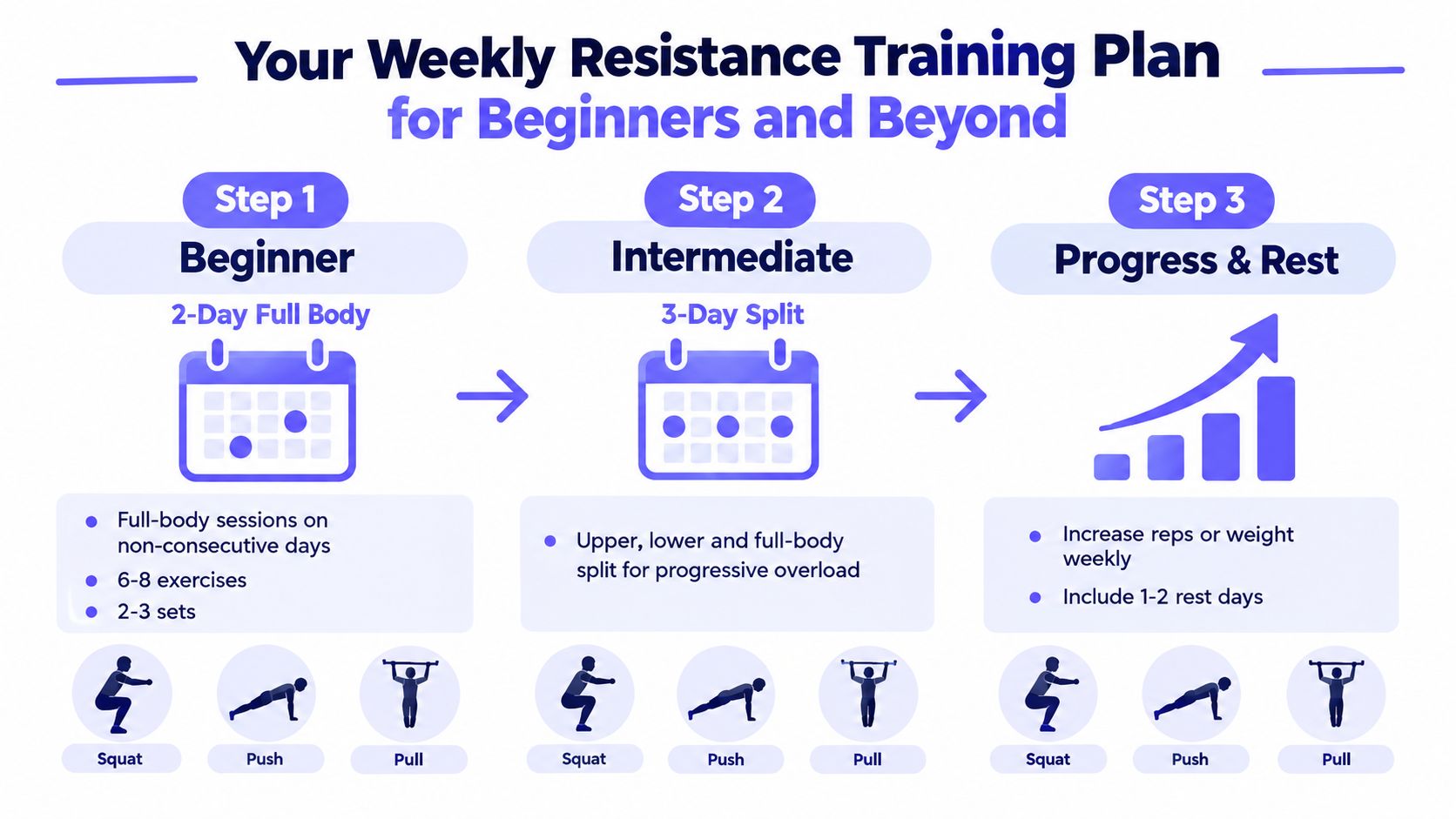
Train on non-consecutive days, such as Monday and Thursday. Begin with a load that allows smooth technique and leaves several controlled repetitions in reserve.
Session A
- Goblet squat, 2 sets of 8 to 10
- Dumbbell Romanian deadlift, 2 sets of 8 to 10
- Incline push-up or chest press, 2 sets of 8 to 12
- One-arm dumbbell row, 2 sets of 8 to 12 per side
- Supported split squat, 2 sets of 6 to 10 per side
- Farmer carry, 2 controlled walks
- Dead bug, 2 sets per side
Session B
- Sit-to-stand or leg press, 2 sets of 8 to 12
- Hip thrust or glute bridge, 2 sets of 10 to 12
- Seated dumbbell shoulder press, 2 sets of 8 to 10
- Resistance-band pulldown or cable pulldown, 2 sets of 8 to 12
- Step-up, 2 sets of 6 to 10 per side
- Suitcase carry, 2 controlled walks per side
- Side plank from knees, 2 sets per side
Rest until you can perform the next set without rushing. A slower lowering phase, roughly two comfortable counts, can make a light load challenging without turning the workout into a competition.
Intermediate three-day structure
Once two full-body sessions feel familiar and recovery is reliable, use an upper-body, lower-body, and full-body pattern. The split isn't automatically better. It distributes work so you can practice movements with less crowding in each session.
- Upper body: chest press, row, shoulder press, pulldown, and an arm exercise.
- Lower body: squat pattern, hinge pattern, split squat, calf work, and core bracing.
- Full body: deadlift variation, step-up, push-up, row, carry, and anti-rotation work.
Use 2 to 3 sets per exercise and choose a repetition range that lets you finish with consistent form. If you have only fifteen minutes, perform one squat or hinge, one push, one pull, and one carry. A shortened session is useful when it keeps the habit alive.
For a broader example of how strength sessions can fit around other training, see this strength training for body recomposition resource. You can also compare the structure with a five-day workout plan for muscle building and fitness, but more training days aren't required for a good starting result.
Watch this demonstration before trying unfamiliar movements, and prioritize the instructor's technique over the speed of the workout.
▶ PlayProgression Guidelines and Minimum Effective Dose
Progressive overload doesn't mean adding weight every session regardless of symptoms. It means giving your muscles a gradually increasing challenge while keeping technique, recovery, and confidence intact. You can progress by adding a repetition, using a slightly heavier dumbbell, improving range of motion, adding a set, or controlling the lowering phase.
Use an effort scale to make decisions. An effort of around RPE 7 should feel challenging while leaving several good repetitions available. On a low-energy day, keep the same exercises but reduce the load or stop earlier. On a strong day, complete the planned work rather than adding random extra circuits.
A minimum dose that can work
For many women after menopause, the starting point is simple: two well-designed full-body sessions each week, separated by recovery time. That isn't a promise of dramatic fat loss. It is a realistic dose that can preserve practice, build strength, and create a base for progression.
The research supports a measured view. The 2022 meta-analysis found that resistance training alone lowered body-fat percentage by 1.6 percentage points and fat mass by 1.0 kg, while resistance training plus caloric restriction reduced body-fat percentage by 3.8 percentage points and fat mass by 5.3 kg, as reported in the review of resistance training and body composition. Resistance training alone was strongest for preserving or increasing lean mass, with a reported change of +0.8 kg.
| Intervention | Body Fat Change | Lean Mass Change |
|---|---|---|
| Resistance training alone | −1.6 percentage points body-fat percentage, −1.0 kg fat mass | Strongest preservation or increase, +0.8 kg |
| Resistance training plus caloric restriction | −3.8 percentage points body-fat percentage, −5.3 kg fat mass | Maintained lean mass rather than driving loss |
The same evidence makes the trade-off clear. If the scale is your only target, lifting may seem disappointing. If you care about fat mass, muscle, strength, and function together, it becomes a central part of the plan.
When more stops helping
A 2025 review of postmenopausal and older females reported that higher resistance-training volume can affect adiposity, metabolic risk, and inflammation. However, another 2025 study found that a one-year resistance-training program after weight loss had no significant impact on body composition or energy expenditure, as summarized in the review discussing training volume and maintenance.
That doesn't make training pointless. It means you shouldn't use endless volume to chase a metabolic effect that may not appear. If strength is improving, movement feels better, and recovery remains stable, your dose may be working even if body weight is not changing quickly.
Deload when sleep, joints, mood, and performance all worsen together. Reduce sets, keep easy technique work, and return to progression after recovery improves. A plateau calls for checking food intake, daily movement, sleep, and adherence before automatically adding more lifting.
Integrating Nutrition Sleep and Daily Habits for Better Results
Resistance training gives your body a reason to retain muscle. Food and recovery determine whether that signal has enough support. A harsh deficit, inconsistent protein intake, poor sleep, and high stress can make training feel harder while reducing the quality of your decisions outside the gym.
You don't need a perfect menu. Build meals around a clear protein source, vegetables or fruit, a high-fiber carbohydrate, and a satisfying fat source. Keep calorie awareness practical by watching portions, liquid calories, grazing, and weekend patterns rather than treating every meal as a calculation.

Make the surrounding habits easier
- Protein at meals: Include a dependable source at breakfast, lunch, and dinner so training isn't followed by accidental under-eating.
- Workout timing: Eat a familiar meal before training if hunger or low energy affects performance. Afterward, choose a normal balanced meal rather than compensating with a large reward.
- Fiber and fluids: Build gradually with beans, vegetables, fruit, oats, or whole grains, and drink regularly. Sudden increases can worsen bloating.
- Sleep protection: Use a dimmer evening routine, reduce stimulating screen use before bed, and keep the bedroom comfortable when hot flashes interrupt sleep.
- Daily movement: Walk, take the stairs when appropriate, or break up sitting. These habits support energy expenditure without turning every day into a formal workout.
- Alcohol awareness: Notice whether drinking worsens hot flashes, sleep disruption, mood, or next-day appetite. Your own pattern is more useful than a generic rule.
A workable day
Start with breakfast that contains protein and fiber. Take a short walk after a meal if your schedule allows. Complete your strength session when your energy is usually most reliable, then eat a balanced meal and avoid treating the workout as permission to abandon your normal portions.
In the evening, prepare your water bottle, shoes, and next meal before you wind down. That small amount of planning removes decisions from the next morning. For more food-focused guidance, use this menopause diet for weight loss resource as a starting point, then adjust based on appetite, symptoms, and training response.
Sleep isn't a character test. If symptoms repeatedly disrupt it, address the symptoms rather than blaming yourself for poor recovery. A plan that works with your real life will beat a demanding plan you can follow only during an unusually calm week.
Tracking Progress and Staying Consistent With App Support
A scale can remain unchanged while your training log improves, your trousers feel looser, and daily tasks become easier. Track several signals so one noisy measure doesn't decide whether your plan is working.
Record the exercise, load, repetitions, and effort after each session. Review the log weekly, not obsessively after every workout. Strength trends are especially useful because they show whether your body is adapting to the training stimulus.
Use a broader scorecard
- Strength: Are the same exercises becoming smoother or more challenging at a higher load?
- Measurements: Check waist or hip changes under consistent conditions, allowing for normal fluctuations.
- Clothing: Keep one or two familiar garments as a practical fit marker.
- Energy: Note whether walking, stairs, lifting, and household tasks feel easier.
- Sleep and symptoms: Record sleep quality, hot flashes, mood, bloating, and joint comfort alongside training.
- Consistency: Count completed sessions and planned meals rather than judging yourself by daily perfection.
Photos can help if you use the same lighting, clothing, and position. More advanced testing, such as DEXA body composition testing in Liverpool, may be useful when you need a detailed assessment of fat-free mass and fat distribution. It isn't necessary to begin with, and it shouldn't replace everyday measures of function and wellbeing.
Build a four-week feedback loop
For four weeks, commit to your chosen training schedule without changing it every few days. At the end of each week, ask whether you completed the sessions, recovered adequately, and progressed in at least one controllable way. At the end of the month, adjust one variable, such as load, repetitions, meal structure, or bedtime routine.
An all-in-one tracker can reduce the friction of collecting those signals. Lila combines daily check-ins, symptom and cycle tracking, meals, mood, sleep, and energy with a chat-based coach that offers ongoing accountability. You can learn more about choosing a menopause symptom tracker app if your symptoms make it difficult to connect training decisions with recovery.
The aim isn't to earn a perfect score. It's to notice patterns early, make smaller adjustments, and keep showing up long enough for strength and body-composition changes to become visible.
Lila offers daily check-ins, centralized tracking for symptoms, sleep, meals, energy, mood, and cycles, plus chat-based coaching to help you adapt your resistance-training routine around real menopause symptoms. Visit Lila to start building a practical, personalized plan for stronger training and more consistent weight-loss habits.
Get Lila, your personal coach for perimenopause.
Built for women in their 40s. 24/7 coaching, in your pocket.