
Menopausal Hot Flashes: Causes, Triggers and Treatments
Learn what menopausal hot flashes are, why they happen, which triggers to track, and which evidence-based treatments help, plus when to see a doctor.
Why can a small change in body temperature leave you flushed and sweating, and why might the same symptoms continue for years after your periods stop? Menopausal hot flashes aren't a sign that your body is overheating. They're linked to changes in the brain's temperature regulation, and their timing, frequency, and effect on sleep can help guide what to try first.
The right response depends on your pattern. A daytime flush after a warm room calls for different practical steps than night sweats that keep waking you, while symptoms that begin before your final period may need longer-term planning. Understanding those distinctions can help you decide what to track, what to test, and when to discuss treatment with a clinician.
Table of Contents
- What Menopausal Hot Flashes Are and What Causes Them
- How Long Hot Flashes Last and Who Gets Them
- Common Triggers and How to Test Them
- Lifestyle and Behavioral Strategies That Help
- Medical Options From Hormone Therapy to Nonhormonal Drugs
- When to See a Clinician and Your Next Steps
What Menopausal Hot Flashes Are and What Causes Them
A hot flash can arrive as a sudden wave of heat across your face, neck, and chest. Your skin may look flushed, sweat may break out, and you might feel chilled as the episode passes. Hot flashes and night sweats are both vasomotor symptoms, or VMS. Night sweats are the same temperature-regulation response happening while you're asleep.
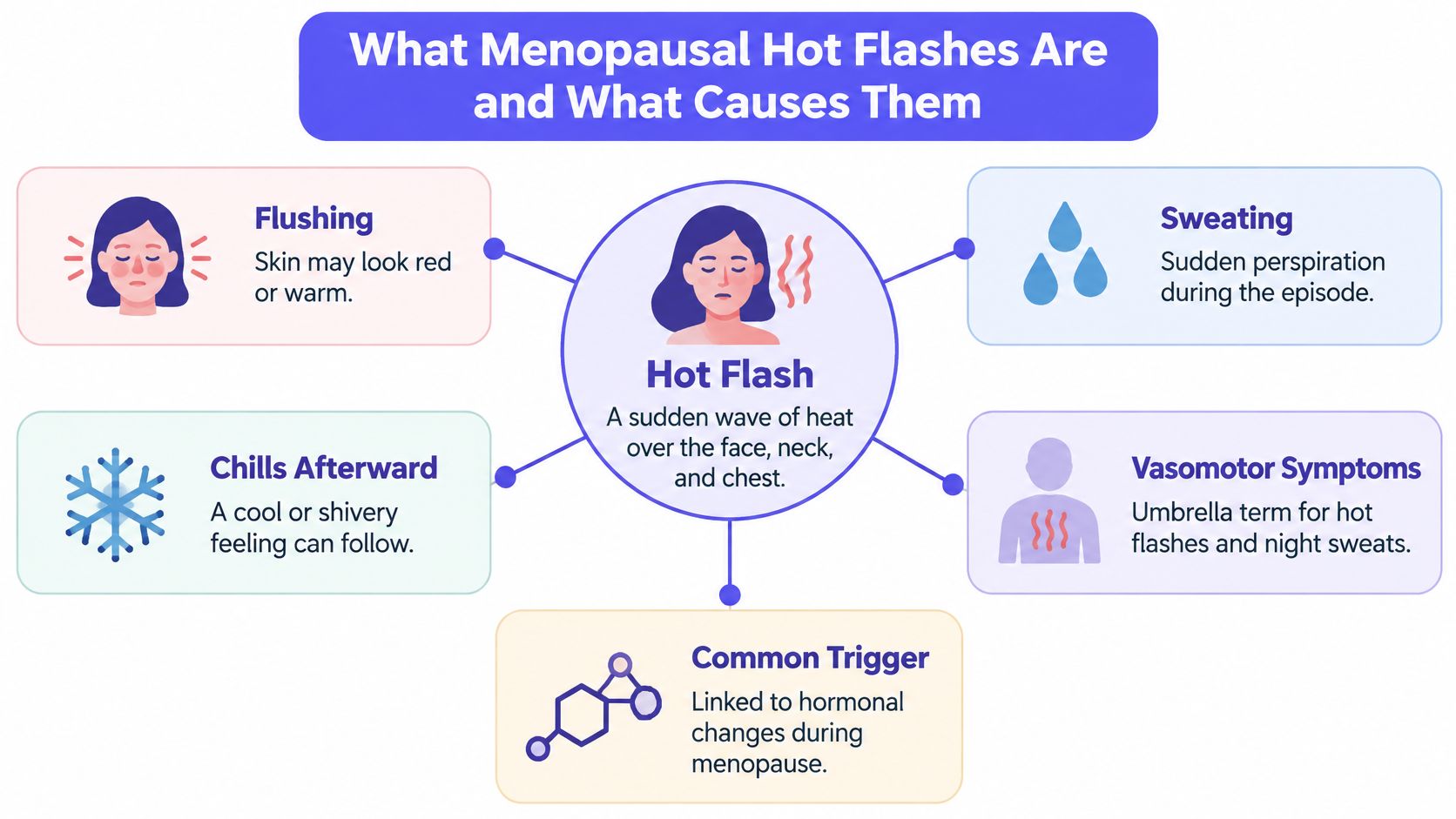
The key to understanding why this happens is to think of your brain as managing a thermostat. It normally keeps your core temperature within a comfortable band, called the thermoneutral zone. As estrogen levels fall, changes in the hypothalamus, the brain's temperature-control centre, can make that band narrower. A small rise in core temperature that once went unnoticed may now cross the threshold for the body to lose heat.
The body's cooling response
The sequence is straightforward:
- The temperature threshold is crossed. The body registers a small rise in core temperature as a signal that it needs to cool down.
- Blood vessels near the skin widen. This brings more blood close to the surface, which can make the face, neck, and chest look or feel warm.
- Sweating releases heat. As heat dissipates, you may then feel cool or shivery.
The review of menopausal thermoregulation describes this as a thermostat problem rather than just too much heat. It explains that estrogen-sensitive KNDy neurons influence the brain's temperature-control pathways; when their signaling changes, the threshold for starting the heat-loss response can fall. That helps explain why a flash can happen without an obvious outside cause.
Episodes are usually brief, around three to four minutes, but their timing can feel unpredictable. Heat, alcohol, spicy food, stress, disrupted sleep, or a warm room may be associated with episodes for some people, but triggers aren't identical for everyone. A log can help you notice your own patterns instead of treating every flash as if it has the same cause.
Important: Sudden, persistent, unusual, or medication-associated flushing deserves clinical assessment. Not every episode of flushing is a menopausal hot flash.
How Long Hot Flashes Last and Who Gets Them
Hot flashes can begin before periods stop, and that timing is linked to how long symptoms tend to continue. In a 2015 SWAN analysis of 1,449 women with frequent hot flashes or night sweats, the median total duration was 11.8 years for women whose symptoms began while they were still menstruating or in early perimenopause. For women whose symptoms began only after their periods stopped, the median was 3.4 years, according to the SWAN study summary.
| Onset pattern | Median duration | What it means |
|---|---|---|
| Began during menstruation or early perimenopause | 11.8 years | Symptoms may continue for years after the final period |
| Began only after periods stopped | 3.4 years | The median course was shorter in this group |
Symptoms can start several years before the final menstrual period, with prevalence increasing around that point, according to longitudinal findings summarized by the National Center for Biotechnology Information. Up to 80% of women experience hot flashes or night sweats during the transition. That broad figure cannot predict how intense your symptoms will be or how much they may affect sleep and daily life.
Use duration to plan, not predict your exact course
A median is the midpoint for a group, not a personal deadline. If symptoms start early, it may help to plan for ongoing management rather than expect them to end after a brief phase. For a plain-language explanation of how onset timing relates to duration, read how long hot flashes can last.
Daytime flashes and night sweats can call for different first steps. In a 2024 survey of 196 women published in Menopause, 54.3% reported daytime hot flashes and 59.2% reported nighttime sweats or hot flashes; episodes occurred up to five times per day on average, according to the survey report indexed by PubMed.
If episodes mainly happen during the day, record their timing and frequency to help identify patterns. If they wake you, note how often sleep is interrupted and how you feel the next day. These details can help you decide whether to start with sleep-related changes, test possible daytime triggers, or ask a clinician about frequent or disruptive symptoms.
Common Triggers and How to Test Them
A food or drink that seems to bring on a flush for one person may have no effect on someone else. That's because triggers interact with individual temperature sensitivity, surroundings, stress, and sleep. Rather than removing several foods at once, test one possible trigger at a time and look for a repeatable pattern.
| Trigger | How it may act | How to test it |
|---|---|---|
| Alcohol | Widens skin blood vessels and can lower the heat-loss threshold | Avoid for two weeks, then reintroduce and compare |
| Spicy food | Increases skin blood flow and body heat | Remove for one week, then reintroduce |
| Caffeine | Stimulates the nervous system and can raise heart rate | Cut back by half for two weeks and compare |
| Hot rooms or heavy bedding | Raises ambient and skin temperature | Adjust room and bedding for one week and log |
| Stress | Activates the stress response that influences temperature control | Log stressful events against episode times |
| Poor sleep | Disrupts temperature regulation and increases sensitivity | Track sleep hours against next-day episodes |
| Smoking | Associated with more frequent and longer episodes | Log episodes before and after changes to smoking |
Keep a useful log
For two to three weeks, note the time of each episode, how long it lasts, what you ate or drank, the room temperature, your stress level, and how you slept the night before. A paper notebook is enough; a tracking app such as Lila can also keep symptoms, meals, sleep, and cycles in one view.
Look for episodes that repeatedly cluster within an hour or two of a particular exposure. Then change just that one factor and compare your symptoms. If you suspect spicy food, for example, pause it for a week, then reintroduce it while keeping other routines steady. The guide to foods that may trigger hot flashes can help you choose what to test first.
A log shows patterns and correlations, not proof that a trigger caused a flash. Before giving up a food you enjoy, see whether the pattern appears again after reintroduction. Keep any restriction practical and balanced, and focus on repeatable changes rather than trying to eliminate every item on a generic trigger list.
Lifestyle and Behavioral Strategies That Help
For tonight, make it easy to cool down without fully waking yourself. Wear removable layers, keep a fan near the bed, choose breathable bedding, make the room comfortable, and place cold water within reach. If you wake hot, loosen a layer, sip water, and let your body cool before trying to settle again.
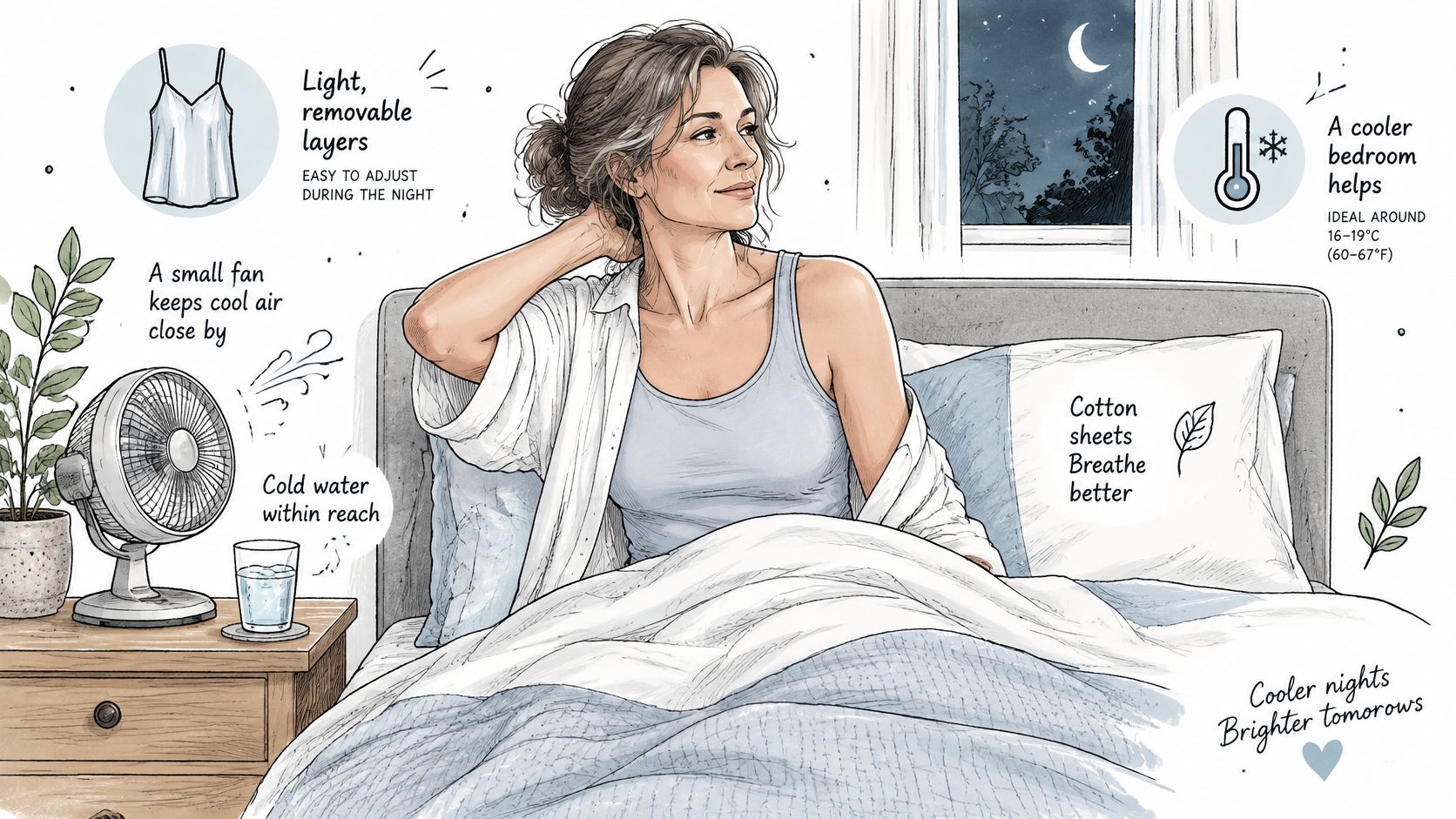
Cooling changes don't prevent every episode, but they can make one less disruptive. If you're often too warm under heavy covers, try lighter bedding or keep an extra layer within reach instead of adjusting the whole room each time. For night sweats, keep a spare top and towel nearby so you can change quickly and get back to bed.
Practices for the moment and over time
At the first hint of a flush, try paced breathing: breathe slowly and comfortably, aiming for about six to eight breaths per minute. Practise for a few minutes and notice whether it softens the episode or helps you feel calmer. It won't work the same way for everyone, so judge it by your own experience rather than expecting it to stop a flash on demand.
Menopause-adapted cognitive behavioral therapy (CBT) can help reduce how distressing and disruptive symptoms feel, even if the number of flashes changes less. A therapist or structured CBT programme can help you respond to symptoms, manage worry about sleep, and build strategies for getting back to rest after an episode.
Regular exercise can support sleep and overall wellbeing. Keep it manageable and choose activities you can sustain, such as walking or gentle strength work. A steady wind-down routine, with a consistent time to reduce screen use and settle before bed, may also make it easier to cope with interrupted sleep. If yoga appeals to you, these yoga practices for perimenopause may offer ideas for a routine that feels comfortable.
Some women find breathing and cooling useful for individual episodes, but these steps aren't a substitute for medical care when symptoms are severe. Lifestyle and behavioral strategies tend to offer modest relief; if flashes are frequent, intense, or repeatedly disrupting sleep, discuss them alongside medical options rather than waiting for self-care alone to solve the problem.
Here's a short video to guide a calming practice:
▶ PlayMedical Options From Hormone Therapy to Nonhormonal Drugs
| Option | Who it suits | Main evidence | Key cautions |
|---|---|---|---|
| Systemic estrogen hormone therapy | Suitable candidates with moderate to severe symptoms | About 75% reduction in frequency, as reported in a BMJ clinical review | Individual review of age, time since menopause, uterus status, clot risk, cardiovascular disease, and breast cancer history |
| Fezolinetant | Women who cannot or prefer not to use hormone therapy | Placebo-adjusted reductions of about 2.39 daily hot flashes at 30 mg and 2.55 at 45 mg by week 12 | Hepatotoxicity warning; liver-function tests at baseline and at 1, 2, 3, 6, and 9 months; check liver disease, renal impairment, and drug interactions |
| Elinzanetant | Women seeking a nonhormonal option for frequent symptoms | 62.8% and 62.2% reached a 50% reduction by week 4 in OASIS trials, versus 29.2% and 32.3% on placebo | Longer-term safety data are still developing |
| Low-dose SSRIs or SNRIs (off-label) | Women who cannot use estrogen and want a nonhormonal option | Moderate reductions in many trials | Side effects and drug interactions; clinician review needed |
| Gabapentin (off-label) | Women whose symptoms are worst at night | Some benefit for nighttime symptoms | Dizziness and sedation; clinician review needed |
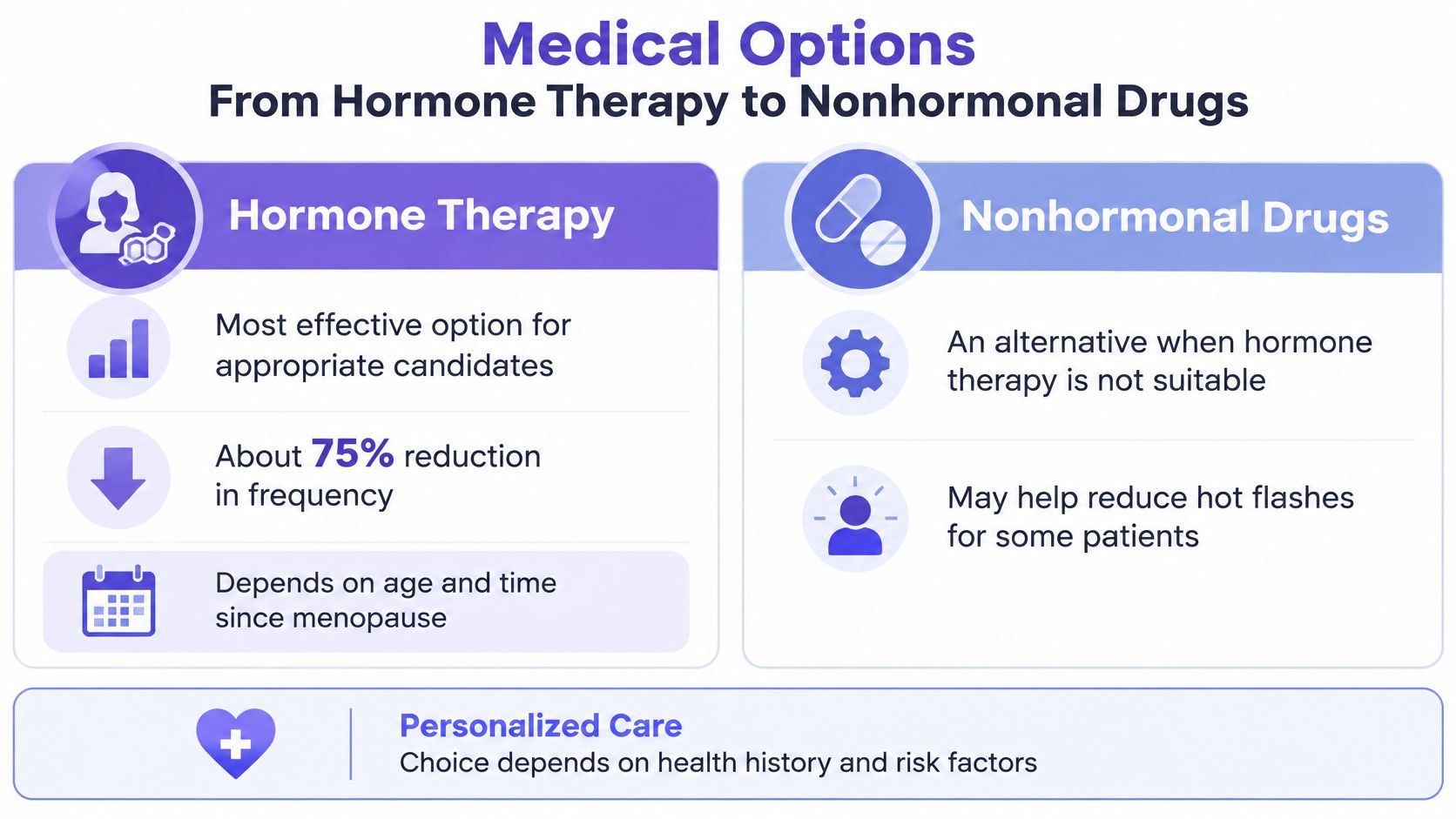
Systemic estrogen hormone therapy is the most effective medical option for suitable candidates with moderate to severe hot flashes. A BMJ clinical review reports an estimated reduction in frequency of about 75%. Whether it is appropriate depends on factors such as age, time since menopause, whether you have a uterus, and your history of clotting, cardiovascular disease, or breast cancer. For questions about how treatment may relate to weight changes, see menopause and weight insights from Trim. This overview of hormone therapy for menopause can help you prepare for a conversation with your clinician.
Nonhormonal choices and their trade-offs
The pattern of symptoms can help guide which option to discuss first. If hot flashes are frequent during the day, ask about treatments that reduce their frequency. If night sweats and sleep disruption are the main concern, gabapentin may be considered. These choices still need to be matched to your medical history and preferences.
Fezolinetant acts on neurokinin-3 signaling involved in temperature regulation. In a phase 3 trial summarized in the BMJ treatment review, it reduced daily hot flashes compared with placebo by about 2.39 at 30 mg and 2.55 at 45 mg by week 12. It carries a hepatotoxicity warning. The review of fezolinetant safety and monitoring describes liver-function tests at baseline and at months 1, 2, 3, 6, and 9. Liver disease, renal impairment, and interacting medicines also require clinician review.
Elinzanetant is another nonhormonal option. In two OASIS trials published in JAMA, 62.8% and 62.2% of participants taking it had at least a 50% reduction in symptom frequency by week four, compared with 29.2% and 32.3% on placebo, according to the trial report. Longer-term safety evidence is still developing.
Low-dose SSRIs or SNRIs may be prescribed off-label. Side effects and drug interactions can affect whether they suit you. Gabapentin may help when nighttime symptoms are the main problem, though dizziness and sedation are possible. Higher doses can bring more adverse effects, and there are no head-to-head comparisons establishing one best option for everyone. Evidence in groups such as breast-cancer survivors is also less developed, so discuss the expected benefits, risks, and monitoring with your clinician.
When to See a Clinician and Your Next Steps
Seek urgent medical care if flushing comes with fainting, chest pain, a racing or irregular heartbeat, or breathlessness. Arrange prompt assessment for new bleeding after menopause, fever with sweats, night sweats alongside unexplained weight loss, or flushing that begins after a new medication. Those symptoms need attention rather than a trial of lifestyle changes alone.
Book a non-urgent appointment if episodes happen more than seven times a day, wake you most nights, disrupt work or daily activities, or are accompanied by low mood or anxiety. If you have a history of breast cancer, blood clots, or liver disease, ask for individual medical advice before starting hormone or nonhormonal treatment. A treatment that suits someone else may not be safe for you.
Prepare for a useful appointment
Bring a symptom record showing when episodes happen, whether they occur during the day or at night, how long they last, and what you were doing beforehand. A perimenopause symptom tracker can help organize details about symptoms, sleep, and routines.
Also bring a list of medications and supplements, relevant family history of cardiovascular disease, and a short note about which symptoms affect you most. If sleep disruption is the main problem, say so plainly. If daytime episodes are making work difficult, describe that instead of only reporting the number of flashes.
Use this decision path to take the next step:
- Keep a symptom log for two to three weeks. Record timing, setting, possible triggers, sleep, and how much symptoms interfere with your day.
- Try two cooling or behavioral changes. Keep them consistent for at least two weeks so you can tell whether they help.
- Book a visit if symptoms are moderate to severe, frequent, or sleep-disrupting. Bring your log and preparation notes.
- Discuss hormone therapy and nonhormonal options in light of your health history and preferences. Ask about expected benefits, side effects, interactions, and any required monitoring.
- Review the plan periodically. Symptom patterns can change across the menopause transition, so a strategy that helped before may need adjustment.
Lila lets you track hot flashes alongside sleep, meals, mood, stress, and cycle changes, then uses those check-ins to shape a personalized action plan. If you'd like one place to organize your symptom patterns and prepare questions for a clinician, visit Lila.
Get Lila, your personal coach for perimenopause.
Built for women in their 40s. 24/7 coaching, in your pocket.