
Yoga for Perimenopause Your Guide to Symptom Relief
Discover how yoga for perimenopause can ease hot flashes, improve sleep, and balance mood. Find actionable routines and tips for navigating this transition.
 Michelle
Perimenopause can feel like your body is in a constant state of rebellion. But what if you could find a sense of calm and control with a practice that’s both gentle and deeply effective? From my experience working with countless women in this phase, I can tell you that yoga is a powerful, science-backed way to manage the perimenopause rollercoaster by dialing down your body's overactive stress response.
How Yoga Eases Perimenopause Symptoms
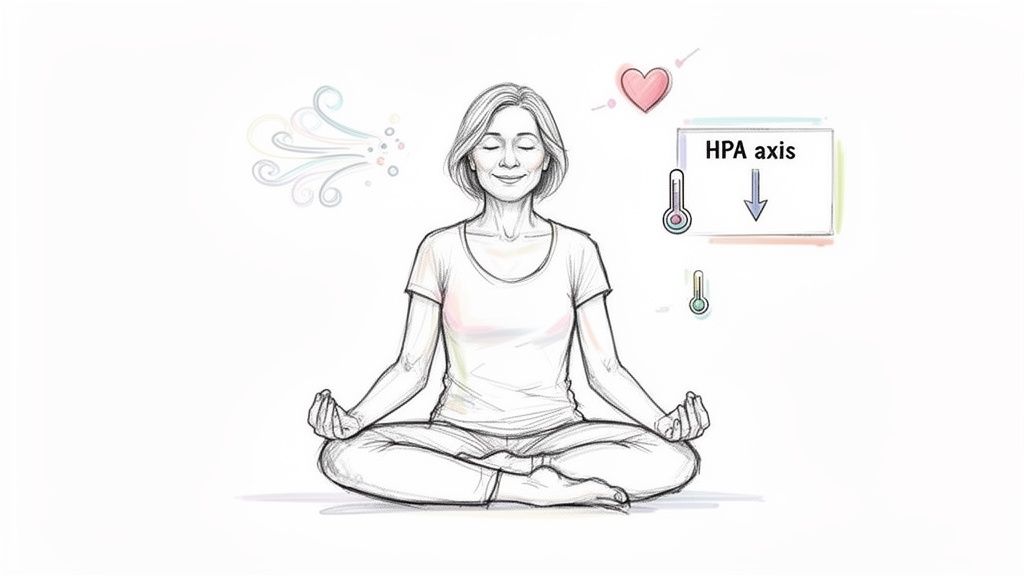
During perimenopause, your hormones are all over the place, which can put your nervous system on high alert. This constant stress is orchestrated by your body's Hypothalamic-Pituitary-Adrenal (HPA) axis. When this system gets stuck in overdrive, it’s no wonder symptoms like anxiety, irritability, and sleepless nights feel so intense.
This is where yoga for perimenopause truly shines. It’s not just about stretching—it's a mind-body practice that works on three levels to bring you back into balance:
Physical Postures (Asanas): These gentle movements and poses are incredible for releasing pent-up physical tension, boosting circulation, and soothing the achy joints so many of us experience.
Controlled Breathing (Pranayama): This is your direct line to a calmer state. Specific breathing techniques activate your parasympathetic nervous system, telling your body to shift out of "fight or flight" and into "rest and digest" mode.
Mindfulness and Meditation: By focusing your attention on the present, you can quiet the mental chatter and endless "what ifs" that come with hormonal changes.
Taming Your Most Frustrating Symptoms
When you bring these three elements together, you get a uniquely effective formula for tackling the hallmark challenges of perimenopause. A consistent yoga practice can make a real, noticeable difference in some of the most disruptive symptoms.
By soothing the nervous system, yoga can have a direct, positive impact on your body’s internal thermostat, helping reduce the frequency and intensity of hot flashes. You can learn even more about tackling this symptom in our guide to natural hot flash relief.
Yoga's impact on cortisol, our primary stress hormone, is also a game-changer for sleep. High cortisol is a well-known culprit behind waking up in the middle of the night. A simple, calming routine before bed can signal to your body that it's safe to power down and repair. While yoga is a fantastic starting point, it's also worth looking into other science-backed alternatives to melatonin for sleep to build a comprehensive toolkit for restful nights.
Reclaiming Your Sense of Well-Being
Ultimately, yoga gives you a practical, accessible strategy to move from just surviving perimenopause to actively managing it. It teaches you to listen to what your body needs—whether that’s cooling down, building energy, or simply finding a moment of stillness.
It’s about reclaiming a sense of agency and well-being, one breath at a time.
The Science of Yoga and Hormonal Balance
▶ PlayWhen we talk about using yoga to manage perimenopause, we're really talking about biochemistry. This isn't just about stretching and feeling a bit more relaxed; it's a direct conversation with your hormonal and nervous systems, which can feel like they're in a state of chaos during this life stage.
The key connection here is stress. As estrogen levels start their rollercoaster ride during perimenopause, your body can become much more sensitive to stress, causing cortisol levels to spike. High cortisol is the culprit behind so many of the most frustrating symptoms—from anxiety and mood swings to disrupted sleep and that stubborn fat that seems to love your midsection.
Calming the Nervous System
This is where gentle and restorative yoga truly shines. These practices are incredibly good at dialing down cortisol by activating your parasympathetic nervous system, which you can think of as your body's "rest and digest" mode. It's the complete opposite of the high-alert, "fight or flight" state that stress throws you into.
Your breath is the most powerful tool you have to make this switch. Slow, deep, and mindful breathing—what we call pranayama in yoga—sends a direct signal to your brain that you're safe. This simple act sets off a chain reaction throughout your body:
Your heart rate starts to slow down.
Blood pressure naturally drops.
Tense muscles begin to let go.
Consciously shifting your body out of a stressed state and into a calm one creates the perfect internal environment for your hormones to find a little more stability. You're essentially clearing away the static from stress hormones, allowing your body to do its job of self-regulation more effectively.
Yoga's Proven Edge Over General Exercise
While any kind of movement is a good thing, the combination of physical postures, breathwork, and mindfulness gives yoga a unique advantage. This isn't just a feeling; it's backed by research.
A significant 2014 study looked at 216 perimenopausal women, comparing a 12-week yoga program to a standard exercise routine. The results were telling. The yoga group saw significant improvements across all symptoms—including hot flashes, mood, sleep, and even sexual health. The group doing general exercise, however, saw no improvement in their hot flashes or sexual wellness. You can read the full research on yoga's holistic benefits for perimenopause yourself.
This shows us that yoga isn't just another workout. It's a targeted practice that works directly on the body's stress and hormonal pathways, offering more complete relief than exercise alone.
For those who want to go deeper, exploring the energetic side of yoga can add another layer of insight. Understanding how to balance your chakras can provide a framework for creating inner harmony that complements the physical practice. Plus, many yoga poses are specifically designed to increase blood flow to the pelvic region, nourishing the very endocrine glands that produce your hormones. This makes your time on the mat a powerful, proactive way to partner with your body through the perimenopausal transition.
Putting It Into Practice: Yoga Routines for Real Relief
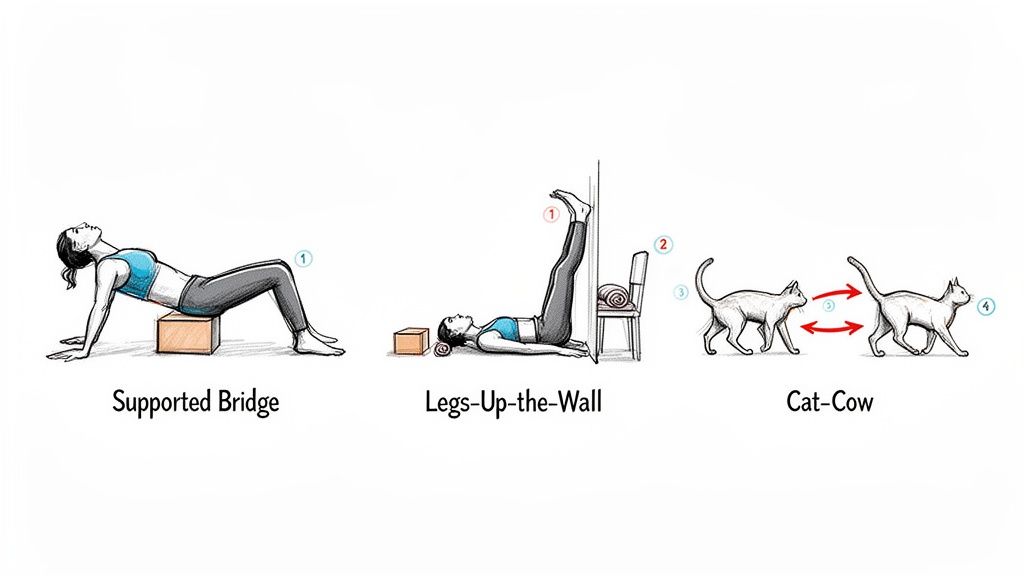
Knowing why yoga helps is one thing, but actually feeling that relief is what truly matters. Instead of overwhelming yourself with a long, complex practice, I encourage you to think of these poses as a personal toolkit. You can pull out these mini-routines whenever a symptom flares up.
The real secret here is consistency, not intensity. Just five to ten minutes a day can make a world of difference in how you feel, both physically and emotionally. Let’s dive into some simple, targeted sequences you can do right at home.
To make it even easier to find the right pose for the right moment, here's a quick reference table.
Symptom-Targeted Yoga Poses for Perimenopause Relief
Symptom | Recommended Yoga Pose | Primary Benefit |
|---|---|---|
Hot Flashes / Overheating | Sheetali Breath (Cooling Breath) | Instantly cools the body and calms the nervous system. |
Anxiety / Racing Mind | Legs-Up-the-Wall (Viparita Karani) | Gentle inversion that soothes the mind and reduces stress. |
Poor Sleep / Insomnia | Child's Pose (Balasana) | Grounding and calming; promotes a sense of safety and release. |
Low Energy / Mood Swings | Cat-Cow (Marjaryasana-Bitilasana) | Gently energizes the spine and releases built-up tension. |
Pelvic Discomfort / Tension | Supported Bridge Pose | Opens the hips and chest while relieving lower back strain. |
Irritability / Tension | Standing Forward Fold (Uttanasana) | Calms the brain and releases tension in the neck and back. |
This table is your starting point. Now, let's explore how to weave these poses into simple, effective routines you can use anytime.
Cooling Down Hot Flashes
When that internal furnace suddenly cranks up, the last thing you feel like doing is moving vigorously. This short sequence is all about calming your nervous system and cultivating a sense of inner cool.
Begin with Sheetali Pranayama, also known as the Cooling Breath. Find a comfortable seat. If you can, curl the sides of your tongue to create a tube. Inhale slowly through your mouth, as if you’re sipping air through a straw. If rolling your tongue isn't possible, simply part your lips and teeth slightly. Close your mouth and exhale gently through your nose. Repeat this for 10-15 breaths, paying close attention to the subtle cooling sensation.
Once you feel a bit calmer, transition into a couple of cooling postures:
Supported Bridge Pose (Setu Bandha Sarvangasana): Lie on your back with your knees bent and feet planted firmly on the floor. As you lift your hips, slide a yoga block or a firm cushion under your sacrum (the flat part of your lower back). Let your arms rest open at your sides. This pose gently opens the chest and calms the mind without building any heat. Settle in for 2-3 minutes.
Gentle Forward Fold (Uttanasana): From standing, bend your knees generously and hinge at your hips to fold forward. Don't worry about touching your toes; just let your head hang heavy. This posture is fantastic for quieting the mind and releasing the irritability that often hitches a ride with a hot flash.
Better Sleep Sequence
Sleepless nights can be one of the most draining parts of the perimenopause journey. This restorative routine is designed to be done just before climbing into bed, signaling to your body and mind that it's time to rest. Keep the lights low and your movements slow and deliberate.
The absolute star of this sequence is Legs-Up-the-Wall (Viparita Karani). Sit with one hip right up against a wall, then smoothly swing your legs up the wall as you lie back. You want your sitting bones as close to the wall as is comfortable for you.
This pose is a game-changer for a racing mind and tired, achy legs. I recommend staying here for a full 5-10 minutes. Focus on your breath, letting it become slow and deep. So many women I've worked with say this one pose has dramatically improved their ability to drift off to sleep.
Afterward, gently ease yourself into Child's Pose (Balasana). From a kneeling position, bring your big toes to touch, widen your knees, and fold your torso forward. You can rest your forehead directly on the mat or on a folded blanket. This posture feels like a gentle hug, creating a sense of safety and release that’s perfect for letting go of the day.
Mood and Energy Boost Routine
For those days when you feel sluggish, anxious, or just plain off, this gentle flow can help shift your energy without feeling depleting. The focus is on releasing spinal tension and creating a feeling of spaciousness in the body.
Start on your hands and knees for Cat-Cow (Marjaryasana-Bitilasana). As you inhale, let your belly drop and lift your gaze (Cow Pose). As you exhale, round your spine toward the ceiling and tuck your chin (Cat Pose). Let your breath guide the movement, flowing between the two for 1-2 minutes to gently awaken your spine.
Next, find a comfortable seated position for a Seated Twist. Sit up tall, inhale to find length in your spine, and then exhale as you gently twist to one side, placing one hand behind you for support. Hold for about five deep breaths before repeating on the other side. Twists are wonderful for wringing out tension and supporting healthy digestion.
While yoga is a fantastic tool for managing symptoms, movement of all kinds can be beneficial. You can discover more options in our guide to the best exercises for menopause.
Remember, these are your practices. Feel free to use props like blankets, pillows, and blocks to feel fully supported. The most important rule in yoga for perimenopause is to listen to your body—it will always tell you what it needs.
Building a Sustainable Weekly Yoga Practice
When it comes to using yoga for perimenopause, the secret sauce isn’t about mastering a perfect headstand. It's about consistency. Showing up for yourself, even for just a few minutes, is what truly makes a difference.
A sustainable practice will always be more powerful than one long, heroic session you only manage to do once a week. Think progress, not perfection. You’d be amazed at the relief you can find in short but frequent sessions.
One of the biggest hurdles I hear about is the classic, "I don't have time." I get it. The key is to start small and anchor your new yoga habit to something you already do every day. This is often called habit stacking.
For instance, what if you rolled out your mat right after you finish your morning coffee? Before you know it, you’ve done ten minutes of gentle movement that can completely shift the tone of your day.
Listen to Your Body First
Your energy levels and symptoms can feel like a rollercoaster during perimenopause. One day you’re up, the next you’re down. Your yoga practice needs to be just as flexible.
Before you start, get into the habit of checking in with yourself. Just ask, "What do I need today?"
Feeling anxious and overwhelmed? A calming, restorative practice is your best friend.
Energy tanking? A gentle flow with some heart-openers like Cat-Cow can work wonders.
Caught in a hot flash? This is the time for cooling breathwork and supported poses.
To make it even easier, here’s a simple guide to help you pick the right practice based on how you’re feeling and how much time you have.
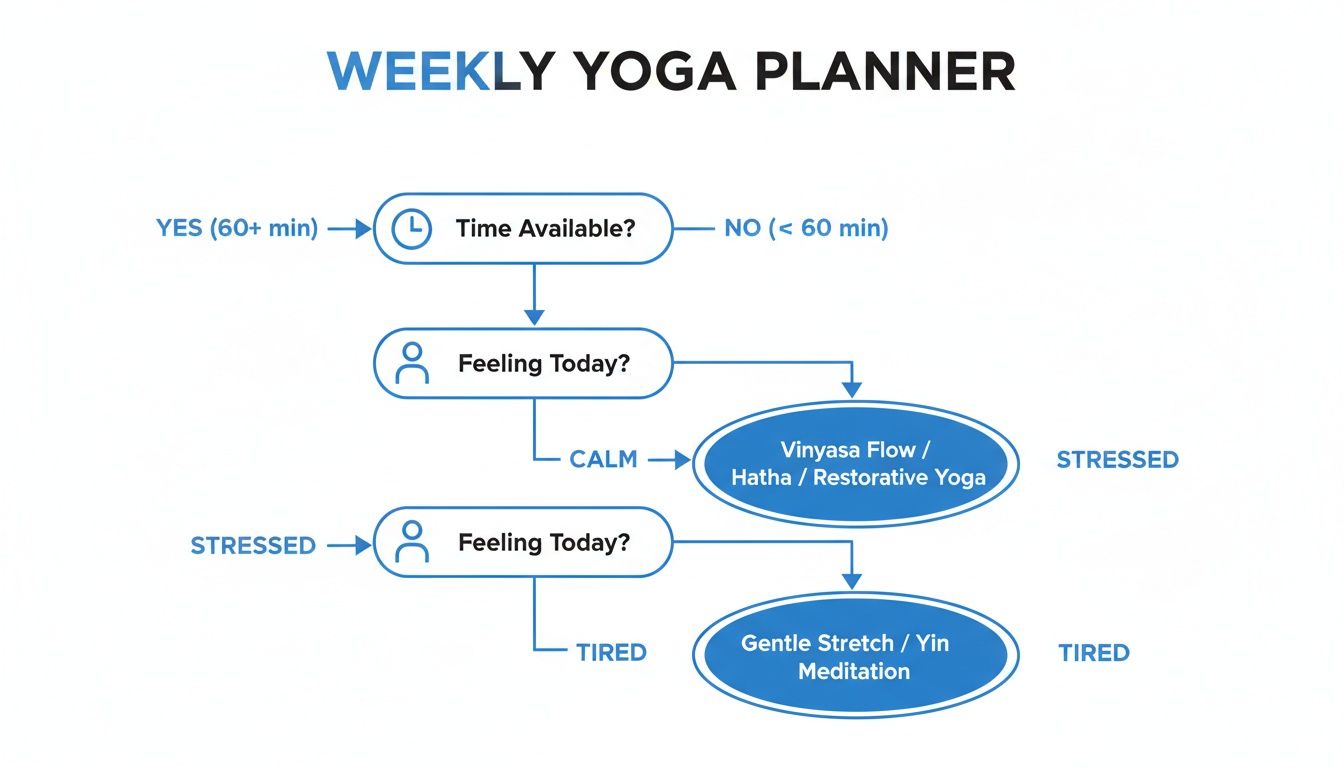
Think of this as your personal decision-maker, taking the guesswork out of choosing a routine that truly honors what your body is asking for in the moment.
How Often Should You Practice?
You might be surprised how little it takes to see real results. Research backs this up, showing that even a manageable commitment pays off big time.
A recent randomized trial found that practicing yoga for just 60 minutes twice a week led to a massive drop in psychological, physical, and urogenital symptoms of menopause over just ten weeks. The women in the study saw their total symptom scores fall by nearly 70%. It’s compelling proof that a consistent, twice-weekly habit can offer powerful relief, and quickly. You can read more about these remarkable findings for yourself.
With that in mind, here are a couple of simple ways to get started:
The Beginner's Plan:
Aim for three 20-minute sessions per week.
Your goal is simply to learn the foundational poses and get comfortable connecting with your breath.
The Symptom-Focused Plan:
Try five or six short 10-15 minute sessions each week.
Each day, choose a mini-routine specifically targeted at whatever symptom is bothering you most.
Remember, the best plan is the one you actually do. It’s far better to practice for ten minutes every day than to aim for an hour once a week and constantly put it off.
A quick but important note: it's always smart to chat with your doctor before starting any new fitness routine, especially if you have pre-existing conditions like osteoporosis or joint problems.
Most importantly, listen to your body’s signals. If you ever feel a sharp pain, that's your cue to gently back off or modify the pose. Your time on the mat should always feel supportive and nurturing, never forced.
Combining Yoga with Symptom Tracking for Better Results
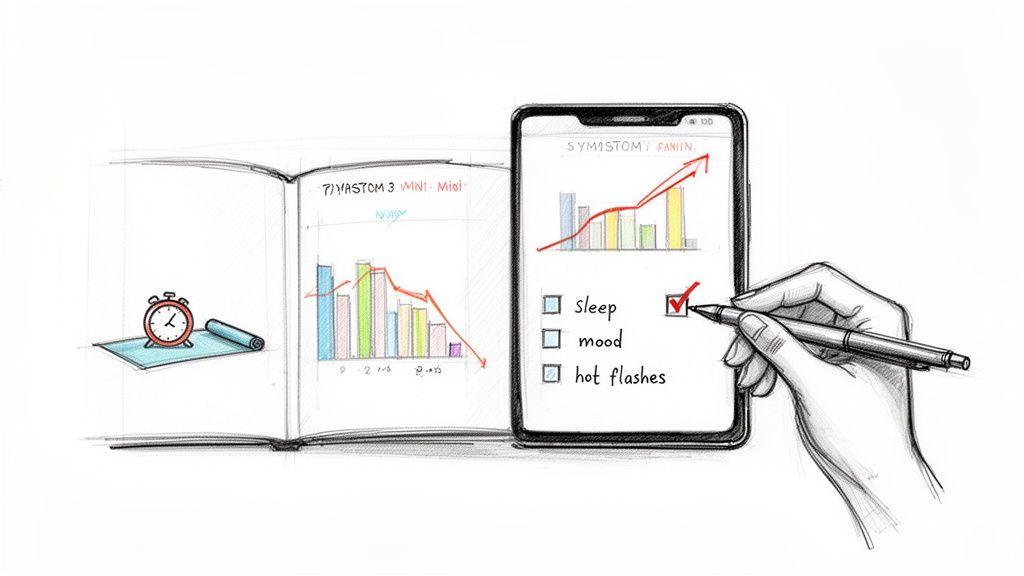
While a steady yoga practice can feel like a godsend during perimenopause, you can take your results to the next level by adding one simple thing: data. This is where you shift from just reacting to your symptoms to proactively and intelligently managing them. It’s about working smarter, not harder, to feel your best.
Think of it as creating a direct conversation with your body. You’re not just guessing if that new yoga sequence is helping your sleep; you're seeing the proof right there in your tracking app. This kind of clear, undeniable feedback is incredibly motivating and helps you build habits that actually stick.
Create Your Personal Feedback Loop
The idea is simple but powerful: you connect how you feel with what you do. Instead of just following a generic schedule, you let your body’s own signals guide your yoga practice for the day. Your daily check-in becomes a specific, targeted action plan.
Here’s how this looks in the real world:
Do a quick morning check-in. Before the day gets away from you, take a moment to notice what your most disruptive symptom is. Did you wake up feeling anxious? Is brain fog making it hard to think?
Pick a routine that fits. Based on that main symptom, choose one of the targeted yoga routines from this guide. If anxiety is the big one, the Mood and Energy Boost sequence is your go-to.
Log it and look for patterns. After your session, make a note of it in your tracker. The next day, you can look back and see if there was any shift. Did your anxiety score drop? Did your focus improve?
Let's say you look at your app and notice your sleep quality score has tanked for two nights in a row. That’s your cue. That evening, you can intentionally practice the 15-minute Better Sleep Sequence. The next morning, you open your tracker and check: did that targeted practice make a difference?
This is what a truly personalized wellness strategy feels like. You stop throwing random solutions at your symptoms and start making informed choices based on your own real-time data. A dedicated menopause symptom tracker app can make this whole process seamless.
The Proof Is in the Data
This isn't just a nice idea—the connection between a consistent yoga practice and symptom relief is backed by solid research. When you track your own progress, you're essentially creating a personal case study that mirrors what larger scientific trials have already discovered.
A 2023 randomized controlled trial with 208 women found that a consistent yoga practice significantly slashes overall perimenopause symptoms and dramatically improves sleep.
This is huge, especially when you consider that a staggering 40-60% of women experience sleep disruption during perimenopause. In that study, which ran for 20 weeks, the women practicing yoga saw major improvements in both their overall Menopause Rating Scale (MRS) scores and, crucially, their sleep quality scores. This kind of data validates yoga as a powerful, non-pharmaceutical tool for reclaiming your nights.
By combining the ancient wisdom of yoga with modern, easy-to-use tracking tools, you put yourself back in the driver's seat. You gain the power to see exactly what works for your body, turning the often-chaotic journey of perimenopause into one of confidence and control.
Answering Your Top Questions About Yoga for Perimenopause
It’s completely normal to have a few questions before you roll out your mat, especially when your body is going through the changes of perimenopause. Let's tackle some of the most common concerns I hear from women so you can get started with total confidence.
The first hurdle for many is the flexibility myth. I get asked all the time, "But I'm not flexible at all!## Answering Your Top Questions About Yoga for Perimenopause
It’s completely normal to have a few questions before you roll out your mat, especially when your body is going through the changes of perimenopause. Let's tackle some of the most common concerns I hear from women so you can get started with total confidence.
The first hurdle for many is the flexibility myth. I get asked all the time, "But I'm not flexible at all! Can I even do yoga?" Let me be clear: you absolutely do not need to be flexible to start. In fact, feeling stiff and achy is one of the best reasons to start.
Flexibility isn't the entry ticket; it's a potential side effect. The real goal here is simply to feel better in your own skin, not to twist yourself into a pretzel. This practice is about meeting your body with kindness, right where it is on any given day.
What Kind of Yoga Is Best During Perimenopause?
With so many styles out there, it's easy to feel overwhelmed. For this specific chapter of life, you'll find the most relief in slower, more grounding practices that calm your nervous system. When you're looking at class schedules, keep an eye out for these names:
Restorative Yoga: Think of this as a "yoga nap." You use lots of props like pillows and blankets to completely support your body in gentle, relaxing poses. It’s a game-changer for high-stress days or when you feel utterly drained.
Yin Yoga: This is a quiet, meditative style that works on the deep connective tissues in your body. It's fantastic for easing physical tension and quieting a busy, anxious mind.
Hatha Yoga: Hatha is often a great entry point. These classes typically move at a slower pace, focusing on the foundational postures and connecting them to your breath.
On the flip side, it’s wise to steer clear of really intense, fast-paced, or hot yoga for now, particularly if hot flashes and fatigue are your primary concerns. These styles can sometimes overwhelm a system that's already working overtime.
The right yoga practice for you is the one that leaves you feeling calmer and more centered than when you started. If a class feels competitive or constantly pushes you past a comfortable edge, it's not serving you right now.
How Often Should I Be Practicing?
When it comes to yoga, consistency will always give you better results than intensity. While some research points to practicing 3-5 times a week for benefits like improved sleep and bone density, you can see a real difference in your overall symptoms with just two dedicated sessions a week.
My best advice? Start small and build from there. Try for just 10-15 minutes a day or a couple of 20-minute practices each week. A short, regular routine is far more sustainable and beneficial than one heroic 90-minute class you only manage once a month.
Above all, learn to listen to your body's daily rhythm. Some days you might have the energy for a gentle, flowing sequence. On others, just resting in a supported Child's Pose for five minutes might be exactly what you need. Let your yoga practice adapt to you, not the other way around.
Ready to see how this all comes together? With Lila, you can log your yoga sessions right alongside your symptoms. Watch in real-time as your practice starts to improve your sleep, mood, and energy. Grab your personalized action plan and start your journey to feeling better at https://getlila.com.
Get Lila, your personal coach for perimenopause.
Built for women in their 40s. 24/7 coaching, in your pocket.


