
Menopause Itchy Breasts: Causes, Red Flags and Relief
Menopause itchy breasts are usually benign, but some signs need a doctor. Learn the causes, red flags and relief steps.
If menopause itchy breasts were only dry skin, a plain moisturizer would settle them in a few days. Why, then, does the itch spike under one breast after a hot flash, or cling to a single nipple long after you changed detergent?
Most advice collapses this into one cause and one cream. The pattern matters more than the label. Dryness on both sides, a sweaty fold, a scaly areola, and a one-sided nipple change don't call for the same first step. Match what you see before you pick a treatment, and you'll know whether about two weeks of gentle care is reasonable or a clinician should see the skin soon.
Table of Contents
- Which Itch Patterns Are Usually Menopause and Which Need a Check
- Benign Skin Causes That Look Like Menopausal Itch
- Red Flags That Mean You Should Get Examined Soon
- Why Estrogen Loss Makes Breast Skin Itch and How to Calm It
- Track Itch Patterns So Your Clinician Can Act
- Confirm the Pattern and Book the Right Check
Which Itch Patterns Are Usually Menopause and Which Need a Check
Most menopause itchy breasts come from dry, irritated skin, not from the gland underneath. Urgency follows the pattern: both sides versus one side, a fold that worsens in heat, or skin that crusts, weeps, or swells.
| Itch pattern | Likely category | First action |
|---|---|---|
| Both breasts, dry or flaky, worse in cold weather or after showers | Dryness from lower estrogen | Fragrance-free emollient twice daily for two weeks |
| Under the breast fold, worse with sweat or heat | Moisture-related fungal or intertrigo irritation | Keep folds dry, change damp clothing, see a clinician if no change within about a week |
| Redness, scaling or thickening on the areola or breast | Eczema or contact dermatitis | Stop new products and use a bland emollient; book a visit if it lasts about two weeks |
| One nipple or one breast only, with crusting, discharge or a lump | Possible Paget disease or another breast change | Book an exam promptly rather than waiting it out |
| Rapid redness, swelling, warmth or skin thickening | Inflammatory breast cancer, which is rare | Same-day or same-week medical assessment |
How common the itch is
Common isn't the same as ignorable. A 2025 systematic review in the American Journal of Clinical Dermatology reported that pruritus affected 46% of 150 postmenopausal women in a cited cohort study. That figure is about itch in that group, not a tally of breast cancer, and it doesn't mean your row can wait.
Practical rule: If your row is dry skin on both sides, start the emollient tonight and recheck at two weeks. If your row is one nipple, a lump, or rapid swelling, the first action is an appointment, not another jar.
Heat often sits behind the fold row, because sweat pools where skin touches skin. Hot flashes and itchy skin often travel together even when the breast tissue itself is healthy. Find your row, then take that row's first action.
Benign Skin Causes That Look Like Menopausal Itch
Menopause doesn't explain every itch on the chest. Eczema, a moist fold rash, and rubbing from a bra can look nearly identical, so a single dryness label sends people to the wrong cream.
| Condition | Typical look | Where it appears |
|---|---|---|
| Eczema (atopic or contact) | Red, flaky or scaly, sometimes weeping or thickened | Anywhere on breast skin, including the areola |
| Intertrigo or fungal rash | Moist, red, sometimes with a sour smell | Under the breast fold and other skin creases |
| Friction or bra irritation | Red band or rawness along the strap, band or underwire line | Where clothing rubs or sits tight |
| Bacterial skin infection | Tender, warm, sometimes crusting or pus | Usually one small area, often where skin is broken |
| Dryness (xerosis) | Fine flaking with a tight feeling and no rash | Both breasts and the wider chest skin |
Where the flare actually sits
Place sorts the lookalikes. Heat and sweat under the breast favor intertrigo or a fungal irritation. A red band along a strap, band, or underwire is friction. A patch that appears the week you switch laundry liquid is contact, not a sudden hormone crash.
Lower estrogen can make soaps, detergents, and textiles you tolerated for years start to sting. OB-GYNs describing these flares note that symptoms show up under the breasts, after hot flashes, and with particular bras and fabrics. Eczema can sit anywhere on the breast and look red, flaky, scaly, or inflamed.
Don't start a steroid or an antifungal before someone has diagnosed the rash. Nipple dermatitis, eczema, infection, and Paget disease can look similar, and the wrong cream hides the pattern.
What to try before a medicated cream
Change one thing at a time so you can tell what helped.
- Cleanser: Fragrance-free only, not a new scented body wash.
- Emollient: A bland cream on a schedule, including the fold once it's dry.
- Bra: Breathable fabric and a band that doesn't dig.
- Sweat: Change damp clothes promptly and let the skin air dry.
- Hands and new scents: Skip scratching, and don't add a fragranced lotion during the test.
If the same tightness covers the chest and arms, menopause itchy skin causes, relief and prevention covers that wider pattern.
Red Flags That Mean You Should Get Examined Soon
Itchy breasts during and after menopause are usually not cancer. A change that stays, sits on one side, or moves fast still needs a clinician, because a few rare cancers begin on the skin.
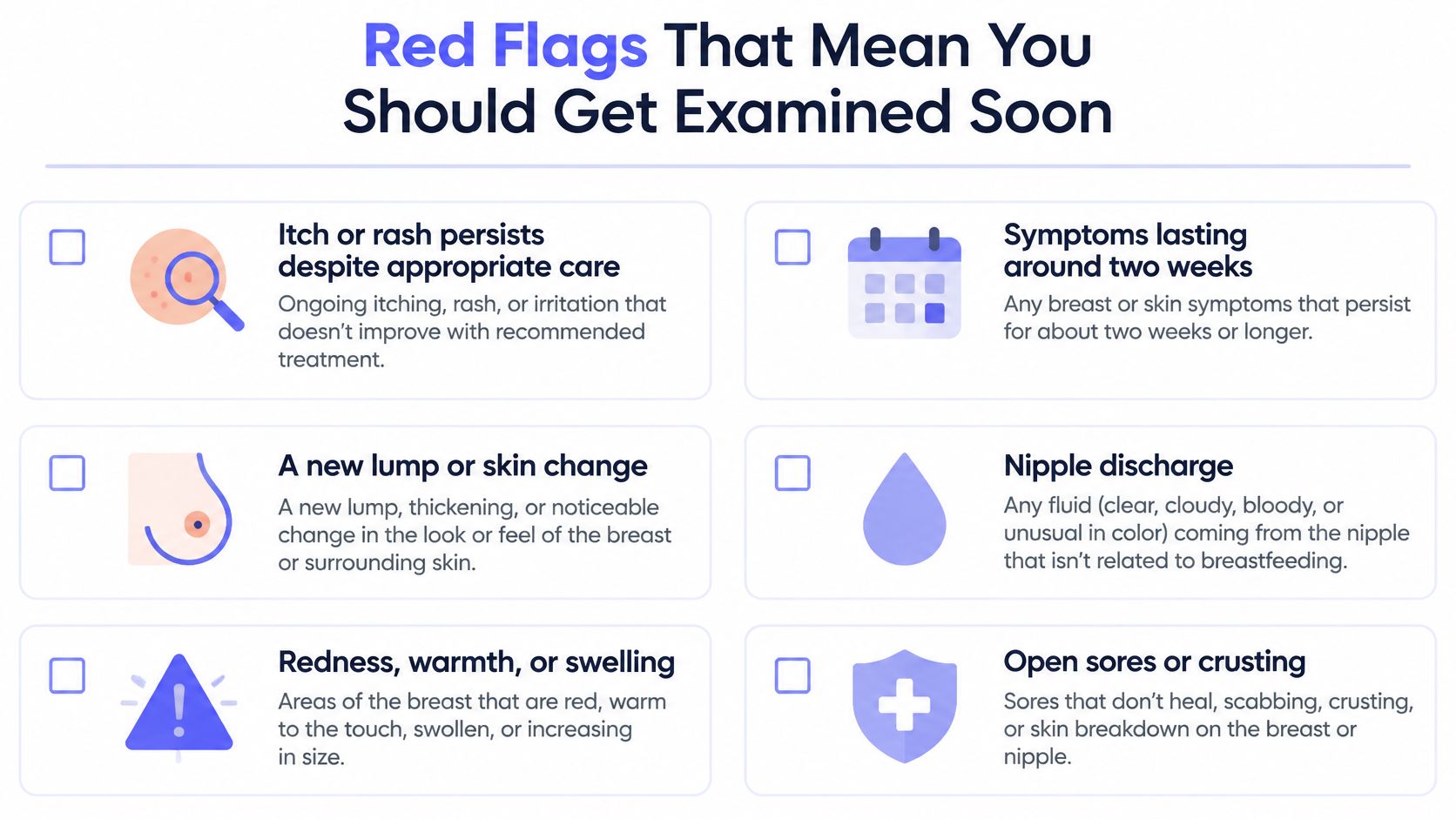
Scan the checklist, then use the thresholds under it rather than a vague sense that something feels off.
Thresholds that should end home care
Paget disease of the breast accounts for up to 4% of breast-cancer cases, MD Anderson Cancer Center explains, and persistent or asymmetric symptoms deserve clinical attention. The U.S. National Cancer Institute advises evaluation of breast or nipple skin changes that don't go away, including itching, redness, darkening, scaling, swelling, dimpling, or puckering.
- Care that fails: An itch or rash that persists despite appropriate care.
- Time: Symptoms lasting around two weeks.
- One side: Nipple or breast changes on one side only.
- A mass or fluid: A new lump, bloody discharge, or nipple inversion.
- Speed: Rapid breast enlargement.
Why two lookalikes can't wait
Paget disease typically affects the nipple and areola. It may cause itching, burning, scaling, crusting, ulceration, or discharge. Early on it can mimic eczema, which is why a one-sided patch that won't settle needs an exam rather than another tube of cream.
Inflammatory breast cancer is rare and fast. It can bring rapid redness, swelling, warmth, skin thickening or tightening, or a peau d'orange texture, sometimes with itching. These signs don't diagnose cancer. They justify a prompt exam instead of assuming dryness. Soreness has its own timing, and when to worry about breast pain after menopause is a separate decision from a skin change.
An exam is the right response to a red flag. It isn't a verdict, and many people leave with a skin diagnosis rather than a cancer diagnosis.
Why Estrogen Loss Makes Breast Skin Itch and How to Calm It
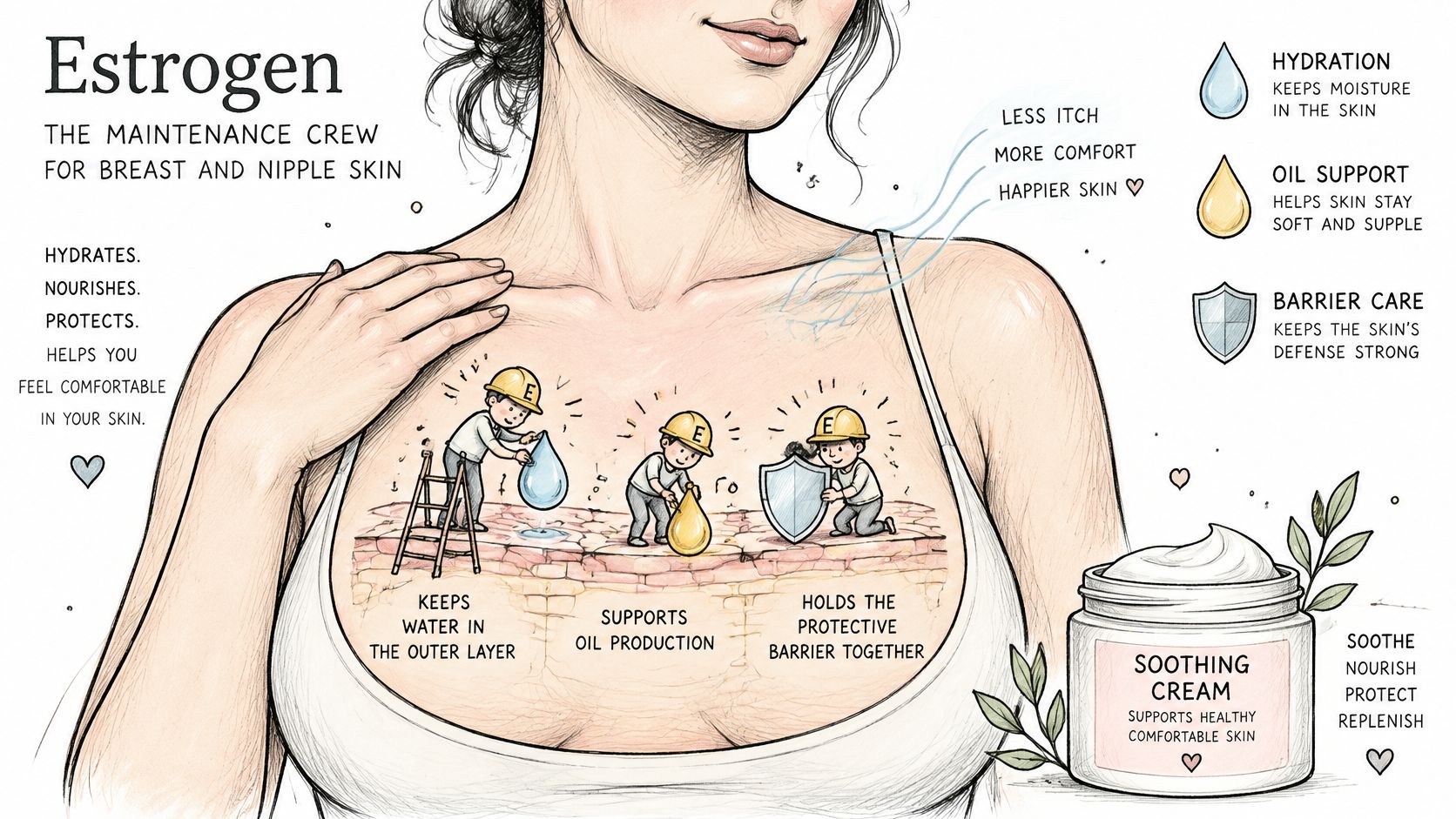
Estrogen works like a maintenance crew for breast and nipple skin. It holds water in the outer layer, supports oil, and keeps the barrier intact. As levels swing in perimenopause and stay lower after the final period, the skin thins, water escapes, and detergents or fabrics you once ignored start to itch. Picture plaster that has dried out. Paint lifts at the edges even though nobody struck the wall.
The sketch below is that crew in one picture: hydration, oil, and a barrier that friction can breach.
Verywell Health links this itching mainly to declining estrogen, which reduces skin thickness, elasticity, and natural oil production, so nipple and breast skin gets drier and easier to irritate with friction, detergents, sweat, or fabrics. Clinically, the itch is more often a benign skin condition, especially eczema, dryness, allergy, or a fungal or bacterial infection, than breast cancer. One dermatology review cited there reports that up to 20% of people with atopic dermatitis develop nipple or areola involvement, so a breast-only itch can still belong to a wider skin disorder.
Put the emollient on while the skin is still slightly damp. Water left on the surface evaporates and pulls more moisture out if you wait until you're fully dry.
A Climacteric review of menopausal skin describes estrogen's support for epidermal hydration, collagen and elastin, glycosaminoglycans such as hyaluronic acid, sebaceous activity, and barrier repair. Lower or swinging levels raise transepidermal water loss and can switch on itch-sensing nerves. Xerosis and pruritus are recognized menopausal skin symptoms, and dryness may begin in perimenopause, then sharpen as sebum declines. That review is also plain that hormone therapy shouldn't be started solely for itchy skin, because evidence of skin improvement is mixed. The call belongs with a clinician who can weigh your full picture, including other signs of low estrogen.
If thinning shows up on the chest and elsewhere, caring for thinning skin during menopause from Skin Perfection pairs well with the steps below.
A routine you can start tonight
- Wash gently. Use a fragrance-free, mild cleanser and lukewarm water. Hot water strips oils the barrier is already short of.
- Seal water in. Pat, then apply a bland, fragrance-free emollient on slightly damp skin.
- Park irritants for two weeks. That means fragranced soap, fabric softener, harsh detergent, and any new skincare product.
- Don't leave sweat sitting. Change damp clothes quickly and let the fold air dry, so moisture doesn't feed fungal growth.
- Cut friction. Choose cotton or a moisture-wicking fabric, and recheck the band and straps. A digging underwire is a trigger.
- Protect broken skin. Skip scratching. A cool compress during a flare eases the urge without tearing the surface.
- Compare day 7 and day 14. Note whether flakes, redness, or night itch have eased. No change, or a one-sided change, means the routine has finished its job as a test and an exam is next.
A short film on estrogen and the skin barrier is worth one viewing, then a return to the steps.
▶ PlayTrack Itch Patterns So Your Clinician Can Act
A clinician can do more with six lines of notes than with "my breasts have been itchy for a while." Keep a few fields for two to four weeks.
| Log field | Why it matters |
|---|---|
| Date and time of each flare | Shows whether itching follows a pattern such as evenings or after sweating |
| Breast or nipple side affected | Separates one-sided changes, which need an exam, from symmetrical dryness |
| Trigger in the two hours before | Flags hot flashes, exercise, alcohol, a new product or a bra |
| Clothing and fabric worn | Identifies friction and synthetic-fabric irritation |
| What you applied and whether it helped | Shows which emollients and washes your skin tolerates |
| Skin appearance (redness, scale, crusting, discharge) | Lets a clinician compare the skin against red-flag signs |
| Current medicines, including hormone therapy doses | Helps the clinician check for interactions and skin side effects |
What one entry looks like
Say Tuesday, 9:40 p.m. Both folds itched after a hot flash and a polyester sports bra. No new product. Petrolatum eased it in twenty minutes. Skin was pink, not scaly, crusted, or weeping. That line ties heat, fabric, and a treatment that helped. Warm evenings or post-workout flares often stay invisible until they're written down.
Use plain words for the skin: red, scaly, crusted, weeping. Those words let a clinician match your notes to warning signs without guessing what "looked bad" meant.
Keep the log in a notes app or a symptom tracker so the fields don't drift. If you already record cycles and sleep, a perimenopause symptom tracker can sit beside the breast notes instead of replacing them.
Bring four things: the log, a list of products and fabrics, current medicines including any hormone therapy, and the date the itch started.
Confirm the Pattern and Book the Right Check
If the itch is on both sides, feels dry, and eases within about two weeks of gentle care, continue the routine and the log. If it persists, sits on one breast or nipple, or carries any warning sign, book an exam soon and take the notes with you. Rapid swelling, redness, or skin thickening needs same-week care, not another fortnight of cream.
What the visit is for
Expect a look at the skin and a review of medicines, detergents, and bras. If the pattern is unclear, the clinician may take a simple sample or refer you to a dermatologist or a breast specialist. After a diagnosis, options can include a prescribed topical steroid matched to eczema, an antifungal for a confirmed fungal rash, or a biopsy when Paget disease or another breast change is suspected. You aren't picking those from a shelf tonight. You're putting the pattern in front of someone who can.
Leave hormone decisions with your clinician, who can weigh benefits and risks for your whole picture.
Book from the pattern, not from fear and not from a product ad. Symmetrical dryness that is easing can stay on home care. Anything one-sided, stuck, or fast-moving gets an appointment.
Lila, our AI-powered perimenopause app, tracks 20+ symptoms in daily check-ins, including hot flashes and sleep, and links those symptoms to logged meals, sleep, alcohol and HRT doses. It isn't a substitute for medical advice, and you should always consult your doctor about perimenopause symptoms.
Tonight, pick the matching row and write the first log entry before bed. That note turns a vague itch into a decision you can explain at the visit.
If breast itch keeps lining up with hot flashes, broken sleep, or a drink in the evening, Lila can show that pattern next to the rest of perimenopause. Daily check-ins and a personalized plan pull symptoms, meals, and sleep into one place so you're not guessing which habit is stirring the flare. Visit Lila and start a check-in tonight alongside the skin log.
Get Lila, your personal coach for perimenopause.
Built for women in their 40s. 24/7 coaching, in your pocket.