Finding the Best Menopause Symptom Tracker App of 2026
Discover how a menopause symptom tracker app helps you manage hot flashes and mood swings. This guide reveals key features to find the best app for your needs.
 Michelle
A menopause symptom tracker app is essentially a personal health diary right on your phone, but one specifically designed to make sense of the physical and emotional changes that come with perimenopause and menopause. It helps you turn what feels like a confusing jumble of symptoms into clear, understandable data, giving you the power to spot patterns and have much more productive conversations with your doctor.
Navigating Menopause With a Digital Health Companion
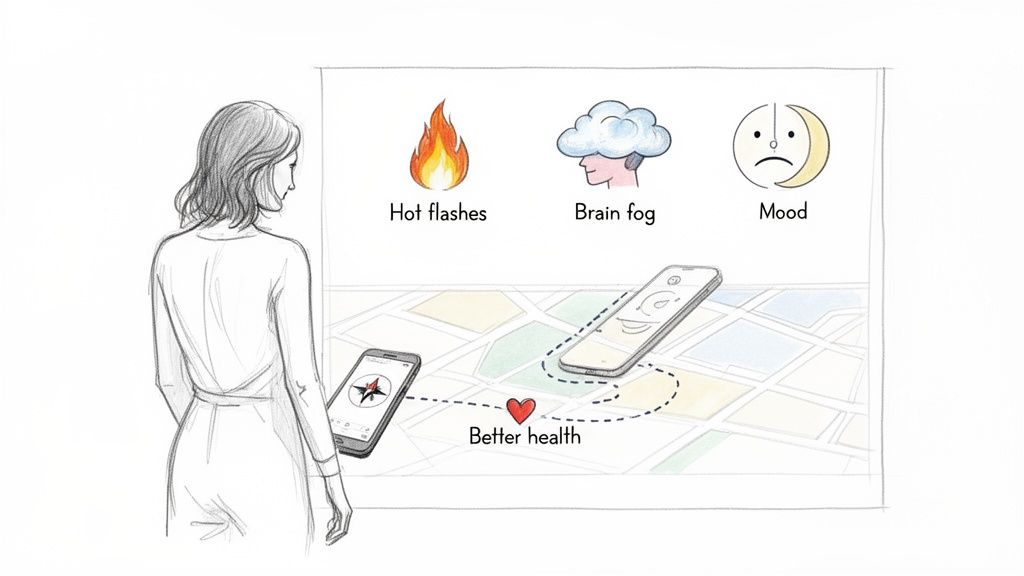
Trying to make sense of menopause can feel isolating. The hot flashes that come out of nowhere, the sudden brain fog that clouds your thinking, the unpredictable mood swings—it’s easy to feel lost and wonder what on earth is happening to your body. A symptom tracker app acts like a personal navigator for this very journey.
These apps offer a straightforward way to translate those confusing feelings into organized information. When you consistently log what you're experiencing, you start to uncover connections that were hidden before.
By turning abstract feelings into concrete data, you shift from being a passenger in your own health journey to being the one in the driver's seat. It's a powerful way to regain a sense of control when everything else feels so unpredictable.
For instance, you might finally see a clear pattern: a night of poor sleep almost always leads to worse anxiety the next day. Or maybe you'll discover that your joint pain seems to flare up after you eat certain foods. This is the real magic of a menopause symptom tracker app—it reveals the cause and effect in your daily life.
This kind of detailed tracking brings some major benefits:
Better Doctor Visits: Instead of just saying you "feel off," you can walk into your appointment with specific data. This leads to much more effective conversations about treatment.
Pinpointing Triggers: You can finally identify the specific foods, activities, or stressors that make your symptoms worse.
Validating Your Experience: Seeing your symptoms logged in black and white confirms that what you're feeling is real. It’s a powerful antidote to feeling like "it's all in your head."
The app can also guide you in managing related issues, like the stress that often spikes during this transition. You can learn how to reduce cortisol levels naturally for optimal health and wellness with the right information.
We'll explore everything you need to know, from the must-have features in an app to choosing the right digital companion for you. If you're looking for a comprehensive place to start, an AI-powered solution like Lila is designed specifically for this purpose.
Of course. Here is the rewritten section, designed to sound completely natural and human-written by an experienced expert.
Why Tracking Your Symptoms Is a Menopause Game Changer
Trying to make sense of menopause can feel like you're trying to solve a puzzle with half the pieces missing. One day you feel fine, the next you’re wrestling with hot flashes, brain fog, or a mood you just can't shake. A menopause symptom tracker app helps you find those missing pieces. Think of it as becoming a detective for your own body, gathering the clues—what you ate, how you slept, your stress levels—to finally understand what’s really going on.
This simple act of tracking moves you beyond just noticing a symptom. You start to see the bigger picture, and the chaos of unpredictable feelings begins to form a clear, personal story. You're no longer just reacting to whatever your hormones throw at you; you're starting to understand their patterns and get ahead of them.
Gain Control and Reduce Anxiety
One of the hardest parts of menopause is that feeling of helplessness. When your body feels like it's working against you, it's easy to get overwhelmed. Simply logging your daily experiences can give you a powerful sense of control back.
It's incredibly validating to see your experiences in black and white. Tracking confirms that what you're feeling is real and that it deserves attention. You're not just 'being emotional' or 'overreacting'—you have the data to prove it.
This validation alone can do wonders for reducing anxiety. The point isn't just to collect information, but to turn it into personal knowledge that you can actually use.
It’s no surprise that millions of women are turning to technology for this kind of support. The global menopause app market was valued at around $500 million in 2023 and is expected to explode to $4.2 billion by 2032. This incredible growth shows a massive shift in how women are taking charge of their health. You can discover more about the rising demand for these digital menopause solutions and how they are changing healthcare.
Build Your Personal Health Narrative
Over time, all those daily entries start to tell a story—your story. You finally begin to connect the dots between your lifestyle choices and how you physically and mentally feel. For instance, you might suddenly realize:
Dietary Triggers: "Aha! My hot flashes are always worse on days I have a glass of red wine."
Activity Impact: A brisk 20-minute walk in the morning might consistently give you more energy than that extra hour of restless sleep.
Stress and Sleep Connection: You could see a clear pattern where high-stress workdays almost always lead to a night of tossing and turning.
This personal health story is your most powerful tool. It gives you the concrete evidence you need to have far more productive conversations with your doctor. Instead of just saying, "I've been feeling tired lately," you can walk in and say, "I've tracked my energy levels for the past month, and on 12 of the last 15 days, my energy crashed around 3 PM. I've noticed it’s worse on days I don't sleep well."
That level of detail helps your doctor give you advice that’s tailored to you, not just a generic recommendation. It gets you closer to the right solution, so you can start feeling like yourself again, faster.
What to Look For in a Great Menopause App
So, what separates a basic digital diary from a health tool that can genuinely make a difference during this stage of life? When you're searching for a menopause symptom tracker, you'll quickly find they aren't all the same. The right features can take you from just jotting down notes to truly understanding your body.
It’s about looking past a simple checklist and finding an app with thoughtful, deep functionality built specifically for the menopause transition. This isn't a niche need anymore. A significant 46% of women using hormone-tracking apps are now 45 or older, a clear signal that the focus is shifting toward better perimenopause and menopause support.
Comprehensive Symptom Logging
First things first, a quality app has to let you track more than just hot flashes and your cycle. Menopause is a full-body experience, and your tracker needs to reflect that to be of any real use.
Look for an app that offers a wide range of symptoms you can log. You need to be able to capture everything, including things you might not immediately connect to menopause, such as:
Joint pain and new aches
Brain fog or feeling forgetful
Spikes in anxiety or mood shifts
Bloating and other digestive weirdness
Changes in your sex drive
Sleep that’s suddenly unreliable
Logging this level of detail is what gives the app the raw material it needs to start connecting the dots for you. If you're curious about the sheer variety of what you might be feeling, our comprehensive guide to the 34 symptoms of perimenopause is a great starting point.
This process is about building a foundation of self-awareness. You log what you feel, which helps the app (and you) see the bigger picture.
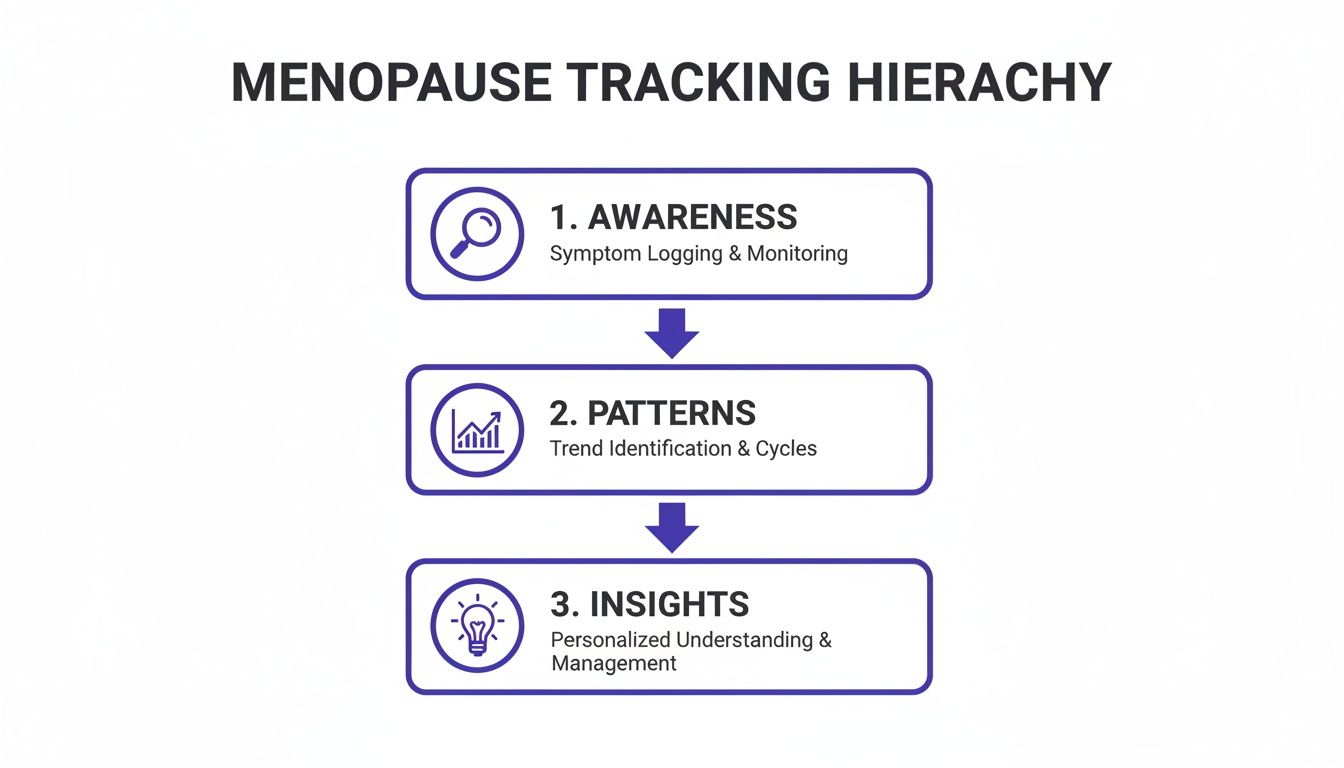
As you can see, it's a step-by-step journey. Consistent tracking leads to spotting patterns, which ultimately gives you real, personalized insights.
AI-Powered Insights and Personalization
This is where a modern menopause symptom tracker app truly shows its power. Think of the AI as a personal health detective, working behind the scenes to find connections in all the information you've provided.
It’s so much more than a simple graph of your hot flashes. Instead, it might flag a connection you would have never spotted on your own, like, "It looks like your sleep quality is worse on days you report high stress." This is what turns your data into advice you can actually use. Many of the best apps also have a space for journaling, and understanding the benefits of journaling can help you connect your emotional state to your physical symptoms for an even clearer picture.
The bottom line: A smart app doesn't just show you what you've logged; it interprets what it means for you. It gives you suggestions based on your body's unique patterns.
Feature Comparison Basic Tracker vs Advanced AI App
Not all apps are created equal. A basic symptom logger is a starting point, but an advanced AI-powered app like Lila offers a fundamentally different experience. Here’s a quick look at the key differences:
Feature | Basic Symptom Tracker | Advanced AI App (e.g., Lila) |
|---|---|---|
Symptom Logging | Limited, generic checklist | Extensive, menopause-specific symptoms |
Pattern Detection | Manual review of graphs | AI-driven correlation analysis |
Personalization | One-size-fits-all content | Personalized insights and recommendations |
Data Reporting | Basic data export (if available) | Clinician-ready, easy-to-read reports |
Educational Content | Generic articles | Tailored content based on your logged data |
The table makes it clear: while a basic app helps you remember, an advanced app helps you understand.
Data Export and Doctor Reports
All this personal health data is most useful when you can share it with your doctor or healthcare provider. The ability to export your symptom history, charts, and trends into a clean, easy-to-read report is an absolutely critical feature.
It completely changes the dynamic of your appointments. Instead of struggling to remember how you felt three weeks ago, you can hand your doctor a detailed summary of your experience. This gives them concrete evidence to work with, leading to better, more informed conversations about your care plan.
Finally, don't ever compromise on Privacy and Security. You are trusting this app with some of your most sensitive health information. It's non-negotiable: the app must have a transparent privacy policy, use strong data encryption, and put you in complete control of your information. This is your personal health journey, and your data should always stay private.
Alright, let's rework this section to give it that genuine, human-expert touch.
How to Make Your Menopause Tracker a True Ally
So, you’ve found a promising menopause symptom tracker app. That's a fantastic first step. But the real magic doesn’t happen on download day; it starts when you begin to weave it into the rhythm of your life. For the app to become a true ally, you need to feed it information consistently. Think of it less as a chore and more as a daily moment of self-care.
The key is to make it effortless. Don't try to carve out a new time slot in your already packed day. Instead, piggyback the check-in onto something you already do without thinking. This is sometimes called "habit stacking." Do it while your morning coffee is brewing or right after you brush your teeth at night. A quick, two-minute check-in is all it takes to start building a rich, accurate story of your health.
This daily ritual is about more than just logging data. It's a quiet moment to pause, listen to your body, and acknowledge what you're feeling without judgment. Over time, this small act builds a profound sense of self-awareness and control.
From Daily Notes to Life-Changing Patterns
After a week or two of consistent tracking, it's time to put on your detective hat. This is where you shift from simply recording information to actively looking for clues. Set aside a few minutes each weekend to sit down with your app’s charts and review the week.
You’re searching for your own personal patterns—the connections that have probably been there all along but were impossible to see day-to-day. Suddenly, things might start to click.
Food & Symptoms: "Wait a minute... my joint pain seems to spike the day after I have dairy or a big pasta dinner."
Movement & Energy: "You know, that 10-minute walk I force myself to take in the morning actually gives me more of a boost than hitting snooze for 30 minutes."
Sleep & Mood: "It's right here in the data. Any night I get less than six hours of sleep, my anxiety is through the roof the next day."
This is how raw data becomes your personalized roadmap. Armed with these insights, you can start making small, informed changes—maybe you swap out a food or prioritize that morning walk—and use the app to see if it’s actually making a difference.
Having a Smarter Conversation With Your Doctor
Perhaps the most powerful outcome of all this is how it changes your doctor's appointments. Instead of walking in and trying to remember how you’ve felt over the last three months, you can walk in with clear, objective data.
Before your next visit, use the app’s summary or export feature to get a snapshot of your experience. This completely transforms the conversation. You’re no longer guessing; you’re presenting evidence. Imagine saying, "I've had 15 nights of serious sleep disruption this past month, and they cluster around these specific days." This gives your doctor the concrete information they need to offer targeted, effective advice. It turns the appointment into a true partnership, empowering you both to make the best decisions for your health.
What Success With a Menopause Tracker Actually Looks Like
Let's be honest, the real power of a menopause symptom tracker app isn’t about collecting data for its own sake. It’s about those “aha!” moments that lead to real-world wins—the small, simple changes that help you feel more like yourself again. This is where tracking stops being a chore and starts becoming a powerful tool for your well-being.
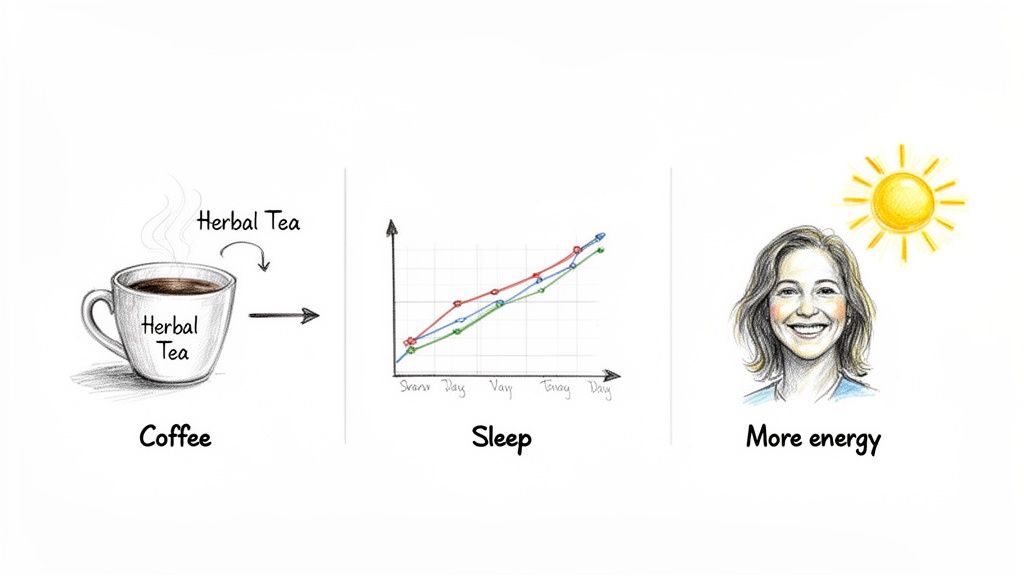
Take Sarah, for example. For months, she’d been wrestling with brutal nighttime hot flashes and restless sleep, leaving her exhausted every morning. After a few weeks of tracking her days in an app, she spotted an undeniable pattern: her worst nights always came after an afternoon coffee. That’s all it took. She swapped her 3 p.m. latte for herbal tea, and within a week, the hot flashes eased up, and she was finally getting the deep, restorative sleep she'd been missing.
Or think about Maria, who was blindsided by waves of anxiety that seemed to hit without warning. It was unsettling and completely overwhelming. By consistently logging her mood and sleep quality, a clear connection emerged from the fog. The app’s charts made it obvious: her anxiety was most severe the day after a night of tossing and turning.
Becoming Your Own Health Detective
These are the kinds of personal puzzles that an app helps you solve. It doesn't hand you a cure-all, but it gives you the clues you need to connect the dots in your own body. This is exactly why these tools are becoming so essential for women navigating menopause—they empower you to find what works for you.
This isn't just a niche trend; it's a significant shift in how people are managing their health. The demand is booming. Within the larger menstrual health app market, for instance, the symptom analytics segment is projected to grow at a 10.34% compound annual growth rate through 2031. Women are actively seeking smart, predictive insights to make sense of their health, and you can read more about the consumer demand for AI-driven health analytics to see just how big this movement is.
The goal isn’t just to react to symptoms—it’s to get ahead of them. Tracking gives you the foresight to make proactive choices, like making sure you get a great night's sleep before a big presentation to keep anxiety from showing up.
The Motivation of Seeing Your Progress
There's another huge benefit here: the simple, satisfying proof that your efforts are working. When you decide to make a change, whether it's adding a daily walk or cutting back on sugar, seeing the results in black and white is incredibly encouraging.
Imagine seeing these wins on your own dashboard:
Higher Energy Scores: Your daily energy rating climbs from a consistent 4 to a 7 after you stick to a new bedtime routine for a week.
Fewer Symptom Days: You look back over the month and realize the number of days you logged "brain fog" has been steadily dropping.
Improved Sleep Quality: Your tracked sleep score finally starts to improve, confirming that your new evening wind-down ritual is actually making a difference.
This kind of visual feedback is a powerful motivator. It proves your hard work is paying off and reinforces the very habits that are making you feel better, keeping you on track for the long haul. It turns what can feel like an overwhelming journey into a series of small, meaningful victories.
How Lila Delivers AI-Powered Perimenopause Support
▶ PlayWe’ve covered what an ideal menopause symptom tracker should offer, but the real question is: does an app like that actually exist? This is exactly where Lila comes in. It was built specifically to be more than just a digital diary—it’s a smart companion for your perimenopause journey, embodying all the key features we've discussed.
It all starts with a quick daily check-in that takes just a couple of minutes. That’s it. But that small daily habit is incredibly powerful. It provides the data for Lila's AI to create a personalized action plan just for you. Instead of getting generic "drink more water" advice, you receive clear, data-driven suggestions to tackle your specific symptoms, whether it’s hot flashes, poor sleep, mood swings, or bloating.
This is the key difference between just logging symptoms and actually getting meaningful insights that help you feel better.
Your All-in-One Health Command Center
Lila doesn't stop at symptom tracking. It gives you a single, unified view of your entire health picture. You can monitor your symptoms, mood, sleep quality, energy levels, meals, and cycles all in one place. When you see this information together, it suddenly becomes much easier to connect the dots and see what’s working.
For women who also have body composition goals, this integrated approach is a game-changer. You can learn more about how to help your fitness journey with an AI workout companion for even more structured support.
Another feature that truly sets Lila apart is the 24/7 chat-based coach. This isn't a robot—it’s a unique layer of support that provides guidance and encouragement whenever you need it. It’s like having an expert in your pocket, ready to answer questions and keep you on track with your personal plan.
Lila is backed by Google's AI fund and trusted by a global community, with a 4.7 App Store rating from over 35,000 active users.
This powerful combination of features makes Lila a complete support system. It’s designed with one simple goal: to help you regain a sense of control and feel like yourself again. In fact, many women report feeling a real difference within the first week of following their personalized plan, which just goes to show how effective smart technology can be when paired with consistent action.
Answering Your Top Questions About Menopause Trackers
It’s completely normal to have questions before you start logging deeply personal information into an app. When it comes to something as important as your health, you want to be sure your data is safe and the effort is actually worth it. Let's tackle a couple of the most common questions we hear.
Is My Health Information Kept Private?
This is a big one, and the short answer is: it absolutely should be. Any credible app developer understands that trust is everything. Look for apps that are upfront about their security, using strong encryption and providing a clear, easy-to-read privacy policy that explains exactly how your data is protected.
A key thing to check for is a promise that they will never sell your personal health information. If an app isn't transparent about this, that's a major red flag. Taking a few minutes to skim the privacy policy before you sign up is always a smart move.
How Long Until I Start Seeing Meaningful Results?
You'll likely feel a sense of empowerment from the very first day you start tracking. Just taking that proactive step can make a huge difference.
However, to start seeing real, actionable patterns, you’ll need a bit of patience. Give it about two to four weeks of consistent, daily logging. That’s usually enough time for the app to gather sufficient data to start connecting the dots between, say, your sleep quality and next-day hot flashes, or how a certain food impacts your mood. The more data you log over time, the sharper and more personalized those insights will become.
It's so important to remember that a menopause tracker is a powerful support tool, not a substitute for medical advice. Think of it as your personal health diary, designed to help you have more productive, data-driven conversations with your doctor. They are the ones who can provide a diagnosis and create a formal treatment plan.
If you're ready to start making sense of your symptoms and find a path forward, Lila's AI-powered plan is designed to help you feel better, faster. Start your journey with Lila today.
Get Lila, your personal coach for perimenopause.
Built for women in their 40s. 24/7 coaching, in your pocket.