
Night Sweats Before Period: Causes and When to Act
Night sweats before period are often luteal warmth, but new intense sweats can mean perimenopause. Learn the pattern and when to see a doctor.
Mild sweating in the few days before a period often reflects luteal progesterone raising core temperature by about 0.3–0.6°C, rather than disease. New, intense sweats or sweating outside that window in your 40s can suggest perimenopause, although timing alone can't establish the cause.
You wake with a damp neckline, turn the pillow over, and wonder whether the duvet is too heavy or your hormones have changed. When bleeding starts and the sweating settles, it's tempting to dismiss the whole thing. The useful distinction is whether the sweating stays mild and predictable or becomes more intense, disruptive, and spread across the month.
Table of Contents
- Why Sweating Shows Up Before a Period
- Which Sweat Pattern You Have
- Triggers That Push a Warm Night Over
- How Progesterone Raises Nighttime Heat
- When the Pattern Becomes Perimenopause
- When to Watch and When to Call
Why Sweating Shows Up Before a Period
Say you wake before your period with a damp shirt. You change into something dry, push off the covers, and fall asleep again. Once your period begins, your nights feel comfortable again.
That sequence is different from waking repeatedly in soaked bedding, including on nights nowhere near your period. Both experiences might get called night sweats, but they don't carry the same implications.
The timing and the amount of sweating matter together. A familiar, mild premenstrual pattern can fit normal cycle-related warmth. A changing pattern deserves a fresh explanation, even if you've always associated sweating with PMS.
Warmth isn't the same as a hot flash
After ovulation, progesterone changes how your body manages heat overnight. You may feel less tolerant of a bedroom or duvet that normally feels comfortable, particularly when alcohol, illness, stress, or a late meal adds to the situation.
A hot flash is more like an episode of suddenly feeling overheated, sometimes with flushing and sweating. When those episodes happen during sleep, they can interrupt rest rather than leave you slightly damp in the morning.
The useful question isn't only whether you sweat before your period. It's whether the experience has changed.
Menopause-related sleep disruption is common enough to take seriously: a 2026 American Academy of Sleep Medicine survey of 2,007 U.S. adults found that 35% of women aged 45–64 reported hot flashes or night sweats that disrupted sleep during menopause, as described in this report on the American Academy of Sleep Medicine survey.
That finding doesn't tell you what's causing your particular night of sweating. It does reinforce that repeatedly losing sleep isn't something you need to accept without discussion.
Which Sweat Pattern You Have
| Pattern | When it happens | How strong | What it usually means | What to do |
|---|---|---|---|---|
| Late-luteal warmth | A few days before bleeding, then it stops | Mild dampness, sheets not soaked | Compatible with progesterone-related temperature elevation | Track across cycles and cool the room |
| Trigger-driven overheating | In the pre-period window after alcohol, heavy bedding, or a hot room | Sweating eases when the trigger is removed | Environmental or lifestyle heat may be contributing | Skip alcohol, layer bedding, and lower the room temperature |
| Shifting perimenopause pattern | Before a period and on other days, sometimes with cycle changes | More intense, with interrupted sleep | Possible vasomotor symptoms, not just premenstrual warmth | Log timing, intensity, and cycle changes, then discuss them with a clinician |
| Red-flag sweating | Any time, including far from the period | Drenching, progressive, or accompanied by concerning symptoms | Needs clinical review rather than a period-only explanation | Seek prompt medical care |
Choose the row that best describes your recent pattern, not just the most memorable bad night. These categories are practical guides, not diagnoses, and you can have features from more than one row.
For late-luteal warmth, the strongest clue is the return to your usual comfortable nights when the premenstrual window ends. Mild dampness that stays confined to that window is more compatible with cycle physiology than sweating that continues regardless of menstrual timing.
Trigger-driven overheating can look almost identical. The distinguishing clue is whether changing the room, bedding, or evening habits makes a noticeable difference.
When the rows overlap
A person entering perimenopause may still have familiar premenstrual symptoms while also developing hot flashes and less predictable sweating. A clinical discussion in Menopause about night sweats and alternative causes emphasizes both this overlap and the importance of reviewing environmental conditions before assuming a hormonal cause.
Don't force every episode into the same explanation. A warm bedroom might contribute to one night, while a new medication or illness could matter on another.
A short diary is more helpful than a label such as bad PMS. Use a notebook or a perimenopause symptom tracker to record:
- Timing: Menstrual dates and whether sweating happened before bleeding or elsewhere in the cycle.
- Intensity: Slightly damp clothing versus sleepwear or sheets that needed changing.
- Context: Room conditions, bedding, alcohol, and medication exposure.
- Other changes: Fever, unexplained weight change, daytime hot flashes, and disrupted sleep.
The red-flag row takes priority over every other row. Drenching or worsening sweating, especially with systemic symptoms, shouldn't be explained away because a period is approaching. Cooling measures can improve comfort, but they aren't a substitute for assessment.
Triggers That Push a Warm Night Over
For mild, predictable pre-period sweating, make the experiment specific. Rather than changing your entire evening routine, identify what was different on the nights you woke hot.
These examples show how ordinary evening conditions can add to an already warm night.
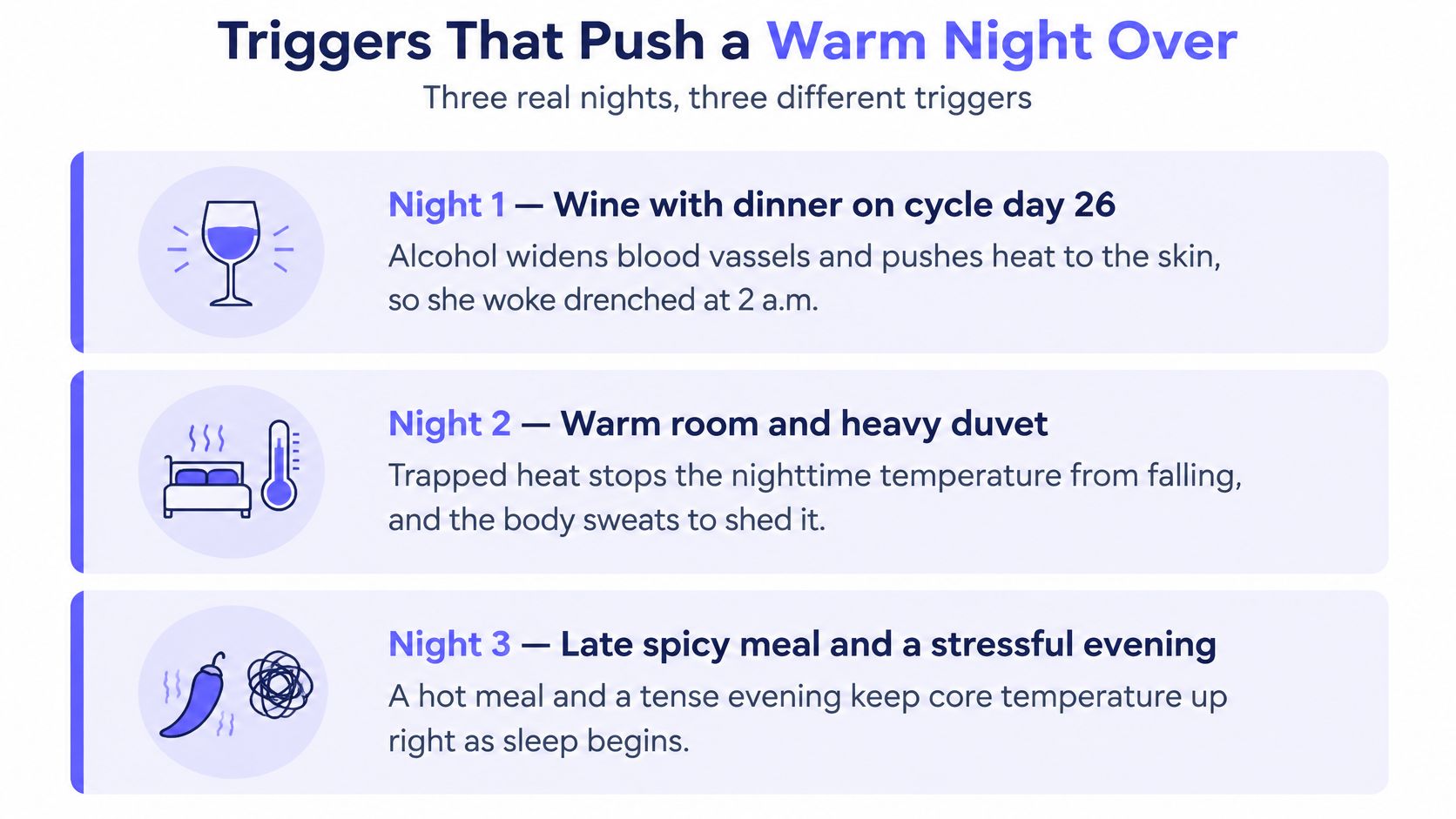
Wine with dinner
Say you have wine with dinner and wake sweaty during your usual premenstrual window. Don't assume the wine proves the cause, but do treat it as something you can test.
Skip alcohol during the next comparable window, keeping your bedding and bedtime routine broadly similar. Note whether the sweating and awakenings improve, rather than relying on how you remember the night afterward.
A heavy duvet in a warm room
If you're comfortable at bedtime but wake trapped under a heavy duvet, change the insulation. Use a light sheet and removable blanket instead of bedding that leaves you choosing between fully covered and completely uncovered.
Choose breathable sleepwear, keep a dry shirt within reach, and change damp clothing rather than lying in it until morning. A cooler room may help, but there's no need to chase a precise thermostat setting that doesn't feel comfortable to you.
A large late meal and a tense evening
Move a heavy evening meal earlier and keep any bedtime snack small. If particular foods seem linked with your episodes, this guide to foods that trigger hot flashes can help you organize what to observe without assuming everyone has the same triggers.
Stress deserves a separate note. If you went to bed feeling keyed up, record that alongside the meal rather than blaming food automatically.
- Consider stimulant exposure: Optimal Native's explanation of how caffeine triggers fight or flight offers context if caffeine also leaves you feeling wired. It isn't proof that caffeine caused your sweating.
- Check for illness: Take your temperature when you feel unwell instead of treating every sweaty night as hormonal.
- Change one thing: Test alcohol, bedding, or meal timing separately so you can tell what helped.
These adjustments can reduce symptom burden; they can't establish a diagnosis. Improvement with cooling doesn't rule out another cause, and persistent or drenching sweating still deserves attention.
How Progesterone Raises Nighttime Heat
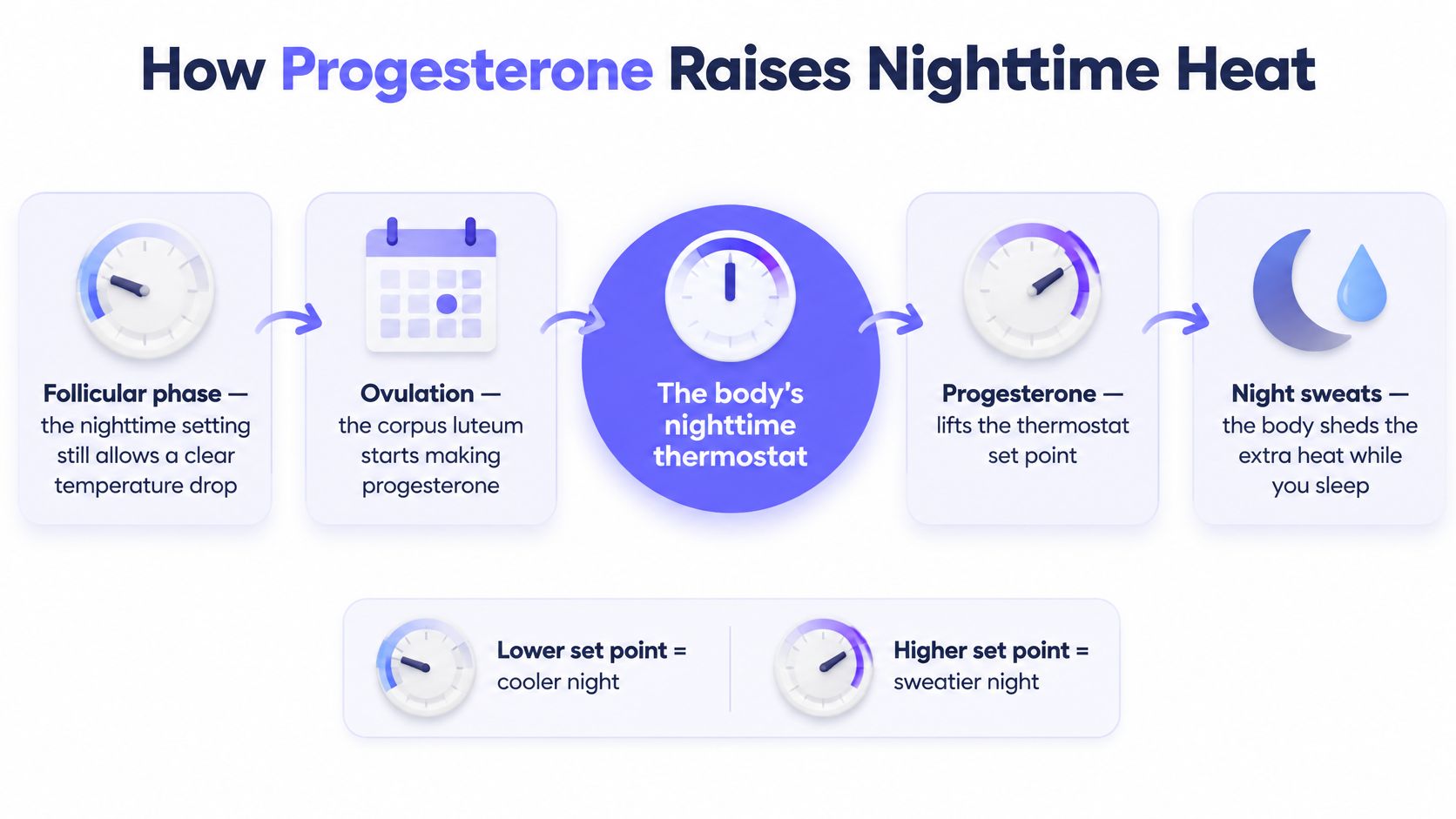
Think of your body's temperature control as a thermostat, not a switch that turns sweating on at a fixed point in your cycle. Hormones can change the setting, while your room, bedding, and health influence how warm you feel.
The sequence begins after ovulation.
A small temperature rise can change the night
After ovulation, a temporary structure in the ovary called the corpus luteum produces progesterone. A review of sleep and menstrual-cycle physiology archived by the National Library of Medicine describes a progesterone-associated core-temperature rise of approximately 0.3–0.6°C, along with a blunted nighttime temperature decline.
That's a modest rise, but it can reduce the margin between feeling comfortable and needing to release heat. The same duvet that felt fine earlier in the cycle may now feel excessive.
Progesterone-related heat production and changes in the control of blood flow to the skin are plausible contributors. In plain language, your body may produce and distribute heat differently, making the bedroom environment more noticeable.
The connection isn't limited to feeling warm. Steeper progesterone increases have also been associated with more wakefulness after initially falling asleep, which helps explain why heat and unrestful sleep can occur together without proving that one directly caused the other.
The cycle pattern matters more than a single reading
The luteal phase is the phase after ovulation and before the next period. Progesterone-related warmth belongs to that part of the cycle and should generally ease as progesterone falls around menstruation.
A female hormone level chart can help you visualize the sequence, but a chart can't tell you what your own hormone levels were on a sweaty night. Symptoms alone can't do that either.
A recurring premenstrual pattern supports a hormonal explanation. It doesn't certify that every episode is harmless.
For the hormone question, mark ovulation if you know it, the start of bleeding, and the sweaty nights across several cycles. Add the factors that could obscure the pattern, particularly illness, medication changes, bedroom conditions, and sleep disruption.
The animation below provides another way to follow the hormone-and-temperature sequence.
▶ PlayIf you're mildly damp before bleeding and comfortably dry again afterward, that's compatible with the thermostat analogy. If sweating continues through the period and into the following phase, ordinary luteal warmth is no longer a sufficient explanation on its own.
When the Pattern Becomes Perimenopause
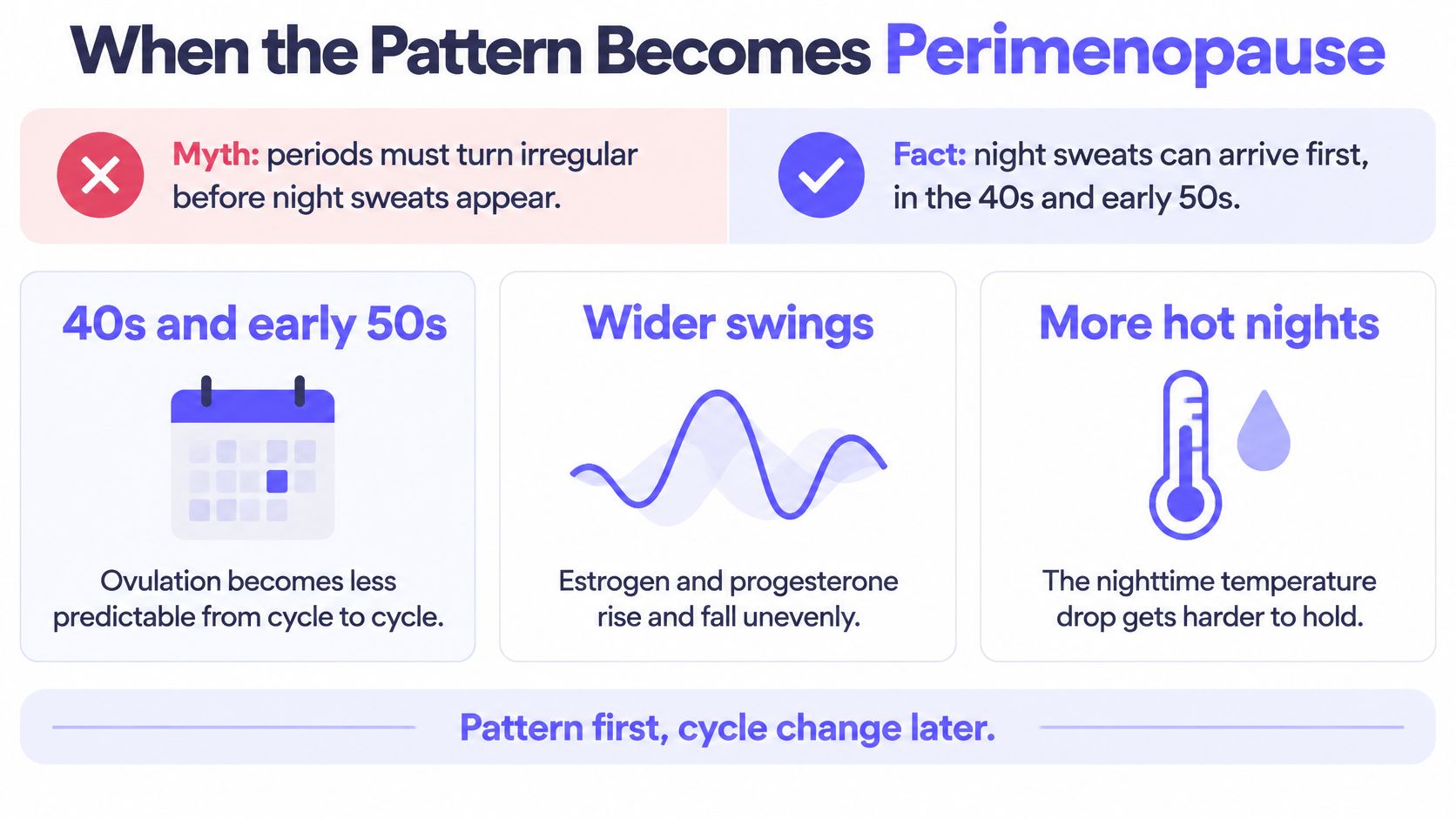
Periods don't have to become obviously irregular before perimenopausal temperature symptoms appear. Waiting for skipped periods can mean overlooking a meaningful change in sleep and sweating.
During the menopause transition, ovulation becomes less predictable, and exposure to estrogen and progesterone can become uneven. You may still recognize your usual premenstrual warmth while also experiencing episodes that no longer follow the old schedule.
The practical threshold isn't a particular birthday or a single unusually hot night. It's a change from your established pattern, especially when symptoms begin to affect daily functioning.
Signs the old explanation is no longer enough
Look for the following changes rather than trying to decide whether every episode is PMS or perimenopause:
- Greater intensity: Sweating is noticeably stronger than your familiar pre-period dampness.
- Different timing: Episodes occur outside the days before bleeding.
- Repeated sleep disruption: You wake uncomfortable and struggle to return to sleep.
- Daytime symptoms: Hot flashes now happen while you're awake, too.
- Menstrual changes: Bleeding becomes shorter, longer, heavier, or less predictable.
You don't need every feature before raising the question with a clinician. Equally, having one doesn't establish perimenopause or rule out another cause.
The important correction is that temperature symptoms can appear before menstrual changes become unmistakable.
Why the change deserves a conversation
In a 2025 Australian study of 5,509 women aged 40–69, moderate-to-severe vasomotor symptoms were nearly five times more likely in perimenopause than premenopause, and almost 40% of perimenopausal participants had untreated potentially debilitating symptoms, according to the Royal Australian College of General Practitioners' report on vasomotor symptoms and diagnosis.
Those findings support taking disruptive symptoms seriously. They don't turn a symptom diary into a diagnostic test, and they don't mean every woman with night sweats is entering perimenopause.
Menstrual symptoms and vasomotor symptoms can overlap during this transition. That's why still having periods, or still noticing a premenstrual peak, doesn't exclude a broader change in temperature regulation.
For clarity about the stages, the distinction between perimenopause and menopause is useful. You don't need to wait until periods stop to ask for help with symptoms that are already affecting your life.
Bring a concise timeline: bleeding dates, sweaty nights, daytime flashes, and the effect on sleep. Include any hormone therapy, hormonal contraception, or other medicines you use, so the clinician can interpret the pattern in context.
When to Watch and When to Call
Watchful waiting should have a deadline and a safety check. It shouldn't mean repeatedly telling yourself that sweating must be hormonal because your period is due.
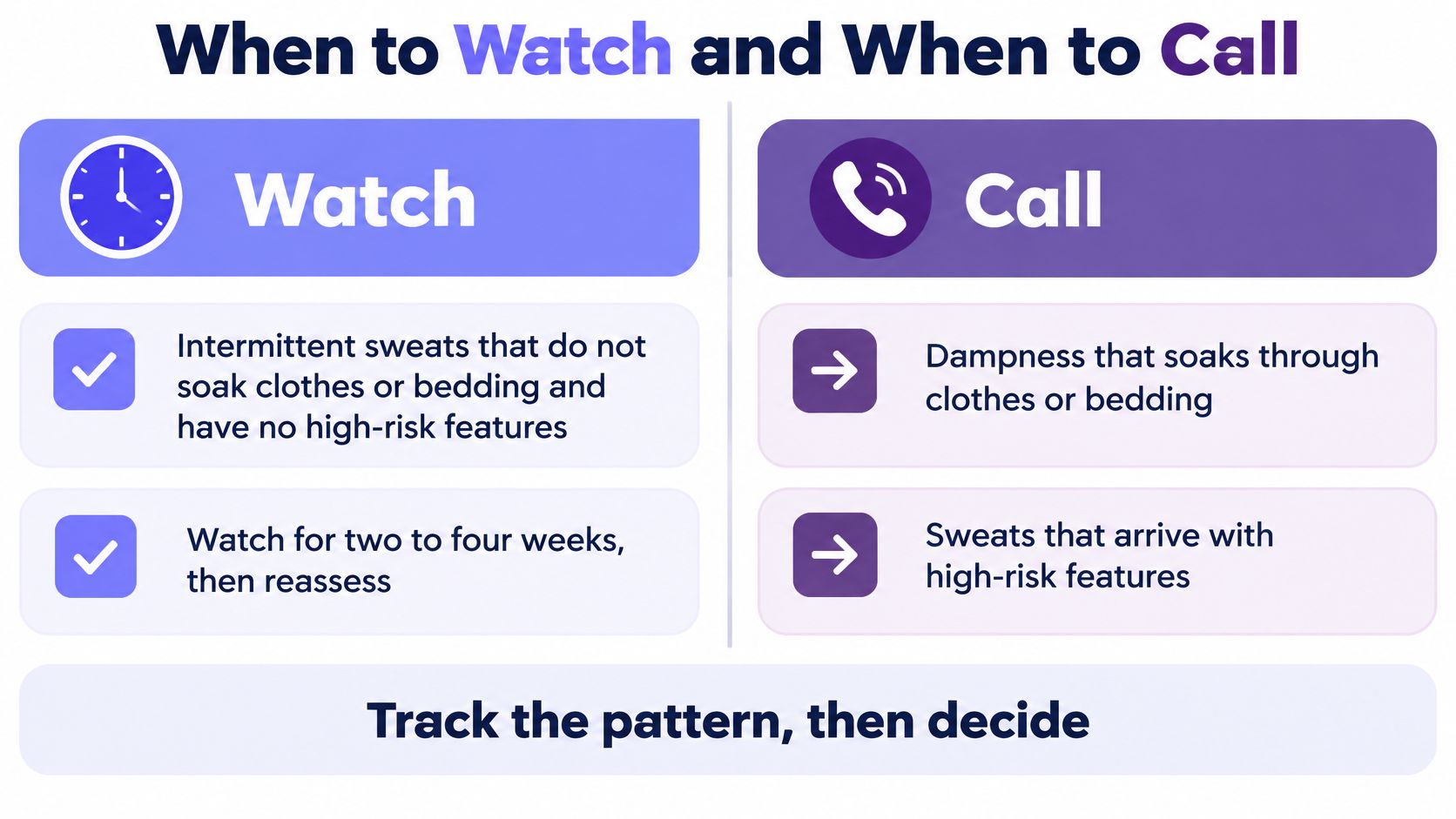
For intermittent sweats that don't soak clothing or bedding and occur without high-risk features, a BMJ clinical assessment of night sweats supports observation for two to four weeks, followed by reassessment.
That's different from waiting indefinitely for a more obvious menstrual pattern. If symptoms are worsening, becoming disruptive, or accompanied by concerning changes, contact your clinician sooner.
The distinction is easier to use when you separate comfort measures from the decision about assessment.
When a short period of observation makes sense
Observation is reasonable when dampness is mild, intermittent, and unaccompanied by warning signs. Use the time to make one practical cooling change and document whether the problem improves, stays the same, or spreads beyond its usual window.
Don't judge improvement only by whether the sheets are dry. Notice whether you're waking less often, whether you can return to sleep, and whether daytime tiredness is affecting work, driving, or ordinary activities.
A useful reassessment asks:
- Has the sweating settled? Consider whether cooling or removing an evening trigger made a difference.
- Is the timing still narrow? Note whether episodes remain linked to the premenstrual window.
- Is sleep recovering? Mild sweating can still deserve help if the repeated awakenings are wearing you down.
- Has anything new appeared? New systemic symptoms change the decision even if the original dampness seemed minor.
If the pattern remains mild and predictable, continued cycle tracking can help clarify it. If it persists without a clear explanation, book an appointment rather than repeatedly extending the observation period.
When not to wait for another period
Contact a clinician promptly for drenching or progressively worsening sweats, or sweating with any of the following:
- Unexplained weight loss: Weight is falling without an intentional change that accounts for it.
- Persistent fever: You repeatedly feel unwell or record a raised temperature.
- Enlarged lymph nodes: You notice persistent swelling, such as in the neck or armpit.
- Cough or marked fatigue: Especially when these are new, persistent, or occurring alongside other symptoms.
- A cycle-independent pattern: Sweating continues across the month rather than remaining a brief premenstrual event.
These features don't automatically mean something serious is wrong. They mean a period-only explanation isn't safe enough to rely on.
Don't wait for a diary to look complete before seeking care. A partial record is enough to start the conversation.
A clinician may consider medication effects, infection, thyroid disease, sleep apnea, anxiety, alcohol or other substance use, and malignancy among the possible explanations. The purpose of that assessment is to identify a cause, not to assume the most alarming one.
Don't stop prescribed medication or change hormone doses on your own to test a theory. Bring the medication list and ask whether the timing of a new prescription or dose change could be relevant.
What to bring and what to ask
Take the diary you already have, rather than creating a perfect spreadsheet. Include bleeding changes, temperatures recorded when unwell, the intensity of hot flashes, current medicines and hormones, and how much sleep you're losing.
Your clinician will usually begin with the history, examination, and review of room conditions, clothing, and bedding. When the cause remains unexplained, particularly with severe symptoms, basic laboratory tests and sometimes imaging may be appropriate; higher-risk features can lead to further testing.
Ask a direct question: Does this still fit predictable cycle-related warmth, or should we assess perimenopause and other causes? That keeps the discussion focused without making a diagnosis in advance.
If you prefer a digital record, our Night Sweats Cause Checker is an optional starting point, and Lila's daily check-ins track 20+ symptoms, including night sweats, hot flashes, sleep quality, mood, and period changes. Lila isn't a substitute for medical advice, and you should always consult your doctor about perimenopause symptoms.
For mild, clearly cyclical dampness, compare successive premenstrual windows while keeping the observation deadline in mind. For drenching, worsening, or concerning symptoms, arrange prompt care rather than waiting for the next cycle.
Visit Lila to keep night sweats, sleep, mood, and period changes together in a daily record. Use those patterns to prepare a clearer conversation with your doctor, especially if sweating is becoming stronger or happening beyond the days before your period.
Get Lila, your personal coach for perimenopause.
Built for women in their 40s. 24/7 coaching, in your pocket.