
Palpitations Hot Flashes
Palpitations hot flashes. Learn why palpitations and hot flashes may occur together, which causes to consider, which symptoms need urgent care, and how

You wake hot, flushed, and abruptly aware of your heart. It may feel like it's pounding against your chest, racing too fast, or skipping a beat just as you throw back the covers. You're not sure if the heat started it, if your heart woke you first, or if you're supposed to be worried.
That uncertainty is normal, and it's why palpitations hot flashes need to be separated into two questions. What are you feeling during a vasomotor episode, and what is your heart rhythm doing at that moment? Those questions can have different answers, and learning to track both gives you clearer language for yourself and for a clinician.
Table of Contents
- When Palpitations and Hot Flashes Overlap
- How Hot Flashes Can Affect Heart Rhythm
- Hormonal Anxiety Cardiac and Thyroid Causes
- Red Flags and When to Seek Care
- How Palpitations May Look Day to Day
- Build a Useful Palpitation and Hot Flash Log
- Talk With a Clinician and Plan Next Steps
When Palpitations and Hot Flashes Overlap
You're lying in bed when a wave of heat spreads across your chest and face. You start sweating, kick off the blanket, and notice your heartbeat feel forceful and fast. It might race, pound, feel missed for a beat, or seem uneven before it settles.
That combination is common enough to take seriously, but it doesn't explain itself. Hot flashes are among the most common menopausal vasomotor symptoms and affect up to 74% of perimenopausal women, and associated symptoms can include sweating, anxiety, weakness, faintness, fatigue, headache, and heart palpitations, as described in the NCBI Bookshelf overview of vasomotor symptoms.
The visual below maps the overlap between sensation and physiology.
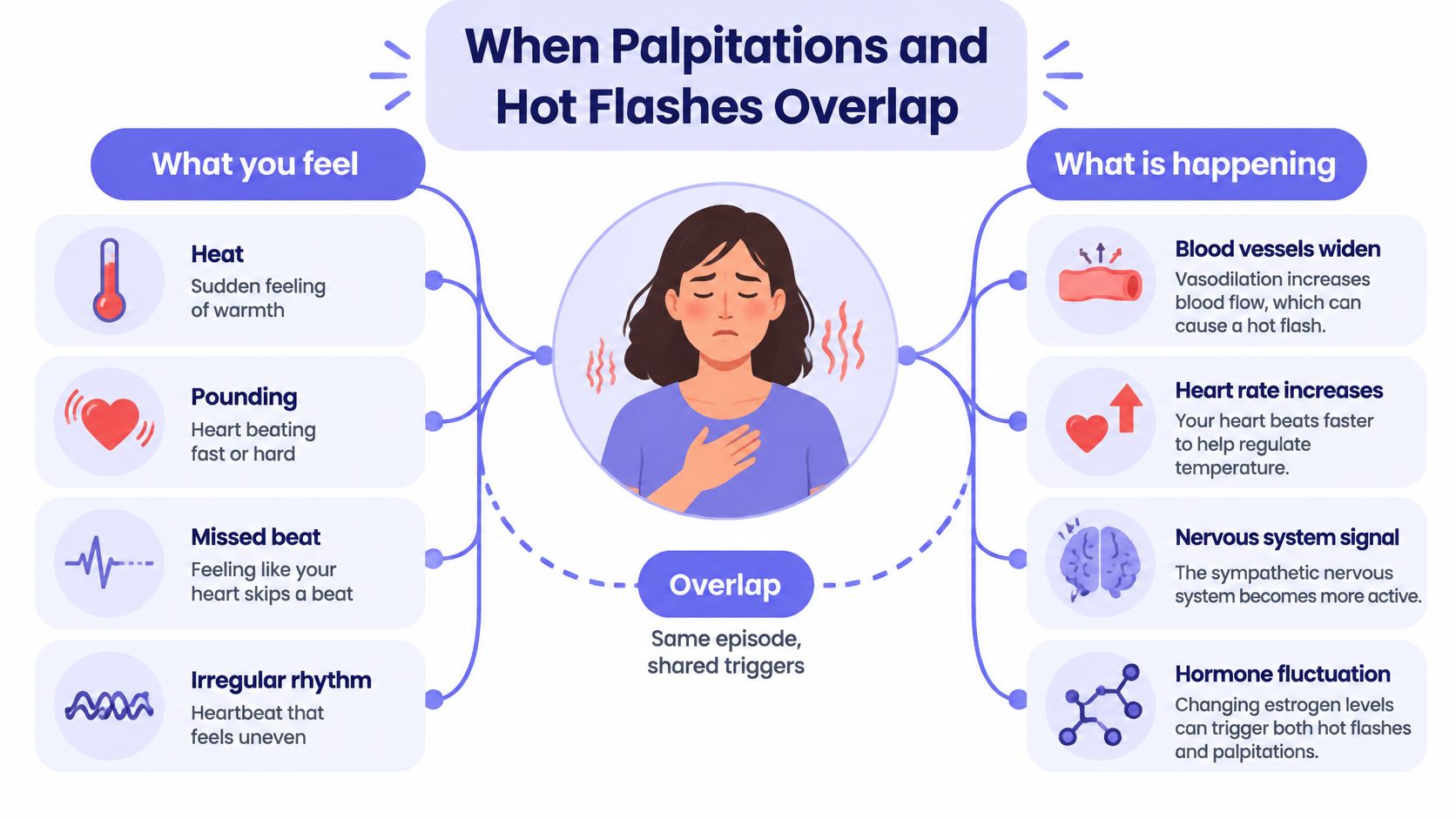
What you feel is not the same as a rhythm diagnosis
Palpitations describe awareness of your heartbeat. They don't, by themselves, confirm an arrhythmia. A heartbeat can feel pounding because your heart rate has risen, because each beat feels stronger, or because you're paying close attention after being woken by heat.
That doesn't make the sensation imaginary. It means the feeling is real information, but it's incomplete information. You need context around it before anyone should label it hormonal, anxiety related, or cardiac.
A useful starting point is simple. Describe what you felt, when it happened, and what else was happening, without deciding the cause in that first sentence.
Episodes also deserve tracking because they may repeat in a pattern. A single note saying your heart raced at night tells a clinician far less than several entries showing whether flushing came first, how long the sensation lasted, and whether you could settle back to sleep.
What to observe about an episode
| Observation | What to record | Why it helps |
|---|---|---|
| Timing | Time, sleep or wakefulness, relation to flushing | Shows whether heat and heartbeat cluster together |
| Sensation | Pounding, racing, skipped, fluttering, irregular | Gives precise language beyond palpitations |
| Duration | Seconds or minutes, sudden or gradual ending | Helps separate brief awareness from sustained episodes |
| Associated symptoms | Sweating, anxiety, faintness, breathlessness, chest discomfort | Flags symptoms that change urgency |
| Recovery | How quickly you felt normal again | Shows whether the episode passed with the flash |
By the end of this guide, you'll have a way to describe episodes clearly, recognize warning signs, and decide whether routine review or urgent care fits the pattern you're seeing.
How Hot Flashes Can Affect Heart Rhythm
Think of a hot flash as a thermostat alarm that goes off too easily. Your body senses heat, blood vessels widen to release it, you flush and sweat, and your nervous system joins in. That nervous system response is where your heart comes in.
During a vasomotor episode, temperature rises and heart rate can increase. Sympathetic activity, the part of the autonomic nervous system linked to alertness and stress responses, may rise, while cardiac vagal control, which helps slow and steady the heart, can temporarily reduce. You may feel that shift as pounding or racing even if the underlying rhythm remains organized.
The process image below shows that sequence from heat to heartbeat awareness.
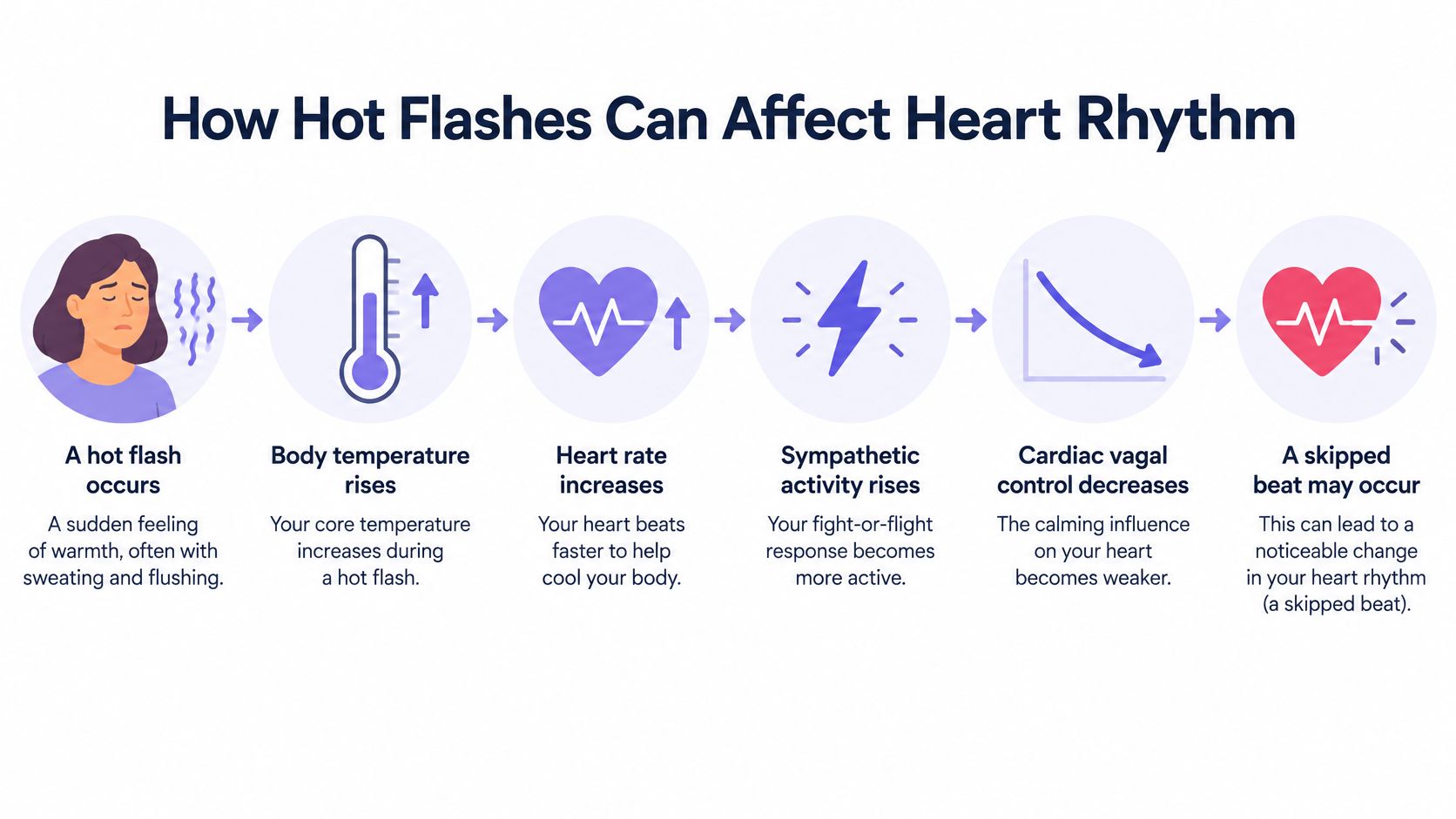
A short episode timeline
Consider a typical sequence you might notice. First there's warmth or an uneasy feeling, then flushing and sweating. Your heart feels faster or stronger for a short stretch, anxiety may spike because the sensation is startling, and then cooling and a slower heartbeat follow as the flash fades.
That timeline matters because it supports a link in time, not a final diagnosis. If palpitations start well before any heat, continue long after cooling, or begin during exertion without flushing, a clinician will ask different questions.
Objective monitoring shows why you can't settle this by sensation alone. A 2025 prospective pilot study in 15 midlife women found that palpitations occurred during both altered rhythms and normal sinus rhythm, with normal sinus rhythm appearing more common at night, according to the PubMed record for the ambulatory ECG pilot study.
Normal sinus rhythm means the heart's usual electrical pathway is in control. You can still feel your heart racing during that rhythm if the rate is faster or beats feel forceful. Conversely, an altered rhythm can occur during a symptom you might otherwise assume came only from a hot flash.
This short video offers another plain language walkthrough of the connection.
▶ PlayPatterns in recovery, sleep, and exertion therefore tell you more than a single rating of severity. If you want background on day to day rhythm variability, you can read the guide to heart rate variability and what it reflects, while remembering that variability numbers don't diagnose the cause of a specific episode.
Two separate questions about an episode
| Question | What it addresses | Why both matter |
|---|---|---|
| Was this during a hot flash | Timing relative to heat, flushing, and sweating | Shows a vasomotor link worth noting |
| Was the rhythm irregular | Whether beats felt regular, missed, or uneven, and what monitoring showed | Determines whether rhythm evaluation is needed |
Keeping those questions separate protects you from two errors. You won't dismiss a potentially important rhythm symptom as just hormones, and you won't assume every forceful heartbeat means dangerous heart disease.
Hormonal Anxiety Cardiac and Thyroid Causes
Several systems can produce a similar sensation in your chest. That's why clinicians think in terms of a differential, a list of possible explanations to sort through with history, examination, and sometimes testing. You don't need to choose one explanation at home.
Menopausal palpitations aren't rare, but estimates vary widely. Reported prevalence ranged from 20.1% to 40.2% among perimenopausal women and from 15.7% to 54.1% among postmenopausal women, while the authors emphasized that the evidence was limited and heterogeneous, in the systematic review of menopausal palpitations prevalence.
Hormonal and vasomotor explanations
During perimenopause, hormonal fluctuation coincides with hot flashes and night sweats for many women. If palpitations repeatedly start with flushing and settle as you cool, that timing supports a vasomotor connection. It still doesn't prove hormones caused every beat you felt.
If you're trying to put fluctuating symptoms into context, the hormonal imbalance info from Spa Black offers a general overview of symptoms people often group together. Use that kind of background to improve your questions, not to assign yourself a diagnosis.
Anxiety stress and heightened awareness
Anxiety and stress can raise heart rate and make each beat feel stronger. After a frightening nighttime episode, you may also monitor your chest more closely, so you notice sensations you'd sleep through on another night. That amplified awareness is understandable, and it can coexist with a physical hot flash.
Anxiety shouldn't become a default label, though. If episodes are new, sustained, highly irregular, or linked to exertion, they need the same careful sorting as any other palpitation pattern.
Cardiac thyroid and other medical explanations
Cardiac rhythm problems can cause racing, fluttering, skipped beats, or an irregular pulse. Concern rises when episodes begin and end abruptly, last longer, become more frequent, or occur with fainting, chest discomfort, or marked breathlessness.
Other explanations also belong on the list. Thyroid disease, anemia, medication effects, and stimulants can all make the heart feel fast or forceful. If thyroid symptoms overlap with menopause symptoms for you, the discussion of hypothyroidism and menopause symptom overlap can help you see why a clinician may check thyroid function rather than guessing from symptoms alone.
Medications and substances deserve a specific review. Bring a full list that includes prescriptions, over the counter products, supplements, decongestants, inhalers, caffeine, nicotine, and alcohol, plus any recent dose changes. Don't stop a prescribed medicine abruptly to test a theory, since withdrawal itself can affect pulse and sleep.
Practical rule: The same sensation can mean different things in different contexts. Timing, associated symptoms, medical history, and what a clinician finds on examination change the interpretation.
Possible explanations and contextual clues
| Possible explanation | Typical context to note | What it does not prove |
|---|---|---|
| Vasomotor response | Starts with heat, flushing, sweating, settles with cooling | Doesn't rule out a rhythm issue |
| Anxiety or stress response | Follows worry, panic, poor sleep, or a startling wake up | Doesn't mean symptoms are imagined or harmless |
| Cardiac rhythm problem | Abrupt onset, sustained, irregular, exertional, or with fainting | Can't be confirmed by sensation alone |
| Thyroid disease | Ongoing fast pulse, heat intolerance, weight or bowel changes | Requires testing, not symptom matching |
| Anemia | Fatigue, breathlessness on exertion, heavy bleeding history | Needs blood work for confirmation |
| Medication or stimulant effect | Follows caffeine, decongestants, inhalers, supplements, or dose changes | Doesn't mean you should stop treatment without advice |
Notice that these rows overlap. A woman can have hot flashes, poor sleep, anxiety about symptoms, and thyroid disease at the same time. Your job isn't to pick the winning row. Your job is to collect enough context that a clinician can sort the possibilities efficiently and safely.
Red Flags and When to Seek Care
Some episodes need urgent assessment, and some need a prompt appointment without being emergencies. Learning that boundary helps you act calmly instead of either waiting too long or panicking over every brief flutter.
Persistent or severe palpitations warrant clinical assessment, particularly when accompanied by fainting, chest pain, significant shortness of breath, or neurological symptoms, and exertional onset also warrants evaluation, as noted in the American Journal of Physiology review of vasomotor symptoms and cardiovascular response.
Seek urgent care for these patterns
Don't explain these away as a hot flash:
- Fainting or near fainting: You lose consciousness or feel you're about to.
- Chest pain or pressure: Discomfort occurs with the palpitations, especially if it's new or severe.
- Severe breathlessness: You can't catch your breath comfortably at rest.
- Neurological symptoms: New weakness, facial drooping, speech difficulty, or confusion appears.
- Sustained or markedly irregular racing: The episode doesn't settle or feels chaotic and prolonged.
If you're unsure whether symptoms fit this group, err toward urgent advice. You're not overreacting by asking for assessment when breathing, consciousness, or chest symptoms are involved.
Arrange timely routine review for these patterns
Book an appointment soon even without the urgent signs above if palpitations are new for you, increasingly frequent, persistent, or changing in character. Episodes that start during exertion, interrupt activity, or repeatedly wake you also merit review. So do episodes if you have known heart disease, thyroid disease, anemia risk, or new medicines or supplements.
At that visit, a clinician may take a history, check pulse and blood pressure, examine you, and order an ECG. An office ECG records only a brief window, so it can be normal if you aren't having symptoms at that moment. For intermittent episodes, ambulatory monitoring worn at home or during sleep may be considered to capture what the rhythm does during a typical episode.
While you wait for review, comfort measures for night sweats still matter because better sleep makes patterns easier to see. Breathable layers and a cooler room can help, and these comfort-first sleep tee tips may be useful if clothing choices are adding to overheating. If you're also wondering about blood pressure during flashes, see the explanation of whether hot flashes cause high blood pressure.
Care urgency guide
| Pattern | Suggested response | Reason |
|---|---|---|
| Palpitations with fainting, chest pain, severe breathlessness, or neurological symptoms | Urgent care now | These signs shouldn't be attributed to a hot flash |
| New, sustained, increasingly frequent, or exertional episodes | Prompt medical appointment | Pattern change needs rhythm and medical review |
| Brief episodes only with flushing, no warning signs, but recurring | Routine appointment and symptom log | Association is useful but still needs context |
| Single brief flutter, settles quickly, no other symptoms | Record it and mention at next visit, sooner if it repeats | A timeline will help if episodes continue |
That framework keeps cardiac warning signs separate from common uncertainty. Most uncertainty can be handled with planned assessment and good notes, but the red flag group always comes first.
How Palpitations May Look Day to Day
Patterns become easier to recognize when you compare scenes. The examples below are illustrations for recognition, not evidence about what is causing your symptoms. Notice how context changes the questions you'd bring to care.
Palpitation distress itself is common and can affect daily life. In the MsFLASH analysis, 25.0% of peri- and postmenopausal participants reported palpitation distress overall, and higher distress was associated with worse insomnia, depression, perceived stress, and menopause related quality of life impairment, as reported in the MsFLASH analysis of palpitation distress.
The image below contrasts common settings where episodes are noticed.
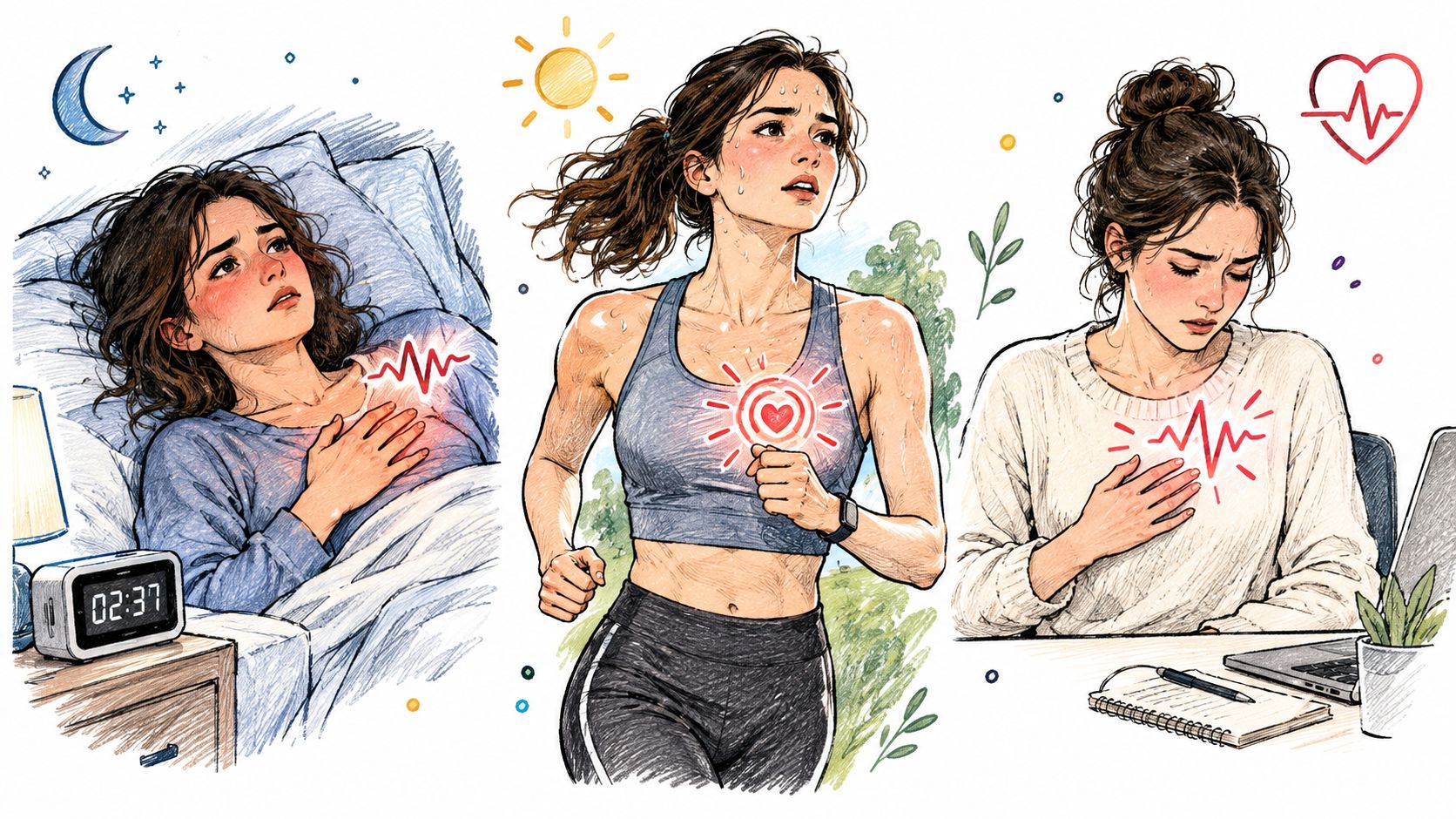
Four illustrative patterns
At night during flushing. You wake hot and sweaty, feel your heart pounding for a short stretch, cool down, and drift back to sleep. Note whether heat came first, how long you stayed awake, and whether the pulse felt regular.
During exertion. You're climbing stairs or exercising and notice sustained racing that feels out of proportion, irregular, or hard to recover from. That exertional onset is a reason for evaluation, not something to file under hot flashes alone.
After caffeine or a stressful morning. At your desk you feel fluttering or skipped beats after coffee, poor sleep, and a demanding meeting. Record caffeine timing, sleep the night before, stress, posture, and any medicines. If you're reviewing triggers, the guide to foods to avoid if you have heart palpitations can help you structure that part of your log.
With faintness or breathlessness. Palpitations come with lightheadedness, marked shortness of breath, or chest discomfort while you're at rest. That combination moves you out of watch and log mode and into prompt assessment.
Your heart can feel like it's racing during normal sinus rhythm, so reassuring monitoring doesn't invalidate what you felt. It answers the rhythm question, while sleep, hot flashes, and distress may still need attention.
Representative episode patterns
| Illustrative pattern | Other details to note | Questions for care |
|---|---|---|
| Nighttime with flushing | Sleep disruption, sweating, regularity of pulse | Could monitoring capture a typical night |
| Exertional | Activity level, recovery time, breathlessness | Does this need ECG based evaluation |
| After stimulants or stress | Caffeine, alcohol, medicines, sleep, cycle timing | Which exposures should be reviewed |
| With fainting or chest symptoms | Exact sequence and duration | What urgent assessment is needed |
Seen side by side, these scenes show why clinicians ask so many questions. Palpitations hot flashes at night with quick recovery raise different concerns than palpitations on stairs. Your notes let that distinction emerge without forcing you to interpret it alone.
Build a Useful Palpitation and Hot Flash Log
A good log is a timeline, not a diary of worry. You're capturing enough detail that a clinician can see sequence and repetition, while keeping the habit simple enough to maintain when you're tired or woken at night.
Frequency alone can justify tracking. A systematic review reported that some women experienced palpitations on nearly half of study days or at least once every 24 hours, with nighttime symptoms often occurring during normal sinus rhythm, according to the systematic review of menopausal palpitation treatments and patterns.
Use the log format below as a visual guide for what to capture.
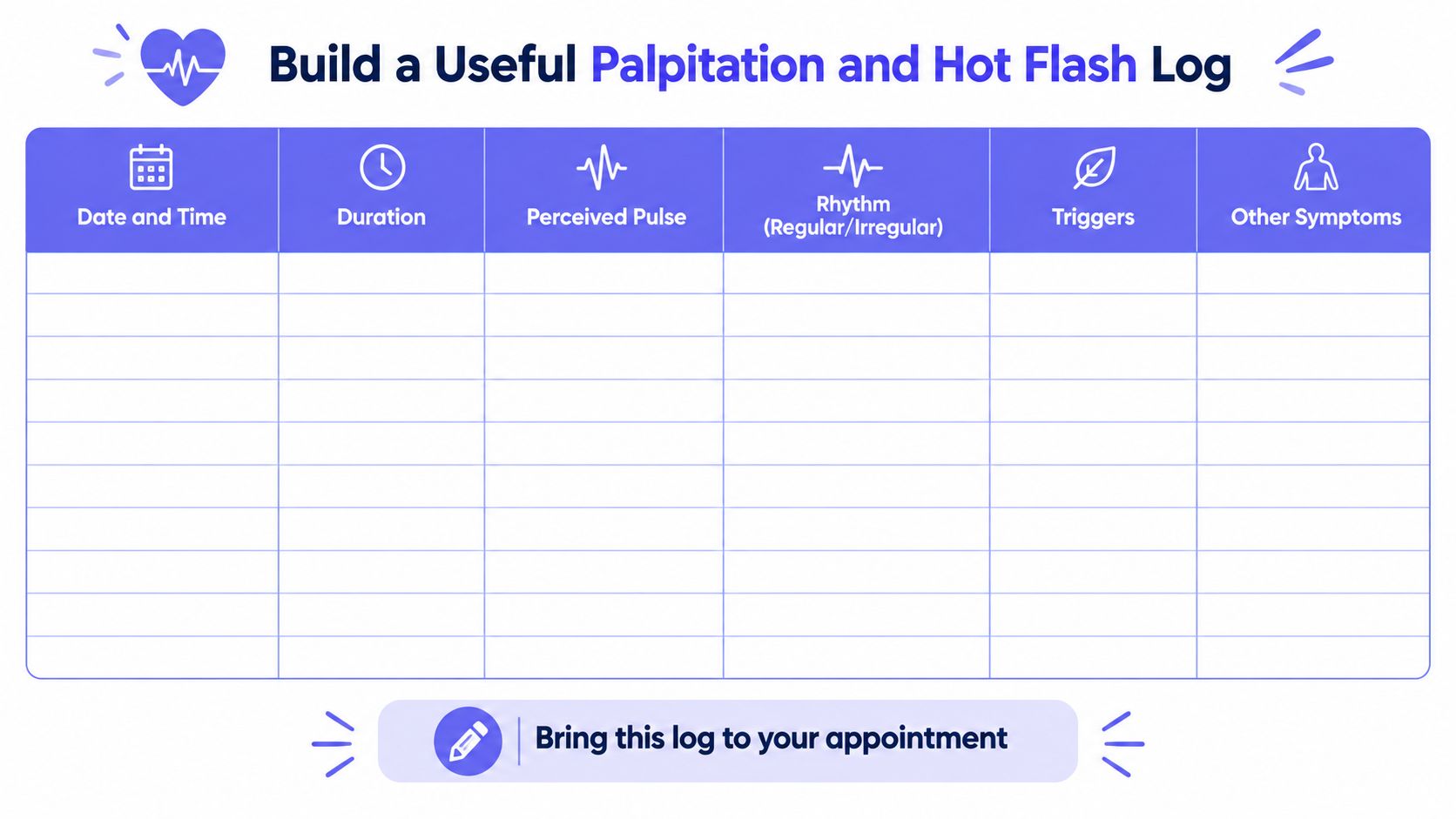
What to record for each episode
Keep the same fields every time so entries can be compared:
- Date and time: Include whether you were asleep, resting, standing, or exerting yourself.
- Duration and pulse impression: Note how long it lasted, whether beats felt regular or irregular, and any pulse rate you safely measured.
- Hot flash details: Record heat intensity, flushing, sweating, and whether palpitations began before, during, or after.
- Context: Add sleep disruption, stress, posture, caffeine or alcohol, meals, and menstrual cycle phase if relevant.
- Medicines and supplements: Note recent starts, stops, missed doses, or dose changes.
- Associated symptoms: Record dizziness, fainting, chest discomfort, breathlessness, weakness, headache, or anxiety.
- Recovery: Write what helped you settle and how long recovery took.
If you use an app, Lila can centralize symptom, mood, sleep, energy, meal, and cycle tracking in one place, which may make this timeline easier to keep. If you prefer paper, a notebook by the bed works if you use it consistently. For structure, see the perimenopause symptom tracker guide.
How to make the log useful
Log close to the episode when you can, even if it's just a few words at night that you expand in the morning. Avoid writing conclusions like hormones or anxiety in the entry. Stick to observations, because conclusions can hide details a clinician needs.
After several entries, look for repetition. Do episodes cluster at night, after poor sleep, during a particular cycle phase, or after specific exposures? That pattern recognition is valuable, but it doesn't diagnose an arrhythmia and it doesn't rule one out.
Episode tracking checklist
| Track | Examples | Useful detail |
|---|---|---|
| Timing | Night wake up, morning desk work, stairs | Relation to flushing and exertion |
| Heartbeat sensation | Pounding, racing, skipped, irregular | Regular versus irregular impression |
| Triggers | Caffeine, alcohol, stress, warm room, medicine change | Timing and amount when relevant |
| Body context | Sleep loss, cycle phase, posture, recent meal | Anything that repeats across entries |
| Safety symptoms | Fainting, chest discomfort, breathlessness | Presence or clear absence |
| Outcome | Settled with cooling, needed care, disrupted sleep | Recovery time |
Bring the log to appointments and show the sequence, not just a total count. Ten brief episodes that always follow flushing tell a different story than ten episodes scattered across exertion, rest, and sleep.
Talk With a Clinician and Plan Next Steps
A productive visit starts with the story your log tells. Lead with when episodes began, how they've changed, and a typical example with timing and recovery. Then mention hot flash burden, sleep, stress, medicines, supplements, caffeine and alcohol, menstrual changes, and any cardiovascular risk factors or known conditions.
What assessment may involve
A clinician may review your history, examine you, check pulse and blood pressure, and order an ECG. Blood tests may be considered depending on your presentation. If symptoms are intermittent and the office ECG is normal, ambulatory rhythm monitoring may be discussed so symptoms and rhythm can be compared during daily life.
Ask what the plan is if monitoring doesn't capture an episode. Also ask which symptoms should prompt you to seek care sooner than the next scheduled review. Clear thresholds reduce nighttime guesswork.
Treatment needs careful framing. Evidence for therapies specifically targeting menopausal palpitations is limited, so don't expect a promise that hormone therapy, supplements, breathing exercises, or lifestyle changes will stop every episode. Symptom relief and rhythm diagnosis are separate goals. Reducing hot flashes or improving sleep may lessen nighttime awareness of your heartbeat, but that improvement doesn't prove every earlier episode had a single cause.
A layered plan often makes more sense. Address sleep and hot flash triggers, review stimulants and medicines with a clinician, keep tracking episodes, and evaluate cardiovascular risk before choosing treatment. If a non hormonal or urgent cause is suggested by your pattern, that investigation comes first.
A practical care plan
| Care stage | Action | Expected purpose |
|---|---|---|
| Recognize | Separate sensation from rhythm, watch for red flags | Avoids dismissal and avoids panic |
| Record | Log timing, triggers, pulse impression, and recovery | Creates a usable timeline |
| Review | Bring log, medicine list, and sleep and cycle context | Supports focused assessment |
| Investigate | ECG and ambulatory monitoring when clinically indicated | Captures rhythm during symptoms |
| Plan | Address triggers, sleep, hot flashes, and any medical causes found | Matches treatment to evidence |
Your goal isn't to stop feeling your heartbeat. It's to identify patterns, reduce avoidable triggers, and make sure anything suggesting a rhythm, thyroid, medication, or other medical cause gets properly checked.
If nighttime palpitations hot flashes are fragmenting your sleep and leaving you unsure what to track first, Lila offers daily symptom, sleep, mood, energy, meal, and cycle tracking with personalized guidance to help you spot patterns over time. Bring that clearer timeline to your clinician, use it to ask sharper questions about hot flashes and palpitations, and start building steadier nights with support that fits your routine.
Get Lila, your personal coach for perimenopause.
Built for women in their 40s. 24/7 coaching, in your pocket.