
Why Is It Hard to Lose Weight After 40? Get Answers
Explore why is it hard to lose weight after 40. Get evidence-based strategies for women in perimenopause, addressing hormonal & metabolic reasons.
 Michelle
You clean up your meals. You start walking more. Maybe you add workouts again because that used to work. For a week or two, you feel hopeful.
Then the scale barely moves. Or your waist feels tighter anyway. Or you lose a little, get exhausted, and gain it right back.
That’s the moment many women start asking, why is it hard to lose weight after 40 when I’m doing all the “right” things? The most important answer is this: your body isn’t failing you, and you’re not lazy. Your biology is changing, and the old rules don’t fit the new reality.
After 40, weight gain usually isn’t caused by one thing. It’s a mix of shifting hormones, gradual muscle loss, changes in appetite signals, stress, poor sleep, and sometimes a hidden medical issue that looks like “just menopause.” When all of those pile up at once, basic advice like “eat less and move more” starts to feel almost insulting.
Understanding the why matters. When you know what your body is responding to, you can stop blaming yourself and start adjusting your strategy. That shift alone can be a relief.
The Frustrating Reality of Weight Gain After 40
A lot of women hit this stage with genuine confusion.
They’re not eating fast food all day. They’re not ignoring their health. They might be making salads for lunch, skipping dessert during the week, and squeezing in gym sessions between work, family, and endless errands. Yet their body looks different. Weight settles around the middle. Energy dips. Cravings get louder at night. Progress slows to a crawl.
That experience is common because midlife weight gain rarely feels dramatic at first. It feels sneaky. Your usual routine still looks healthy on paper, but your body responds differently than it did at 28 or even 35.
You can be disciplined and still feel stuck when your biology has changed faster than your strategy.
That’s why so much advice misses the mark. It treats the problem like a motivation issue when it’s often a body-composition and hormone issue. If your muscle mass is drifting down, your stress is high, your sleep is broken, and your hormones are changing, then the same plan that once created quick results may now leave you hungry, tired, and frustrated.
Many women also make the same understandable mistake. They double down on restriction. Less food. More cardio. More pressure. But if the root problem is changing metabolism, disrupted hunger signals, and muscle loss, that approach can backfire.
A better approach starts with a different question. Not “What’s wrong with me?” but “What has changed inside my body, and how do I work with it now?”
Your Metabolism Isn't Broken It's Changing
“Metabolism” gets blamed for almost everything, but after 40, there really is a meaningful shift happening. The key is understanding what changed.
Muscle is your metabolic engine
Your body burns calories all day, even when you’re resting. A large part of that baseline burn comes from the tissue you carry, especially muscle.
Think of muscle like the engine of a car idling in the driveway. Even when the car isn’t moving, the engine is still running and using fuel. Fat tissue is more like stored luggage in the trunk. It matters, but it doesn’t use much fuel on its own.
From around age 30, adults lose about 3 to 8% of muscle mass per decade, a process called sarcopenia. That same age-related shift can lower resting metabolic rate by about 2 to 8% per decade, and by age 50 it can mean a 100 to 300 calorie daily reduction in baseline energy use, according to The Nutrition Clinic HB’s explanation of fat loss after 40.
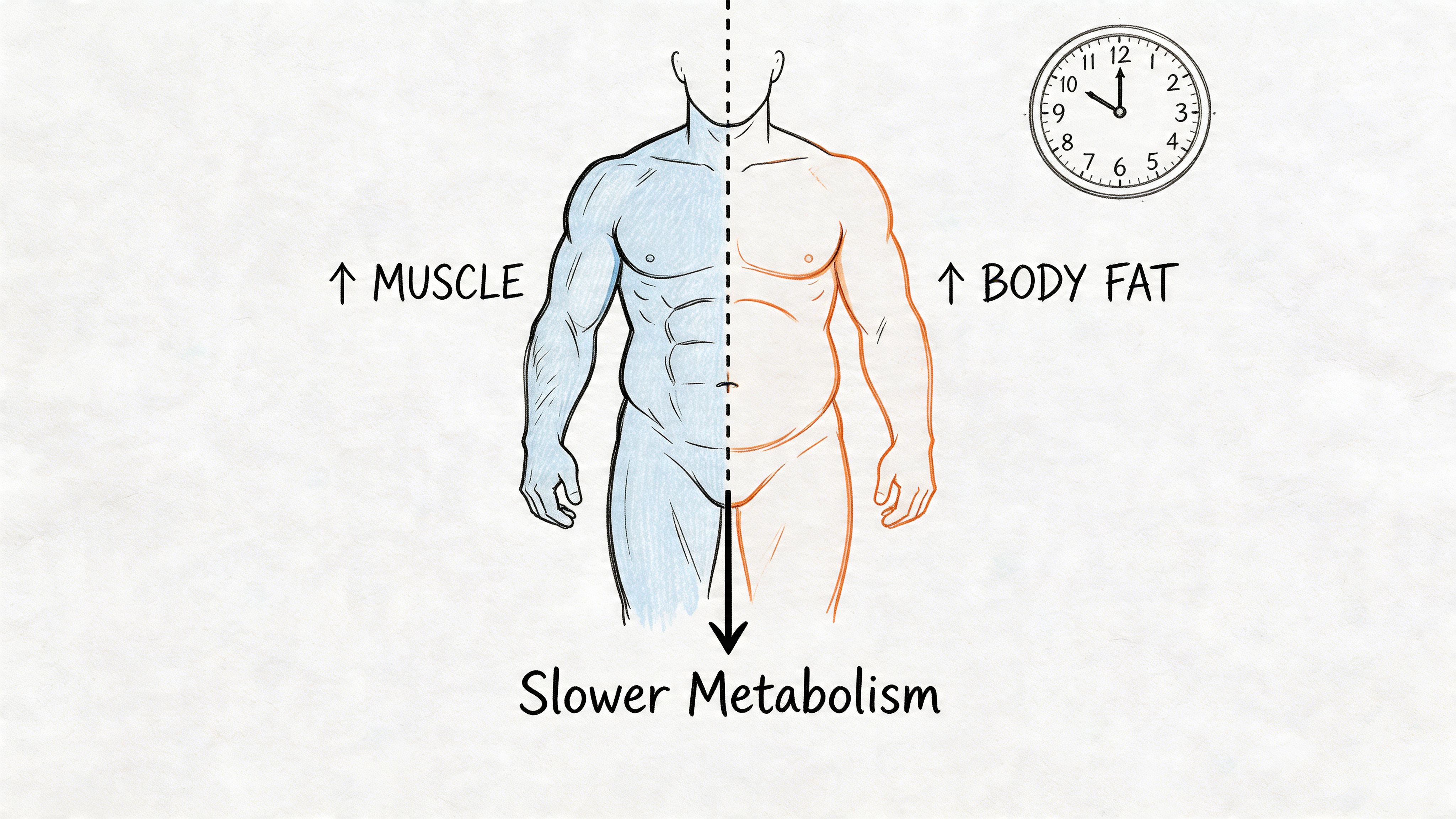
That’s why the same lunch, the same commute, and the same workout routine can suddenly produce different results. You may be burning fewer calories than you used to without doing anything “wrong.”
Why the old math stops working
Women often get confused.
They say, “But I’m eating the same way I always have.” Exactly. If your resting burn has dropped, “the same” no longer lands the same way. Your body is operating under a new budget.
Here’s what that looks like in real life:
Same breakfast, different result. The oatmeal or toast that once fit easily into your day may now leave less room for the rest of your meals.
Missed workouts matter more. If life gets busy and strength training slips, muscle loss can continue.
Dieting can make it worse. If you cut calories hard without protecting muscle, your body can lose the very tissue that helps keep metabolism higher.
If you want a simple explanation of the baseline calorie side of this, Lila’s guide to basal metabolic rate helps clarify what your body burns before exercise is even added in.
The real takeaway
Your metabolism isn’t broken. It’s adapting to age-related muscle loss.
That distinction matters because “broken” sounds hopeless. “Changing” means you can respond. When you rebuild or preserve muscle, you give your body more metabolic support. When you stop crash dieting, you reduce the odds of losing more lean tissue. When you shift your plan, progress starts making sense again.
The Hormonal Cascade Driving Midlife Weight Gain
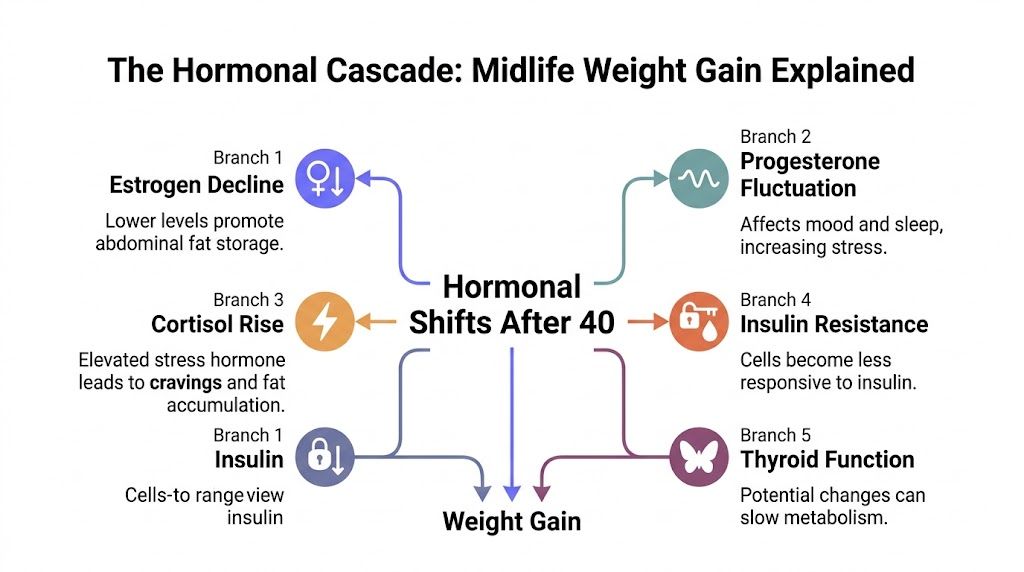
Hormones don’t just affect periods and hot flashes. They influence where you store fat, how hungry you feel, how well you handle carbs, and whether your body protects muscle or breaks it down.
After 40, many women enter perimenopause. That transition often creates a chain reaction, not one isolated problem.
Estrogen changes the fat-storage pattern
Before midlife, many women tend to store more fat in the hips and thighs. As estrogen declines, fat storage often shifts toward the abdomen.
That shift is one reason weight gain after 40 feels so personal. Even when the total gain isn’t massive, the location changes how your clothes fit and how you feel in your body.
According to Franciscan Health’s overview of why weight loss gets harder after 40, declining estrogen during perimenopause can reduce insulin sensitivity by 20 to 30%, and low estrogen can also disrupt appetite hormones, with ghrelin potentially rising 20 to 28%. The same source notes that chronic stress and cortisol can promote visceral fat accumulation, and women may gain 5 to 10 kg (11 to 22 lbs) during the menopausal transition.
Insulin and appetite signals get noisier
Insulin helps move glucose out of the bloodstream and into cells for use or storage. When your body becomes less sensitive to insulin, it doesn’t manage that job as smoothly.
A useful way to think about it is a key and lock. Insulin is the key. Your cells are the locks. If the locks become harder to open, your body has a tougher time directing fuel where you want it to go.
At the same time, your hunger system can become less reliable.
What that may feel like day to day
You get hungrier sooner, even after meals that used to hold you.
You crave quick carbs, especially when tired or stressed.
You store more around the middle, even if your habits haven’t changed much.
This is why generic low-calorie plans often feel miserable in midlife. They ignore the fact that appetite and blood sugar regulation may be less stable than before.
For a broader overview of menopause weight gain causes, this guide from Trim is a useful companion read because it lays out how these shifts connect in practical terms.
A more targeted look at symptom support can also help. Lila’s article on balancing hormones during menopause covers ways women often connect sleep, mood, and eating patterns during this phase.
Cortisol adds pressure from another direction
Cortisol is your stress hormone. In short bursts, it’s useful. In a chronically overloaded life, it can become part of the weight-gain picture.
That matters because midlife is often the busiest season of life. Work deadlines. Teenagers. Aging parents. Poor sleep. Mental load. All of that can keep your body in a state of “brace yourself” mode.
Practical rule: If your body feels constantly stressed, it will often act more like it needs protection than fat loss.
When cortisol stays high, it can push the body toward belly fat storage and work against muscle retention. So even a “perfect” diet can feel less effective if stress is high all the time.
A short visual summary can help connect these moving parts:
▶ PlayWhy this matters more than willpower
If you’ve ever thought, “I suddenly have no self-control,” pause there.
For many women, this isn’t a character problem. It’s a physiology problem. When estrogen shifts, insulin sensitivity changes, appetite hormones get louder, and cortisol stays high, your body sends stronger signals to eat and weaker signals that you’ve had enough.
That doesn’t mean you’re powerless. It means your plan has to account for biology instead of pretending biology doesn’t exist.
Uncovering the Hidden Roadblocks to Weight Loss
Sometimes the biggest barriers aren’t the obvious ones.
A woman may focus on calories and workouts while missing the quiet forces that keep nudging her body toward fatigue, cravings, and stalled progress. These roadblocks often sit in the background and make every plan feel harder than it should.
Poor sleep changes the whole day after it
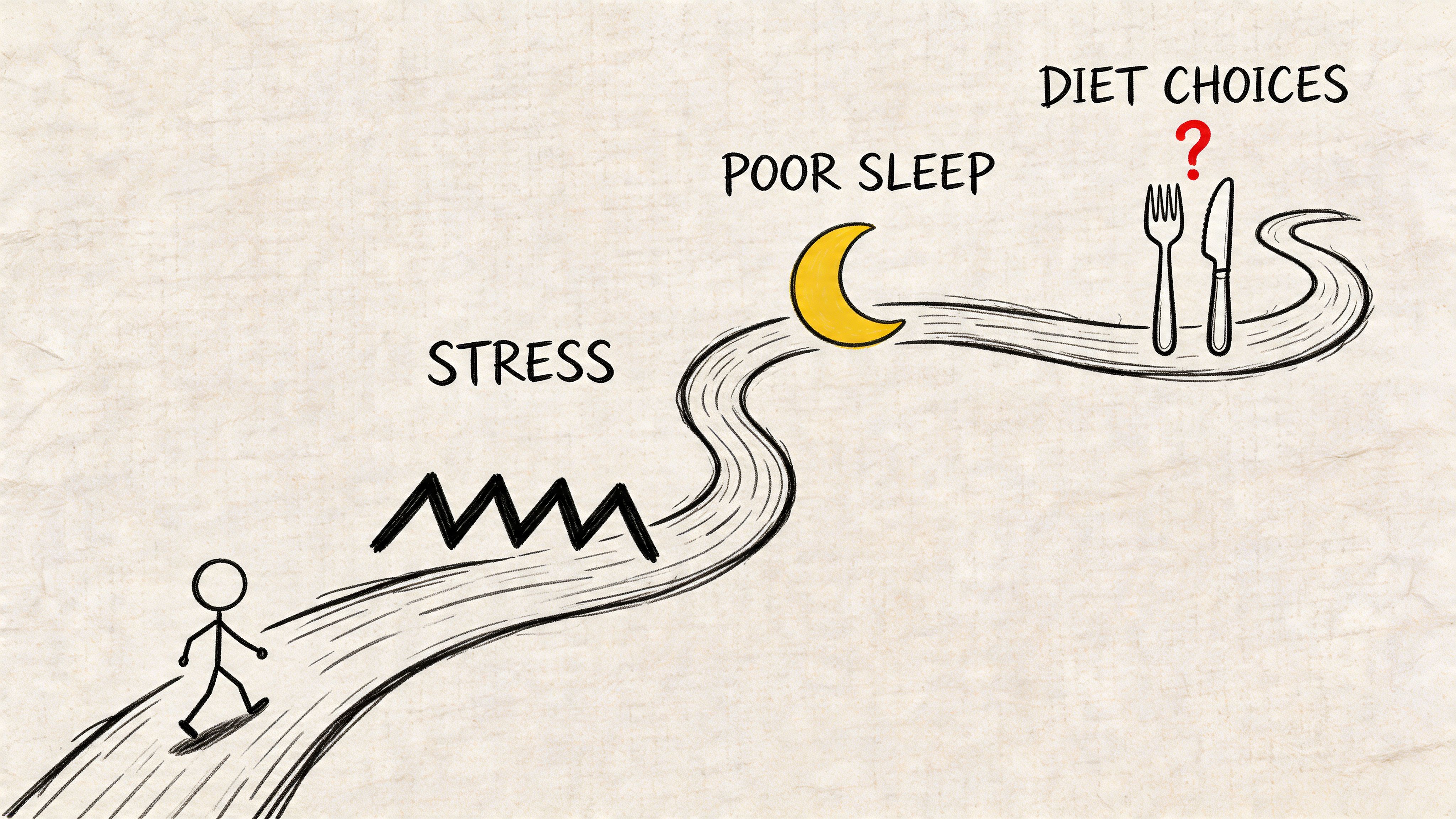
Bad sleep doesn’t just make you tired. It changes the quality of your decisions.
When sleep is broken, most women notice the same pattern. They want more sugar, less effort, and quicker comfort. The workout feels harder. Meal prep feels annoying. Patience disappears by late afternoon.
That’s one reason midlife weight management has to include sleep support, not just food rules.
Stress can block progress even with “healthy” habits
Chronic stress is sneaky because it often looks productive from the outside.
You’re handling everything. You’re showing up for everyone. But inside, your body may be stuck in a constant survival loop. In that state, it’s harder to recover well, easier to overeat reactively, and much tougher to stay consistent.
A few common stress patterns include:
All-day restraint, nighttime eating. You hold it together until evening, then raid the pantry.
Skipping meals, then overeating later. Busy schedules create chaos, not balance.
Exercise as punishment. Movement becomes another stressor instead of support.
When weight loss feels impossible, look beyond food. Many women aren’t failing a diet. They’re trying to diet on top of exhaustion.
Sometimes it isn't “just hormones”
There’s another issue worth keeping on the radar. Thyroid dysfunction can look a lot like perimenopause.
According to WebMD’s guidance on losing weight after 40, thyroid dysfunction affects about 5% of people, with women commonly affected. Its symptoms can include weight gain, fatigue, and mood changes, and a TSH/free T4 screening can help identify it.
Signs that deserve a conversation with your clinician
Persistent fatigue that feels out of proportion to your schedule
Weight gain with no clear explanation
Mood changes or brain fog that don’t improve with basic lifestyle changes
Feeling stuck despite consistency with nutrition and movement
This doesn’t mean everyone struggling after 40 has a thyroid issue. It means you shouldn’t assume every symptom is “normal aging” and leave it there.
Myths vs Reality A New Truth About Midlife Dieting
A lot of women are following rules that made sense years ago but don’t match what their bodies need now. Midlife dieting usually gets easier when you stop obeying outdated advice.
Common Weight Loss Myths After 40 Debunked
Myth: The Old Rule | Reality: The New Rule After 40 |
|---|---|
You just need more cardio | Cardio can support health, but too much of it without muscle-focused work can leave you tired and still stuck. After 40, preserving lean mass matters more. |
All calories are created equal | Calories matter, but your body also responds to protein, fiber, meal composition, stress, and blood sugar stability. Food quality affects hunger and adherence. |
You have to cut out all carbs | Many women do better with carbs that are paired well and eaten in a way that supports steady energy, not with extreme restriction that triggers cravings later. |
A low-fat diet is best | Healthy fats can help meals feel satisfying and support a more balanced eating pattern. A diet that leaves you hungry is hard to sustain. |
Eating less is always the answer | If you under-eat while losing muscle and running on stress, your body often pushes back with fatigue, cravings, and inconsistency. |
If the scale isn’t moving, your plan isn’t working | Midlife progress often shows up in waist fit, strength, energy, recovery, and steadier eating before the scale fully reflects it. |
Why these myths stick around
They contain a grain of truth.
Yes, movement matters. Yes, calories matter. But after 40, the context matters more than ever. A plan that ignores muscle, hormones, sleep, and stress asks your body to cooperate without giving it what it needs.
That’s why women can be “good” all week and still feel defeated. The plan is often too simplistic for the body it’s trying to change.
A more useful question
Instead of asking, “What can I cut?” ask, “What does my body need in order to feel safe enough to change?”
That question tends to lead to better answers. More protein. Better recovery. Smarter strength work. More consistent meals. Fewer extremes.
Your New Playbook for Sustainable Weight Management
The goal after 40 isn’t to be stricter. It’s to be more strategic.
A workable plan supports muscle, steadies hunger, and lowers the background noise that leads to overeating. It should feel firm enough to create change and flexible enough to survive real life.
Put muscle first
One of the most overlooked shifts in midlife nutrition is that the body often needs a stronger protein signal to maintain or build muscle.
According to HelloLingo’s review of weight management after 40, women over 40 may need 30 to 40 grams of protein per meal rather than 20 grams for younger adults in order to effectively stimulate muscle growth and counteract sarcopenia.
That changes how you build a day of eating.
What this means in practice
Start meals with protein in mind. Don’t leave it as an afterthought.
Spread protein across the day. One protein-heavy dinner won’t do the whole job.
Pair protein with strength training. Food gives your body building material. Resistance work gives it a reason to keep muscle.
Use strength training as protection, not punishment
Many women still think weight loss exercise should mean long cardio sessions. But after 40, strength training does something cardio alone can’t. It helps protect the tissue that supports your metabolism.
That doesn’t require becoming a bodybuilder.
It may look like:
resistance bands at home
dumbbell workouts a few times a week
machine-based training if you prefer a gym
bodyweight movements done with progression and intention
The point is not to burn off food. The point is to tell your body, “This muscle is needed. Keep it.”
Build meals that calm cravings
Midlife eating works better when meals are boring in one specific way. They don’t send your blood sugar and hunger on a roller coaster.
A steadier meal often includes:
Protein for fullness and muscle support
Fiber-rich foods to slow digestion and help satisfaction last
Healthy fats so meals feel complete
Carbohydrates chosen intentionally, not feared or binged on
A balanced meal reduces decision fatigue later. It’s easier to say no to random snacking when lunch actually fed you.
If you want another practical roundup, practical ways to thrive when losing weight after 40 offers a useful real-world perspective on building habits that hold up outside perfect conditions.
Treat sleep and stress like part of the plan
If sleep is poor, your eating plan becomes harder to follow. If stress is relentless, recovery drops and cravings usually rise.
So part of a strong playbook is non-food support:
create a simple wind-down routine
avoid making every evening a work catch-up session
keep easy protein options available for high-stress days
choose movement that helps recovery when your system feels overloaded
Make your plan visible
Most women don’t need more information. They need better pattern recognition.
That’s where tracking helps. Not obsessive tracking. Useful tracking.
Lila’s guide to perimenopause weight loss tips is one example of how symptom patterns, nutrition habits, and energy changes can be reviewed together instead of treated as separate problems.
When you can see, “I sleep badly, then crave sugar, then skip my workout,” you stop treating each day like a mystery.
How Lila Creates Your Personalized Path Forward
Knowing what to do and doing it consistently are two different things.
The hard part for many women isn’t hearing “eat more protein” or “manage stress.” It’s figuring out how those pieces fit together in their own life. Which days trigger cravings? Which meals leave them full? How often does poor sleep show up right before overeating? What symptoms line up with low energy?
That’s where a tracking tool becomes useful. Not as a judge, but as a pattern finder.

It connects the dots that isolated plans miss
A food plan on its own can’t tell you much about your stress. A fitness app on its own can’t explain late-night cravings. A symptom tracker on its own may not reveal what happened at lunch.
When those pieces live together, the picture gets clearer.
For example, a woman might notice this sequence:
sleep gets worse for several nights
energy drops
convenience foods increase
workouts feel harder
cravings spike in the evening
That pattern is common in midlife, but it’s easy to miss when everything is tracked in separate places or not tracked at all.
Why personalized logging matters
Generic plans assume every tough day is a discipline problem. Real life is messier than that.
A more practical system helps you watch:
meals and whether they satisfy you
symptoms like bloating, low mood, or disrupted sleep
energy patterns across the week
cycle or hormonal shifts if they’re still present
That kind of logging can be especially helpful after 40 because the same body may respond very differently from one week to the next.
One place to track, review, and adjust
Lila is an AI-powered perimenopause app that combines daily check-ins with tracking for symptoms, mood, sleep, energy, meals, and cycles, along with a personalized action plan and chat-based coaching. In practical terms, that means a woman can monitor the variables that often influence midlife weight changes instead of guessing which one matters most.
Weight management after 40 is rarely solved by a single instruction. It usually improves when women can see their own trends and make smaller, better-timed adjustments.
The most useful plan is the one that reflects your real body, your real schedule, and your real barriers.
That’s the value of a more integrated approach. It makes the invisible more visible. Once that happens, choices feel less random and more informed.
Take the First Step to Reclaim Your Body Today
If weight loss feels harder than it used to, that doesn’t mean you’ve lost your chance. It usually means the strategy that once worked no longer matches the body you have now.
After 40, your body may be dealing with muscle loss, shifting hormones, disrupted appetite signals, higher stress, worse sleep, or a hidden issue like thyroid dysfunction. Any one of those can affect progress. Several together can make you feel like nothing works.
But “harder” doesn’t mean hopeless.
It means your body needs a more intelligent kind of support. One that protects muscle. One that respects hormones. One that treats sleep and stress as real parts of weight management, not side notes. One that helps you see patterns instead of blaming yourself for them.
What to remember most
You’re not failing. Your biology is changing.
Extreme restriction usually isn’t the answer. It can make the situation worse.
Muscle matters. Protein and strength work deserve a central place.
Symptoms tell a story. Sleep, stress, cravings, energy, and weight are connected.
Tracking creates clarity. Clarity makes better decisions possible.
If you’ve been stuck in the cycle of trying harder and getting more discouraged, the next step may be simpler than you think. Stop trying to force your body to behave like it did years ago. Start learning how it behaves now.
That shift is often where progress begins.
If you want a practical way to understand your patterns and build a more personalized plan, explore Lila. It gives women in perimenopause and menopause one place to track symptoms, meals, sleep, energy, and cycles so they can make decisions based on what their body is doing, not guesswork.
Get Lila, your personal coach for perimenopause.
Built for women in their 40s. 24/7 coaching, in your pocket.


