
Best Menopause Supplements: Find Your Relief
Discover the best menopause supplements that truly work. Our evidence-based guide offers top options for hot flashes, sleep, & mood, plus how to choose quality.
 Michelle
The supplement aisle can feel like a test you were never taught to take.
One bottle promises hot flash relief. Another says it supports calm, sleep, metabolism, hormones, and weight, all at once. A third uses soft colors, the word “natural,” and just enough menopause language to sound credible. If you are dealing with broken sleep, mood swings, brain fog, or sudden waves of heat, it makes sense to want something you can buy today without another long appointment.
That urgency is real. So is the confusion.
Many women come to menopause supplements after feeling brushed off, told to “wait it out,” or handed advice that is far too generic for what they are living through. They do not want hype. They want relief. They also want to avoid wasting money on products that are underdosed, poorly made, or designed more for marketing than symptom support.
The best menopause supplements can play a useful role. But they are not all equal, and they are not all aimed at the same problem. A supplement that may help with hot flashes is not the same one I would reach for first for constipation, poor sleep, low mood, or muscle loss. Most guides fall short in this area. They hand you a list. They do not teach you how to judge the list.
This guide takes a different approach. Instead of treating menopause as one single issue, it treats it like what it is: a set of changing symptoms that need symptom-specific, evidence-aware decisions. The goal is not to buy more bottles. The goal is to become much harder to market to, and much better at spotting what is worth trying.
Feeling Lost in the Supplement Aisle? You're Not Alone
A common pattern looks like this. A woman starts with one symptom, often sleep disruption or hot flashes. Then mood changes creep in. Energy drops. A friend mentions magnesium. Social media recommends black cohosh. Search results add red clover, maca, ashwagandha, and “menopause blends” with long ingredient lists and no clear rationale.
By the time she gets to the store, every label sounds like a solution.
That overload matters because menopause symptoms are personal. One woman is waking soaked at night. Another is not sleeping, but never gets hot flashes. Another feels flat, irritable, and foggy, yet her biggest long-term concern is bone health. When products are marketed as if one formula fits every stage and every body, women end up guessing.
Why generic supplement advice fails
Most roundups of the best menopause supplements make one big mistake. They rank ingredients by popularity, not by whether the ingredient matches the symptom.
That leads to poor decisions, such as:
Taking a trendy blend for “hormone balance” when your real problem is poor sleep and constipation
Using a low-quality black cohosh formula without checking whether the extract and dose resemble what has been studied
Adding multiple products at once and then having no idea what helped, what did nothing, or what caused side effects
If you want practical guidance, symptom matching matters more than shelf appeal. So does quality. So does tracking.
A better way to approach the aisle
Use a simple filter before buying anything:
Name the symptom. Hot flashes? Waking at 3 a.m.? Low mood? Muscle loss?
Ask what evidence exists for that symptom. Not for menopause in general.
Check the form and dose. Ingredient names alone do not tell you enough.
Try one change at a time. Otherwise you lose the signal.
Track what happens. Your body is the true test.
If you want a broader primer on how supplement needs shift in midlife, this guide on supplements for women over 40 is a useful starting point.
The goal is not perfection. It is clarity. Once you stop shopping by label promise and start shopping by symptom, the supplement aisle gets much less intimidating.
Understanding the Menowashing Maze and Demanding Evidence
The first thing to know is that menopause has become a major commercial category. The global menopause supplement market reached $17 billion and is projected to grow more than 5% annually, according to Harvard Health’s review of menopause supplements and “menowashing”. That same piece describes “menowashing” as the practice of putting menopause language on products to make relief seem simple, even when evidence is weak.
That term matters because it names what many women are already sensing. Plenty of products are designed to look targeted without being well-supported.
What menowashing looks like in real life
You will see it in products that:
Use menopause branding as proof. “Meno” in the product name is not evidence.
Bundle many ingredients into one blend. This makes it harder to know what dose you are getting and what is supposed to do what.
Rely on testimonials instead of trials. Personal stories can be sincere and still not tell you whether a supplement works reliably.
Promise broad relief. Hot flashes, belly fat, mood, libido, sleep, and brain fog in one bottle is usually a sign to slow down.
The hard truth is that supplement marketing often moves faster than the science.
Why the burden falls on you
Supplements are not approved by the FDA the way medications are. As GoodRx’s menopause supplement review explains, there is no regulatory requirement for pre-market safety or efficacy testing in the same way consumers often assume. That means a menopause supplement can be sold without proving it works for the symptom on the front label.
For buyers, that changes the job. You are not just choosing a product. You are also vetting the claim.
A useful mindset is skepticism with purpose. Not cynicism. Just better questions.
Your evidence filter
When assessing the best menopause supplements, ask these questions before you buy:
Was this ingredient studied for my symptom? Not just “for menopause.”
Was it studied alone or only in a mix? Mixed formulas make causality murky.
Does the label give a standardized dose? If not, comparison to research becomes difficult.
Are safety issues or interactions disclosed? If a label is all promise and no caution, that is a warning sign.
Practical rule: If a product makes the condition sound simple, slow down. Menopause is not one symptom, and a credible solution should reflect that complexity.
A second reality check is important here. Harvard Health also notes that a 2023 review by the Menopause Society found that no supplements had been proven effective for hot flashes and night sweats, the most common menopausal complaints, in the strongest sense of proof expected in medicine. That does not mean nothing helps. It means evidence is mixed, product quality varies, and marketing often overstates certainty.
If you are comparing supplements with prescription options, this overview of hormone balance supplements for menopause can help frame where supplements fit and where they do not.
The key shift is this. Do not ask, “What’s the best menopause supplement?” Ask, “What has meaningful evidence for my symptom, in a form and dose that makes sense, with trade-offs I understand?”
Matching Menopause Supplements to Your Symptoms
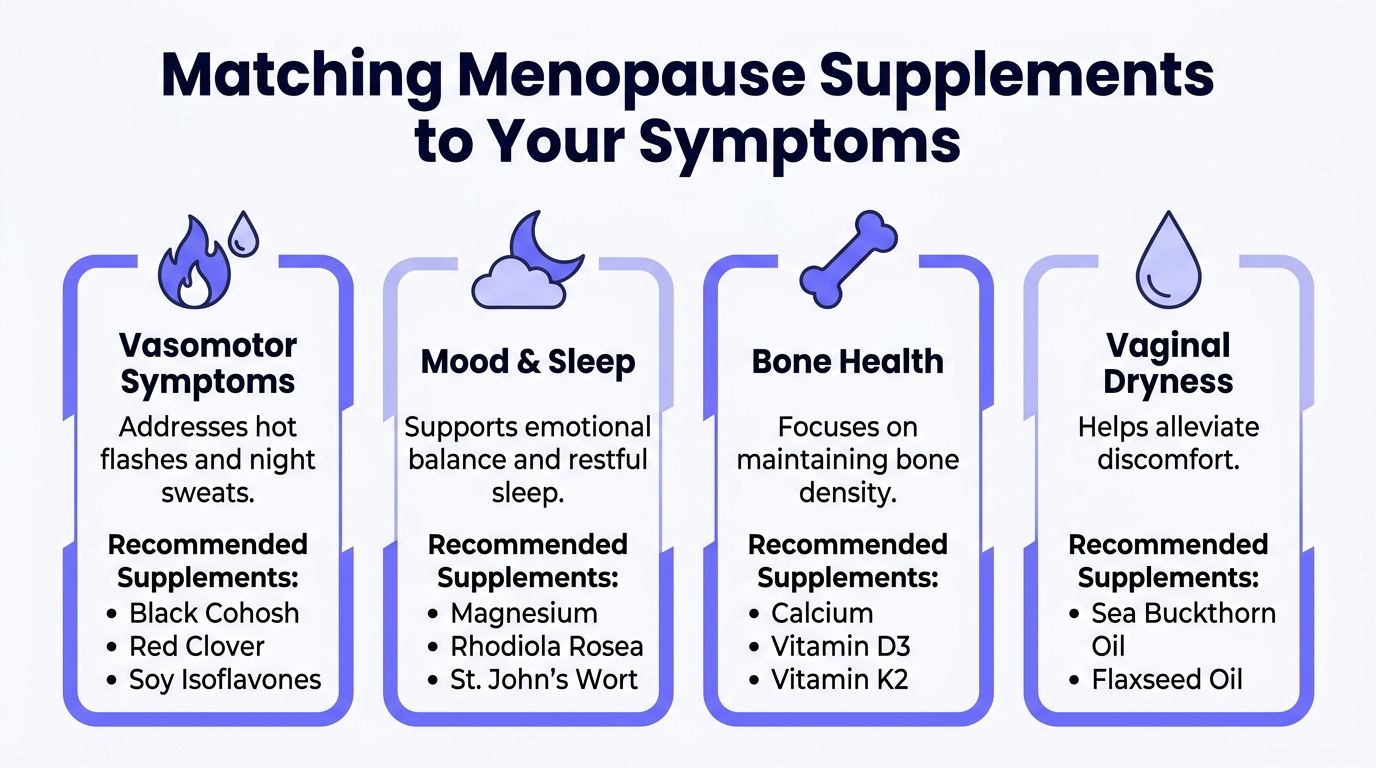
The most useful way to think about menopause supplements is by symptom cluster, not by popularity. That keeps you from taking a scattered approach and helps you focus on what is most likely to matter.
A 2023 systematic review and meta-analysis of 22 randomized placebo-controlled trials found that plant-derived dietary supplements significantly improved overall menopausal symptoms and vasomotor symptoms. In that review, the supplement group had lower total Menopause Rating Scale scores, with SMD -1.02 (95% CI -1.48 to -0.56, p<0.001), psychological subscale improvement of SMD -0.85 (95% CI -1.28 to -0.42), and vasomotor symptom reduction of SMD -0.76 (95% CI -1.15 to -0.37). The same review highlighted black cohosh as a particularly notable option, and one trial reported 40 mg/day was equivalent to 0.6 mg conjugated estrogen in reducing symptoms over 3 months.
Those findings are promising. They also come with caution. The review noted variability in dosages, extracts, and study quality. So the right takeaway is not “buy any product with these ingredients.” It is “match the symptom, then match the studied form.”
For hot flashes and night sweats
Most women start their search for relief here, and the marketing is loudest for these symptoms.
Black cohosh has some of the strongest support among herbal options. It has been studied repeatedly, and the trial details matter. In research, the extract, dose, and standardization were specific. In practice, that means a random menopause blend containing a small amount of black cohosh is not the same as a product designed around a studied extract.
Red clover isoflavones are another example of a supplement with a narrower but still relevant role. Harvard Health reports that in a randomized controlled trial involving 205 women aged 49 to 65 over one year, the red clover group lost significantly less bone mineral density than placebo, but there was no difference in mammographic density. That is useful if bone health is part of your concern, but it is not the same thing as proving strong hot flash relief.
Plant-based phytoestrogen supplements also come with some reassurance on safety. GoodRx notes that a 2009 research review found phytoestrogen supplements did not increase rates of endometrial cancer, breast cancer, or vaginal bleeding.
What to keep in mind for vasomotor symptoms
Black cohosh may be worth considering when hot flashes are a main complaint, especially if the product uses a standardized extract similar to studied formulas.
Red clover may fit better when you are also thinking about bone support, not only symptom relief.
Do not expect a guaranteed effect. Evidence is mixed across products and formulations.
Key takeaway: Hot flash supplements are not interchangeable. The ingredient name matters less than the extract, dose, and whether it was studied that way.
For mood, stress, and cognitive drag
This category gets messy because many women describe a blend of symptoms: irritability, anxiety, low resilience, poor concentration, and “not feeling like myself.” Those symptoms can be worsened by bad sleep, so it helps to avoid over-attributing everything to one cause.
Some ingredients show support for specific symptoms. GoodRx notes that L-theanine, St. John’s wort, Asian ginseng, and pollen extract show some research support for specific symptoms, though not all are equally studied or appropriate for everyone.
St. John’s wort is one to approach carefully. It is one of the better-known mood-related supplements, but it is also known for medication interactions. In clinic, I think of it less as a casual wellness product and more as something that deserves the same caution you would give a medication.
Magnesium often enters this conversation because women use it for calm, tension, and sleep quality. The more important point is not “take magnesium.” It is “take the right form for the right reason,” which I cover in the label section below.
Creatine also belongs in this broader symptom cluster for some women because low energy, mental fatigue, and reduced physical resilience often travel together in menopause.
For sleep disruption
Sleep during menopause can unravel for several different reasons. Some women are waking from night sweats. Others are waking anxious, restless, or uncomfortable. Some become light sleepers who never feel restored.
A supplement can only help if it matches the driver.
Magnesium is commonly used here, particularly when the sleep issue feels tied to tension, irritability, or constipation. But “magnesium” is too broad a recommendation on its own. One form may be more suitable for bowel support. Another may be preferred when the goal is sleep and mood support.
Herbal mood supplements are often marketed for sleep as well, but many have less direct evidence than the label implies. Symptom tracking becomes critical in such cases. If poor sleep improves after reducing evening alcohol, improving meal timing, and supporting magnesium intake through food, you may not need a complicated stack at all.
For bone health and long-term protection
For bone health and long-term protection, menopause guidance should become less reactive and more strategic.
Bone loss is not always obvious symptomatically. You do not “feel” declining bone density the way you feel a hot flash. That is why women often under-prioritize this area until later.
Vitamin D and calcium remain the standard nutrients people think of first. But broad supplement advice can still be sloppy. Product doses vary, and so do recommendations. One reviewed source noted that vitamin D suggestions can vary widely, with significant differences between recommendations, highlighting how confusing dosing conversations can become when context is missing. That is one reason it is smart to tie supplementation to your diet, labs, and clinician input rather than using a generic checklist.
Red clover has already been mentioned because of its bone mineral density finding in the trial above. That makes it a more nuanced option than a simple “hot flash herb.”
For vaginal dryness and tissue comfort
The evidence base for this is not as strong as many women would like, and this is also an area where prescription therapies often outperform supplements. Still, some women look for a non-hormonal adjunct.
Food-first and fat quality often matter more than people expect, and some supplement approaches are aimed at supporting mucosal tissue rather than changing hormones directly. In practice, this is another place where symptom clarity matters. Vaginal dryness, recurrent irritation, low arousal, and pelvic discomfort are related but not identical issues.
If this is your main complaint, I would be cautious about spending heavily on broad menopause blends. A targeted plan is usually more sensible.
Quick reference table
Supplement | Primary Target Symptom(s) | Level of Evidence | Key Considerations |
|---|---|---|---|
Black cohosh | Hot flashes, night sweats, overall menopausal symptoms | Moderate, with mixed product quality | Look for standardized extracts and studied dosing rather than generic blends |
Red clover isoflavones | Bone health, possible symptom support | Mixed to moderate | Bone density data is more specific than broad symptom claims |
Phytoestrogen supplements | Vasomotor symptoms, broader plant-based support | Mixed but relevant | Safety reassurance exists from a review on cancer and bleeding outcomes |
Magnesium | Sleep support, mood support, constipation depending on form | Practical but form-dependent | The form matters as much as the ingredient |
Vitamin D and calcium | Bone health | Strong as nutrient support, not for hot flashes | Best considered in the context of diet, labs, and long-term risk |
St. John’s wort | Mood-related symptoms | Some support for specific use | Medication interactions are a major concern |
L-theanine, Asian ginseng, pollen extract | Specific symptom support | Early to moderate depending on symptom | Better used selectively than as default picks |
What usually does not work well
Some of the most heavily marketed ingredients remain poorly studied.
GoodRx specifically notes that maca, vitamin E, wild yam, dong quai, and kava remain insufficiently studied, and the Menopause Society has said studies on vitamin E have been too small to be convincing. That does not mean every woman who tries them feels nothing. It means the evidence is not strong enough to treat them as front-line choices. The idea of “natural” can become expensive noise here.
A better use of money is often a narrower plan with one or two targeted supplements, chosen for a defined symptom, in a studied form, with a time-limited trial and a way to measure change.
Exploring Emerging Supplements for Energy Mood and Muscle
Once women move beyond hot flashes, the next set of complaints often sounds less dramatic but can be just as disruptive: flat energy, lower stress tolerance, reduced exercise recovery, more noticeable muscle loss, and a sense that mental stamina is slipping.
The conversation around the best menopause supplements gets more interesting in this context. The concept of “natural” often translates to expensive noise in this area. Not because every trending ingredient deserves a place, but because menopause affects more than vasomotor symptoms.
Creatine deserves attention
Among emerging options, creatine stands out most clearly in the available guidance. GoodRx notes that it is now recognized as supportive for muscle strength, energy, and cognitive function, and recommends a starting dose of 5 grams daily. That matters because these are all areas many women notice changing during perimenopause and menopause.
Creatine is not a hormone supplement. It does not “balance” menopause. Its value is more practical than that. It may support the systems that make women feel more capable physically and mentally, especially when paired with resistance training and adequate protein intake.
For the woman who says, “I don’t just feel moody, I feel weaker,” creatine is often a more coherent idea than another vague adrenal or hormone blend.
Mood and stress support needs more discrimination
In this scenario, many women also get pulled toward adaptogens and broad stress formulas. Some of these may be useful for some people, but the evidence quality is uneven, and symptom language gets blurry fast.
If stress is the main issue, ask a sharper question. While a supplement can sometimes support the edges of the problem, it cannot replace the need to name the problem accurately.
That same caution applies to probiotics and omega-3s. They may fit a broader health strategy well, especially when digestion, inflammation, or general resilience are concerns. But they should not be sold as direct fixes for every menopause complaint.
The ingredients to be cautious about
GoodRx also points out that maca, wild yam, and dong quai remain insufficiently studied. These ingredients appear constantly in menopause marketing because they sound traditional, natural, and hormone-related. That does not make them useless. It does make them weak first choices if you are trying to be evidence-driven.
A simple way to think about this category:
Creatine makes sense when muscle, energy, and cognitive function are central concerns.
Mood-focused botanicals may have a role for selected women, especially when the symptom is clearly defined and interactions are checked.
Heavily marketed hormone herbs deserve more skepticism when the evidence is thin.
Practical rule: If your biggest complaint is physical decline, choose supplements that support function, not just menopause branding.
In this instance, women often do better with a lifestyle-led plan and a few targeted tools than with a long supplement stack. Strength training, sleep support, nutrition, and a selective supplement or two usually beat a cabinet full of “menopause support” capsules.
How to Read a Supplement Label and Choose Quality Products
A good ingredient in a poor product is still a poor purchase.
Many women lose money at this stage. They find a supplement with some evidence behind it, then buy the version with the prettiest label, the vaguest blend, or the cheapest price. Quality, standardization, and form all affect whether a supplement has any realistic chance of helping.
Start with the ingredient form
As Marie Claire’s review of menopause supplements points out, magnesium comes in multiple forms, and those forms matter. The example they give is especially useful: glycinate for sleep and mood, citrate for constipation.
That one distinction explains why “magnesium didn’t work for me” is often not a meaningful conclusion. A woman who is constipated and takes magnesium glycinate may not get the bowel effect she wanted. A woman who wants evening calm but takes magnesium citrate may spend more time in the bathroom than in bed.
The same principle applies broadly. Ingredient category is not enough. Form changes function.
What to look for on the label
Use this checklist before buying:
Clear active ingredient: Avoid proprietary blends when possible. You want to know what is in the product and how much.
Standardized extracts: This matters especially for herbs like black cohosh.
Dose transparency: The label should let you compare the product to studied amounts.
Safety language: Look for side effects, cautions, and medication interactions.
Minimal filler logic: More ingredients are not automatically better.
Red flags that should slow you down
Some labels signal trouble quickly.
Label feature | Why it matters |
|---|---|
“Proprietary blend” with no specifics | You cannot tell whether the ingredient is meaningfully dosed |
Long list of herbs for every menopause symptom | Usually more marketing than precision |
No explanation of extract or form | Hard to compare to research |
Grand claims with little caution language | Suggests sales-first formulation |
A practical buying mindset
When I review supplements with patients, I am less interested in whether the front of the bottle sounds smart and more interested in whether the back of the bottle is honest.
Buying tip: If a label tells you what the product promises but not what form it uses, how much is included, or what to watch out for, put it back.
This is one reason generic “menopause support” formulas often disappoint. They trade specificity for convenience. Menopause does not reward that approach very often.
Build Your Personalized Plan and Track Results with Lila
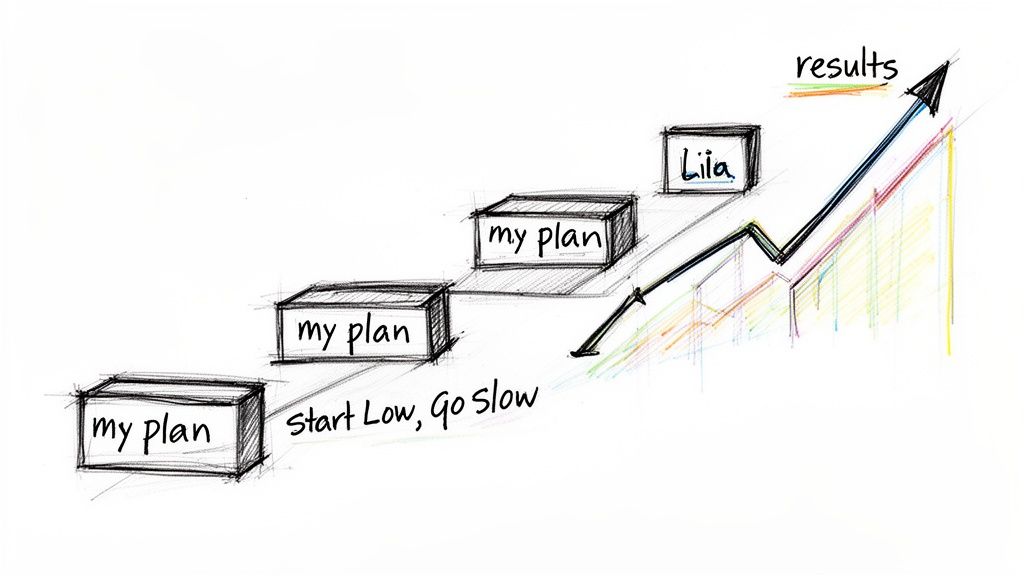
The smartest supplement plan is usually the least dramatic one.
Most women do better when they start low, go slow, and change one thing at a time. That gives you a fair test. If you start magnesium, black cohosh, creatine, and a new sleep tea in the same week, you learn almost nothing. If you add one targeted supplement and track your symptoms carefully, patterns become easier to see.
Start with food and symptom clarity
A food-first strategy is not anti-supplement. It is more grounded.
As noted in this menopause supplement guide focused on food-first choices, nutrients from foods like pumpkin seeds for magnesium are often better absorbed, and tracking meals alongside symptoms can help women see whether diet changes help before turning to supplements. That matters because not every symptom needs a bottle. Sometimes the first fix is better fueling, steadier meal timing, more protein, less alcohol, or improved sleep hygiene.
Build your trial the way a clinician would
A practical self-test looks like this:
Choose one symptom to target first. Not five.
Pick one supplement with a plausible reason for that symptom.
Set a baseline for at least several days. Track hot flashes, sleep, mood, bowel habits, or energy.
Introduce one product only.
Reassess results. Better, worse, unchanged, or unclear.
A tool can help at this stage. A symptom tracker such as Lila’s menopause symptom tracker app can be used to log daily changes in sleep, mood, meals, energy, and symptoms so your decisions are based on patterns rather than memory.
What a good tracking system reveals
Tracking does more than tell you whether a supplement “worked.”
It can show you:
Whether the benefit is consistent or only shows up on lower-stress days
Whether your symptom improves more from food or lifestyle changes
Whether a side effect began after a new product
Whether a clinician conversation needs to shift toward hormone therapy or another treatment
The best menopause supplements are not the ones with the loudest label. They are the ones that fit your symptom, your physiology, your tolerance, and your response over time.
That response is personal. Track it like it matters.
Common Questions About Menopause Supplements
Can I take supplements if I’m also using hormone therapy
Sometimes yes, but this should be individualized. The main issues are interaction risk, duplication of effect, and whether a supplement complicates an otherwise clear treatment plan. Mood herbs and multi-ingredient blends deserve extra caution. Bring the exact product label to your clinician.
How long should I give a supplement before deciding it is not helping
Long enough to observe a pattern, but not so long that you stay on a useless product indefinitely. A defined trial works better than vague hope. Track the target symptom, not your overall impression of the week.
Are any supplements clearly overhyped
Yes. Products that promise relief for every menopause symptom at once are usually trying to do too much. Ingredients like maca, wild yam, and dong quai are heavily marketed but remain insufficiently studied in the verified guidance above.
Is “natural” the same as safe
No. Natural products can still cause side effects and interact with medications. St. John’s wort is a good example of an ingredient that may have a role for some women but requires care because of interactions.
Should I start with supplements or food
Food first is often the better opening move, especially for nutrients such as magnesium and calcium. Supplements can then be added in a targeted way if symptoms persist, intake is inadequate, or a specific need becomes clear.
What if nothing seems to help
That is useful information, not failure. It may mean the supplement is wrong for the symptom, the product quality is poor, the symptom has another driver, or a prescription approach would be more appropriate. The answer is not always “try more supplements.”
If you want a calmer, more structured way to test changes, Lila can help you track symptoms, meals, sleep, mood, and energy in one place so you can make supplement decisions based on what your body is doing, not what the label promised.
Get Lila, your personal coach for perimenopause.
Built for women in their 40s. 24/7 coaching, in your pocket.


