
Hot Flashes and Stress: What Actually Links Them
See how hot flashes and stress reinforce each other, which triggers raise the odds, and a one-change plan that eases the loop.
Hot flashes and stress feed each other, but stress does not create every flash and cannot be managed away as the sole fix. About 60 to 80 percent of women have vasomotor symptoms at some point, moderate or severe hot flashes reach 46 percent in the first two years after the final period, and frequent symptoms last a median of 7.4 years. Those numbers tell you this is not a short-term annoyance you can breathe your way out of, yet calming tools still matter, because they target the distress and sleep loss that make each flash feel heavier than it has to.
Table of Contents
- Why Hot Flashes and Stress Reinforce Each Other
- The Narrow Temperature Window Behind a Flash
- Triggers That Raise the Odds of a Flash
- When a Hot Flash Feels Like Panic
- How to Log One Change for Two Weeks
- What Counts as Progress If Flashes Continue
- Start a Two-Week Stress and Flash Log
Why Hot Flashes and Stress Reinforce Each Other
The usual advice sounds neat: lower stress and the flashes will follow. That promise leaves out half the loop. Hot flashes can be triggered by a narrow temperature window, then the flush, the racing heart, the embarrassment, and the sleep loss can raise stress afterward. Stress does not have to be the first spark to become a real amplifier.
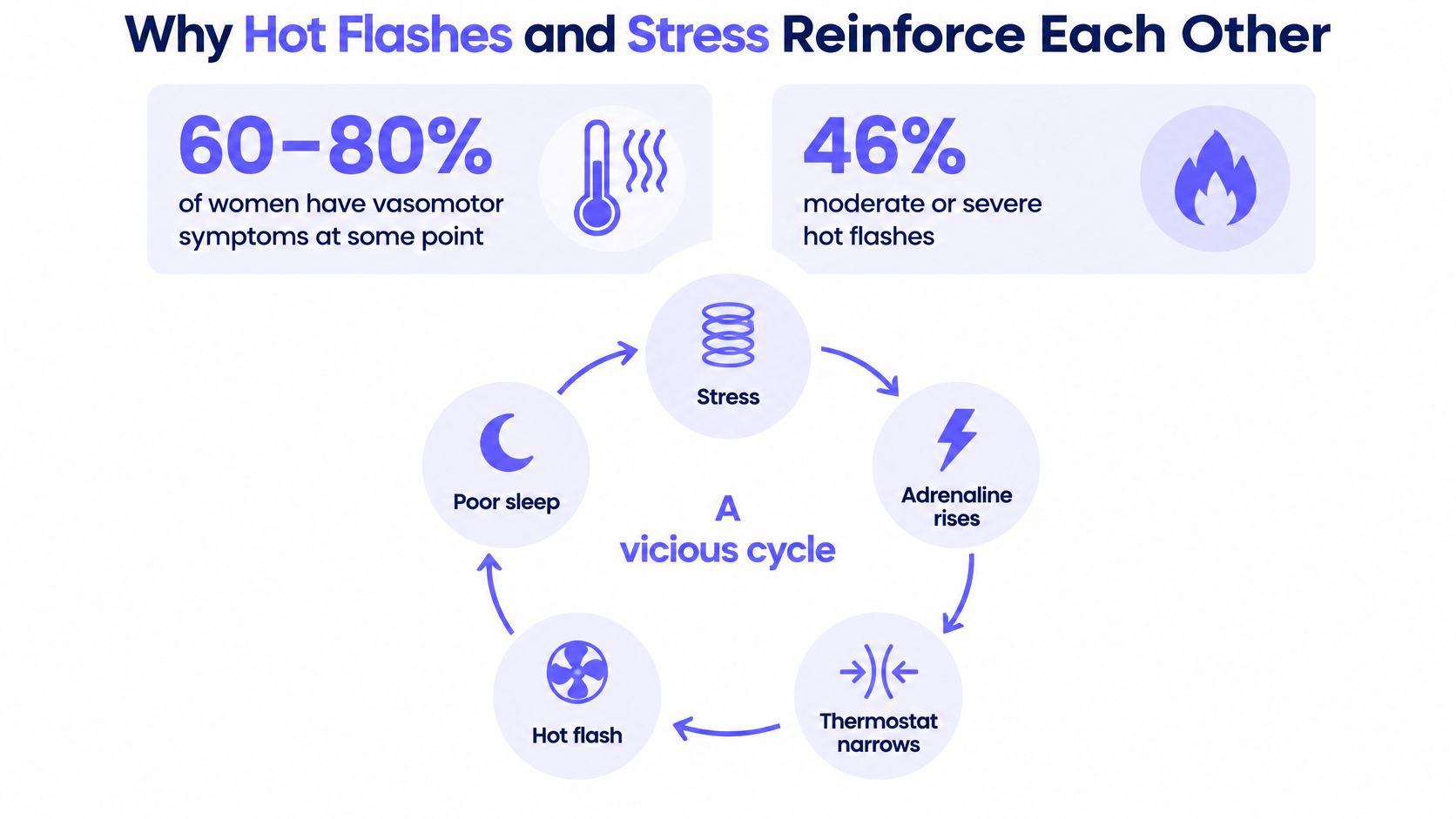
A useful way to separate the two forces is to ask what came first. A flash that begins after a warm room, alcohol, or a sudden shift in sleep can still become stressful once it interrupts a meeting or wakes you at 3 a.m. A flash that arrives during a tense conversation may feel as if stress switched it on, even when the same low-grade trigger load has been building all day. In both cases, the body event and the meaning you attach to it can feed each other.
The stress response works like an amplifier knob. When sympathetic activation rises, the body becomes more alert, the heart may beat faster, and sensations feel sharper. A warm flush that might have been annoying becomes alarming. That alarm can make the next flash more threatening before it even starts. Over time, the anticipation can be as tiring as the episode.
The evidence points to a two-way relationship, not a simple cause-and-effect story. A study of midlife women with vasomotor symptoms from PMC found a smaller cortisol response to a laboratory social stressor among women with frequent symptoms than among women without them: cortisol rose 54 percent versus 83 percent, respectively. The authors described this as preliminary evidence of altered stress responsivity, not proof that worry causes flashes. One interpretation is that a worn-down stress system may respond less flexibly because of the same hormonal shifts involved in vasomotor symptoms.
Useful distinction: Acute stress is the difficult meeting or the stuck traffic. Chronic stress biology is the accumulated burden of broken sleep, symptom worry, and a nervous system that no longer bounces back quickly. They overlap, but they are not identical.
That difference matters because calming techniques have a realistic job. They may not close the narrowed temperature window that produces a flash, and they do not deserve blame when a flush still happens. They can reduce the second wave: the fear that another one is coming, the tension that makes sleep lighter, and the sense that your body has betrayed you in public.
Lila was built after the founders watched women they love be dismissed during perimenopause, left guessing and blaming themselves for symptoms they were told were "just aging or stress." That is why the distinction is so practical here. A hot flash is a physical event, the distress around it is real, and a care approach that treats both can reduce the burden without demanding that stress be the sole explanation. For broader context on women's health, this women's health reading for informed wellness offers additional reading.
The goal is a shorter distress loop, not a life with zero episodes. A flash still counts as a flash. Progress can also mean less panic during one, faster recovery afterward, and a night that is less fragmented by worry. That is the thread to keep in view as the next sections separate temperature triggers, panic-like sensations, and the small daily logs that make patterns visible.
The Narrow Temperature Window Behind a Flash
A hot flash behaves like a thermostat with almost no margin. The thermoneutral zone is the core-temperature band where the body neither sweats nor shivers, and in asymptomatic women it spans about 0.4 degrees Celsius in the physiology work summarized by PubMed. In a woman with frequent flashes, that band can become extremely narrow or nearly absent. A tiny rise in core temperature, the kind a warm room or a hot drink can produce, crosses the line and triggers skin blood flow and sweating.
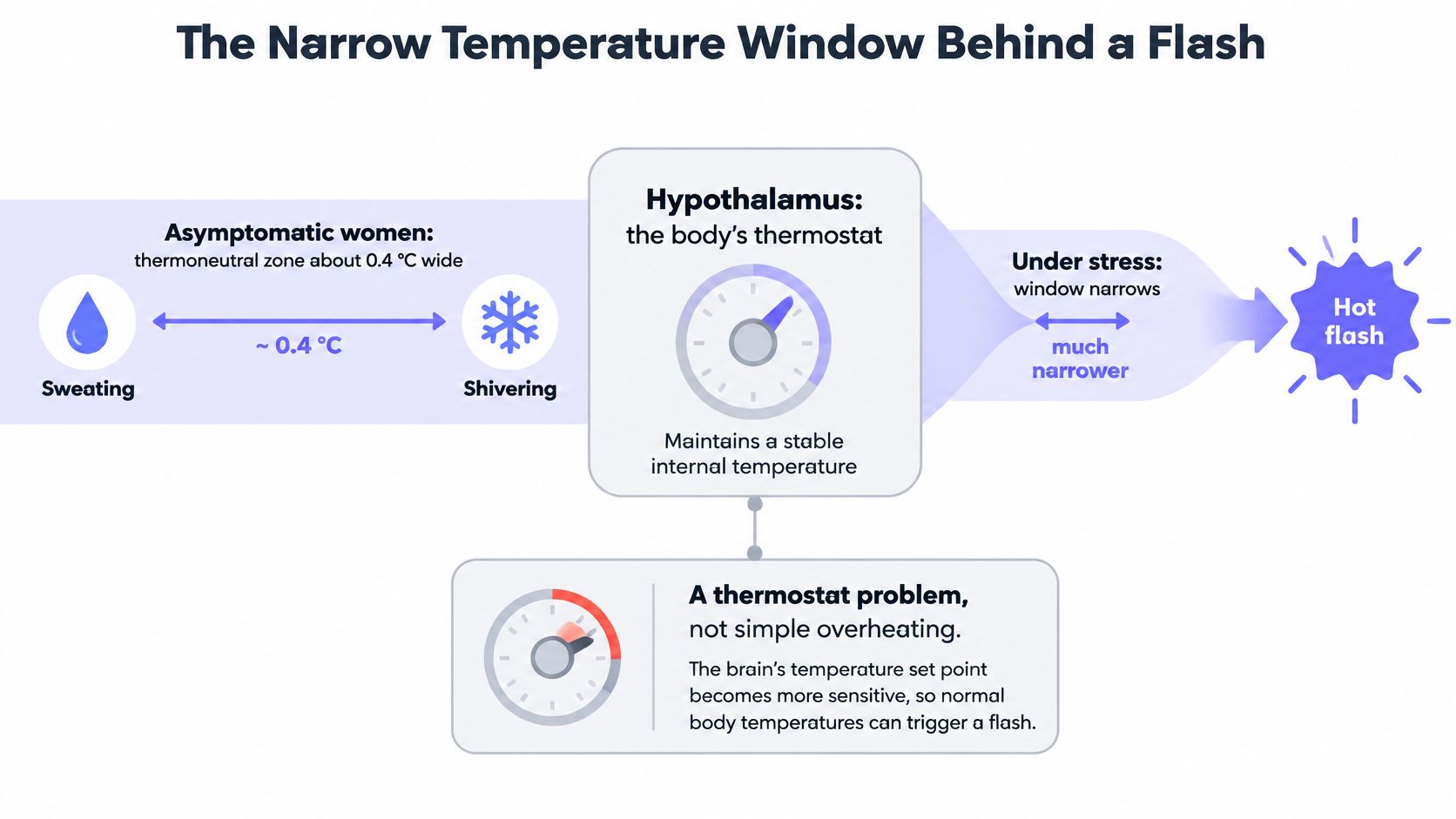
A household thermostat works the same way when the gap between heat and cool is almost gone. The room warms a fraction, the furnace cuts in, and the fan starts. The body's response can look exaggerated from the outside, yet the trigger may be small. The hypothalamus is reacting to a tolerance band that has squeezed shut, so ordinary fluctuations register as emergencies. Core temperature does not need to climb far for a flash to begin.
Stress can tighten that band further. Central sympathetic activation, the autonomic arm of the fight-or-flight response, can narrow the thermoneutral zone, while lowering that activation can widen it and lessen hot flashes. A tense meeting, a poor night, or a warm room can all nudge temperature across the same thin line. This is why a stress tool may reduce how often a flash fires, but cannot guarantee silence. The baseline thermostat is still narrow, and the science of menopause hot flashes explains the hormonal root in more detail in why menopause causes hot flashes.
Bother and frequency deserve separate scores. Frequency counts episodes. Bother measures how much those episodes interrupt sleep, concentration, mood, or a normal day. Two people can have the same number of flashes and very different experiences, because one may notice brief warmth while the other loses sleep, avoids social plans, or starts bracing for the next episode. That anticipation can make the nervous system more reactive, which can make the next flash feel louder.
The practical point is simple. Calming techniques may reduce distress and sleep loss even when the flash count stays flat. That is a real result, not a consolation prize. A narrower temperature window may still open, but a calmer response can shorten the distress loop around it.
Practical rule: Frequency is how many flashes you have. Bother is how much they disrupt you. A calmer nervous system can shrink the second number even on a day the first number barely moves.
Triggers That Raise the Odds of a Flash
A trigger is not a cause. It is something that pushes core temperature or arousal across a thermoneutral zone that is already too narrow. The table below is a working tool, not a ban list. Each row pairs one trigger with one change to test for seven days while everything else stays steady.
| Trigger | What it does | One change to test |
|---|---|---|
| Acute stress before a known event | Raises sympathetic arousal and can narrow the thermoneutral zone | Two minutes of slow paced breathing beforehand |
| Warm room or heavy clothing | A small core-temperature rise crosses a narrow threshold | Cool the room and remove one layer early |
| Alcohol in the evening | Associated with night sweats and fragmented sleep | Skip alcohol for seven nights and compare |
| Caffeine late in the day | Adds arousal when the threshold is already tight | Keep caffeine to the morning only |
| Sleep loss | Lowers next-day coping and can intensify bother | Protect one earlier bedtime for a week |
| Spicy food or a very hot drink | Stacks heat on a small core-temperature rise | Swap for a cooler option on high-symptom days |
How to read a row
Start with the row you suspect most. Say a meeting reliably leaves you overheated and rattled. Acute stress raises sympathetic arousal, which can narrow the thermoneutral zone. The test is not a promise that the flash will vanish. It is two minutes of slow paced breathing before the meeting, done every day that week, while you watch whether the flush arrives later, feels shorter, or bothers you less. For readers who want professional support to build that kind of down-regulation habit, brief therapy options for stress can teach the skill efficiently.
Alcohol is the row many women find easiest to test because the comparison is concrete. Evening alcohol is associated with night sweats and fragmented sleep. Skip it for seven nights and compare how many times you wake, how drenched you are, and how you feel the next morning. You are not giving up alcohol forever; you are gathering a clean data point. Caffeine gets the same treatment, except the change is moving it to morning only, since late caffeine adds arousal precisely when the threshold is tightest.
Why several rows can be true at once
A 2025 line of research ties symptom intensity to experienced stress, sleep duration, age, and reproductive hormones. That means a bad Tuesday could involve a warm office, a skipped cool-down, a glass of wine at dinner, and only five hours of sleep. All four rows are in play, and no single change will cancel the others. The caffeine and hot flashes link is worth testing on its own for exactly this reason. Test one row for seven days, keep the others steady, and judge bother and sleep as well as flash count. The full two-week version comes later.
When a Hot Flash Feels Like Panic
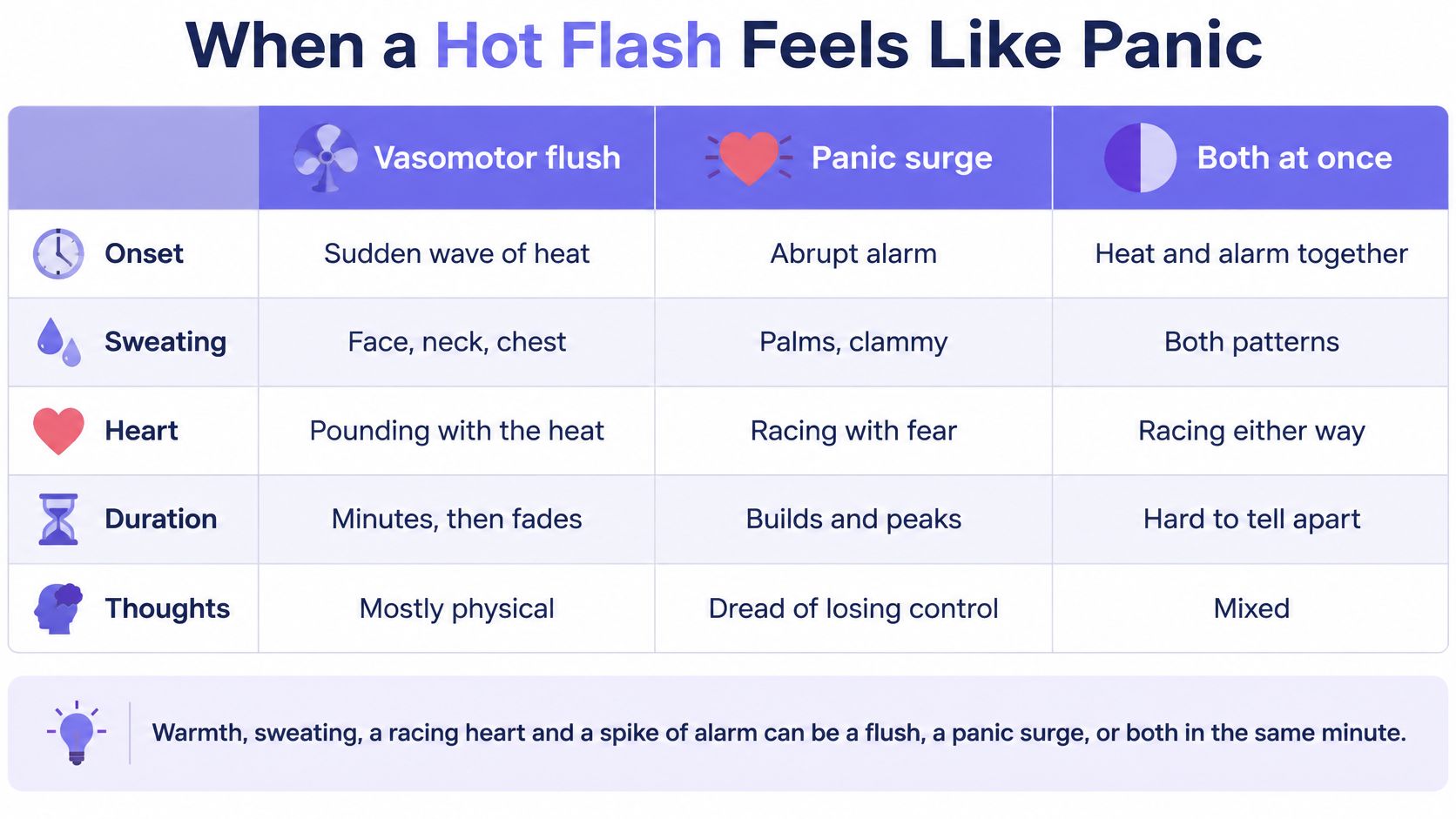
Warmth, sweating, a racing heart, and a spike of alarm can be a vasomotor flush, a panic surge, or both in the same minute. Most coverage lists stress as a trigger but never helps you tell the two apart, and that gap can delay real evaluation. Anxiety, panic, sleep deprivation, medication effects, thyroid disease, infection, and cardiovascular problems can all produce sweating, warmth, palpitations, flushing, or a sense of alarm. Treating every episode as a menopause symptom is not safe.
| Clue | More like a hot flash | More like anxiety or another cause | What to do |
|---|---|---|---|
| Heat then sweat then chill | Typical vasomotor wave | Less typical if there is no heat wave | Log timing, cycle stage, and sleep |
| Racing heart with dread | Can follow the heat wave | Panic can do this without flushing | Note whether heat came first |
| Length and setting | Often a few minutes, at night or near cycle change | May last longer and follow a fear cue | Track duration for a week |
| Chest pain, fainting, severe breathlessness, or new neurological symptoms | Not explained by a typical flash | Needs urgent evaluation | Seek urgent care |
| New, unusual, or rapidly worsening episodes | May still be vasomotor | Thyroid, infection, medicine, or heart causes are possible | Discuss with a clinician |
Why a stress diary cannot name the cause
Here is the cortisol caution that complicates the popular story. In a longitudinal study of 169 women reported by PubMed, higher cortisol during the late menopausal transition was associated with more severe vasomotor symptoms, yet the higher-cortisol group did not differ in reported stress, mood, sleep, exercise, or body mass index. Your diary can record that you felt calm but still flushed, or stressed but flash-free, and that pattern matters. What it cannot do is prove whether a given episode was hormonally driven, anxiety driven, or caused by a thyroid problem or a medication. That requires a clinician.
Log timing, duration, heart symptoms, sleep, cycle stage, medicines, alcohol, caffeine, and emotional context. If episodes are new, unusual, rapidly worse, or unlike your usual pattern, bring that log to a clinician. Urgent care is for chest pain, fainting, severe shortness of breath, or new neurological symptoms. The emerging clinical picture also matters: 2025 reviews examined neurokinin antagonists and possible links between vasomotor symptoms, cortisol, metabolic health, cardiovascular disease, and bone health. Hot flashes are not only a lifestyle or stress story, and panic attacks in perimenopause deserve attention in their own right.
▶ PlayHow to Log One Change for Two Weeks
A two-week log works like a small experiment. Instead of asking whether stress caused a flash, you test one change and watch three separate signals: how often flashes happen, how much they bother you, and how well you sleep.
Laboratory and observational data from PMC show that women who find vasomotor symptoms more bothersome may show higher cortisol, higher baseline norepinephrine, greater vascular resistance, lower cardiac index, and higher interleukin-6. Stress reactivity alone did not fully explain symptom severity. Bother and recovery deserve their own columns because a smaller flash count can still leave you drained.
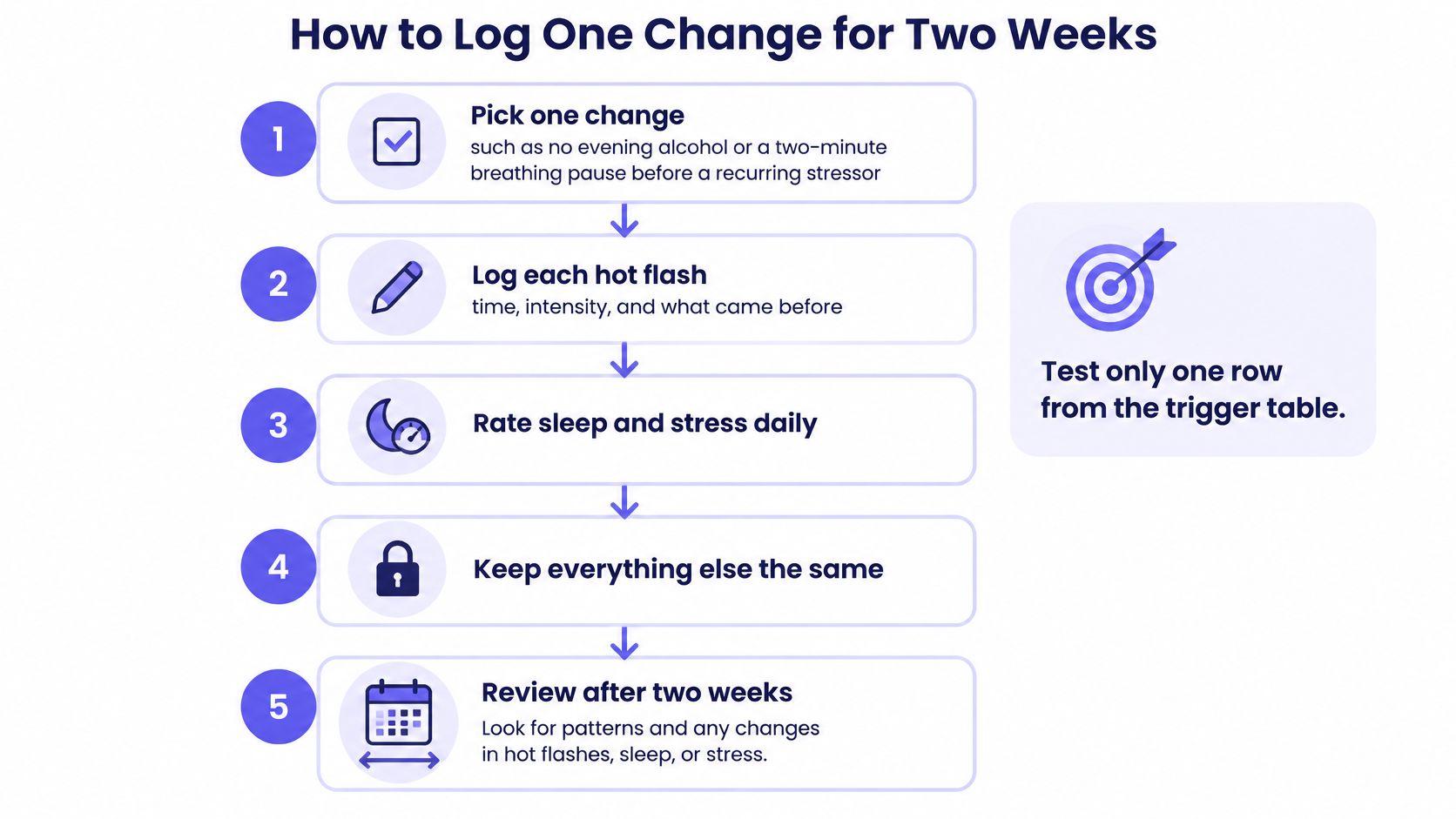
The routine is six steps, tested one row at a time.
Pick one change. Choose a single row from the trigger table, such as no evening alcohol or a two-minute breathing pause before a recurring stressor.
Log the evening context. Each night, note stress from 0 to 10, hours slept, and whether alcohol, late caffeine, or a warm room showed up.
Log the flash the moment it happens. Note the clock time, how long it lasted, and a bother score from 0 to 10, separate from the count.
Add recovery time in the morning. Write down how long it took to feel steady again after the last flash of the night or the first one of the day.
Keep everything else steady. You cannot freeze real life, but hold other habits as close to constant as you can so the one change stays readable.
Compare after 14 days. Look at the first three days against the last three on three lines only: flash count, average bother, and sleep hours.
Cognitive-behavioral therapy has evidence for reducing vasomotor-symptom severity, and clinical guidance supports it as a nonhormonal option. Paced breathing or mindfulness can sit beside it as adjuncts, but they are not substitutes for clinical evaluation when symptoms are severe or atypical. A useful log often reveals a repeating pair, such as short sleep followed by higher bother the next day, even when the flash count barely moves. If you want a ready-made structure, Lila combines a 24/7 AI nutrition coach, photo meal logging, and symptom tracking in one perimenopause app, and a perimenopause symptom tracker can hold the fields so you do not rebuild them each night.
Read the pair, not the single day: One calm Tuesday proves little. Two weeks that show lower bother after the same number of flashes proves your stress tool is doing real work.
What Counts as Progress If Flashes Continue
After a calm week that still includes flashes, the natural question is whether the tools failed. They did not. The vasomotor mechanism can keep firing while stress tools cut the second wave, which is embarrassment, anticipatory dread, broken sleep, and a shorter fuse the next day. That second wave is real suffering, and it is the part stress care can reliably shrink.
Three success marks do not require a zero count. First, bother drops even if the number of flashes is similar. Second, sleep fragments less often, because a night sweat that wakes you for twenty minutes is a different burden from one you sleep through. Third, recovery gets faster, meaning you return to the meeting or to sleep without a long tail of alarm.
Say a presentation still brings a flush, but paced breathing and a cooler layer keep you from leaving the room. Or say skipping evening alcohol does not end night sweats, yet you wake once instead of three times. Both are wins. Both are visible in a two-week log, and both are invisible to anyone who only counts flashes.
Resist the reverse reading too. A higher-stress week is not proof you caused your hormones to misbehave. The Study of Women's Health Across the Nation shows that symptoms commonly grow most frequent during late perimenopause and the early postmenopausal years, and they can start while cycles are still occurring. A bad fortnight in that stretch is not a personal failure. Judge the trend with the two-week comparison, not a single calm day, and use that same lens for hot flash management decisions overall.
Start a Two-Week Stress and Flash Log
Choose one trigger row, run the six-step log for 14 days, and judge count, bother, and sleep rather than waiting to feel fixed. If episodes include chest pain, fainting, severe shortness of breath, or new neurological symptoms, skip the experiment and get urgent care. If the pattern is new, rapidly worse, or unlike your usual flashes, book a clinician visit and bring the log. Hormone therapy and other treatments are medical decisions, not app decisions.
Lila is an optional perimenopause app that combines a 24/7 AI nutrition coach, photo meal logging, and symptom tracking in one place. The daily symptom check-in takes about 30 seconds, with the user tapping intensity on the symptoms that matter, including hot flashes and sleep. Lila is not a substitute for medical advice, and users should always consult their doctor about perimenopause symptoms, HRT, or any health condition. After two weeks, look for lower bother, steadier sleep, or faster recovery. A remaining flash count is information for the next single change or for a clinical conversation, not proof that stress care failed.
Hot flashes and stress loop through each other, but you can interrupt the loop even when you can't silence every flash. Lila gives you a single place to log hot flashes, sleep, stress, and meals so the two-week test stays simple, and it turns those daily check-ins into a clear pattern you can bring to your doctor. Visit Lila to start logging and see which change moves your bother, sleep, and recovery.
Get Lila, your personal coach for perimenopause.
Built for women in their 40s. 24/7 coaching, in your pocket.