
Lower Back Pain Menopause: Causes, Red Flags and Relief
Lower back pain menopause is common and often treatable. Learn the causes, warning signs, and exercises that help.
Nearly six in ten postmenopausal women report back pain, and the proportion only dips a little when you look at women still in perimenopause. That comes from a pooled analysis of 93,021 women in 37 observational studies across 22 countries, published through the U.S. National Institutes of Health in a systematic review and meta-analysis.
A number that high changes how you read your own symptoms. Back pain in this transition is common enough to be expected, not bad luck you keep to yourself. But how common it is raises a harder question that most lower back pain menopause advice skips: is this ordinary wear and tear, the kind that responds to movement and time, or is it the first signal that your bones have lost density?
Those two situations feel similar from the inside. They need very different responses.
Table of Contents
- How Common Back Pain Is Across the Menopause Transition
- Why Menopause Changes Your Lower Back
- Red Flags and When to Ask for a Bone Density Scan
- Exercise and Posture Changes That Ease Back Pain
- Treatment Options Compared by Goal and Evidence
- Book a Doctor Visit to Confirm Your Next Step
How Common Back Pain Is Across the Menopause Transition
The pooled review sorted prevalence by menopausal stage, then compared each stage against premenopause directly. Back pain affected about 42% of premenopausal women, 57% of perimenopausal women and 59% of postmenopausal women (pooled review of 93,021 women).
Read that as a steady climb rather than a spike. Back pain doesn't switch on the month your periods stop and then hold steady. It accumulates across the years on either side of the transition, which is exactly why so many women assume it's unrelated to hormones and equally why so many assume it's entirely hormonal. Both readings are too tidy.
| Menopause stage | Back pain prevalence | Risk compared with premenopause |
|---|---|---|
| Premenopausal | 42% | Reference group (RR 1.00) |
| Perimenopausal | 57% | RR 1.15 (95% CI 1.06-1.24) |
| Postmenopausal | 59% | RR 1.20 (95% CI 1.11-1.30) |
What a relative risk of 1.15 actually means
A relative risk of 1.15 means perimenopausal women were about 15% more likely to report back pain than premenopausal women in the same body of evidence, based on 15,821 participants. The confidence interval of 1.06 to 1.24 is the range the true figure plausibly sits in. Because the whole range stays above 1.0, the direction of the finding is dependable even if the exact size isn't.
The postmenopausal comparison is slightly stronger at RR 1.20 (95% CI 1.11 to 1.30) across 20,565 participants.
Three things that number does not mean:
- It isn't a personal forecast. It's a group average. A relative risk can't tell you whether your back will hurt next year.
- It isn't a percentage of women affected. A 15% higher relative risk is not the same as 15 out of 100 women developing pain.
- It isn't proof of cause. A higher risk in a group says the two things travel together, not that one produced the other.
The practical reading: back pain that appears in your late 40s and settles into a pattern is common enough to expect. Common is not the same as unimportant, and it is not the same as harmless.
Why the review can't settle the cause question
The 37 underlying studies were observational, meaning they watched what happened rather than testing a cause. They also varied widely in how they defined menopause, how they measured pain and which populations they sampled. That heterogeneity is why the authors describe the findings as showing an association rather than proving that menopause directly causes back pain.
Association is still useful. It tells you that your back is worth tracking the same way you'd track sleep, hot flashes or weight, because a symptom that moves with a life stage is a symptom your doctor can work with.
If you want a wider map of what else shifts in this decade, this guide to the full range of menopause symptoms shows how joint and muscle complaints sit alongside sleep, mood and cycle changes.
Why Menopause Changes Your Lower Back
No single mechanism explains menopausal back pain, and the search for one cause is where most explanations go wrong. Estrogen receptors sit in spinal and joint tissues, and experimental work shows estrogen can influence how the intervertebral disc remodels its matrix and how nociceptive signals are processed (review of estrogen, discs and joint pain). That's a real biological story.
It's also an incomplete one, because the human data don't behave the way a simple hormone-deficiency story predicts. If low estrogen damaged the back, replacing estrogen should protect it. Observational studies have instead reported slightly higher low-back-pain prevalence, or worse back function, among some postmenopausal women using systemic menopausal hormone therapy.
That mismatch matters. It means back pain shouldn't be automatically attributed to estrogen deficiency, and it shouldn't be treated with hormone therapy alone.
The contributors that overlap in the same spine
| Likely contributor | Typical pattern | What to check |
|---|---|---|
| Disc and facet-joint changes | Pain worse after bending or long sitting, gradual onset | Note which movements trigger pain and whether it eases with rest |
| Reduced muscle mass (sarcopenia) | Stiffness and fatigue when standing, weaker core | Sit-to-stand test with a clinician |
| Weight gain and altered load | Pain with standing or carrying | Waist measurement every few months |
| Low activity and poor sleep | Pain on waking that eases with movement | Two-week sleep and step log |
| Estrogen-related pain sensitivity | Widespread aches that feel amplified | Track pain alongside cycle changes and mood |
The patterns are the useful part, not the labels. Pain that's worst on waking and loosens as you move usually points toward stiffness, sleep position or a long stretch in one posture. Pain that bites after twenty minutes of standing points toward load and muscular endurance. Pain that wanders across the body and flares with poor sleep looks more like altered pain processing.
A useful rule: if the pattern changes, the working theory should change with it. A single explanation that never updates is usually wrong.
Women often arrive at the estrogen theory because it's the only one they've been offered. Low estrogen does have recognizable signs beyond the back, and this breakdown of the signs of low estrogen helps you tell a hormonal pattern from a mechanical one.
An honest assessment covers mechanical loading, physical conditioning, sleep, body composition, inflammatory disease and osteoporosis risk together. Not one of those alone.
Red Flags and When to Ask for a Bone Density Scan
Most back pain after menopause is not a fracture. That statement is true, and it is also the reason serious cases get missed, because it gets applied to every new pain indiscriminately.
A vertebral compression fracture can present as nothing more than back pain, and it can happen with minimal trauma. No fall, no car accident, no dramatic moment. Clinical guidance is explicit that new, severe or unexplained back pain after menopause warrants osteoporosis-focused triage (National Osteoporosis Guideline Group guidance).
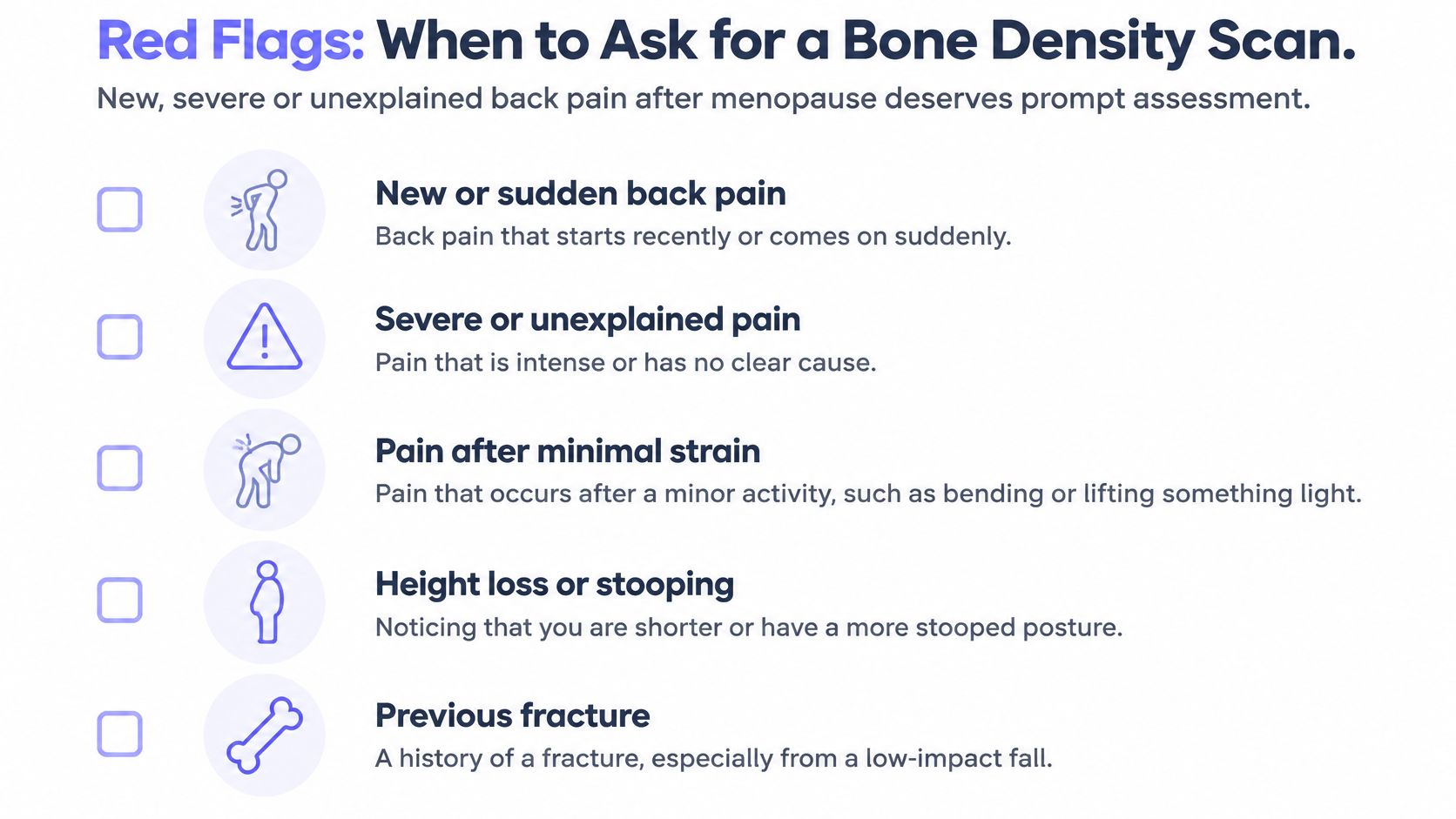
The checklist that separates ordinary pain from a fracture signal
Work through these in order. Any single one is a reason to book an appointment rather than wait it out.
- Persistent, worsening or sudden pain. Pain that ramps up over days rather than easing, or that arrives abruptly without a clear strain, needs assessment.
- Night pain or rest pain that doesn't settle with a position change. Mechanical pain usually finds a comfortable position. Pain that ignores position doesn't.
- Measured height loss, a new stoop, or visible spinal curvature. Measure at the same clinic, same time of day, once a year, so the comparison is real.
- A minor fall or knock followed by new back pain. Low-trauma fractures are the signature of reduced bone density.
- Leg weakness, numbness or tingling. These suggest nerve involvement and shift the timeline from soon to promptly.
- Bowel or bladder changes. Same-day emergency care. This one is not a wait-and-see symptom.
A low pain score doesn't rule out a fracture
This is the point readers get wrong most often. Severity is a poor screening tool on its own. A compression fracture can produce a dull, manageable ache that never climbs above a four out of ten, and it can do that for weeks. Judging urgency by how much it hurts will miss cases.
Guidance sets specific thresholds for considering vertebral-fracture imaging in postmenopausal women with acute back pain:
| Trigger | Action |
|---|---|
| Acute back pain plus osteoporosis risk factors | Consider vertebral-fracture imaging |
| Height loss of at least 4 cm | Consider vertebral-fracture imaging |
| Kyphosis (visible spinal curvature) | Consider vertebral-fracture imaging |
| Long-term oral glucocorticoid use | Consider vertebral-fracture imaging |
| Bone-mineral-density T-score of -2.5 or lower | Consider vertebral-fracture imaging and DXA follow-up |
The same principle applies when a clinician is deciding who to investigate for osteoporosis at all: risk assessment is relevant even if you've never been given a diagnosis, and a normal pain score doesn't exclude a vertebral fracture (Australian guidance on identifying patients to investigate).
If your pain travels down one leg rather than sitting in the middle of your back, the guide to spotting serious sciatica symptoms sets out the neurological signs that change how urgently you should be seen.
What to bring to the appointment
Collect five things before you go, because each one changes the decision:
- Height history. Two measurements a year apart beat a single reading taken on the day you're in pain.
- Fracture history. Any break from a minor fall, at any age.
- A full medication list. Include steroids, however long you've taken them and whatever the dose.
- Fall risk at home. Loose rugs, poor lighting, stairs without a rail.
- Whether you've ever had a DXA scan. If not, that's part of the conversation.
Then ask one direct question: given my height history, this back pain and these medicines, do I need a DXA scan or vertebral imaging?
Vitamin D status belongs in that same conversation, since it affects how bone is maintained, and this guide to vitamin D and menopause covers what testing and supplementation look like in practice.
Before you close the tab: most menopausal back pain is not a fracture. The checklist exists so the rare case doesn't slip through in the year it's still easy to treat.
Lila isn't a substitute for medical advice, and you should always consult your doctor about perimenopause symptoms, back pain or bone health.
Exercise and Posture Changes That Ease Back Pain
The strongest intervention evidence in this area is unglamorous. In a 2017 study of healthy postmenopausal women, 32.9% reported low-back pain at baseline, making it one of the most common pain sites recorded (physical activity trial in postmenopausal women). Participants assigned to a physical-activity programme saw prevalence fall from 33.3% to 21.6%, a statistically significant change (p = 0.02). The non-intervention group moved from 32.4% to 25.9%, a change that was not statistically significant (p = 0.30).
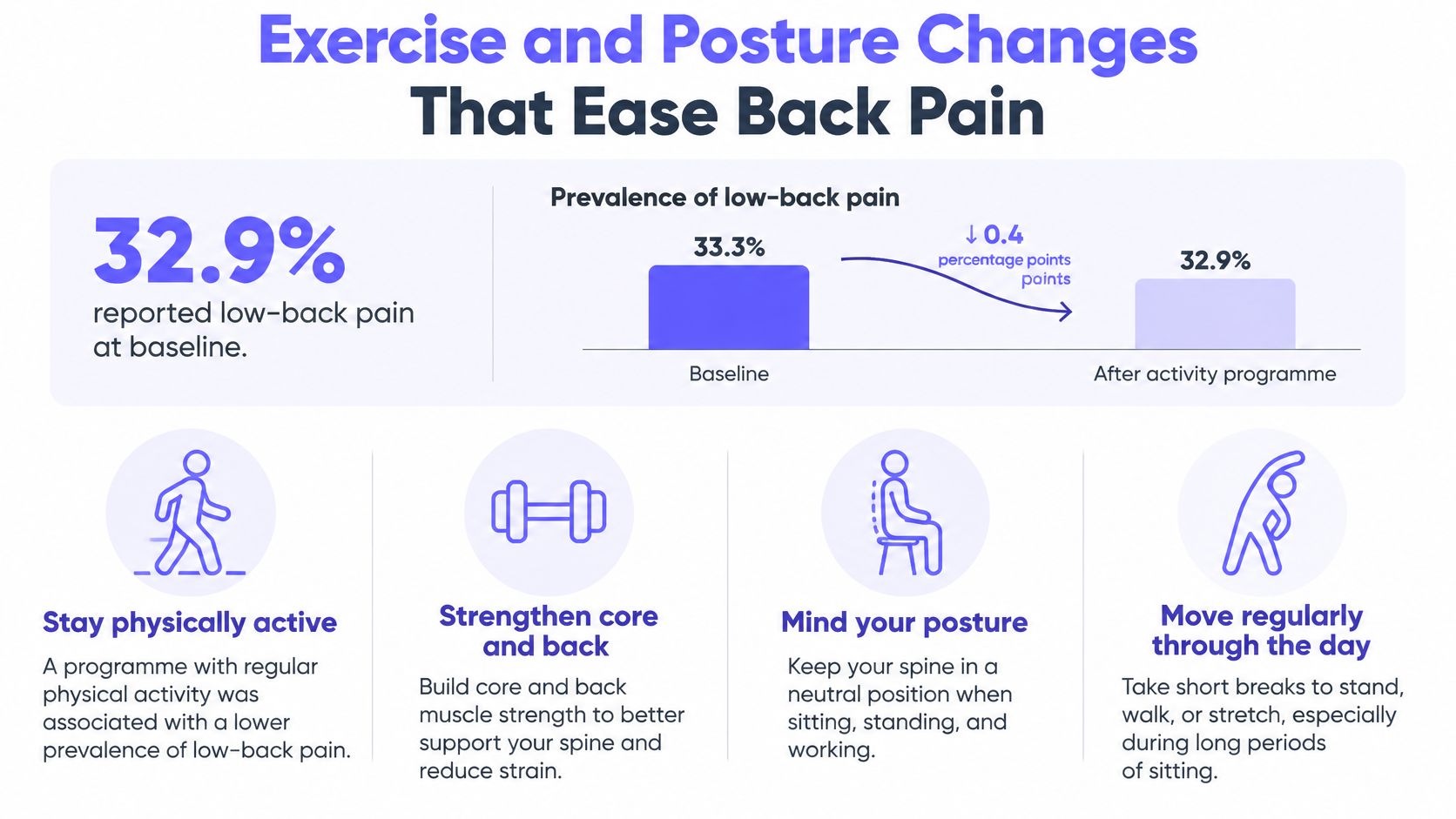
That's a roughly 11.7 percentage point drop in the active group. It doesn't promise the same result for you, and it doesn't replace assessment of severe, persistent or nerve-related pain. It does show that movement is a reasonable first lever to pull.
Five practices worth building in
- Walk most days at a comfortable pace. Twenty to thirty minutes, broken into two shorter walks if that's what fits. Walking loads the spine in a gentle, repetitive way that discs tolerate well.
- Add strength work two or three times a week. Hips, glutes and trunk. A chest-supported row instead of a bent-over pull spares the lower back while still loading the upper body, and a hip hinge with a light weight teaches the pattern you need for lifting groceries.
- Break up sitting every 30 to 60 minutes. Stand, walk to the kitchen, do five slow sit-to-stands. Sustained sitting is the load most backs tolerate least.
- Adjust your sleep position. A pillow between the knees keeps the pelvis stacked if you sleep on your side; a pillow under the knees takes extension load off if you sleep on your back.
- Lift with your hips and knees, load close to the body. The further a weight sits from your spine, the more force your back muscles must produce.
How long before it counts as working
Judge progress over six to eight weeks, not day to day. Pain fluctuates for reasons that have nothing to do with whether a programme is helping, and daily scoring turns normal variation into false feedback. Pick two or three functional markers instead: how long you can sit before it aches, whether you can carry shopping to the car, how you feel the morning after a strength session.
Building load gradually is also how bone responds, which is why the same sessions that ease pain can support density, as this guide to strength training for bone density explains.
One safety note: if you're over 35 or have been inactive for a few years, see a physician before beginning any exercise programme.
Treatment Options Compared by Goal and Evidence
Two goals get tangled together in most treatment advice, and untangling them solves most of the confusion. Relieving hot flashes, protecting bone and easing back pain are three separate targets. An option that's excellent for one can be neutral for another.
The mechanism question stays open. Proposed contributors include disc degeneration, facet-joint osteoarthritis, sarcopenia, inflammation, altered biomechanics and shifts in body composition, while the precise pathways remain poorly understood (synthesis of menopause and back pain evidence). When mechanisms are uncertain, treatments should be judged on the outcome they're meant to produce.
Comparing the options honestly
| Option | Best for | Evidence and caution |
|---|---|---|
| Exercise and strength training | Ongoing back pain with weak core or low activity | Most promising; regular, adapted movement |
| Physical therapy | Pain that limits movement or has an unclear cause | Tailored assessment and progression; ask for a clinical review first |
| Hormone therapy (HRT) | Hot flashes and sleep disruption, with bone protection as a separate goal | Not established as a back pain treatment; some observational data show slightly higher pain among users |
| Bisphosphonates | Confirmed osteoporosis or fracture risk | Protects bone; evidence for back pain relief is less convincing |
| Over-the-counter analgesics | Short-term flare-ups | Use for limited periods and check with a doctor if other conditions apply |
| Heat packs and massage | Temporary relief of muscle tension | Eases symptoms but does not address the underlying cause |
Read the middle column, not the first. Every one of these options does something real. None of them does everything.
Will hormone therapy fix my lower back pain
This is the question women ask most, and the answer is unsatisfying but honest: hormone therapy may improve your sleep and reduce hot flashes, and better sleep often makes pain easier to manage. That's an indirect benefit, not a treatment effect on the back itself. The evidence that hormone therapy specifically relieves low-back pain is weak, and some observational data point the other way.
Decide on hormone therapy for the reasons it's indicated, with your doctor. Not as a back-pain strategy.
Physiotherapy referral is worth asking for when pain limits daily movement, lasts beyond several weeks, or has no clear cause. Expect a first session to include movement testing, a strength and range assessment, and a graded plan you build up over weeks rather than a list of stretches to do forever.
Here's a short walkthrough of what to expect from a clinical assessment:
▶ PlayTrack pain alongside sleep, activity, weight and what you can do in a day. Pain intensity alone is a poor scoreboard, because it swings with mood, rest and stress. Whether you can put on your shoes without sitting down is a better measure of whether something is working.
Lila's guide to what hormone therapy for menopause involves covers the risk and benefit conversation in more detail. Always talk to your doctor about HRT, hormone testing or any health condition.
Book a Doctor Visit to Confirm Your Next Step
You don't need to solve this before your appointment. You need to arrive with enough detail that the appointment produces a decision.
- Write down the pain itself. Where it sits, when it started, what makes it worse and what eases it. Add whether any red flag from the checklist applies: sudden onset, night pain, height loss, a minor fall, leg symptoms, bowel or bladder changes.
- Track for two weeks. Symptoms, sleep, steps and meals, in the same place. Patterns show up in a fortnight that you can't recall accurately in a five-minute conversation.
- Book the appointment and bring three things. The log, your height history if you have one, and a complete medication list including anything steroid-based.
- Ask the direct question. Whether a DXA scan or spine imaging is appropriate, and what your options are for hormone therapy, physiotherapy and pain relief given your own goals.
- Start something low-impact if your doctor agrees. Review it at six to eight weeks using functional markers, not daily pain scores.
Why the log matters more than the pain score: a clinician can work with a pattern, a timeline and a height measurement. "It's been bad for a while" gives them almost nothing to act on.
Lila tracks more than 20 symptoms in its daily check-ins, including hot flashes, night sweats, sleep quality, mood, energy, joint pain and weight, and links those symptoms to your logged meals, sleep, alcohol and HRT doses. Setup takes about two minutes, and the result is a shareable record you can take into the appointment rather than reconstruct from memory. The app supports tracking only. It isn't medical advice about back pain or bone health, and it doesn't replace your doctor.
Back pain that arrives with perimenopause is common enough that you'll hear it dismissed as normal, and the dismissal is half right. It is common. It just isn't always ordinary, and the difference between mechanical ache and bone fragility is settled by a height measurement, a medication list and, sometimes, a DXA scan, not by how much it hurts. Lila turns two weeks of daily check-ins into that record for you: symptoms, sleep, meals and joint pain in one place, ready to hand to your doctor. Visit Lila to start your first check-in today.
Get Lila, your personal coach for perimenopause.
Built for women in their 40s. 24/7 coaching, in your pocket.