
Menopause Night Sweat Relief: What Works and When to Act
Menopause night sweat relief that works: causes, evidence-based treatments, trigger tracking, and when to see a doctor.
Nearly 40% of perimenopausal women in a 2025 Monash University study of 5,509 women had untreated, potentially debilitating vasomotor symptoms, including hot flushes and night sweats, according to Monash University's study summary. If night sweats are disrupting your sleep, you're not alone, and you don't have to wait until they become unbearable to seek help.
Relief can mean fewer sweats, but it can also mean falling back asleep sooner and having more energy the next day. Tracking those outcomes helps you work out what's helping, while a clinician can help you choose treatments that fit your health and preferences.
Table of Contents
- Your Fastest Route to Fewer Night Sweats
- Why Night Sweats Happen When Estrogen Falls
- Why You Still Feel Exhausted After Sweats Ease
- Tracking Night Sweats to Find Your Triggers
- Behavioral and Bedroom Changes That Cut Sweats
- Hormone Therapy and What Your Clinician Will Check
- Nonhormonal Medicines and How They Differ
- Decide Whether to Book a Clinician Visit
Your Fastest Route to Fewer Night Sweats
Menopause night sweat relief often works best as a layered plan. Hormone therapy is the strongest medical option for many people with bothersome symptoms. Cognitive behavioral therapy (CBT) and nonhormonal medicines can also help, while bedroom adjustments and trigger tracking support better sleep and more informed treatment choices.
The table ranks these approaches by the strength of their role in symptom relief. It isn't a checklist you must complete in order. The right starting point depends on how often you sweat, whether you wake and struggle to fall asleep again, and whether hormone therapy is suitable for you.
| Option | Best For | Evidence Strength | Time to Notice | Clinician Needed? |
|---|---|---|---|---|
| Hormone therapy (estrogen-based) | Frequent, bothersome sweats without contraindications | Strongest medical option for vasomotor symptoms | Usually within weeks | Yes |
| Cognitive behavioral therapy (CBT) | Sweats that disturb sleep or cause anxiety | Good; structured CBT can reduce symptoms and related distress | Several weeks | Optional; therapist-led or self-guided |
| Nonhormonal medicines (SSRIs or SNRIs, low-dose paroxetine, gabapentin, clonidine, fezolinetant, elinzanetant) | People who cannot or don't want hormones | Established options; effects and suitability differ by medicine | Days to weeks | Yes |
| Bedroom and clothing changes | Mild sweats, or a practical first step | Limited alone; supports other options | Days | No |
| Trigger tracking | Finding personal patterns | Supports every option | Patterns may become visible over several weeks of logs | No |
A bedroom change and a medical treatment aren't competing choices. You might adjust bedding while tracking awakenings, then take that record to a clinician if symptoms keep interrupting your rest. CBT may help with distress and sleep habits whether or not you also use medication.
A useful rule: Match the option to how much your sleep and daytime function are affected, not only to how many sweats you count.
Why Night Sweats Happen When Estrogen Falls
Think of your body as having a thermostat and a comfort range, called the thermoneutral zone. While estrogen levels decline during menopause, this range can narrow, so a small change in core temperature may prompt the body to cool itself. For more about estrogen changes and related symptoms, see this guide to signs of low estrogen.
The temperature-control system in the brain responds to the change. Blood vessels close to the skin widen, a process called vasodilation, bringing more blood toward the surface. Your skin may flush, and your heart rate may rise. Then sweat glands activate to help release heat.
The body's cooling response
When this sequence happens during sleep, the resulting episode is a night sweat. It is a hot flash that occurs while you're asleep, and it can wake you even if the bedroom feels comfortable. Vasomotor symptoms (VMS) is the clinical term for this group of symptoms, which includes both hot flashes and night sweats.
After sweating, your body may feel chilled as its temperature-control system recalibrates. That change from heat to cool can make it harder to settle back into sleep, particularly if you get up to change clothes or bedding.
The thermostat analogy also explains why cooling the room may not prevent every episode: the initial trigger can come from the body's internal temperature response, rather than from a hot bedroom. A comfortable room and breathable bedding may still help you recover after an episode, but they don't address every cause.
So, look beyond the room temperature. Track what may be nudging your internal thermostat, notice how episodes affect your sleep, and consider treatment for the symptoms themselves when they're persistent or disruptive.
Why You Still Feel Exhausted After Sweats Ease
A less intense sweat doesn't always mean better sleep. Night sweats can wake you, but so can worry, needing the bathroom, pain, a partner's snoring, light, or breathing problems. Moderate-to-severe vasomotor symptoms are associated with impaired sleep, quality of life, and productivity across seven countries. A research review also reports that up to half of postmenopausal women have sleep impairment that warrants medical attention, as discussed in this review of vasomotor symptoms and sleep.
It helps to identify what starts each awakening. For a week, note whether you first notice heat, a thought, or a physical need. Then record how long it takes to fall asleep again.
Identify what interrupts the night
- Heat: You wake with a flush or sweat and need time to cool down.
- Anxiety: You wake after an episode, then worry about another one and find it hard to settle.
- Urination: You wake needing the toilet; note when and what you drank in the evening.
- Other disturbances: You wake to pain, a partner's snoring, screen light, or a breathing problem, even without sweating.
The point isn't to diagnose yourself from a diary. It's to see whether the sweat is the main reason you're awake or one part of a larger sleep problem. This overview of menopause fatigue relief can help you think about the difference between symptom relief and recovering your energy.
Measure awakenings per night, minutes awake after each episode, and morning energy. If sweating eases but those measures don't improve, another factor may still be fragmenting your sleep. If sleep remains poor after you've tried targeted changes for a few weeks, raise it with a clinician.
Tracking Night Sweats to Find Your Triggers
Suppose you keep a diary for three weeks and notice that nights after wine tend to include more awakenings, while lighter bedding seems to shorten the time you stay awake after a sweat. That hypothetical pattern gives you two things to test separately: keep the bedding change and try reducing alcohol, then see what happens to sleep.
Record each sweat and its time, every awakening, and the minutes you stay awake after an episode. Add next-day energy and mood, alcohol, late meals, caffeine, cycle stage or hormone dose, bedroom temperature, bedding, and stress. A perimenopause symptom tracker can help you decide which details to include.
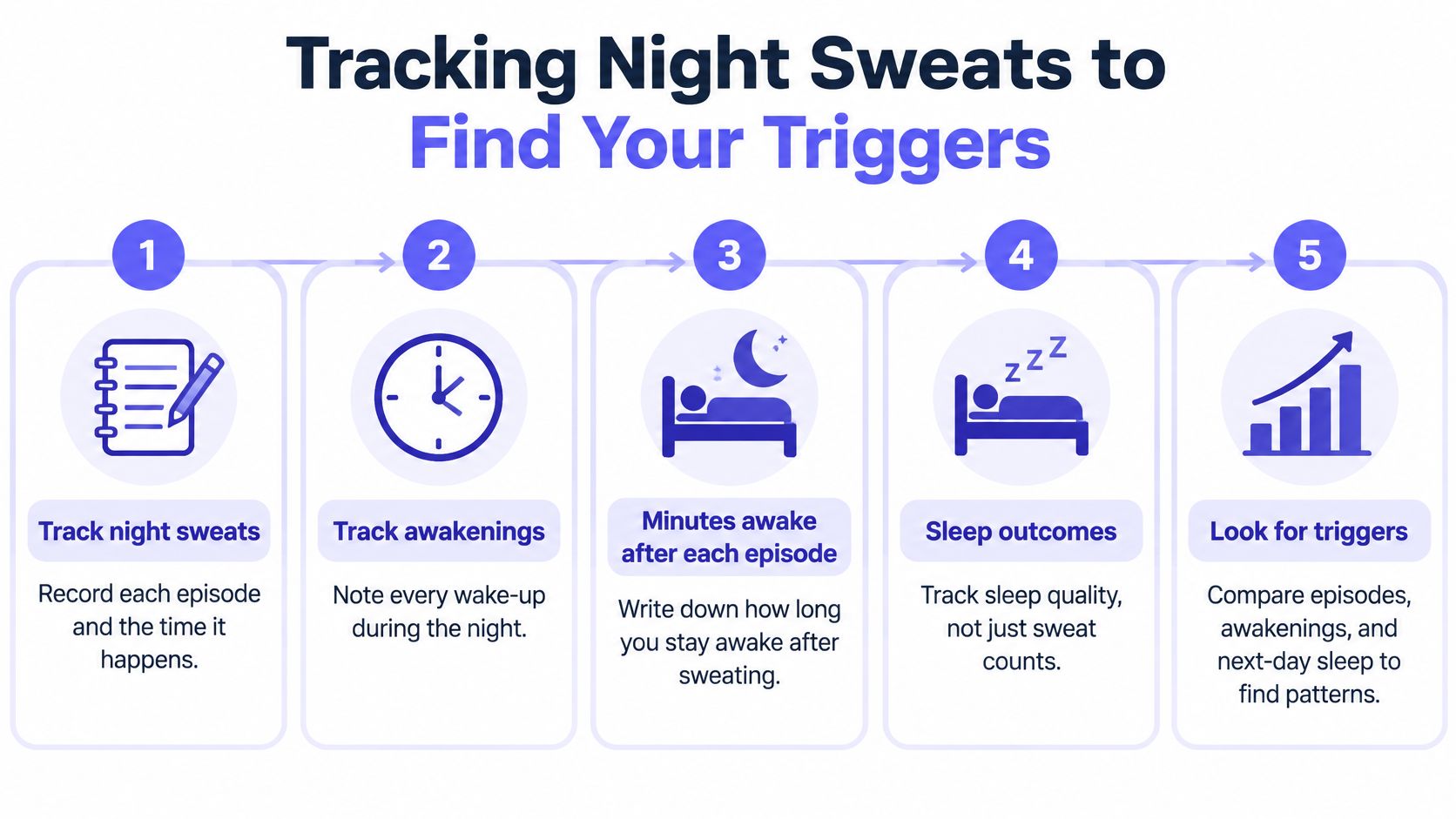
| Logged Item | What to Record | Pattern That Points to a Trigger |
|---|---|---|
| Alcohol | Drinks and timing before bed | More awakenings and sweats on drinking nights |
| Caffeine | Amount and time of last cup | Episodes clustered after afternoon intake |
| Spicy or hot meals | Meal type and time | Sweats within an hour or two of eating |
| Bedroom temperature | Room temperature and bedding layers | Awakenings when bedding is too heavy or the room is too cold |
| Stress or screens | Late-evening stress and screen time | Difficulty returning to sleep after an episode |
| Cycle or hormone dose | Cycle stage and any HRT dose | Sweats shifting with cycle phase or dose changes |
Review your log once a week and focus on three measures: awakenings, minutes awake, and morning function. A paper diary or spreadsheet works just as well as an app if it captures the same information. Lila's daily check-ins track 20+ symptoms, including night sweats, sleep quality, mood, anxiety, and energy. Lila also links symptoms to logged meals, sleep, alcohol, and HRT doses.
Use the log to test one change at a time where possible. Fewer sweats may be encouraging, but fewer awakenings and better next-day function are stronger signs that your sleep is recovering.
Behavioral and Bedroom Changes That Cut Sweats
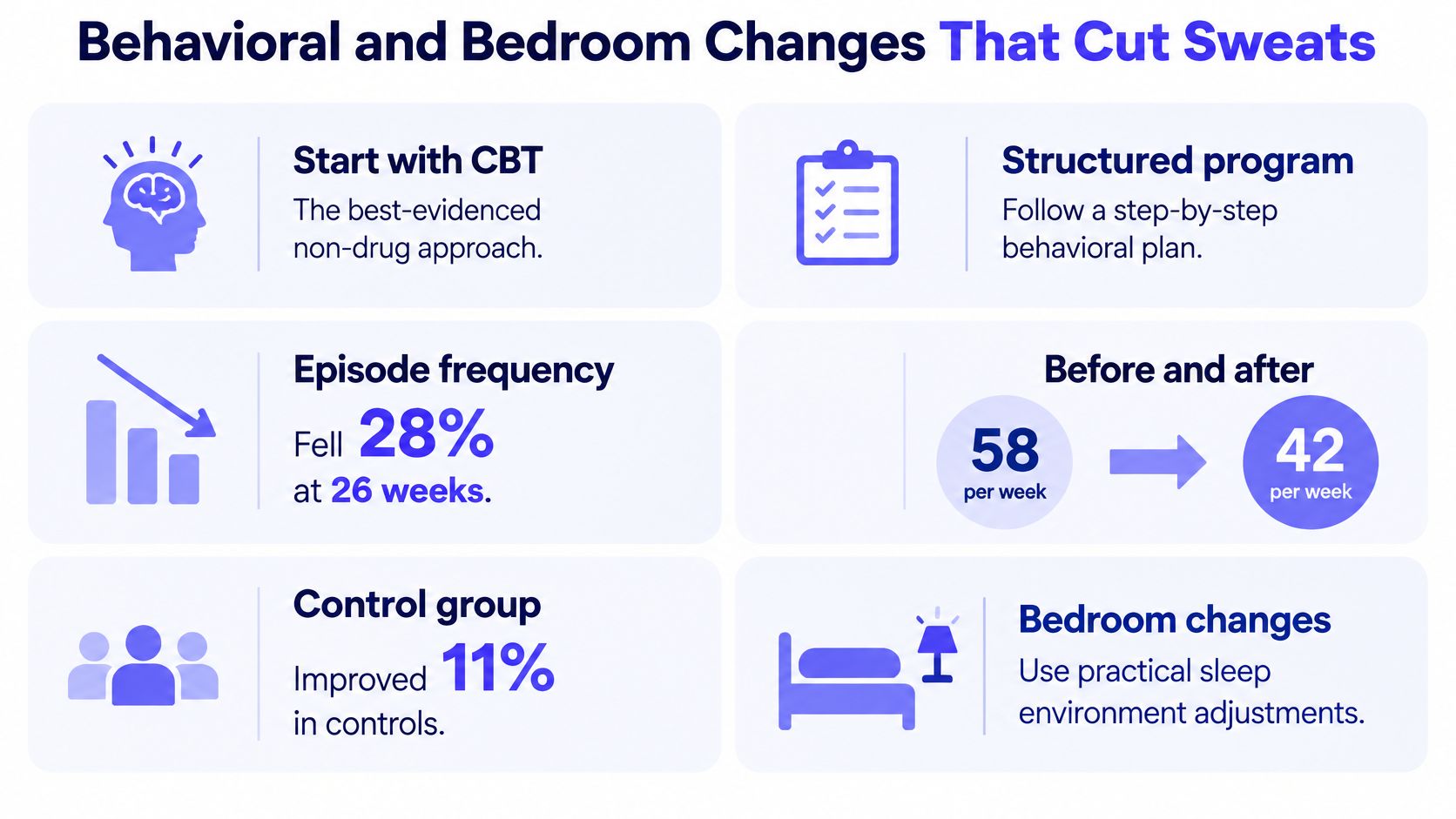
CBT is a well-studied non-drug approach for people whose sweats disrupt sleep or cause distress. In a NICE-reviewed randomized trial, a structured CBT program reduced hot-flush and night-sweat frequency by 28% at 26 weeks, from 58 to 42 episodes per week. The control group's frequency fell by 11%, from 63 to 56 episodes per week. The program also improved sleep quality, anxiety, depression, and symptom-related interference, according to NICE's evidence review of CBT.
Try these techniques as part of a structured plan:
- Breathe slowly during an episode. Use gentle, paced breathing with a longer, slower exhale for about a minute. The aim is to settle your response, not force the heat to stop instantly.
- Set aside anticipatory worry. Before bed, name the thought you're worried about, write it down, and return to your evening routine rather than trying to solve it in bed.
- Reframe the episode. Treat a sweat as a passing body response, not proof that the whole night is ruined.
- Use stimulus control when you can't sleep. If you've been awake too long, get out of bed and sit somewhere dim and quiet. Return when you feel drowsy.
Set up the room for comfort
Aim for comfortable rather than cold. An overly chilly room can make you more alert and disturb sleep, while layered bedding lets you shed warmth without fully waking. Consider lightweight, moisture-wicking sleepwear, a fan, and a breathable mattress cover. For more practical ideas on airflow, bedding, and sleepwear, see Gorins Furniture & Mattress cooling tips.
Test one bedroom change at a time and compare it with your tracking log. Keep the change if it improves awakenings or minutes awake, even if the number of sweats stays the same. If you suspect a food pattern, this guide to foods that trigger hot flashes may help you think through what to track.
▶ PlayHormone Therapy and What Your Clinician Will Check
Systemic hormone therapy is the most consistently effective medical treatment for bothersome night sweats and other vasomotor symptoms. Estrogen acts on the body's temperature-control system, and therapy can improve sleep as well as reduce symptoms. The North American Menopause Society's 2022 hormone therapy position statement says the benefit–risk balance is generally favorable for healthy women younger than 60 or within 10 years of menopause onset, provided there are no contraindications.
That guidance is not a universal prescription. Your clinician will consider whether your health history and symptoms make treatment appropriate, and which approach fits your circumstances. For a plain-language overview to support that conversation, see ProMD Health's guide to menopause hormones. You can also read what hormone therapy for menopause involves.
The checks that shape a treatment decision
Expect the discussion to cover:
- Timing and symptoms: Your age, how long it has been since menopause began, and how much the sweats affect sleep and daily life.
- Health history: Cardiovascular conditions, clotting risk, breast cancer history, liver health, and any unexplained bleeding.
- Uterine status: People with a uterus generally need a progestogen alongside systemic estrogen to protect the uterine lining.
- Route and follow-up: Estrogen may be taken orally or through the skin. The route can matter when assessing clot risk, so share your full history and ask why a particular option is recommended.
Evidence reviewed for the position statement reports that oral conjugated equine estrogen and transdermal estradiol reduced hot flashes by approximately 70–95% in randomized-trial meta-analyses. Hot flashes and night sweats are both vasomotor symptoms, but your own expected benefits and risks require an individualized discussion.
Bring a two-week sleep and sweat log to your appointment. Include awakenings, minutes awake, next-day energy, and the timing of episodes. Those details can help your clinician discuss whether treatment may improve not only the sweating but also the sleep disruption behind your exhaustion.
Nonhormonal Medicines and How They Differ
If you can't or don't want to use hormones, there are other options to discuss with a clinician. These include certain SSRIs or SNRIs, low-dose paroxetine, gabapentin, clonidine, and neurokinin-receptor medicines such as fezolinetant and elinzanetant. The right choice depends on your health, other medicines, symptoms, and the monitoring a treatment may require.
These medicines don't work in exactly the same way, and no single option is right for everyone. Some may be more appropriate when sleep disruption is prominent; others may be unsuitable because of side effects, contraindications, or interactions. Drowsiness or nausea, for example, may matter differently depending on your work, caregiving, and sleep needs. Access and approval for newer medicines can also differ by region.
Weigh the treatment against the trade-offs
A phase 3 trial report presented at The Menopause Society's annual meeting found that approximately 80% of women receiving elinzanetant achieved at least a 50% reduction in hot flashes, according to Medscape's report on the trial results. That result describes a trial group, not a guarantee of what an individual will experience.
Progesterone is another point to clarify rather than assume is a standard first choice. In a randomized trial of women with vasomotor symptoms, nightly micronized progesterone at 300 mg reduced symptoms by 55% after 12 weeks, compared with 29% with placebo. The BMJ clinical review notes that this high dose may cause more side effects than estrogen and that progesterone alone is not commonly used as the primary treatment.
CBT can be used before or alongside medicines, particularly when symptoms are milder or distress and sleep habits are central concerns. Across studies summarized in the same review, 65–78% of participants receiving CBT reached a threshold for improvement in VMS-related problems. Your clinician can help compare these options and determine whether a medicine's likely benefit is worth its possible side effects and monitoring needs.
Decide Whether to Book a Clinician Visit
Book a visit when night sweats regularly break your sleep or affect your daytime function. Mild symptoms that leave sleep mostly intact can be a reason to try behavioral adjustments and tracking first. But new, severe, or unusual symptoms deserve medical attention rather than an assumption that menopause is the cause.
| Pattern | What It May Indicate | Next Step |
|---|---|---|
| Mild sweats, sleep mostly intact | Common vasomotor symptoms | Try behavioral changes and track for four to six weeks |
| Sweats waking you most nights or impairing the day | Clinically meaningful vasomotor symptoms | Book a clinician visit to discuss options |
| Sweats with fever, weight loss, or signs of infection | Possibly not menopause | Seek medical evaluation promptly |
| Sudden or drenching sweats outside a menopause pattern | Not automatically menopause | Get medically assessed |
| Sweating with chest pain, breathlessness, or fainting | Possible emergency | Seek emergency care now |
If you have chest pain, breathlessness, or fainting alongside sweating, seek emergency care now. For other symptoms that are sudden, drenching, or accompanied by fever, unexplained weight loss, or signs of infection, arrange prompt medical assessment.
Take one practical step this week: bring a log covering at least two weeks of nights to your appointment, or start one today if you haven't booked yet. Lila can help organize daily symptom and sleep tracking, but it isn't a substitute for medical advice. A paper diary works, too, as long as it captures the details your clinician needs.
Use Lila to track night sweats alongside awakenings, sleep quality, mood, and energy, so you can spot patterns and bring clearer information to a clinician. Its daily check-ins connect symptoms with details such as meals, alcohol, and HRT doses. Start tracking what happens overnight and make your next treatment conversation more specific.
Get Lila, your personal coach for perimenopause.
Built for women in their 40s. 24/7 coaching, in your pocket.