
Personal Action Plan Format for Daily Symptoms
Use this personal action plan format to map symptoms to if-then actions, set a weekly review, and know when to call a clinician.

The usual advice for a personal action plan is to list your goals, break them into tasks, and keep adding detail. For daily perimenopause symptoms, that can leave you with more work than clarity. A better personal action plan format narrows your attention to a small action you can do, a symptom you can observe, and a clear reason to contact a clinician.
You don't need a longer wellness checklist. You need a plan that still makes sense after a poor night's sleep, a late meeting, or an uncomfortable symptom you'd rather keep private.
Table of Contents
- A Personal Action Plan Format You Can Copy
- How to Write One If-Then Behavior
- Sample Actions for Common Perimenopause Symptoms
- How Often to Track and What to Review
- Stop Rules and Private Support
- Load This Week's Plan into Lila
A Personal Action Plan Format You Can Copy
A useful plan is shorter than a complete list of everything you could improve. Start with a worked example, not an empty page.
Say you're testing an evening routine for sleep. Your example outcome is two or fewer nighttime awakenings on five of seven nights. Your priority behavior is a 10-minute wind-down, triggered by finishing dinner, with a two-minute fallback if the evening collapses.
The likely barrier is a late meeting. Your coping response is to dim the lights at 10 even if the meeting runs past 9. You'll log awakenings, review on Sunday evening, and contact a clinician if your bleeding pattern changes or symptoms keep worsening rather than extending the experiment.
Nine core fields, plus a support note
Copy this table into Apple Notes, a paper notebook, or a spreadsheet. Keep each cycle to one or two behaviors, not a different routine for every symptom.
| Field | What to write | Sample entry |
|---|---|---|
| Outcome | One measurable result for the example seven-day cycle | Awakenings at two or fewer on five of seven nights |
| Priority behavior | One action you control | 10-minute wind-down after dinner |
| If-then line | Cue plus the action | If I finish dinner, then I start the wind-down |
| Fallback | Minimum dose on a hard day | Two minutes if the evening collapses |
| Barrier | The obstacle most likely this week | A meeting that runs past 9 |
| Coping response | Second if-then for that barrier | If the meeting runs late, then I still dim lights at 10 |
| Metric | The number logged against a baseline | Nighttime awakenings |
| Review date | A fixed check | Sunday evening |
| Clinician trigger | When to pause and ask | New bleeding pattern, or symptoms worsening rather than settling |
| Support note | Private or shareable, plus who helps | Cooling routine shareable; intimacy goal stays private |
These entries are planning examples, not treatment targets. A wind-down routine might mean putting your phone away and sitting with the lights lowered. It doesn't need to become another elaborate bedtime project.
The fields separate today's action, the number you watch, and the reason to seek clinical review. A self-diagnosis, a medication change, or five new habits at once doesn't belong in the daily action row.
Personalization means making decisions
Individualized menopause care considers symptom history, health risks, shared decisions, explicit goals, and reassessment. The need for better conversations is substantial: in a 2025 U.S. survey of 1,005 working women, only 37% reported proactive and satisfactory perimenopause conversations with a clinician, according to the published menopause-care discussion.
Your note can help you prepare for that conversation without pretending to replace it. Add why you selected the action, such as making evenings feel less rushed, and save any treatment question for your clinician.
If meals are your chosen focus, Recipe One's weekly planning template offers a separate place to organize the practical food details. Keep your symptom plan focused on the behavior and outcome rather than copying an entire menu into it.
Before choosing a symptom, paste the nine core fields and support note into a note you'll reopen.
How to Write One If-Then Behavior
An intention describes what you want. An implementation intention names what you'll do when a particular situation occurs. That distinction matters when a busy evening leaves little room for another decision.
Use hot flashes as an example. The following targets and timings are illustrative choices for a personal experiment, not a validated hot-flash treatment protocol.
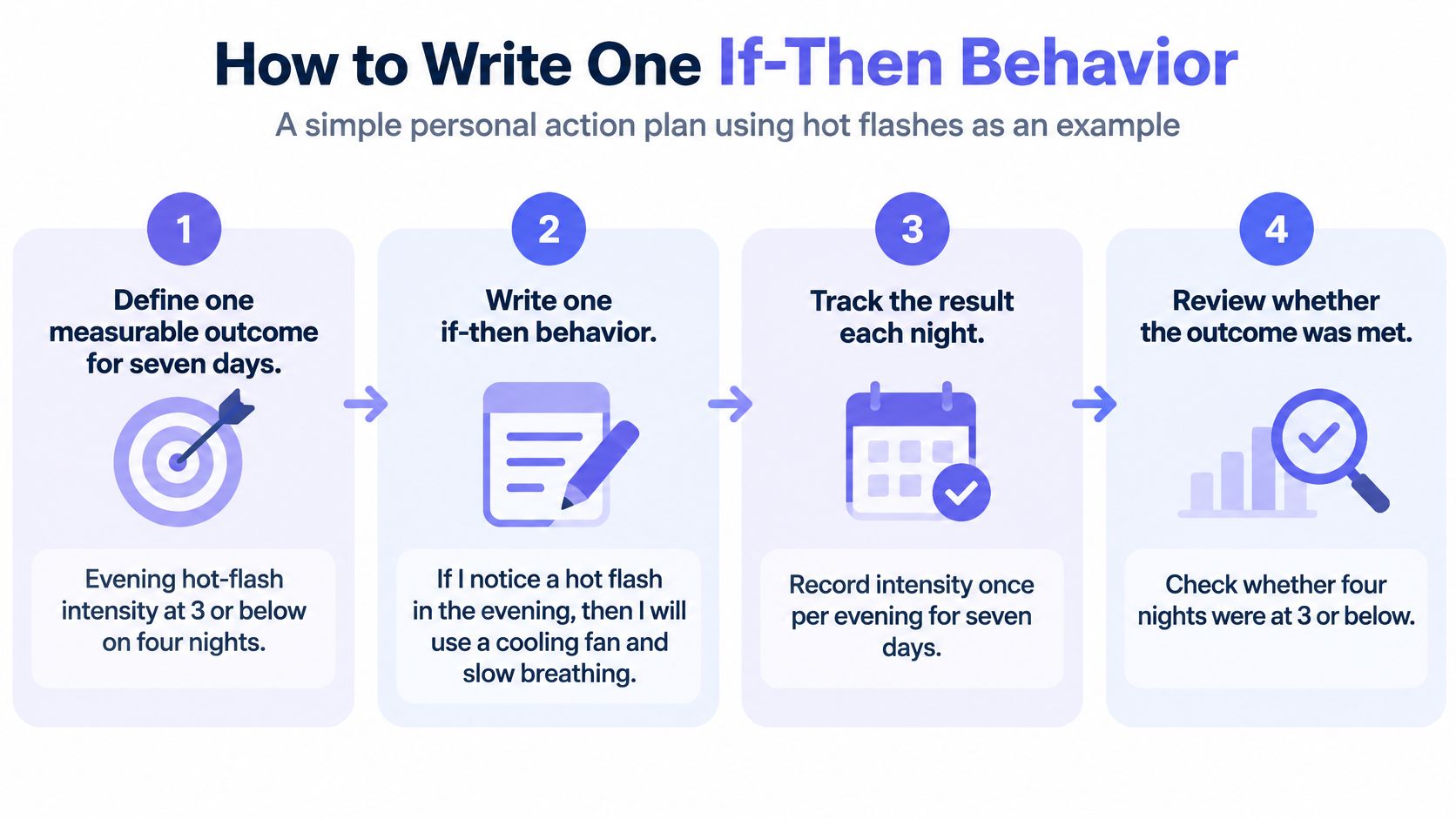
Define one measurable outcome. For example, aim to record evening hot-flash intensity at three or below on four nights during a seven-day cycle. Use a consistent personal scale, with zero meaning none and 10 meaning your most intense experience. The target gives you something to review; it doesn't promise symptom relief.
Pick a behavior you control. You can place a fan beside your chair or prepare a cooling kit. You can't directly choose whether a hot flash occurs, so fewer hot flashes isn't the behavior.
Attach the action to an existing cue. Name when, where, and how: sitting down to dinner, at the kitchen table, with the fan already accessible. Choose a cue you can recognize without checking a reminder.
Weak intention: Feel less flushed.
Actionable line: If I sit down for dinner, then I set a cool drink and a fan within reach.
Write the likely barrier in ordinary language. For example, a work call may run late and you may eat somewhere else. A useful barrier is something you can prepare for, not a judgment such as being bad at routines.
Add a coping response and fallback. For that scenario: if the call delays dinner, then I put the fan beside the chair where I'll eat. If setup feels like too much, the fallback is bringing the fan within reach. A brief fallback preserves the action without requiring the full routine.
Review against a baseline. In this example, record your usual evenings for three days before changing anything, then compare them with the planned week. Change only the cue, dose, or action at the review, rather than changing everything together.
Why the sentence is worth writing
A meta-analysis of 94 independent tests involving more than 8,000 participants found a medium-to-large improvement in goal attainment from implementation intentions, d = 0.65, beyond forming a goal intention alone, as reported in Gollwitzer and Sheeran's implementation-intention meta-analysis. That finding concerns goal attainment across settings, not proof that a fan or routine will treat perimenopause symptoms.
Say your sentence aloud when you write it. If you have to explain what the cue means or search for the equipment, make the line more concrete.
If tension is your chosen focus, Vancouver Counselling Clinic's body relaxation strategies for stressed adults can help you explore an action to discuss or try comfortably. Don't add relaxation just because it's another available option.
Practical rule: Write an action you can recognize as completed, not a feeling you hope to produce.
For help keeping that action manageable, use our guide to sustainable lifestyle changes. Stop after writing the behavior; another symptom can wait for review.
Sample Actions for Common Perimenopause Symptoms
Choose the row that addresses the symptom interrupting your day most. This is a lookup table, not a list of assignments.
Each row below is an illustrative starting action, not a claim that the action treats the symptom. Copy your selected row into the full plan, then add your own barrier, fallback, and clinician trigger.
| Symptom | Cue | If-then action | Metric | Review |
|---|---|---|---|---|
| Hot flashes | Sitting down to dinner | If I sit down to dinner, then I set a cool drink and a fan within reach | Evening intensity on a personal zero-to-10 scale | Day seven |
| Sleep disruption | Finishing dinner | If I finish dinner, then I start a 10-minute wind-down | Awakenings per night | Day seven |
| Bloating | First meal of the day | If I start my first meal, then I build it around protein and fiber I already like | Bloating intensity, using the same scale each day | Day seven |
| Mood changes | Morning check-in | If I finish the morning check-in, then I take a 10-minute outdoor walk, if appropriate for me | Mood score that day | Day seven |
| Low appetite on a weight goal | The meal most often skipped | If I reach that meal, then I eat a small protein-forward plate | Protein eaten, yes or no | Day seven |
| Intimacy or low desire | A private weekly note | If I open the private note, then I record comfort and one question for my clinician | Comfort rating, kept private | Day seven or next visit |
Choose by burden and feasibility
If hot flashes disrupt dinner but sleep feels manageable, choose the dinner row. If low appetite means you're repeatedly missing meals, the small-plate action may be more relevant than another evening routine. Pick the problem you want help understanding, not the goal that sounds most impressive.
For bloating, familiar food matters. The example isn't an instruction to suddenly increase fiber, adopt a restrictive diet, or keep eating something that makes you uncomfortable. A plate might use eggs and toast, yogurt with a tolerated accompaniment, or another familiar combination that suits your preferences.
The low-appetite row deliberately tracks whether you ate protein rather than whether the scale changed that day. That keeps the record tied to the behavior under consideration. If reduced appetite persists or concerns you, make it a clinician question rather than treating the meal checkbox as a sufficient answer.
Early perimenopause, late perimenopause, and postmenopause needn't use identical nutrition guidance. In our approach, these stages have different nutrition emphases. Your existing meal cue can stay in place while the food choices are adjusted to your needs.
Don't turn every symptom into a habit problem
A mood score is a description, not a diagnosis. If your concerns include intrusive thoughts or compulsive behaviors, the Total Mental Wellness guide to OCD genetics offers condition-specific reading, but it shouldn't be used to label ordinary mood fluctuations or explain them as hormonal.
The intimacy row is optional. You can choose a non-sexual connection, write a question, or leave the row untouched; low desire isn't automatically a problem you must solve.
Our perimenopause symptom-relief guide offers broader context when you're deciding what deserves attention. Once you've chosen, leave the other rows for a later cycle rather than combining the whole table into your week.
How Often to Track and What to Review
| Check | When | What you record | Decision it supports |
|---|---|---|---|
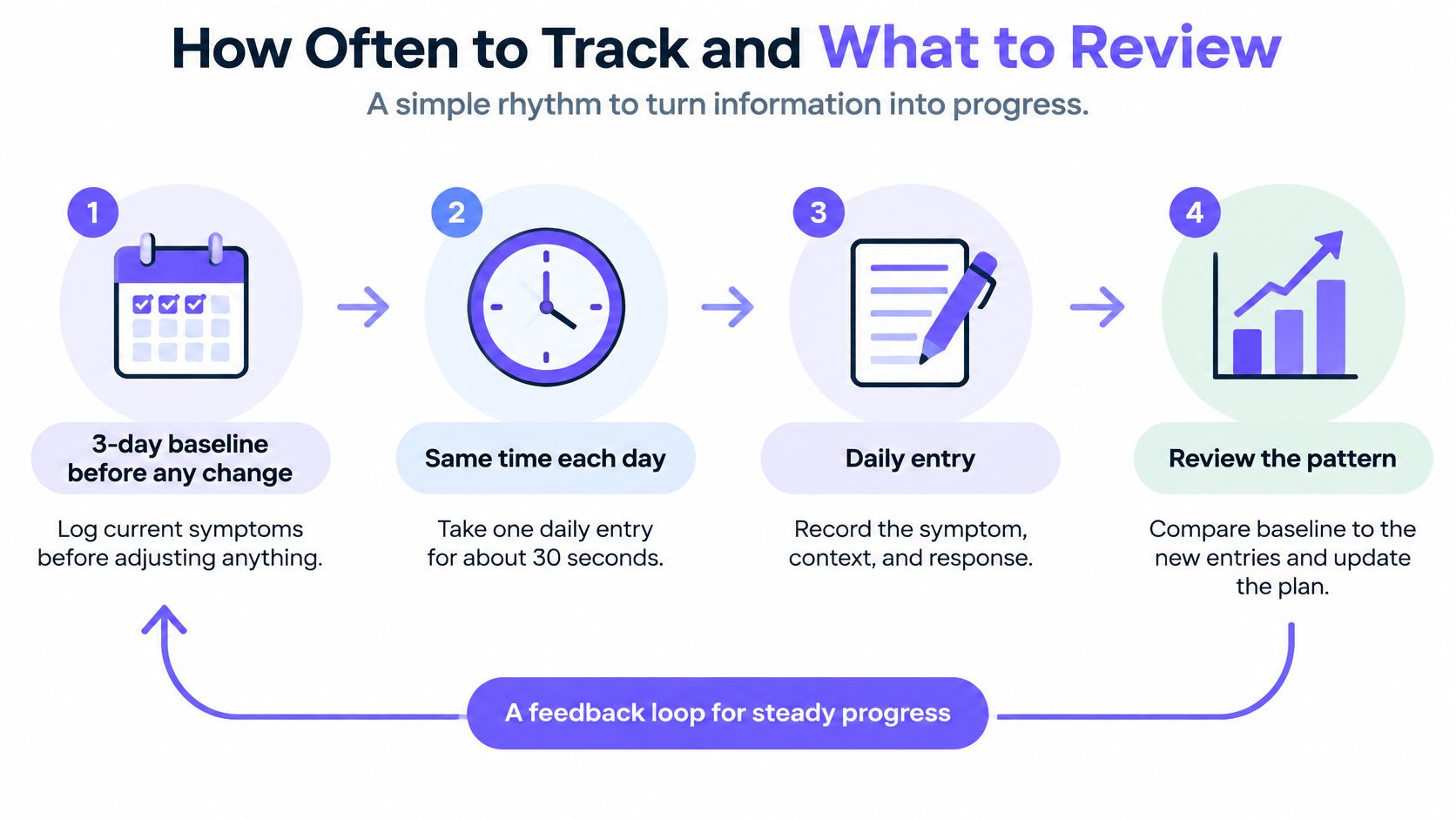
| Baseline | In this example, three days before changing anything | Symptom intensity and the target metric | The number you compare later |
| Daily check-in | Same time each day, kept brief | If-then done or not, actual dose, symptom intensity | That day's adherence |
| Weekly review | A fixed day, such as Sunday | Completions, barrier, coping used, next adjustment | Keep, shrink, or swap |
| Clinician pack | When a stop rule applies or a visit is booked | Log history plus your written questions | Shared decision, not a new self-diagnosis |
A personal plan works like a thermostat. A baseline sets the starting temperature, the daily entry shows whether the heater ran, and the weekly review decides whether to adjust the setting. None of those readings proves cause on its own. They show a pattern you can act on.
For example, a daily entry might read:
Monday: If-then completed, yes. Wind-down, six minutes. Nighttime awakenings, two.
Write down what you did, including the fallback when you used it. A short routine marked clearly as a fallback stays visible. A vague yes hides it.
Review execution before interpreting symptoms
A weekly example might read:
- Completion: Five of seven evenings, including a fallback.
- Barrier: Wednesday's meeting ran late.
- Coping used: Dimmed lights at 10.
- Next adjustment: Keep the action and cue unchanged.
This order matters. Research on behavior change has examined action planning paired with barrier-specific coping ideas as a way to support follow-through. That is why your review checks whether the routine happened before asking whether symptoms shifted. Compare completion with your planned dose first, then compare the symptom record with baseline. A missed action calls for a cue repair. An unchanged symptom despite steady completion calls for a different decision.
Keep, shrink, or swap
Set an example decision rule before you start. If the action happens on fewer than four of seven days, shrink the dose or repair the cue. If it happens on five or more days and the symptom is unchanged, keep it for another cycle or swap the action. Do one change at a time.
These are organizational choices, not clinical thresholds. A worsening symptom overrides the experiment and moves you to the stop rule.
Our perimenopause symptom-tracker guide can help you choose a small set of observations without recording everything. In our process, the protocol is the starting point, and your logged data shifts its emphasis. Activity shared through Apple Health also adjusts protein and fueling guidance.
Finish Sunday's review with a written choice: keep, shrink, or swap. Express that choice as the next if-then line. One line carries forward. The rest waits.
Stop Rules and Private Support
A stop rule tells you when not to keep experimenting. It belongs beside the action, where you'll see it, rather than in a forgotten disclaimer.
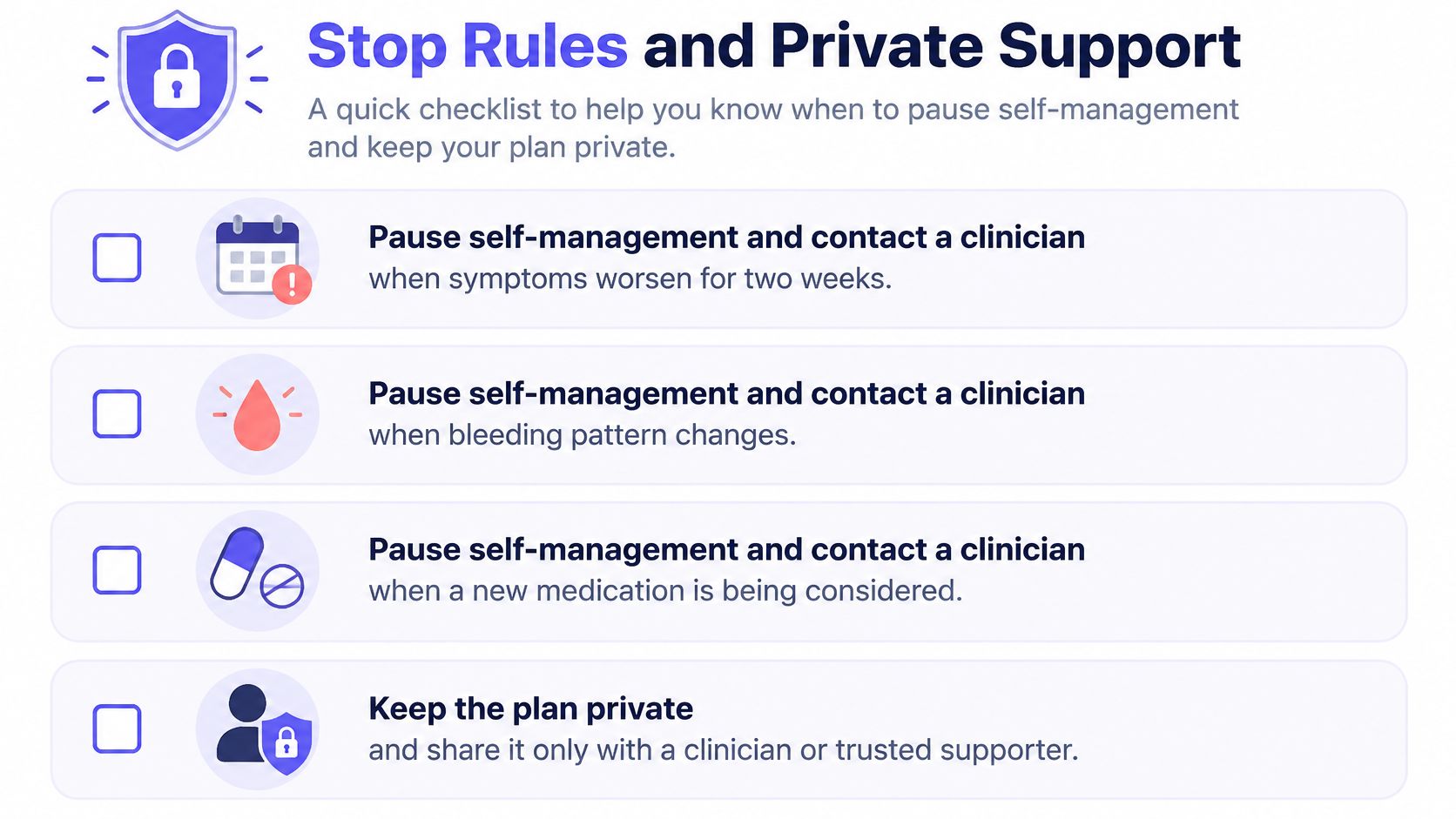
Pause the action you're testing and contact a clinician if it appears to cause side effects, your bleeding pattern changes, symptoms worsen, or you're considering a new medication. Don't stop or change prescribed treatment without medical advice.
Separate a review date from a safety deadline
For a hypothetical non-urgent plan, you might write a backstop such as contacting your clinician if symptoms have worsened over two weeks. That is not permission to wait when symptoms are severe, sudden, or worrying. Chest pain needs urgent medical care now, not a revised habit goal.
Use the perimenopause bleeding checker to help organize information about a bleeding change, not to rule out a medical problem. Record what changed and bring that description to your clinician.
Our safety requirements also apply before exercise. Users must confirm either physician approval to use the Services or that a list of health statements is true, such as having had no chest pain in the past month. Users who are over 35 or have been inactive for a few years should see a physician before beginning an exercise program.
Workouts provided through our Services are educational only. They aren't recommendations for a specific treatment plan, product, or course of action.
Decide what stays private
Sensitive symptoms deserve space without compulsory disclosure. A 2025 qualitative study of women aged 38–54 identified insufficient sexual-health information, limited discussion of sexual function and pleasure, feeling dismissed by clinicians, and inadequate treatment options as unmet needs in the Journal of Sexual Medicine study abstract.
Mark each goal private or shareable. That's a decision about what you disclose to other people, not a claim about any app's technical privacy protections.
- Confidence check: As a planning example, score your confidence from zero to 10. If it's below seven, shrink the action before starting.
- Support slot: Name a partner who can help with the cooling routine, a friend who can join a walk, or a question you'll take to a clinician.
- Disclosure choice: Share only what's useful and comfortable. An intimacy goal doesn't require telling a partner, and a symptom discussion doesn't commit you to medication.
If follow-through is difficult, ask what practical or emotional backup is missing. Stigma, embarrassment, and lack of help deserve attention before you blame your willpower.
Personalization is fewer actions plus a named stop rule.
Load This Week's Plan into Lila
Use the week you've already designed rather than asking for a completely new list of recommendations. Keep the selected symptom, action, and review evening together so you can act without rebuilding the plan each day.
Choose the symptom row. Bring across the row you selected, including its cue and metric. Leave the unused rows out of this cycle so your daily record stays readable.
Share the starting context. Setup takes two minutes: you share your symptoms, goals, and menopausal stage, and we build a perimenopause nutrition plan. Describe the concern you want to prioritize rather than presenting every possible goal as equally urgent.
Write the action and fallback. Keep your if-then line in that day's planning note, with the minimum version directly underneath. You can use our AI coach to discuss a manageable wording, but retain the final sentence where you'll see it when the cue occurs.
Use the daily symptom check-in. It takes about 30 seconds, with intensity taps for the symptoms that matter to you. Keep attention on the symptom selected for this cycle rather than turning each entry into a lengthy investigation.
Review on your named evening. Apply your keep, shrink, or swap decision. If your example week shows fewer than four completed days, make the action easier before adding another behavior; note whether the obstacle was time, discomfort, equipment, or the cue itself.
Prepare for clinical review when needed. We can export your tracking history as a PDF for a GP or telehealth appointment. Add written questions about the symptom change and the next appropriate step, and seek care according to urgency rather than waiting to finish the cycle.
Your commitment is specific: one behavior for a seven-day example cycle, reviewed on a named evening, with your history available if a clinician trigger appears. Success includes learning that an action needs changing or that a symptom needs medical attention. It doesn't require forcing an unsuitable routine to work.
Lila offers personalized perimenopause nutrition guidance, a brief daily symptom check-in, and tracking history you can take to a clinician. Visit Lila to put your chosen action into a focused weekly plan, with a fallback, a review evening, and a clear boundary for seeking medical advice.
Get Lila, your personal coach for perimenopause.
Built for women in their 40s. 24/7 coaching, in your pocket.