
Symptoms of Low Oestrogen in Menopause Explained
Symptoms of low oestrogen in menopause explained, from hot flushes to dryness, with what is linked and what helps.
Approximately 75% of women aged 45–55 experience menopausal symptoms that can affect mood, self-esteem, sleep quality and energy, according to the 2025 Menopausal Hormone Therapy Guidelines. But that doesn't mean every difficult night, anxious morning or change in weight is caused by low oestrogen. The useful distinction is between symptoms closely linked to falling oestrogen and symptoms that need a wider explanation.
Recognising the symptoms of low oestrogen in menopause starts with the pattern, not a checklist score. Sudden heat and night sweats tell a different story from tiredness alone. Vaginal burning and urinary discomfort deserve a different treatment conversation from either.
Table of Contents
- A Symptom Map for Low Oestrogen
- How a Narrower Thermostat and Thinner Tissues Explain the Signs
- Signs That Fit Low Oestrogen and Signs That May Not
- What the Same Hormone Drop Looks Like at Different Stages
- Treatments and Daily Habits That Match the Symptom
- Genitourinary Changes That Do Not Fade with the Flushes
- Track the Pattern and Know When to Be Seen
A Symptom Map for Low Oestrogen
Hot flushes and night sweats are the clearest starting point. They belong to a group called vasomotor symptoms, which involve changes in temperature regulation. A flush can feel like heat spreading across your chest, neck and face, with sweating or a noticeable heartbeat.
These episodes don't have to wait until your periods stop. During perimenopause, ovarian activity becomes less predictable, so you can have symptoms while you're still menstruating. A quiet month also doesn't invalidate a difficult one.
Match the cluster, not just the symptom
The table separates temperature symptoms, their possible knock-on effects, and local vaginal or urinary changes. It's a guide to describing what's happening, not a way to diagnose yourself.
| Symptom cluster | What it often feels like | How common | Usual timing |
|---|---|---|---|
| Hot flushes and night sweats | Sudden heat, sweating, palpitations and nocturnal sweats | About 46% during the early transition and 60–80% at some point during the transition or postmenopause, as summarised in this review of menopausal symptoms | Generally begin around 2 years before the final period, peak in the year after it, then gradually ease, according to the same review |
| Sleep disturbance | Difficulty sleeping or awakenings, frequently after sweats | A substantial problem in early postmenopause | May accompany troublesome night sweats |
| Low or depressed mood | Low mood, irritability and reduced emotional resilience | A recognised part of the symptom burden, but not specific to low oestrogen | May occur alongside broken sleep and flushes |
| Vaginal dryness and painful sex | Dryness, burning, reduced lubrication and pain with intercourse | A characteristic part of genitourinary syndrome of menopause | Can begin before periods stop and often persists |
| Urinary urgency, dysuria and recurrent infections | Urgency, stinging when passing urine and repeated infections | Can become more prominent later in postmenopause | May persist or progress rather than behaving like a short flare |
How common doesn't mean how severe. Someone with occasional flushing may feel little disruption, while someone whose night sweats repeatedly interrupt sleep may struggle with work, relationships or concentration. Your need for help should reflect the effect on your life, not whether your experience sounds worse than someone else's.
Separate the starting symptom from its consequences
Say you wake sweating, struggle to get back to sleep and feel irritable the next morning. That sequence is more informative than recording sweating, insomnia and irritability as unrelated complaints.
The same applies to sexual discomfort. Avoiding intercourse because it hurts is different from losing interest without pain, even though both might be described as a sexual symptom.
Practical rule: Notice which symptoms arrive together, which follow a bad night, and which continue even when your temperature symptoms settle.
Choose the row that most closely describes your main problem. Then note its companions, including changes in bleeding, sleep, medication or urinary comfort.
How a Narrower Thermostat and Thinner Tissues Explain the Signs
You're sitting in a comfortable room when heat suddenly spreads over your face and chest. You sweat, your heart feels faster, and the episode passes even though the room hasn't changed. That can happen because the body's temperature-control system has become more sensitive.
A smaller temperature comfort band
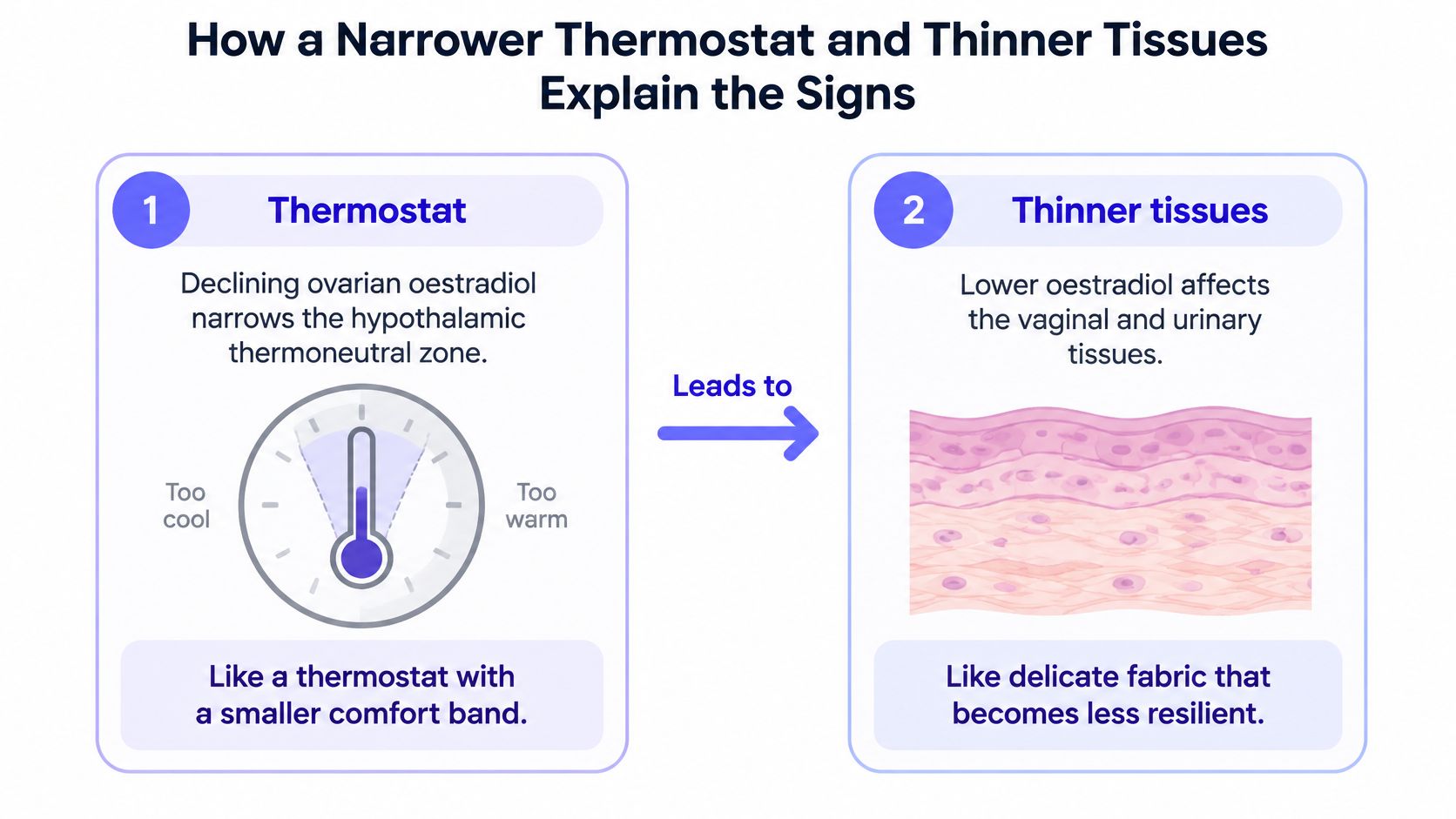
The hypothalamus, a temperature-regulating region of the brain, normally allows a range of internal temperatures without triggering sweating or shivering. Declining ovarian oestradiol can narrow that thermoneutral zone, so a small temperature change starts a heat-loss response, as described in this clinical review of menopausal flushing.
Think of a household thermostat with a smaller comfort band. A temperature shift that previously went unnoticed now switches the cooling on. In your body, increased blood flow to the skin and sweating help release heat.
At night, that response can wake you even if you don't remember feeling hot beforehand. The practical consequence is that counting daytime flushes alone may underestimate how much temperature symptoms affect you.
The diagram separates this temperature mechanism from local tissue changes.
Less resilient vaginal and urinary tissues
Vaginal and urinary symptoms involve a different process. These tissues respond to oestrogen, so declining hormone activity can affect their moisture, thickness and resilience. Delicate fabric becoming less supple is a useful analogy, although living tissue can respond to appropriate treatment.
This distinction explains an otherwise confusing experience: your flushes may improve while intimate discomfort becomes more noticeable. The symptoms don't share the same timetable because they don't arise through the same mechanism.
Flushes reflect a more sensitive temperature-control system. Genitourinary symptoms reflect changes in local tissues.
Perimenopause also isn't a smooth slide from high oestrogen to low oestrogen. Hormone activity fluctuates, and symptoms can come and go rather than increasing steadily. A better week doesn't mean you imagined the previous one, and a difficult week doesn't prove that oestrogen explains everything you're feeling.
Signs That Fit Low Oestrogen and Signs That May Not
Not every midlife symptom is an oestrogen-deficiency symptom. A 2025 American Family Physician editorial identifies hot flushes, night sweats and vaginal dryness as the symptoms most clearly linked to menopause, while questioning broader claims about complaints also common in same-age men.
Fatigue, anxiety, weight change, brain fog, joint pain and low mood are real problems. But ageing, inadequate sleep, thyroid disease, depression and medicines can produce overlapping experiences. Calling them hormonal without considering alternatives can delay useful care.
Pattern is evidence, not proof
Flushes accompanied by changing periods make the menopausal transition more plausible. Isolated tiredness or a change in clothes size is much less specific. Neither observation should be used to dismiss symptoms or promise that replacing oestrogen will resolve them.
When a symptom fits low oestrogen and when to look elsewhere
| Pattern | More suggestive of low oestrogen | Consider another cause |
|---|---|---|
| Heat and sweating | Discrete flushes or night sweats alongside cycle changes, sometimes with palpitations | Sweating with fever, unexplained weight loss, chest pain or fainting; thyroid disease, infection, medication effects or malignancy may need consideration |
| Cycle plus hormones | Changing or skipped periods accompanying a recognisable menopausal symptom pattern | Bleeding after menopause or very heavy bleeding needs assessment; regular periods without flushes make isolated symptoms less informative |
| Vaginal and urinary cluster | Persistent dryness, painful sex, urgency or stinging | Blood in urine, pelvic pain, postmenopausal bleeding or presumed infections that haven't been examined |
| Mood and anxiety | Irritability or low mood occurring with flushes and disrupted sleep | Anxiety or depression occurring independently needs its own assessment |
| Fatigue, weight, fog and joint pain | Supporting context when clearer menopausal symptoms are present | Sleep debt, thyroid disease, depression, medication effects and other causes remain possible |
A regular cycle doesn't rule out early perimenopause. Equally, skipped periods don't establish that every accompanying symptom has the same cause.
Why anxiety needs its own conversation
Oestrogen therapy doesn't consistently reduce anxiety. Some symptomatic women may experience improvement, but it isn't a dependable stand-alone anxiety treatment, and the response can differ with the person and treatment approach.
Ask whether anxiety follows nights of sweating and poor sleep, occurs throughout the day regardless of sleep, or began after a medication change or stressful event. These distinctions help a clinician decide whether to address menopausal symptoms, anxiety itself, or both.
Thyroid problems deserve particular attention when symptoms overlap. This guide to hypothyroidism and menopause explains why tiredness, mood changes and weight concerns shouldn't automatically receive a hormonal label.
Joint and muscle pain can coexist with the transition, but they aren't diagnostic by themselves. Localised pain, swelling or steadily worsening limitations warrant assessment rather than an assumption that menopause is responsible.
The decision rule is straightforward: track the company a symptom keeps. A pattern can support a clinical assessment; a single nonspecific symptom can't establish low oestrogen.
What the Same Hormone Drop Looks Like at Different Stages
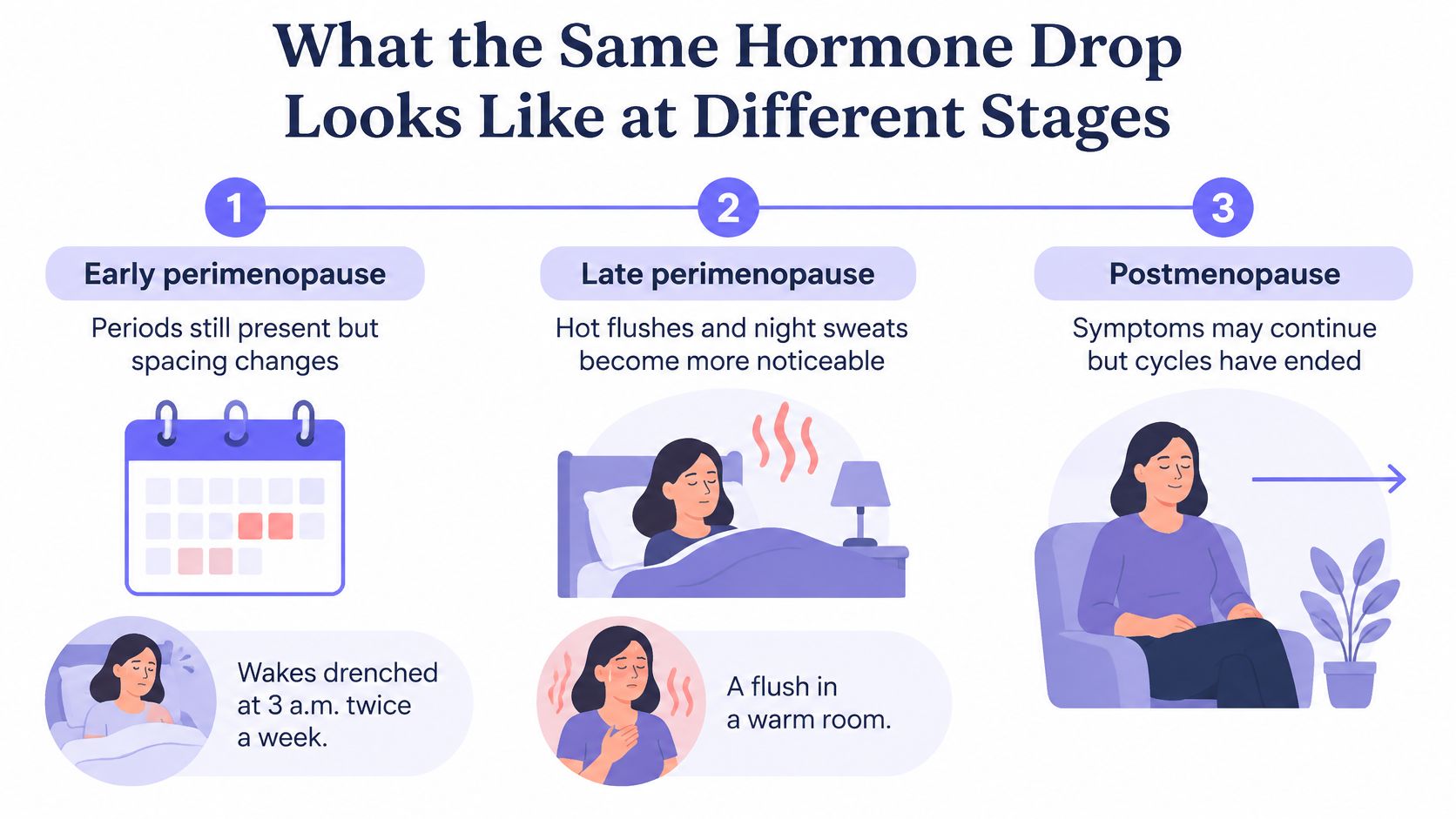
Consider a hypothetical woman whose periods still arrive, but no longer predictably. During a difficult week, she wakes drenched, flushes in a warm meeting and struggles to concentrate after poor sleep. Later, she has a quieter stretch and wonders whether the whole experience was stress.
Early perimenopause can be inconsistent
That stop-start experience can fit early perimenopause. The important information isn't whether symptoms occurred, but how they relate to cycle changes and how much they interfere with daily life.
Another woman may notice only altered periods at first. There isn't a compulsory sequence in which everyone develops heat symptoms, mood changes and vaginal discomfort.
This timeline illustrates the broad stages without suggesting that every woman follows the same course.
Around the final period, symptoms can overlap
Now consider a woman whose night sweats repeatedly interrupt sleep around the end of her menstrual cycles. She feels less patient the next morning and needs more effort to complete familiar tasks. Her account describes an interacting set of problems, not necessarily separate illnesses.
In early postmenopause, sleep disturbance affects more than 40% of women and depressed mood affects approximately one-third, according to the AHRQ review of menopausal symptom management. Those figures describe symptom burden; they don't establish that every episode of depression or insomnia is caused directly by oestrogen loss.
Later postmenopause may feel different
A third woman finds that temperature symptoms no longer dominate her week. Instead, burning, uncomfortable sex or urinary urgency determines what she wears, whether she exercises comfortably and whether she avoids intimacy.
That change in emphasis matters. She shouldn't have to keep describing herself as having mild menopause symptoms just because she no longer has frequent flushes.
For a fuller explanation of the phases, use this guide to menopause stages. The labels help you describe timing to a clinician; they don't replace an assessment of the symptom itself.
A stage description helps organise your history. It doesn't turn a difficult week, weight gain or joint stiffness into proof of low oestrogen.
Treatments and Daily Habits That Match the Symptom
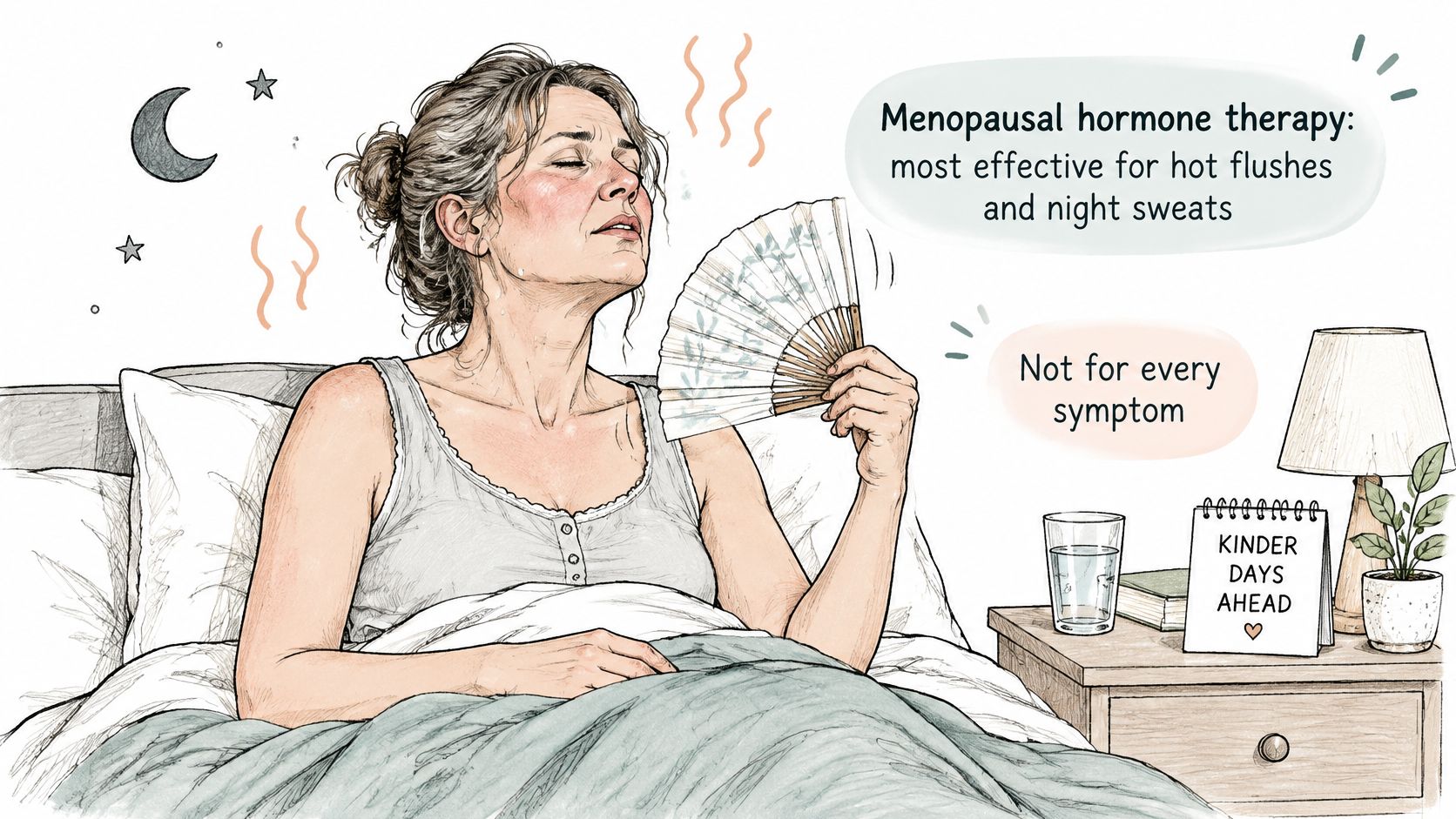
Choose treatment for the problem you want to improve. Menopausal hormone therapy is the most effective treatment for bothersome hot flushes and night sweats, but deciding whether to use it requires an individual discussion. Age, time since menopause, cardiovascular and clotting risks, breast-cancer history, whether you have a uterus and other contraindications all matter.
Simple cooling measures can make an episode easier to manage, even when they don't prevent it.
Discuss treatment goals before choosing a product
Go into the appointment with a concrete goal, such as sleeping without repeated sweat-related awakenings. This makes it easier to judge whether treatment is helping and whether side effects or risks outweigh the benefit.
Hormone therapy isn't a weight-loss treatment. Don't choose it expecting a particular change in weight or body composition, and don't assume that improving flushes will resolve an independent mood disorder.
The guide to hormone therapy for menopause can help you prepare questions about systemic treatment. If hormones aren't suitable or you'd rather avoid them, ask a clinician about non-hormonal prescription options.
Make daily changes testable
Start with adjustments you can assess rather than changing everything at once.
- Reduce overheating: Use removable clothing layers, lighter bedding and a cooler bedroom.
- Check personal triggers: Record whether alcohol, spicy meals or warm rooms precede symptoms before imposing broad restrictions.
- Protect your sleep routine: Keep a steady sleep window and note whether awakenings follow sweating or occur independently.
- Keep movement manageable: Choose activity you can sustain, adapting it if pain limits you rather than pushing through worsening symptoms.
For movement-related discomfort, Lake City Physical Therapy's resource on physical therapy for hormonal joint pain offers a rehabilitation-focused discussion. It's a starting point for questions about movement and function, not proof that hormones caused your pain.
The following video offers an additional format for exploring the topic.
▶ PlayUse tracking to judge the result
A paper diary, notes app or symptom-tracking app can connect a change in habits with what happens next. Record the symptom you're targeting and its effect on your day, rather than collecting information you won't use.
Improved sleep may make concentration and irritability easier to manage, but persistent problems still deserve attention in their own right. The aim is a better-functioning day, not an assumption that oestrogen should fix every midlife difficulty.
Genitourinary Changes That Do Not Fade with the Flushes
Genitourinary syndrome of menopause, often shortened to GSM, describes changes affecting the vulva, vagina, urethra and bladder. It can involve sexual comfort, but it isn't solely a sexual-health issue. Burning while sitting, urinary urgency or irritation during exercise can be just as disruptive.
Why this is more than dryness
Oestrogen-responsive tissues undergo structural and environmental changes. Reduced epithelial glycogen affects the conditions that support lactobacilli and vaginal acidity, while reduced blood flow, collagen and elasticity can make tissues less resilient, as explained in this clinical review of genitourinary syndrome.
The result can include dryness, burning, irritation, reduced lubrication, painful intercourse, urgency, dysuria and recurrent urinary-tract infections. Unlike a passing flush, this tissue problem commonly persists or progresses without treatment.
Imagine someone using more lubricant each month while sex becomes increasingly uncomfortable. The useful observation isn't dryness alone: it's worsening pain despite an attempted solution. Similarly, repeated urinary symptoms need more detail than a record of suspected infections.
Match local care to the level of discomfort
For mild symptoms, vaginal moisturisers and lubricants serve different purposes. Moisturisers are used regularly for ongoing comfort; lubricants reduce friction during sexual activity.
- Persistent discomfort: Ask about low-dose vaginal oestrogen, an evidence-supported local treatment.
- Other treatment options: Vaginal dehydroepiandrosterone or oral ospemifene may suit selected patients after clinical review.
- Uncertain symptoms: Seek an examination before repeatedly treating presumed infection or attributing all burning to dryness.
Local treatment is a different decision from systemic treatment for flushes. A clinician can explain the formulation, your medical history and what improvement to look for.
Examination matters as much as treatment
The American Urological Association's 2025 GSM guideline announcement emphasises evaluation, examination, diagnosis, counselling and follow-up. That approach helps distinguish hormone-related tissue changes from urinary, infectious or dermatological conditions.
Track pain with intercourse, lubricant use, urgency, stinging and confirmed infections, rather than assuming every uncomfortable episode is a UTI. New postmenopausal bleeding, blood in urine or persistent pelvic pain also requires examination.
For practical background on comfort and treatment conversations, this guide to genitourinary syndrome of menopause expands on the local symptoms. You don't need to wait until pain is severe or sex is impossible to ask for help.
Track the Pattern and Know When to Be Seen
Use a fortnight as a practical observation period, not a diagnostic test. A notebook or perimenopause symptom tracker can help you bring a clear account to a GP, gynaecologist or menopause clinician.
Keep the record useful
Record enough detail to explain the pattern without turning your day into a monitoring exercise.
- Heat and sleep: Note flush frequency, approximate duration and whether sweating wakes you.
- Daily functioning: Record mood and energy on waking, and whether symptoms interfere with work or ordinary activities.
- Cycles and bleeding: Note period changes, skipped bleeding and unexpected bleeding.
- Local discomfort: Include dryness, pain with sex, urgency, stinging and any infection confirmed by a clinician.
Bring that record and ask: Does this pattern fit the menopausal transition? Is anything here better explained by another condition? Include medicines and recent changes in health so the discussion isn't limited to hormones.
Don't use a diary to postpone assessment
Some symptoms need examination rather than a longer period of self-management.
- Bleeding after menopause or blood in urine: The source needs investigation.
- Persistent pelvic pain or recurrent unexamined urinary symptoms: Infection and other local conditions need consideration.
- Night sweats with unexplained weight loss or fever: Don't assume menopause explains the combination.
- Chest pain or fainting: Seek urgent medical care.
- Sudden severe mood change or inability to function: Seek prompt mental-health or medical support; get emergency help if you can't stay safe.
Ordinary flushes, cycle changes and mild dryness are common, but you don't have to tolerate them when they affect your life. If there are no warning signs, begin the log and choose a matching habit or treatment discussion. If a warning sign is present, arrange assessment first.
Lila offers daily check-ins, symptom, meal and cycle tracking, and personalised plans for habits affecting sleep, hot flushes, mood and energy. Visit Lila if you'd like an app-based way to organise those patterns and support follow-through alongside medical care, not instead of it.
Get Lila, your personal coach for perimenopause.
Built for women in their 40s. 24/7 coaching, in your pocket.