
What Does Perimenopause Feel Like? a Symptom Guide
Curious what does perimenopause feel like day to day? Explore common symptoms, timeline, coping steps, and the signs that need a doctor's review.
You wake up tired despite spending the night in bed. Your period arrives earlier than expected, your stomach feels bloated, and an ordinary request leaves you unusually irritated. You might blame stress, poor sleep, or a busy week, especially if you haven't had a hot flash.
Perimenopause can feel like several parts of your usual routine changing at once. The challenge isn't just recognising individual symptoms. It's noticing how your sleep, energy, mood, digestion, and periods change together, without assuming hormones explain everything.
Table of Contents
- Perimenopause Symptoms at a Glance
- Irregular Periods and Other Physical Signs
- Sleep, Energy and Mood Changes Day to Day
- How Hot Flashes and Poor Sleep Feed Each Other
- How Long Perimenopause Lasts and How It Varies
- How Perimenopause Differs from Menopause
- Practical Ways to Ease Each Symptom
- When Symptoms Need a Medical Review
- Track Your Pattern and Confirm Your Next Step
Perimenopause Symptoms at a Glance
Perimenopause usually feels like a shifting cluster of changes rather than one signature symptom. You might notice your cycle first, or find that exhaustion, restless nights, and a shorter emotional fuse are more obvious.
Common perimenopause symptoms and how they show up
| Symptom | What it feels like | How common | Typical pattern |
|---|---|---|---|
| Hot flashes and night sweats | Sudden heat, flushing, sweating, sometimes chills afterward | Up to 80% experience vasomotor symptoms, according to the clinical findings summarised alongside ACOG's perimenopausal guidance | Episodes come and go, including overnight |
| Sleep disruption | Trouble falling asleep, repeated waking, or waking unrefreshed | Reported both with and without night sweats | May affect falling asleep, staying asleep, or early waking |
| Irregular periods | Shorter or longer cycles, changes in flow, skipped periods | No single frequency estimate used here | Often an early noticeable change |
| Mood changes | Irritability, tearfulness, low mood, reduced emotional resilience | Recognised across the transition | May fluctuate rather than remain constant |
| Fatigue and exhaustion | Low energy, mental weariness, difficulty recovering from ordinary demands | 83% reported fatigue and physical or mental exhaustion in a 2026 survey of 17,494 women across 158 countries described by The News & Observer | Can accompany disrupted sleep or occur as a broader complaint |
| Digestive issues | Bloating or changes in bowel habits | Reported in symptom surveys; not specific to perimenopause | Record whether changes accompany meals, bleeding, or other symptoms |
| Anxiety | Worry, restlessness, racing thoughts, feeling unexpectedly on edge | Recognised, but not diagnostic on its own | Can occur alongside sleep and mood changes |
| Brain fog | Losing your train of thought, forgetfulness, slower concentration | No single frequency estimate used here | May be more noticeable after poor sleep |
| Vaginal dryness and low libido | Dryness, discomfort during intimacy, less sexual interest | No single frequency estimate used here | Can become more noticeable as the transition progresses |
Survey percentages describe the participants who answered, not your personal likelihood of having a symptom. They also don't show that hormones caused every reported complaint.
Look for combinations, not a perfect match
Say your periods still seem fairly predictable, but you're sleeping badly, feeling unusually anxious, and struggling to concentrate. That combination is worth discussing even without dramatic sweating or skipped periods.
Conversely, bloating alone doesn't establish perimenopause. Neither does a difficult week at work or an isolated late period.
Practical rule: Notice what has changed from your own baseline, which changes occur together, and whether they recur over time.
You don't need every symptom in the table. You do need room for uncertainty, because thyroid problems, anemia, mood disorders, medication effects, and other conditions can overlap with this experience.
Irregular Periods and Other Physical Signs
Your calendar may reveal the earliest clue. A cycle that used to be predictable might arrive sooner, take longer, or bring a different amount of bleeding. Some people notice skipped periods; others notice spotting despite having otherwise familiar cycles.
The important comparison is your previous pattern, not someone else's. A change that seems minor on paper can be significant if it's unusual for you.
Why the rhythm changes
During the transition, ovulation becomes less reliable. Estrogen and progesterone no longer follow their familiar monthly sequence, so the uterine lining may build and shed differently. This helps explain why bleeding can become unpredictable rather than getting lighter until it stops.
Keep separate notes for a period and bleeding between periods. If you're unsure how to describe the difference, this guide to perimenopause spotting between periods can help you prepare a clearer account for your clinician.
Physical changes beyond bleeding
- Vaginal dryness: You may notice friction, soreness, or discomfort during intimacy. Describe the sensation directly rather than assuming it's something you must tolerate.
- Reduced desire: Sexual interest can change alongside discomfort, fatigue, disrupted sleep, and emotional strain. Lower desire doesn't automatically mean there's a relationship problem.
- Temperature shifts: You may suddenly need to remove a layer when everyone else feels comfortable, or feel chilled after sweating.
These changes don't have to arrive in a fixed order. Someone with obvious cycle changes may have little dryness, while someone else may find intimacy uncomfortable before recognising other signs.
Changing periods also don't confirm perimenopause by themselves. Fibroids, polyps, thyroid conditions, and other causes can produce similar changes. Treat unexpected bleeding as something to describe and assess, not proof that you've entered a particular stage.
Sleep, Energy and Mood Changes Day to Day
A difficult day may begin before you get out of bed. Say you've spent the night repeatedly waking, then opening your eyes early with a busy mind. You've been in bed long enough, but you don't feel restored.
The illustration shows how that experience can stretch across an ordinary day.
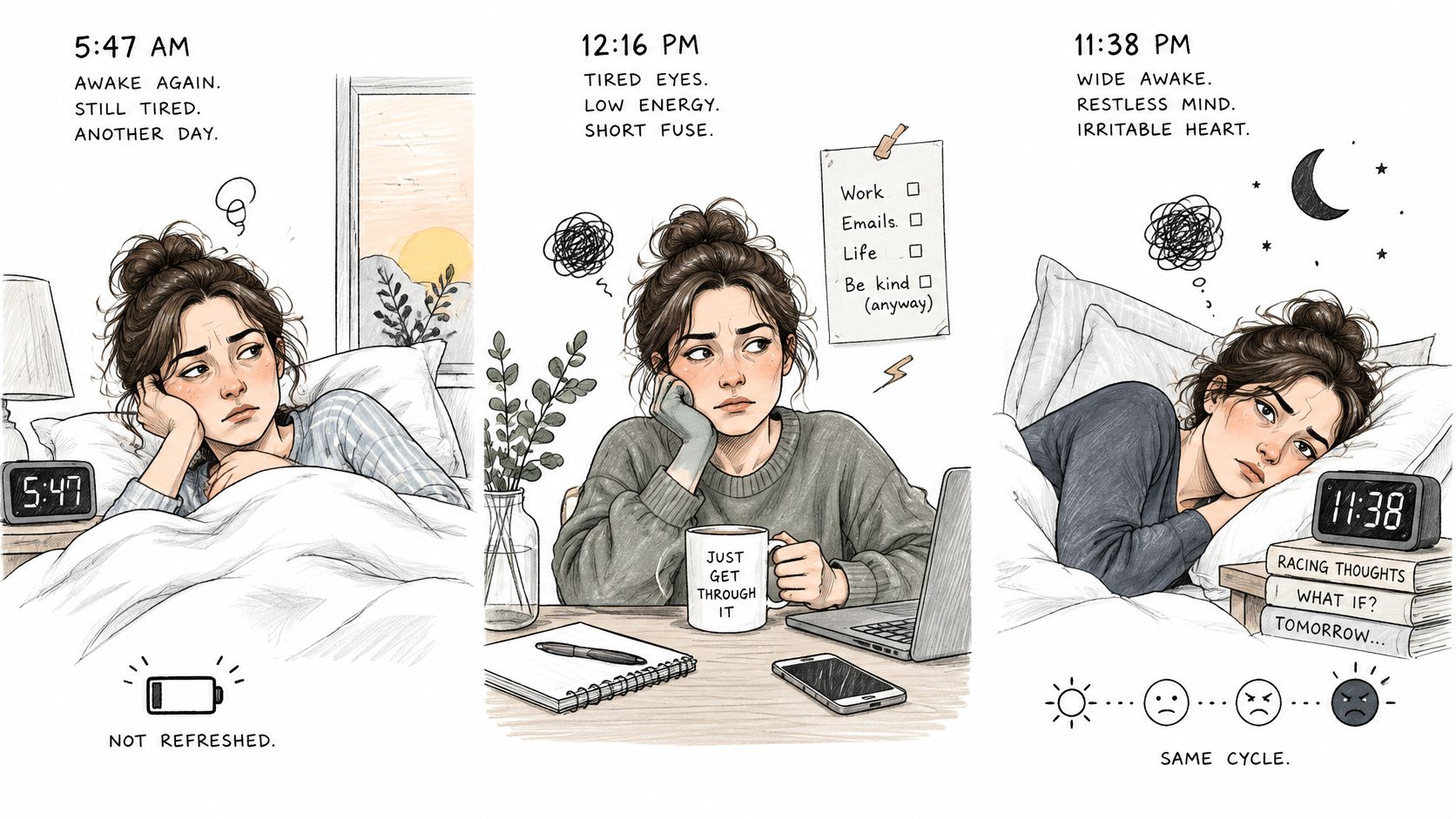
By afternoon, reading an email takes more effort than usual. You lose your place in a conversation or postpone a task you'd normally finish easily. That can feel like reduced ability, even when fatigue and poor concentration are making the task harder.
A U.S. National Health and Wellness Study analysis summarised in a review of perimenopausal sleep and mood found sleep disruption in 61.7% of perimenopausal women with vasomotor symptoms and 38.0% without them. The distinction matters: you don't need night sweats for sleep problems to deserve attention.
When tiredness becomes emotional strain
By evening, a small inconvenience may feel disproportionately upsetting. You might snap at someone, feel tearful, or worry about tomorrow despite having no obvious new problem. Then you feel frustrated with yourself for reacting differently.
This doesn't mean every mood change comes from poor sleep. Hormonal variability, existing anxiety or depression, life pressures, and physical symptoms can overlap. The useful question is whether your emotional baseline has changed, and how much that change affects daily life.
For help describing the difference between ordinary worry and a recurring symptom pattern, explore perimenopause anxiety symptoms.
The video offers another format for learning about the transition.
▶ PlayRecord the whole day together
A useful check-in connects the night to the following day:
- Sleep: Note awakenings and whether you felt refreshed.
- Energy: Describe when tiredness interfered with work, exercise, or ordinary chores.
- Mood: Record irritability, worry, tearfulness, or loss of interest.
- Context: Add caffeine, alcohol, heat episodes, and unusual stress.
You're not trying to explain every feeling through hormones. You're gathering enough detail to make a more informed conversation possible. Persistent depression or severe anxiety deserves professional support, even if it seems to follow a cycle.
How Hot Flashes and Poor Sleep Feed Each Other
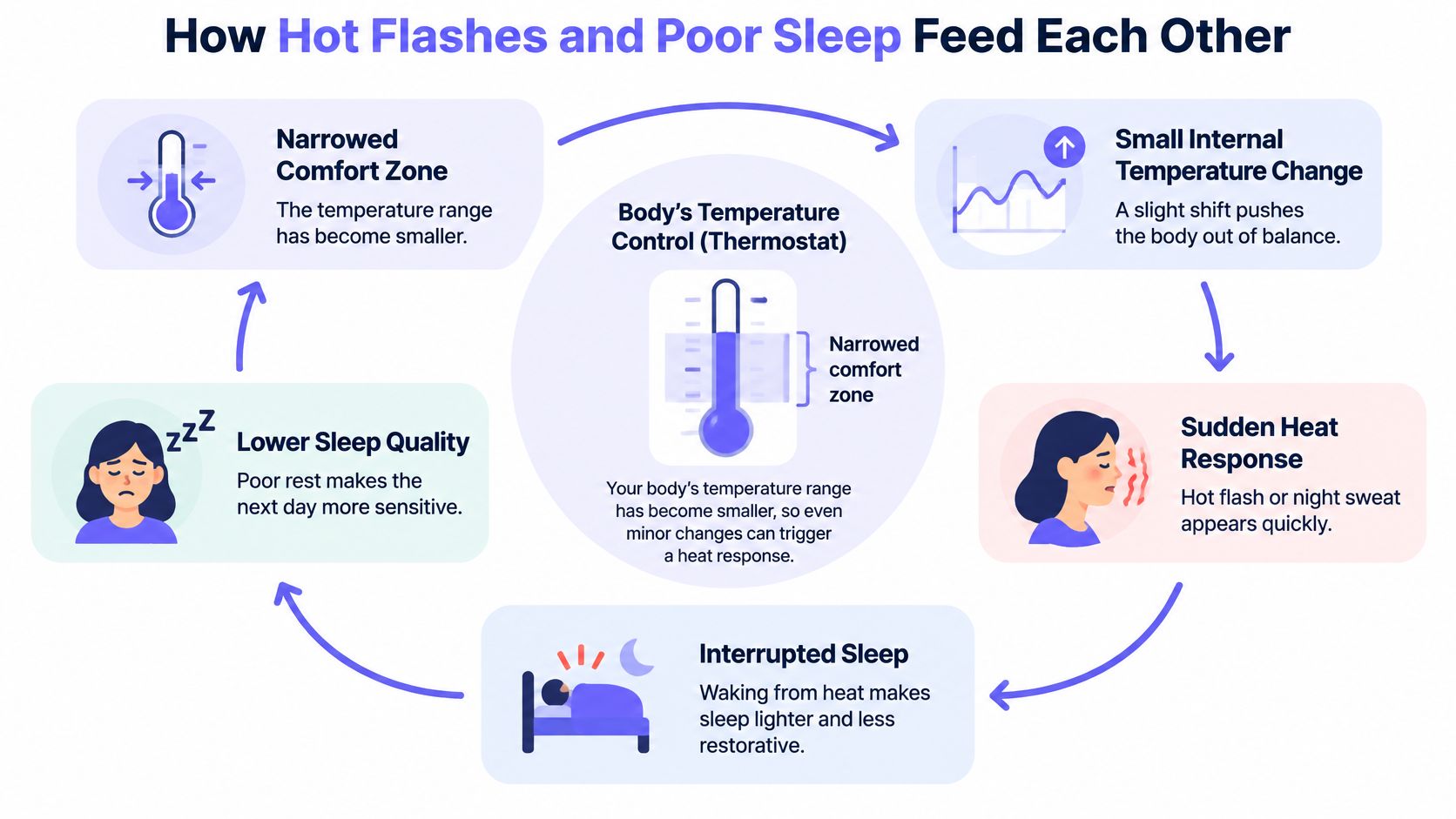
Think of your body's temperature control as a thermostat with a narrower comfort zone. A small internal temperature shift can prompt an outsized cooling response, even when the room hasn't changed.
Unpredictable ovarian activity, including skipped ovulation and irregular estrogen and progesterone changes, accompanies this transition, as described in ACOG's explanation of changing periods and approaching menopause. Vasomotor symptoms involve a narrowed temperature comfort range in the brain's temperature-regulating system.
The diagram shows how temperature changes and interrupted rest can connect.
What one disrupted night can feel like
Say you wake during the night with heat spreading across your chest, neck, and face. Your clothes feel damp, your heart seems to pound, and you throw off the covers. Afterward, you feel cold but remain alert.
You begin wondering whether it will happen again. By the time you're comfortable, you're mentally rehearsing tomorrow's responsibilities instead of drifting back to sleep.
The following day, you feel tired and less patient. At bedtime, concern about another bad night makes it harder to relax. That's a plausible feedback loop, not an inevitable sequence everyone experiences.
Find the most disruptive link
The sensations themselves can include sweating, flushing, palpitations, dizziness, or anxiety. However, new or concerning heart symptoms shouldn't automatically be labelled a hot flash.
Separate your notes into what happened first:
- Heat first: You woke sweaty or overheated, then became alert.
- Wakefulness first: You were already awake before noticing warmth or worry.
- Anticipation first: You felt anxious about sleep before going to bed.
That distinction helps you choose a starting point. Cooling arrangements may improve comfort when heat is prominent; a sleep-focused discussion may be more useful when prolonged wakefulness is the main difficulty.
The most useful detail isn't simply that you slept badly. It's what you noticed before, during, and after waking.
A guide to sleeping better during perimenopause can help you organise practical changes. If nights remain disruptive, ask for an assessment rather than assuming you must endure them until the transition ends.
How Long Perimenopause Lasts and How It Varies
There isn't one timetable that predicts your experience. The duration of hot flashes also isn't the same thing as the duration of perimenopause itself.
Perimenopause stages and how long symptoms last
| Stage or symptom group | Typical age or start | What tends to change | How long it lasts |
|---|---|---|---|
| Early perimenopause | Often becomes noticeable in midlife | Cycle timing and bleeding begin to shift | No fixed duration for an individual |
| Vasomotor symptoms | Can start across the transition | Hot flashes and night sweats | Typically four to five years, with some experiencing them for up to 10 years, according to a review of sleep and menopausal symptoms |
| Full perimenopause | The years surrounding the approach to the final period | Ovulation becomes irregular and symptoms may cluster | Continues through the transition to menopause |
| Symptoms that began before menopause | Before or during perimenopause | Heat episodes can continue beyond the final period | May persist across reproductive stages |
| Symptoms that began after menopause | After periods have stopped | Hot flashes and night sweats may first become noticeable | Can continue after the transition has ended |
Those typical durations aren't a countdown. They don't tell you whether your symptoms will be frequent, mild, severe, or intermittent.
Why your timeline may be hard to recognise
Early changes can be subtle enough to resemble ordinary variation. You may only recognise the beginning retrospectively, after comparing your current cycles and sleep with older records.
Symptoms can also ease and return. A quieter stretch doesn't necessarily mean the transition is over, and a difficult stretch doesn't establish that symptoms will keep worsening.
- Track onset separately: Record when sleep problems began, not just when periods became irregular.
- Describe impact: Note whether a symptom interrupted your life, rather than only whether it occurred.
- Keep uncertainty visible: If you can't remember when something started, say so rather than guessing.
Age provides context, but it doesn't replace your history. Dates of changing periods, new symptoms, medication adjustments, and major life events give a clinician a more useful account than an assumed schedule.
How Perimenopause Differs from Menopause
Perimenopause is a transition; menopause marks the end of menstrual periods. The terms are often used interchangeably in conversation, which can make symptoms and treatment discussions confusing.
During perimenopause, your ovaries are still active, but their activity is becoming less predictable. You can still have periods and experience symptoms associated with the menopausal transition.
| Question | Perimenopause | After menopause |
|---|---|---|
| Are periods still happening? | Usually, although their pattern can change | Menstrual periods have stopped |
| What is the hormonal pattern? | Fluctuating ovarian activity | Lower ovarian hormone production |
| Can symptoms continue? | Symptoms may emerge, change, or fluctuate | Heat episodes, sleep problems, and dryness can persist |
| Does bleeding need attention? | Unexpected or excessive bleeding warrants review | New bleeding needs medical assessment |
Symptoms don't define the boundary
A hot flash doesn't tell you whether you're before or after menopause. Neither does vaginal dryness, difficulty sleeping, or a change in sexual desire.
Likewise, the disappearance of a symptom doesn't establish that you've reached menopause. Clinicians interpret menstrual history alongside your circumstances, including hormonal contraception or treatments that affect bleeding.
This is particularly important if your periods are absent for reasons other than the natural transition. You may need help interpreting your stage rather than relying on a calendar alone.
Fertility questions still matter
Pregnancy can remain possible during perimenopause because ovulation may still occur. Irregular periods aren't a reliable contraceptive method, and symptom treatments don't necessarily provide contraception.
- If pregnancy prevention matters: Ask which contraceptive options suit your medical history and current symptoms.
- If bleeding is masked by treatment: Ask how your clinician will assess your reproductive stage.
- If symptoms continue after periods stop: Seek support based on their impact, rather than assuming you've missed the opportunity for treatment.
The label helps organise care, but you don't need to reach a particular stage before asking for help. Discomfort, impaired sleep, and emotional distress deserve attention while they're happening.
Practical Ways to Ease Each Symptom
Start with the symptom that most disrupts your day. Making a manageable adjustment and observing what happens is more useful than changing your meals, bedtime, exercise, and supplements all at once.
These measures are comfort and routine strategies, not proof that a symptom is hormonal or a substitute for medical treatment.
Choose a practical starting point
- Hot flashes: Wear removable layers so you can respond quickly when your temperature comfort changes.
- Nighttime heat: Keep bedding easy to adjust without fully getting out of bed.
- Possible triggers: Record whether alcohol, spicy meals, hot drinks, or stressful situations precede episodes.
- Sleep timing: Choose a consistent waking time that you can maintain.
- Caffeine: Move your last caffeinated drink earlier if you notice difficulty settling at night.
- Evening stimulation: Put your phone out of reach during your wind-down routine.
- Low energy: Schedule a realistic walk rather than waiting until you feel ready for a demanding workout.
- Racing thoughts: Try slow, comfortable breathing before bed without forcing deep breaths or holding your breath.
- Brain fog: Write tasks in one place and choose a priority before starting work.
- Bloating: Keep a food-and-symptom note without cutting out multiple food groups at once.
- Intimacy discomfort: Consider a lubricant and discuss ongoing dryness with a clinician.
Be selective about products
If you're comparing nonprescription products, inspect ingredients and discuss them with a pharmacist, especially if you take medication. For example, the listing for HempWell USA's CBD menopause patches in packs of 30 is a product-information resource, not clinical evidence that CBD treats perimenopause.
Before buying: Ask what evidence supports the intended benefit, what risks apply to you, and whether the product could delay more appropriate care.
Lifestyle adjustments aren't a test of willpower. If symptoms remain intrusive, ask about treatment options suited to your health history, priorities, and need for contraception.
When Symptoms Need a Medical Review
The common mistake is assuming that a plausible hormonal explanation is the only explanation. Exhaustion, palpitations, mood changes, and irregular bleeding may fit perimenopause, but they can also have other causes.
There's no definitive laboratory test for perimenopause, because hormone levels fluctuate; clinicians commonly assess age, menstrual changes, and the overall pattern, explains the American Medical Association's guide to perimenopause. A normal hormone result therefore doesn't necessarily exclude the transition.
Know when tracking isn't enough
Symptoms that need medical review
| Warning sign | Why it matters | Next step |
|---|---|---|
| Bleeding lasting longer than your usual period | May have causes beyond the transition | Book a medical review |
| Bleeding between periods | Fibroids, polyps, thyroid problems, and other conditions can produce unexpected bleeding | Book a medical review |
| Unusually heavy bleeding | Can cause significant blood loss and may contribute to anemia | Arrange assessment; seek urgent care if you feel faint or seriously unwell |
| Symptoms beginning earlier than expected while periods remain regular | Thyroid disease, anemia, depression, or medication effects may overlap | Ask for an assessment and appropriate testing |
| Persistent depression or severe anxiety | Needs care beyond symptom monitoring | Arrange prompt professional evaluation |
| Thoughts of suicide | An urgent safety concern | Contact emergency services or a crisis service now |
Heavy bleeding with faintness, severe weakness, or difficulty breathing needs urgent help rather than a routine appointment. Likewise, don't wait to collect a complete symptom record if you're struggling to stay safe.
What to bring to an appointment
Bring your bleeding history, medication and supplement list, and a description of what has changed in daily life. Explain whether fatigue prevents normal activities, whether anxiety is new, and whether symptoms are becoming more severe.
A guide to whether you can test for perimenopause can help you prepare questions. Ask what else needs ruling out and what each proposed test would clarify.
You don't have to choose between recognising perimenopause and investigating other conditions. A careful assessment can do both.
Track Your Pattern and Confirm Your Next Step
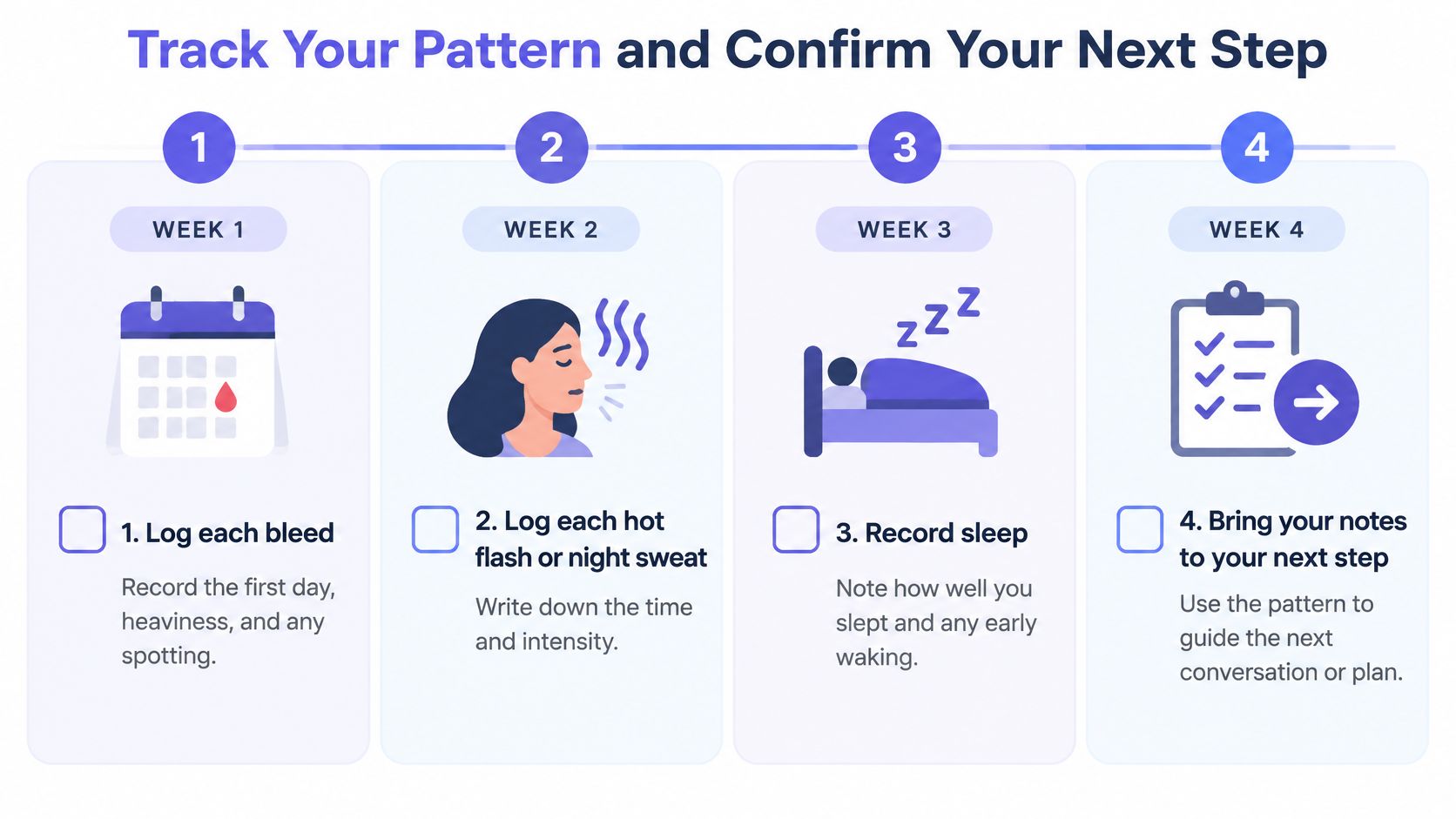
Use a notebook, calendar, or tracking app to make brief entries over the coming weeks. Aim for consistency rather than perfect detail, and don't delay care while waiting for a pattern.
- Log each bleed. Record the first day, heaviness, and spotting. This guide to tracking your cycle can help you distinguish useful details from unnecessary ones.
- Log heat episodes. Note when a hot flash or night sweat occurred and whether it interrupted an activity or sleep.
- Record sleep each morning. Include awakenings, early waking, and how refreshed you feel.
- Rate energy and mood. Use the same simple categories each day, such as low, moderate, or good, with a brief note when something feels unusual.
- Add context. Record caffeine, alcohol, meals, medication changes, and major stressors without assuming they caused the symptom.
The checklist provides a simple visual reminder.
Turn observations into a decision
If your symptoms resemble the pattern and no warning signs appear, try appropriate comfort measures while arranging routine advice as needed; if a warning sign appears, seek medical review first.
Look for useful relationships rather than a diagnosis: poorer concentration after broken sleep, repeated anxiety around cycle changes, or bloating that follows particular meals. Symptoms that don't fit a pattern still deserve attention if they persist.
An app can keep these observations together, but tracking doesn't diagnose perimenopause. Your next step should reflect both the pattern and how much it affects your life.
Lila offers a daily check-in for symptoms, mood, sleep, energy, meals, and cycles, alongside a personalised action plan and an around-the-clock chat coach. If you'd like one place to organise what perimenopause feels like for you, visit Lila and use your entries to guide practical changes and conversations with your clinician.
Get Lila, your personal coach for perimenopause.
Built for women in their 40s. 24/7 coaching, in your pocket.

