
Estradiol Pill vs Patch Which Is Better for Menopause
Deciding on estradiol pill vs patch for menopause? This guide compares safety, side effects, and real-world use cases to help you make an informed choice.
 Michelle
When you're considering estradiol for menopause symptoms, one of the first big decisions you and your clinician will make is how you'll take it. The two most common options, a daily pill or a transdermal patch, might seem like a simple choice of convenience, but the way they work inside your body is fundamentally different.
This difference in delivery—swallowing a pill versus absorbing it through your skin—has a ripple effect on everything from your hormone levels and side effects to your overall safety profile.
Pill vs. Patch: A Quick Comparison for Menopause Relief
Let's get straight to the heart of the matter. While both the estradiol pill and patch are designed to replenish your body's estrogen, they take completely different routes to get there. Understanding this journey is key to figuring out which path is a better fit for your health and lifestyle.
The oral pill is a daily commitment, passing through your digestive system and liver before it enters your bloodstream. The patch, on the other hand, is usually applied once or twice a week, delivering the hormone directly through your skin.
This visual gives a great overview of how these two methods work.
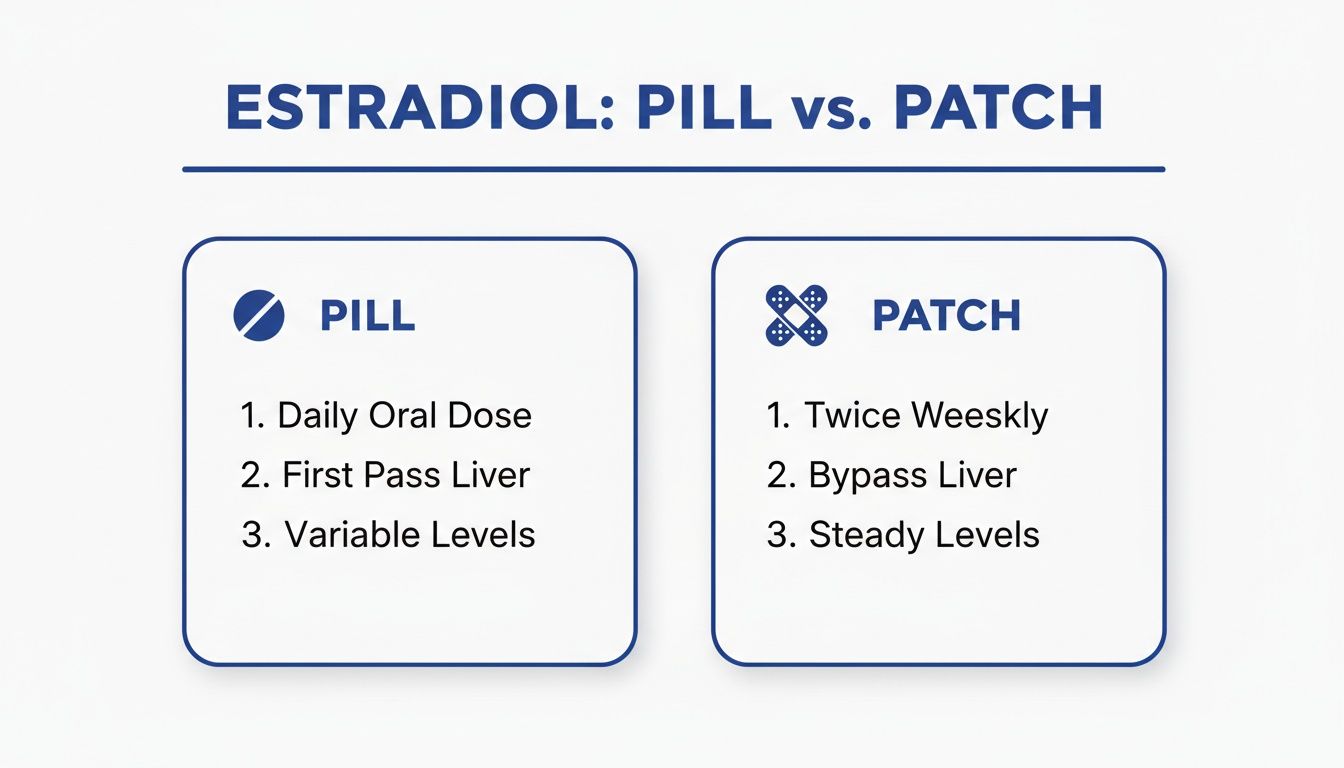
As you can see, the route the estradiol takes matters. The pill’s journey through the liver—what doctors call “first-pass metabolism”—changes how the body processes it. The patch skips this step entirely, which is a game-changer for many women.
Key Factors in Your Decision
It's about more than just remembering a daily pill or a weekly patch. Your personal health profile and daily routine will heavily influence which option feels right.
Hormone Delivery and Stability: The pill can create a bit of a hormone rollercoaster, with levels peaking after you take it and then dropping off. Patches offer a more stable, steady-state release of estradiol, which can mean smoother, more consistent symptom control.
Safety Profile: This is a big one. Because oral estradiol is processed by the liver, it can increase the production of clotting factors. This leads to a small but real increase in the risk of blood clots (venous thromboembolism, or VTE). Transdermal estradiol, by bypassing the liver, doesn't carry this same risk.
Lifestyle and Convenience: Are you someone who thrives on a daily routine and will have no trouble remembering a pill? Or does the "set it and forget it" nature of a patch you only change once or twice a week sound more appealing? There’s no wrong answer—it's about what works for you.
To make this even clearer, let's break down the core differences in a simple table.
Quick Comparison: Estradiol Pill vs. Patch at a Glance
This table sums up the essential differences you'll want to discuss with your doctor.
Feature | Estradiol Pill (Oral) | Estradiol Patch (Transdermal) |
|---|---|---|
Administration | A pill taken by mouth, usually once daily. | A patch applied to the skin, changed once or twice a week. |
How it Works | Absorbed through the gut and processed by the liver before entering the bloodstream. | Delivers estradiol directly through the skin into the bloodstream, bypassing the liver. |
Hormone Levels | Can cause daily peaks and valleys in estradiol levels. | Provides a more consistent, steady stream of estradiol. |
Blood Clot (VTE) Risk | Carries a small but statistically significant increased risk. | Not associated with an increased risk of blood clots above baseline in most users. |
Common Side Effects | Nausea, bloating, headaches, or breast tenderness are more common. | Skin irritation, redness, or an allergic reaction to the patch adhesive. |
Who is it Good For? | Women without major VTE risk factors who prefer the simplicity of a daily pill. | A safer first choice for women with VTE risk factors, migraines, or liver issues. |
Ultimately, both are effective tools for managing menopause symptoms, but their profiles are distinct.
The bottom line: The choice between an estradiol pill and a patch isn't just about preference; it's a medical decision rooted in your personal health history. A conversation with your healthcare provider about your lifestyle and risk factors—especially for blood clots—is the most critical step you can take.
How Your Body Processes Estradiol From Pills and Patches
The real difference between an estradiol pill and a patch boils down to one thing: the journey it takes to get into your bloodstream. How the hormone gets into your system fundamentally changes its impact, from how well it manages your symptoms to its overall effect on your health.
Think of it like this: one delivery method sends a crucial package directly to your door, while the other takes a major detour through a central processing hub first. That detour makes all the difference.
The Journey of an Oral Estradiol Pill
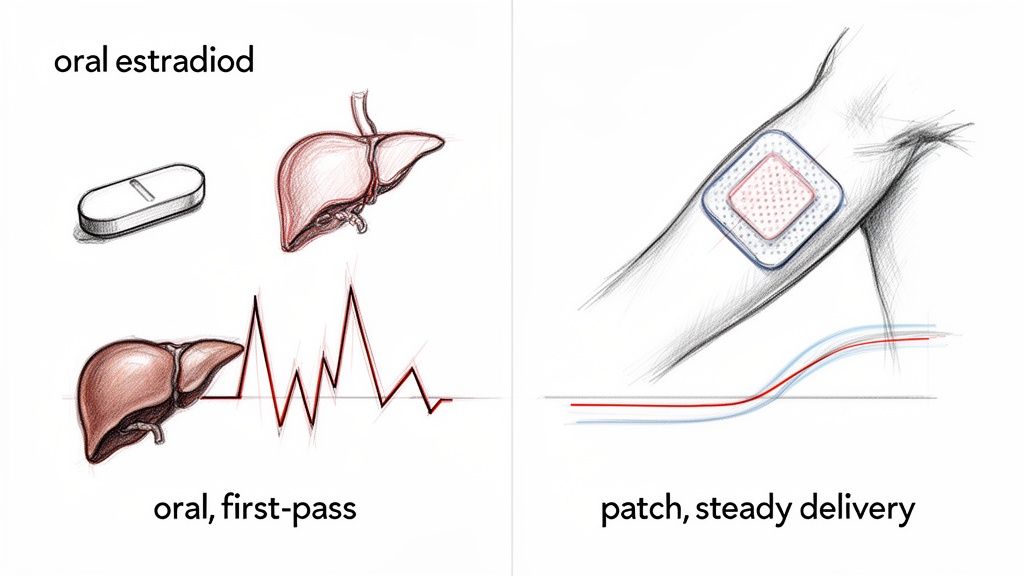
When you swallow an estradiol pill, it’s not a straight shot. After it’s absorbed in your gut, its first stop is the liver.
This is a critical step called first-pass metabolism. Your liver acts as a gatekeeper, and it metabolizes a huge chunk of that potent estradiol, converting much of it into a weaker form of estrogen called estrone. Only after this happens does the hormone enter your general circulation to do its job.
This process often creates a hormonal "rollercoaster." You get a spike in estrogen right after taking the pill, which then tapers off until your next dose 24 hours later. For some women, these daily peaks and valleys can make it harder to find consistent, around-the-clock symptom relief.
The Direct Route of the Estradiol Patch
The estradiol patch skips that entire detour. By sticking it on your skin, you’re creating a direct-to-bloodstream delivery system.
The patch allows estradiol to be absorbed right through the skin into the tiny blood vessels below. This means it completely bypasses the liver's first-pass metabolism. Think of the patch as a tiny, slow-release reservoir that delivers a steady, consistent trickle of estradiol into your body over several days.
This mimics the body’s natural hormone production much more closely. The result is more even, stable hormone levels, without the dramatic spikes and dips that can come with oral pills. It’s this stability that many women find gives them smoother, more predictable control over symptoms like hot flashes and mood swings.
One of the biggest differences between estradiol pills and patches comes down to how steadily they deliver estrogen to your body, which can make a real difference in managing perimenopause symptoms. A common transdermal patch delivers about 50 μg/day, roughly equivalent in potency to 1-2 mg/day of oral estradiol, but with far less variability from person to person. Find out more about how delivery methods impact hormone levels and symptom control. Learn more about the differences between estrogen pills and patches on goodrx.com.
What This Means for Your Body
The route the estradiol takes has very real-world consequences. When the liver processes oral estradiol, it doesn't just convert the hormone—it also ramps up the production of other substances, including proteins involved in blood clotting. This is a key reason why the safety profile for pills is different from that of patches, something we'll dive into later.
In contrast, the patch’s direct delivery provides a "cleaner" dose of estradiol that doesn't trigger the same liver response. For many people, this makes it a safer starting point.
Ultimately, knowing how these therapies work can help you have a more informed conversation with your clinician. Understanding what’s happening inside your body is the first step. To get a better sense of your baseline, you might want to review our guide on normal estradiol levels and what they mean. Pairing this knowledge with careful symptom tracking in an app like Lila can help you and your doctor fine-tune your treatment for the best possible results.
Pills vs. Patches: A Deep Dive Into Safety
When we talk about the safety of hormone therapy, the conversation almost always turns to one key difference between estradiol pills and patches: how they interact with your liver. This isn't just a minor detail—it has very real consequences for your risk of developing certain health conditions, especially blood clots.
It’s the primary reason why, as clinicians, we often have a strong preference for one method over the other depending on a woman’s individual health profile and history.
The Liver's Critical Role and Blood Clot Risk
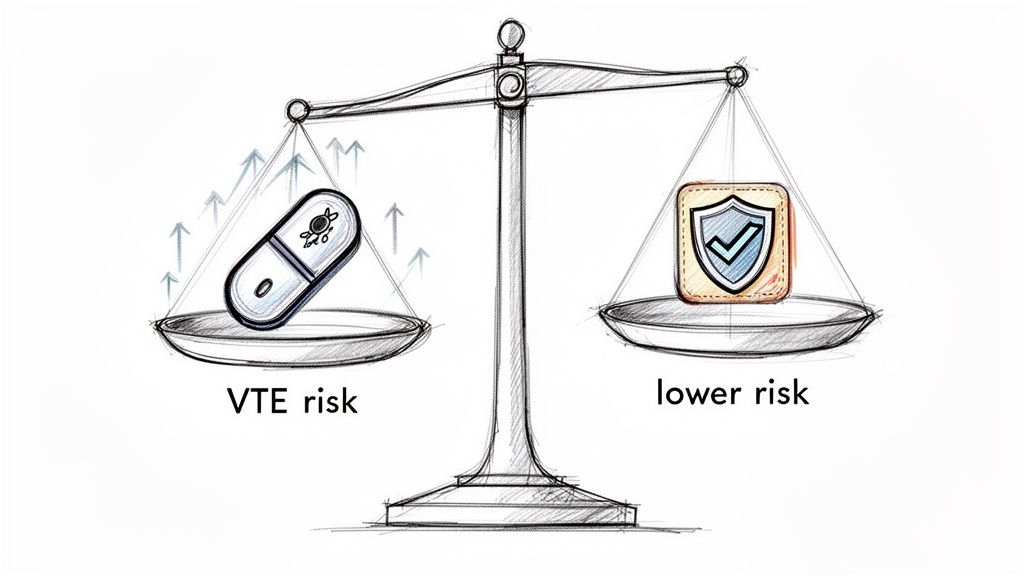
The most significant safety distinction between the pill and the patch comes down to the risk of venous thromboembolism (VTE), which is a blood clot in a vein. This risk is directly linked to what’s known as the “first-pass effect” of oral estradiol.
When you swallow an estradiol pill, it travels first to your liver to be metabolized before it ever reaches your wider circulation. This process signals the liver to ramp up the production of clotting factors, which makes your blood slightly "thicker" and more prone to clotting.
The estradiol patch, on the other hand, delivers the hormone straight through your skin and into the bloodstream. It completely sidesteps the liver. Because it avoids that first-pass metabolism, transdermal estradiol does not increase the production of clotting factors. This simple biological route makes the patch a significantly safer choice when it comes to VTE risk.
The evidence on this is quite compelling. One very large UK study found that oral hormone therapy was associated with a 70% higher VTE risk. Another major review of 51 studies confirmed that oral estrogen could quadruple clot risk compared to patches—a staggering 4 times higher risk.
For those using the Lila app to track their health metrics, this is an important distinction. The patch allows you to manage your menopause symptoms without adding the specific metabolic burden and clot risk that can come with oral estrogen.
Who Is a Better Candidate for the Patch Based on Safety?
Given the clear difference in blood clot risk, the estradiol patch is almost always the go-to, first-line choice for women who have certain pre-existing risk factors. A clinician will strongly favor the patch if you have:
A personal or family history of blood clots (VTE)
A known genetic clotting disorder, like thrombophilia
Obesity (specifically a BMI over 30)
A history of smoking
High blood pressure (hypertension)
Diabetes
Certain types of migraines
For anyone with these conditions, the choice between a pill and a patch is less about personal preference and more about medical necessity. It’s a straightforward safety decision.
Other Health and Metabolic Considerations
Beyond the risk of blood clots, the delivery method also influences other aspects of your metabolic health. Oral estradiol can sometimes raise triglyceride levels and C-reactive protein (a key marker of inflammation), which are important factors for your overall cardiovascular health. The patch, in contrast, tends to have a neutral or even more positive impact on these markers.
This is all part of the bigger picture when choosing the right hormone therapy. Understanding these nuances helps you and your doctor make a truly informed decision for your immediate relief and your long-term health.
While we're focused on pills versus patches here, it's also helpful to be aware of the general safety considerations for Hormone Replacement Therapy.
Ultimately, both methods work well for relieving symptoms. However, the transdermal patch clearly offers a better safety profile, especially if you have any underlying health risks. To get more comfortable with the basics before your next appointment, take a look at our guide on what is hormone therapy for menopause. Having this foundational knowledge makes for a much more productive conversation with your provider.
Comparing Symptom Relief and Side Effects
Let’s get straight to the point: when you're deciding between an estradiol pill and a patch, what you really want to know is which one will work better for you. You need relief from hot flashes, night sweats, and mood swings, and you want to do it with the fewest possible side effects. The good news is that both methods are excellent at what they do. The real difference comes down to how they deliver the hormone and how your body responds to that delivery.
A patch delivers a steady, low dose of estradiol directly through your skin, 24/7. For many women, especially those who feel like they're on a hormonal rollercoaster, this consistency is a godsend. It smooths out the highs and lows, which can lead to more predictable and stable symptom control. If your hot flashes or mood swings seem to pop up without warning, the steady state of a patch might be the calm you're looking for.
Oral pills, on the other hand, deliver their dose all at once. After you take your daily pill, your estradiol levels will spike and then slowly decline until it’s time for the next one. Many women don't even notice this daily rhythm. For others, though, this fluctuation can create a pattern where symptoms like headaches or irritability seem to creep back in a few hours before their next dose is due.
How Effective Are They for Symptom Relief?
On paper, both are fantastic. Clinical evidence shows that pills and patches can reduce the frequency and intensity of vasomotor symptoms—that’s the medical term for hot flashes and night sweats—by 80-95%. They both work. The difference isn't in their power, but in their consistency.
Imagine the patch as a thermostat set to a perfect temperature, keeping things comfortable around the clock. The pill is more like a space heater that you turn on for a while—it gets the job done, but you might feel the chill start to return before you turn it back on.
A Clinician's Perspective: From my experience, women who were very sensitive to hormonal shifts during their cycling years—maybe they had severe PMS or menstrual migraines—often feel much better on the steady delivery of a transdermal patch. It seems to provide a more stable foundation for their well-being.
This is especially true for sleep. By preventing night sweats from happening in the first place, rather than just treating them after they start, patches can be a game-changer for achieving deep, uninterrupted sleep.
A Look at Common Side Effects
No medication is without potential side effects, and estradiol is no different. The interesting thing here is that the side effects are usually tied directly to the delivery method. Choosing between a pill and a patch often means deciding which set of potential issues you find more manageable.
Side Effects of Oral Estradiol Pills
Because they go through your digestive system and liver first, the side effects of oral pills often center around that journey.
Stomach Upset: Nausea is a common complaint, particularly when you first start. Bloating can also be an issue.
Headaches: That daily spike in hormone levels can be a headache trigger for some.
Breast Tenderness: While this can happen with any form of estrogen, the daily peaks and troughs of the pill can sometimes make it more noticeable.
A practical tip: You can often sidestep nausea by taking your pill with a small snack or right before bed. If headaches pop up, try tracking them with an app like Lila. This can help you and your doctor see if there’s a clear pattern connected to your dosing time.
Side Effects of Transdermal Estradiol Patches
With patches, the side effects are almost always skin-deep—literally.
Skin Irritation: The adhesive, not the hormone, can sometimes cause redness, itching, or a rash at the application site.
Sticky Residue: The patch can leave a gummy square on your skin that’s a bit of a nuisance to get off.
A practical tip: The golden rule for avoiding skin irritation is to rotate your patch sites. Never put a new patch on the exact same spot you just used. A little baby oil or a medical adhesive remover on a cotton ball will make quick work of any sticky residue left behind.
It’s worth noting that any form of systemic estrogen can have an impact on vaginal and urinary health. If you're experiencing symptoms in that area, you can learn more about managing genitourinary syndrome of menopause in our detailed guide. The best path forward is always an open conversation with your clinician about these trade-offs to find the method that fits your body and your life.
Beyond the science, the practical, day-to-day realities of hormone therapy are what truly determine success. The most effective treatment is, quite simply, the one you'll actually take consistently. It has to fit your life, not the other way around.
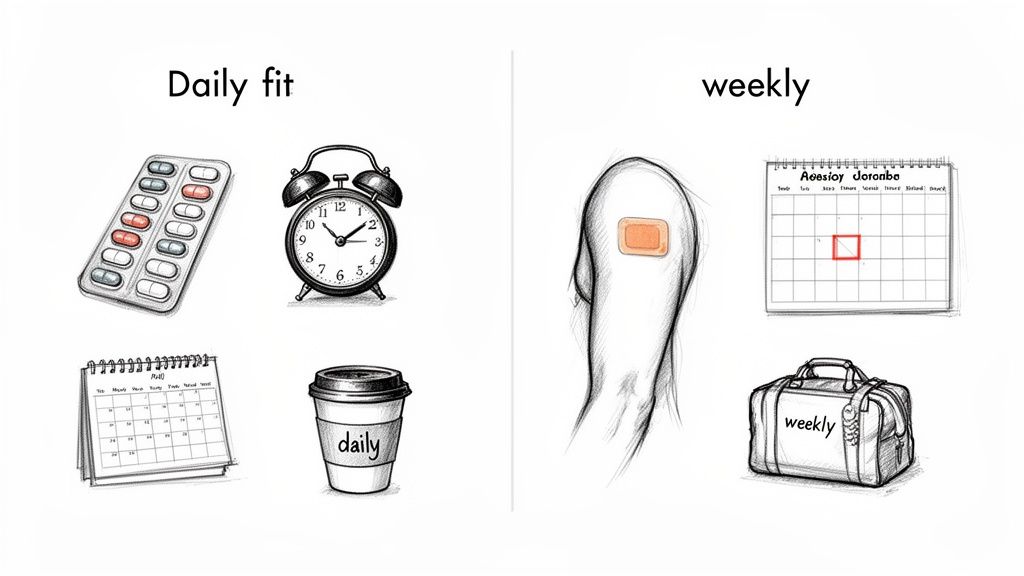
This often boils down to a personal preference: would you rather remember a small task every day, or a slightly bigger one just once or twice a week? There's no right or wrong answer—only what works for you.
Daily Routine vs. Weekly Task
Taking an estradiol pill means making it a daily habit. If you already take other medications or vitamins each morning, adding one more pill into the mix is usually a breeze. For some women, this daily ritual can even feel grounding, a concrete way of taking control of their health.
On the other hand, the estradiol patch offers a "set it and forget it" approach that many women love. You typically change it just once or twice a week, which means less to think about on a daily basis. The trade-off is that you need a reliable system for remembering your change-out days and rotating the application site to keep your skin happy.
A Note From Experience: Your personality and lifestyle really guide this choice. If you thrive on daily habits, the pill might feel like a natural fit. If you prefer to minimize daily medication tasks, the "out of sight, out of mind" nature of a patch could be the perfect solution.
Making any new behavior stick can be a challenge. Understanding the psychology behind building consistent habits can make all the difference, whether you're trying to remember a daily pill or a weekly patch. A great resource for this is Mastering Habit Formation Psychology, which offers practical insights that can help you succeed.
Dosing and Finding the Right Strength
One of the most important things to understand is that the dosage numbers on a pill versus a patch are not interchangeable. A common starting dose for a transdermal patch is 0.025 mg/day or 0.05 mg/day. An equivalent starting dose for an oral pill, however, might be 0.5 mg or 1 mg daily.
Why the huge difference? The patch delivers hormones directly into your system, so a tiny amount goes a long way. The pill has to pass through your digestive system and liver first (a process called first-pass metabolism), where much of the hormone is broken down. The higher dose is needed to ensure enough estradiol makes it into your bloodstream.
We almost always start with the lowest effective dose to manage your symptoms. After a few months, we'll see how you're feeling and adjust if needed. This is where tracking your symptoms with an app like Lila can be incredibly helpful—it gives us clear, concrete data to guide those dosing decisions together.
Comparing the Cost and Insurance Coverage
Let's talk about a very real factor: cost. What you'll actually pay for either option depends almost entirely on your insurance plan and whether you choose a generic or brand-name product.
Here’s a general breakdown of what to expect:
Generic Estradiol Pills: These are almost always the most budget-friendly choice. With good insurance, a 30-day supply can be just a few dollars. They are generally inexpensive even if you're paying out-of-pocket.
Generic Estradiol Patches: Patches usually cost more than pills. While generic versions are much more affordable than brand names, you can still expect a higher monthly cost compared to oral estradiol.
Brand-Name Products: Brands like Vivelle-Dot® (a patch) or Estrace® (a pill) will consistently have a higher co-pay or out-of-pocket cost than their generic counterparts.
Before you decide, it's smart to check your insurance plan's formulary (their list of covered drugs) or call them directly for a price estimate. Don't hesitate to ask your clinician to prescribe the most cost-effective option that is medically right for you.
How to Choose the Right Estradiol for You
So, the big question: should you choose an estradiol pill or a patch? The truth is, there’s no single “better” option. The best choice is the one that works for your body, your health history, and your daily life.
Think of this decision as a conversation between you and your doctor. Your lifestyle, personal risk factors, and even your daily preferences all play a major role in finding the right fit.
Let's break down a few real-world scenarios to help you see where you might land.
When the Estradiol Patch Makes More Sense
From a clinical perspective, the patch is often my starting recommendation for many women, primarily because of its impressive safety profile and how it delivers hormones. A patch might be right for you if any of these situations sound familiar:
You have certain health risks. The patch is the clear medical front-runner if you have a personal or family history of blood clots, are a smoker, have a BMI over 30, or are managing conditions like high blood pressure. Because it bypasses the liver, it sidesteps the increased VTE risk linked to oral estrogen.
You're tired of hormonal ups and downs. Do you struggle with mood swings, menstrual migraines, or terrible sleep? The patch provides a slow, steady stream of estradiol, which can be a game-changer for smoothing out those peaks and valleys. This consistency often leads to a more stable mood and deeper, more restorative sleep.
You have a sensitive stomach. If oral medications often leave you feeling nauseous or give you digestive trouble, the patch is a perfect solution. It delivers hormones directly through the skin, avoiding your gastrointestinal system entirely.
You want a "set-it-and-forget-it" routine. If remembering a daily pill feels like just one more thing on your plate, the patch's twice-weekly or weekly schedule can feel like a breath of fresh air. It’s a low-maintenance approach that busy women often love.
When the Estradiol Pill Might Be Your Best Bet
Even with the patch's benefits, the oral pill is still a fantastic and effective choice for millions of women. Don’t count it out, especially if you find yourself in these shoes:
You thrive on a daily routine. If you already take a daily vitamin or another medication, adding one small pill to the mix is incredibly simple. For many, that daily habit is easy to build and maintain.
You don't have major VTE risk factors. The oral pill is a perfectly safe and effective option for healthy, non-smoking women without a history of blood clots or other significant cardiovascular risks.
You have sensitive skin. This is a big one. If you have a known allergy to adhesives or find that wearing a patch leaves your skin red and irritated, the pill is a simple fix that completely avoids any skin reactions.
Your budget is a top priority. Let's be practical. Generic oral estradiol is almost always the most affordable form of hormone therapy. If cost is a significant factor, the pill is often the most accessible choice.
The ultimate takeaway: Remember, this choice isn't permanent. If you start with one method and it just doesn't feel right—because of side effects, convenience, or cost—you can always talk to your doctor about switching. The goal is to find what makes you feel your best.
Using an app like Lila to track your symptoms and side effects can make a huge difference here. Bringing that data to your appointment gives your clinician a clear, objective look at how you're responding, empowering you both to make confident decisions about your treatment plan.
Frequently Asked Questions About Estradiol Therapy
▶ PlayIt’s completely normal to have questions when you’re figuring out hormone therapy. Getting to grips with the day-to-day realities of using estradiol is key to feeling confident in your choice. Here are some of the most common questions I hear from women weighing the pill against the patch.
Can I Switch Between Pills and Patches?
Absolutely. Many women try one method before settling on another, and switching between estradiol pills and patches is a simple, very common process.
Your clinician will handle the switch, which typically doesn’t require any washout period or overlap. The most important part is adjusting the dose. Because pills are metabolized differently (first-pass metabolism) than patches (which deliver hormones directly into the bloodstream), the milligram strengths aren't a one-to-one swap. Your doctor will calculate the correct equivalent dose for you.
This makes it easy to pivot if one method isn’t working. If a pill upsets your stomach or a patch irritates your skin, you can move to the other option without a fuss.
What Should I Do If My Patch Falls Off?
First off, don't worry—it happens. If your estradiol patch comes off, the first thing to do is try and stick it back on a clean, dry patch of skin. If it’s not sticky enough to stay put, you’ll need to apply a fresh one.
Here’s what to do:
Try to Reapply: Press the original patch firmly onto your skin for about 10 seconds.
Apply a New One: If it won’t hold, throw the old one away and put a new patch on.
Stick to Your Schedule: This is the key part. Do not change your patch-change days.
For instance, if your schedule is to change your patch every Sunday and Wednesday, but it falls off on a Monday, go ahead and apply a new one right away. You would then still change that patch on Wednesday, as originally scheduled.
Which Works Faster for Hot Flashes: Pills or Patches?
Both estradiol pills and patches are very effective for hot flashes, but neither is an overnight fix. You can usually expect symptoms to start improving within a few weeks, with the most significant relief happening after one to three months of consistent therapy.
The speed of relief is less about the estradiol pill vs patch and more about finding the right dose that works for your individual body.
The biggest factor for getting relief quickly is consistency. That said, because the patch provides a steady, continuous dose of estradiol, some women find it gives them a smoother, more predictable handle on sudden symptoms like hot flashes and night sweats right from the start.
Ultimately, both are excellent options, and the timeline for relief is quite similar. The best thing you can do is stick with your prescribed therapy for at least a couple of months to give your body a real chance to adjust.
Feeling overwhelmed by all the symptoms and options is a shared experience, but you don't have to manage it by yourself. Lila is designed to help you track your symptoms, notice your body’s unique patterns, and clearly see the progress you're making with your treatment. Take the next step in your menopause journey by visiting https://getlila.com to get started.
Get Lila, your personal coach for perimenopause.
Built for women in their 40s. 24/7 coaching, in your pocket.


