
Low Energy Solutions for Perimenopause: Ranked by Impact
Feeling drained during perimenopause? Compare low energy solutions ranked by impact, from sleep and movement to medical checks and tracking.
Search for low energy solutions and the first answer comes from the wrong field entirely. The International Energy Agency reports that buildings used more than 120 exajoules of energy in 2023, equivalent to 28% of global total final energy consumption (the IEA's Energy Efficiency 2024 report). Useful if you're specifying a heat pump. Useless if you're 49, waking at 3 a.m. in a sweat, and running the afternoon on a second coffee.
This guide covers the second problem. It treats low energy in perimenopause as a linked cluster, where sleep, bleeding, meals, movement, mood and stress pull on each other, so that repairing one weak link often lifts more than you'd expect. You'll get a ranked order, the red flags that send you to a clinician first, and a two-week test for deciding what works for you. Where the evidence is thin, I'll say so.
Table of Contents
- Which Energy Fixes Work and How Fast
- When Low Energy Needs a Medical Check
- Why Low Energy Arrives With Other Symptoms
- Repair Night Sleep Before Anything Else
- Movement Doses That Build Energy Without Crashing
- Nutrition and Stress Habits Worth Testing
- Track Your Triggers and Run a Two-Week Test
Which Energy Fixes Work and How Fast
Six changes cover most of what moves energy during the transition. They're listed in the order worth trying, with what each one targets and roughly how long it takes to show up in how you feel.
Low energy solutions ranked by impact and speed
| Solution | What It Targets | Evidence Strength | Time to Notice |
|---|---|---|---|
| Repair night waking and night sweats | Sleep and morning fatigue | Moderate | 1 to 2 weeks |
| Medical check for iron, thyroid and B12 | Persistent fatigue and heavy bleeding | Clinical test required | 1 to 3 months after treatment |
| Progressive walking plus two strength sessions | Daytime energy and metabolic health | Moderate | 2 to 3 weeks |
| Protein and fiber at each meal | Afternoon crashes and cravings | Moderate | 1 to 2 weeks |
| Short evening stress downshift | Wind-down and anxious fatigue | Moderate | 1 to 2 weeks |
| Limit alcohol near bedtime | Night sweats and fragmented sleep | Moderate | Variable, often within days |
The evidence column describes how strong the case is in this guide, not a grade of the entire scientific literature. Sleep tops the list because a stretch of broken nights sits upstream of appetite, mood, glucose handling and the willingness to put your shoes on.
The order is the point
The medical row sits second on purpose. If your fatigue is driven by low ferritin, an underactive thyroid or low B12, no amount of walking and protein will touch it, and treatment takes weeks to build. Getting bloods done early means the results land around the time you've tested the behavioural steps.
Treat this as a priority order, not a menu. Testing two or three changes at once is sensible. Testing all six is how people end up unable to say which one helped. If you want the broader picture on everyday fatigue drivers before you start rearranging anything, Yuve's guide to lasting energy walks through the common contributors in plain terms.
Practical rule: Pair sleep with meals for two weeks. Add movement next. Book the blood work in parallel so results are ready by the time you review what changed.
One exception overrides all of this. Fatigue that arrives suddenly, feels severe, or keeps worsening goes to a clinician before any self-management plan, because rapid decline is a different problem from the slow grind of the transition.
When Low Energy Needs a Medical Check
It's tempting to file menopausal fatigue under hormones and move on. That assumption misses causes that are treatable, and occasionally urgent.
Bleeding is the one most often skipped. A 2025 study of more than 2,300 midlife women found that abnormal uterine bleeding, including periods lasting longer than eight days or unusually heavy flow, was associated with greater fatigue (Welltory's review of perimenopause fatigue). Heavy periods deplete iron stores over months, and ferritin can fall well before haemoglobin drops, which is why a normal blood count doesn't rule out iron deficiency.
Symptoms that need a clinician
| Symptom | Possible Cause to Check | Action |
|---|---|---|
| Periods longer than 8 days or soaking protection every hour | Heavy bleeding with iron deficiency | Book a visit for a full blood count and ferritin |
| Breathlessness at rest or a racing heartbeat | Anaemia, thyroid or heart problem | Same-day medical review, emergency care if severe |
| Loud snoring with breathing pauses | Sleep apnoea | Request a sleep assessment |
| Persistent low mood or hopelessness | Depression, thyroid or medication effect | Clinical review within the week |
| Fatigue with cold intolerance or unexplained weight change | Thyroid disorder | Thyroid blood test |
Beyond that list, three more causes deserve a mention. Sleep apnoea is common in midlife and under-diagnosed in women, who often report headaches and fatigue rather than loud snoring. Thyroid disorders mirror perimenopause closely, and hypothyroidism and menopause explains where the two blur and what to ask for. Some blood pressure drugs, antihistamines and antidepressants also cause drowsiness, so bring your full medication list rather than only the ones you think are relevant.
What to document before the appointment
Two weeks of notes beats a five-minute recollection. Record bleeding days and how heavy the flow is, night wake-ups and their cause, any episodes of breathlessness or palpitations, snoring your partner notices, and your mood across the fortnight. That record turns a vague complaint into something a clinician can work with.
Hormone therapy and GLP-1 medications are prescription decisions made with a clinician who knows your history, not something to source yourself.
Chest pain, fainting or severe breathlessness at rest is emergency care now, not a two-week experiment.
Why Low Energy Arrives With Other Symptoms
Think of a chain. One weak link slows the whole line, no matter how strong the other links are. Energy in the transition works the same way, which is why a 2025 survey of 19,000 U.S. women in perimenopause or menopause found low energy sitting inside a cluster rather than on its own (Patient Care Online's summary of the menopause symptom survey).
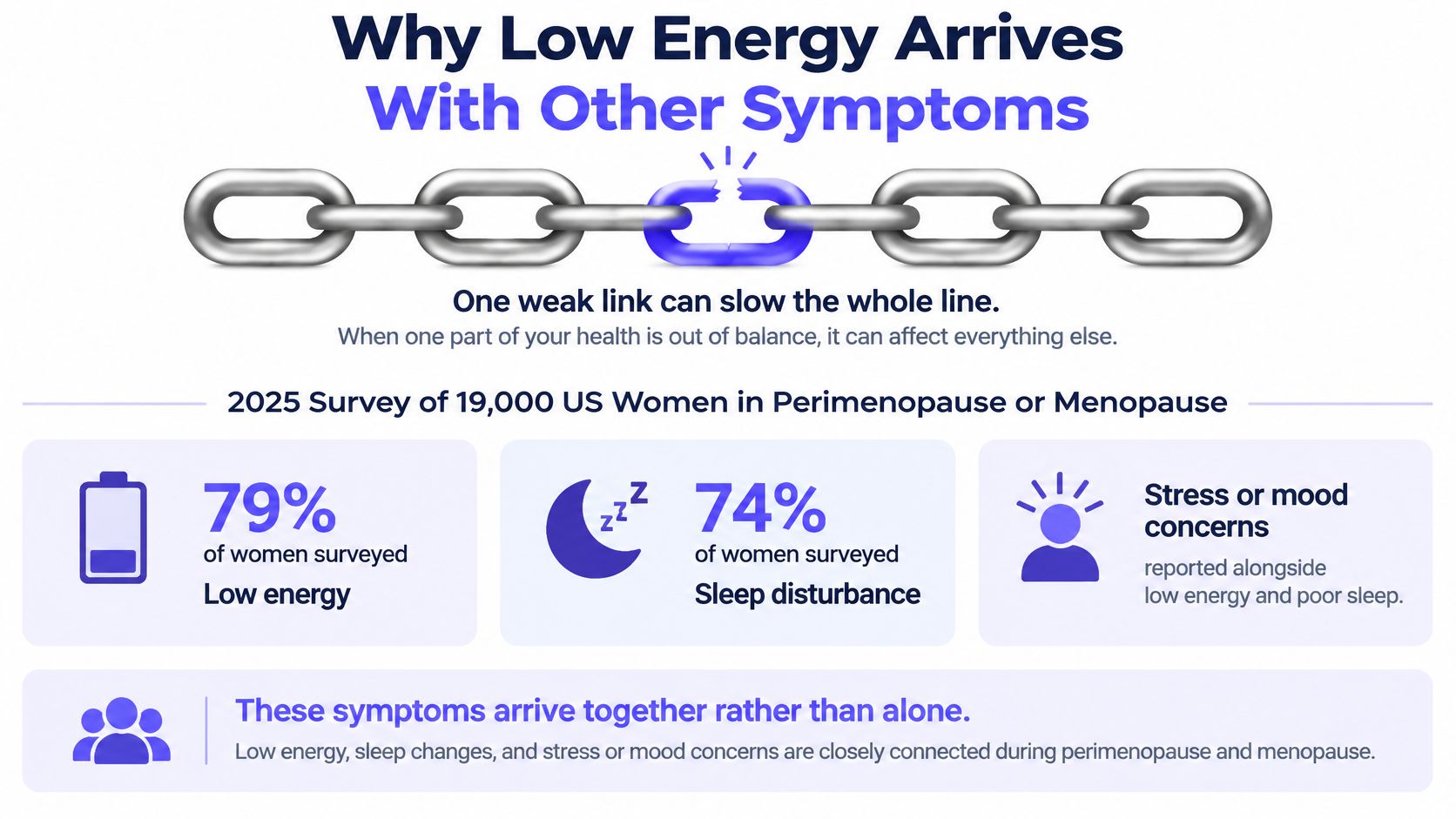
Symptoms reported by US women in perimenopause or menopause (2025 survey, 19,000 participants)
| Symptom | Share of Participants |
|---|---|
| Low energy | 79% |
| Sleep disturbance | 74% |
| Stress or anxiety | 72% |
| Brain fog | 71% |
| Weight gain | 70% |
The loop behind a low-energy day
Night sweats break sleep. Poor sleep raises next-day fatigue and cravings, which pushes you toward quick carbohydrates and away from the walk you'd planned. Low mood and brain fog then make movement feel like more effort than it is, and the day ends with you more tired than you started. Research summarized alongside that survey links worsening sleep across the transition with hot flashes, night sweats and lower estradiol, which is why the loop tightens rather than resolves on its own.
The same pattern can hide a nutrient gap. If you're eating less, skipping meals or cutting whole food groups to manage weight, it's worth learning how to check for hidden nutrient gaps before you assume the tiredness is purely hormonal.
Find the weakest link first
Sequencing beats intensity. Decide whether your energy is limited mainly by nighttime awakenings, daytime inactivity, mood, heavy bleeding or meal-related dips, then change one thing at a time. Five questions narrow it down fast.
- Do your energy dips follow broken nights? If yes, sleep is the lever, not willpower.
- Do you wake sweating? That points to vasomotor symptoms fragmenting sleep.
- Is anxiety climbing alongside the fatigue? Mood and sleep reinforce each other and both deserve attention.
- Do you slump an hour or two after refined carbs? That's a meal pattern, not a character flaw.
- Are your periods heavy or long? That sends you back to the medical row first.
Repair Night Sleep Before Anything Else
Sleep is the strongest lever in this guide because the effect shows up in days, and because the mechanism is measurable. In a randomized crossover trial, 14 post-menopausal women completed four nights of habitual sleep and four nights restricted to 60% of habitual sleep while eating a eucaloric diet. Insulin sensitivity fell by 20% under low-dose insulin exposure, with glucose infusion rates dropping from 2.55 ± 0.22 to 2.03 ± 0.20 mg/kg/min, and by 12% under high-dose exposure, from 10.48 ± 0.72 to 9.19 ± 0.72 mg/kg/min, while resting energy metabolism stayed unchanged (the sleep restriction crossover trial). Four bad nights changed how the body handled glucose. Cutting calories wouldn't have fixed that.
An evening routine built for night waking
- Fix your wake time. Same time within 30 minutes, seven days a week. A stable wake time anchors the body clock more reliably than a stable bedtime.
- Stop caffeine by noon. Caffeine clears slowly, and a 4 p.m. cup can still be active at 11 p.m.
- Cool the bed, not the whole house. Breathable cotton or bamboo bedding, layered covers you can shed at 3 a.m., and a fan within reach for hot flashes.
- Dim the lights and stop screens 60 minutes before bed. Bright light late tells your brain it's still afternoon.
- Keep alcohol out of the evening. A glass of wine at 9 p.m. is one of the most reliable ways to wake at 2 a.m. soaked.
- Note each waking and its cause. One line: time, sweat, bladder, noise, worry. Two weeks of that tells you which lever to pull.
If you want to try magnesium, choose magnesium glycinate rather than magnesium oxide. It's better absorbed and gentler on digestion, and 300 to 400mg of elemental magnesium at night is the usual target. Check with your clinician first if you take prescription medication or have kidney disease.
Ask for more than a blood count if you snore loudly with pauses in breathing, since that pattern needs a sleep apnoea assessment. Restless legs or heavy periods call for an iron check.
Two specific flags belong here. Loud snoring with breathing pauses is a sleep study question, not a pillow question. Restless legs or heavy periods point to iron. For the hormonal side of 3 a.m. wake-ups, how to sleep better during perimenopause goes deeper.
Your two-week sleep test
Run your current routine for seven days and rate morning energy from 1 to 10 before you get up. Then run the routine above for seven days with the same rating. Compare the averages, not the best single day. If the second week isn't better, the problem probably isn't sleep hygiene, and the medical row becomes the next stop.
Movement Doses That Build Energy Without Crashing
Movement can support energy when you build up gradually. A sudden burst of hard training may leave you exhausted for days, making exercise seem unsuitable. Often, the starting dose was too much. Begin with a level you can repeat, then adjust according to how you feel afterward.
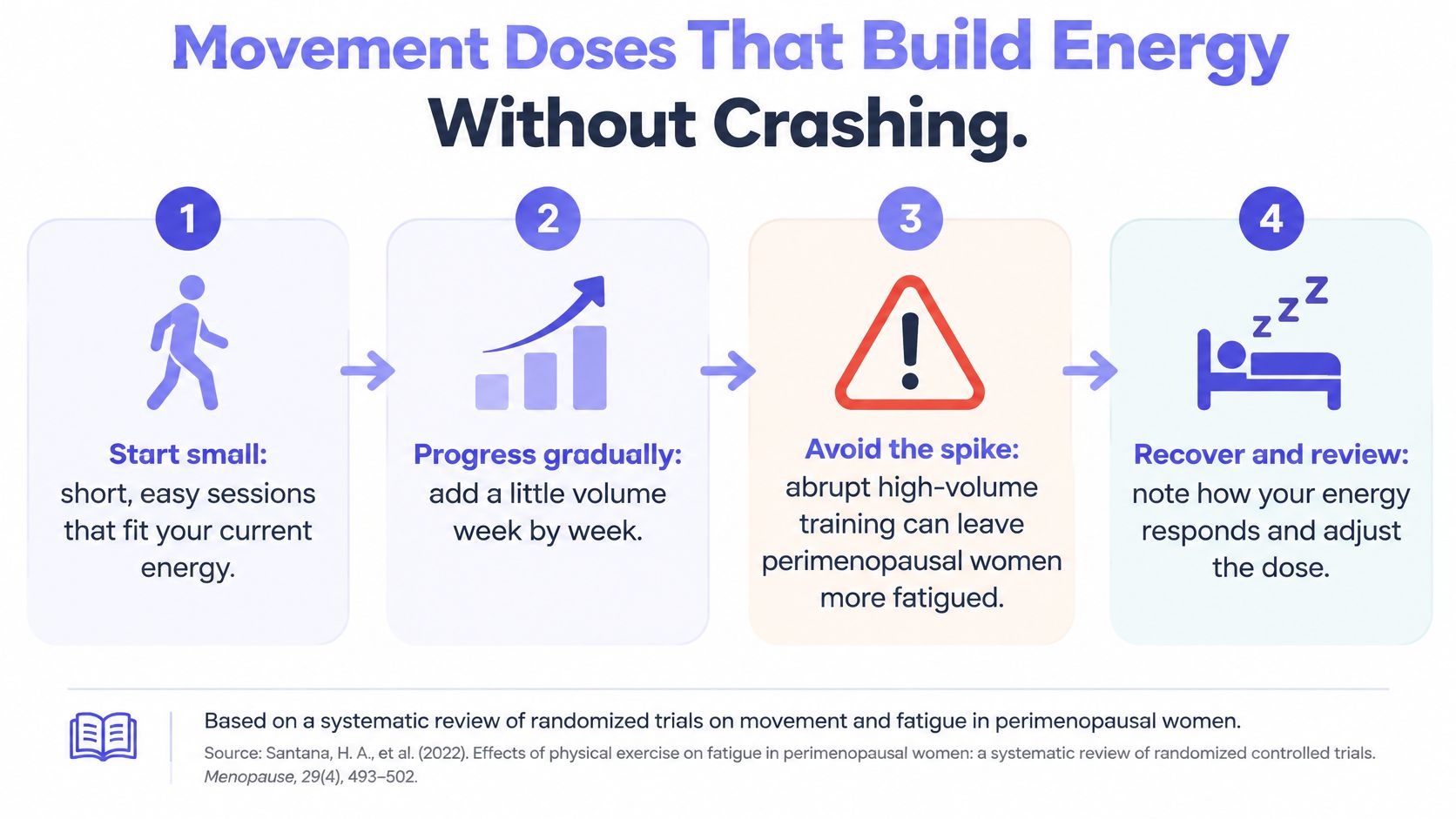
Evidence supports trying regular movement, though it does not establish one ideal routine for everyone. A systematic review of randomized controlled trials in perimenopausal women reported improvements in several symptoms, including fatigue, insomnia, hot flushes, headache, muscle pain and irritability. Average fatigue and insomnia scores fell from approximately 2 to 1 (the systematic review of exercise trials in perimenopausal women). A separate observational analysis linked regular moderate activity with a lower risk of metabolic syndrome. Because it was observational, the association may partly reflect differences in participants' health, rather than exercise alone.
The six-step progression
- Start with 10 minutes. Try a brisk walk or easy cycling most days. A short session is easier to fit in after a poor night and can still get you moving.
- Build toward 120 minutes a week. Spread activity across four or five sessions instead of doing it all at once.
- Add two light strength sessions. Work your legs, hips, back and arms with bodyweight, bands or dumbbells. Strength work helps protect muscle through the transition.
- Track sleep quality and next-day fatigue. Each morning, record both. These two measures can help show whether your movement dose is manageable.
- Increase volume by about 10% only after a week of stable sleep and recovery. Small changes make it easier to notice when an increase is too much.
- After a poor night or a heavy hot-flash night, drop back a step. Adjusting the dose helps you keep the habit going without treating fatigue as a failure.
If you're deciding what to include, these exercises for menopause can help you compare options.
No single exercise dose is proven best for every woman. Use this progression as a starting point, then judge it by your sleep, energy and recovery. If a step repeatedly leaves you depleted, reduce the dose before increasing it again.
Nutrition and Stress Habits Worth Testing
Here's a sample week that pairs one movement habit with one food or stress check, so the plan looks like a routine instead of a list. Sleep steps live in the routine above and don't need repeating here.
Sample weekly energy routine
| Day | Movement | Food and Stress Check |
|---|---|---|
| Monday | 20-minute walk | Protein at breakfast, five-minute breathing before bed |
| Tuesday | 10-minute walk plus stretching | Fiber at lunch, 10 minutes of morning daylight |
| Wednesday | Strength session (light loads) | Protein at lunch, no alcohol |
| Thursday | 20-minute walk | Avoid refined carbs without protein |
| Friday | Easy cycling 20 minutes | Short walk after a stressful meeting |
| Weekend | Light walk and one strength session | Plan two protein-rich meals |
Food patterns that shift afternoon energy
Protein at breakfast and lunch is the single most useful change for most women, because it steadies the afternoon and reduces the 4 p.m. hunt for something sweet. If you're starting from very little protein, aim for roughly 1.2 to 1.6 g per kg of body weight across the day. Fiber from vegetables and legumes does the same job more slowly, and long gaps between meals tend to produce the crashes people blame on hormones.
Refined carbohydrates eaten alone are the common trigger. A pastry at 11 a.m. and no protein will land as a slump by 2 p.m. for many women. Evening alcohol is the other one, showing up as night sweats and a 3 a.m. wake-up rather than as a dinner problem.
Track the pairing, not just the food. A slice of toast alone and a slice of toast with eggs produce very different afternoons. Your log should capture what came with it.
Three stress tools that cost nothing
- Five minutes of slow breathing before bed. In for four counts, out for six. The long exhale is what does the work.
- Ten minutes of outdoor daylight in the morning. It anchors your body clock and improves sleep pressure that night.
- A short walk after a stressful meeting. Ten minutes outside beats scrolling for twenty.
The two-week test
Change one habit at a time, keep it for two weeks, and rate your energy from 1 to 10 each morning. Compare that average with the week before you started. Stop any change that brings new bloating, reflux or lost sleep, because a fix that costs you rest isn't a fix. For food specifics across the transition, the best foods for perimenopause is a practical reference to keep open.
Track Your Triggers and Run a Two-Week Test

A 52-year-old woman logs sleep, night sweats, meals and energy for three weeks. The pattern that emerges is unglamorous. Afternoon crashes follow lunches built on refined carbs with no protein. Night sweats follow the two evenings she had wine. Her best evening energy comes on the days she walked for 10 minutes after dinner. None of that was visible from memory, and all of it was obvious from three weeks of entries.
What to log, and what it can't tell you
Keep the fields small enough that you'll fill them in. Hours slept, number of wake-ups, night sweats, meals and whether each included protein, movement minutes, an energy rating from 1 to 10, and any bleeding.
Lila's daily check-in takes about 30 seconds, with you tapping intensity on the symptoms that matter to you. After usually 2 to 3 weeks of consistent logging, it surfaces the foods most correlated with each symptom, ranked by impact, so you're not guessing which change did the work. Photo logging identifies ingredients and estimates portions from a picture of your plate, and activity from Apple Health adjusts your protein and fueling guidance.
Honest limit: photo-based and self-reported logs show trends over weeks. They are built for pattern detection, not lab-grade calorie counts or clinical values, and they never replace a blood test.
The two-week test that produces a decision
- Choose two changes from the ranked table. Usually a sleep routine plus one movement step.
- Book the medical check if any red-flag symptom applies, and get ferritin, thyroid and B12 on the request.
- Log for 14 days with sleep, movement, meals and the morning energy rating.
- Compare averages with the week before, and keep only the changes that raised energy without costing you sleep.
- Take the log to your clinician, who decides on medication, hormone therapy or GLP-1 options.
A symptom tracker like the perimenopause symptom tracker helps you see the month as a whole rather than as a string of bad days. Everything in this plan supports medical care. None of it replaces it, and none of it should delay an appointment when something has changed quickly or feels wrong.
Lila turns this two-week test into a routine you can keep. A daily check-in takes about 30 seconds, and after a few weeks of logging, Lila ranks the foods and habits most correlated with your symptoms so you know which change earned its place. Visit Lila to start with a plan built around your sleep, meals and energy rather than a generic checklist.
Get Lila, your personal coach for perimenopause.
Built for women in their 40s. 24/7 coaching, in your pocket.