Mid Cycle Pain Perimenopause: What It Really Means
Understand mid cycle pain perimenopause with clear guidance on ovulation pain, red flags, tracking tips, and self-care strategies that actually help.
Last month, you noticed a sharp twinge low on one side of your abdomen, roughly between periods. This month, your period is harder to predict, the ache feels different, and you're wondering whether it's ovulation, perimenopause, or something that needs checking.
That uncertainty deserves more than “it's probably hormonal.” Mid-cycle pain is a clue, not a diagnosis, especially when your cycles no longer follow a familiar pattern.
Table of Contents
- The Mid-Cycle Pain Puzzle During Perimenopause
- What Mittelschmerz Actually Is
- Why Perimenopause Changes the Picture
- The Wider Differential Beyond Ovulation
- How to Track Mid-Cycle Pain So Patterns Emerge
- Red Flags That Change the Triage Level
- Contraception and Pregnancy Are Not Off the Table
- Self-Care and When to Bring a Clinician In
The Mid-Cycle Pain Puzzle During Perimenopause
The word mid-cycle sounds precise. In everyday conversation, though, it often means “somewhere between periods,” rather than a confirmed point in an ovulatory cycle. When you don't know when the next period will arrive, you can't reliably identify the midpoint in advance.
That creates a practical problem: you may recognize a sensation without knowing what it represents. A brief, familiar twinge and a new, persistent ache can both occur between periods, but they shouldn't automatically receive the same explanation.
Separate the sensation from the explanation
Start by describing what happened before deciding why it happened. “A sharp ache on the left that settled” gives a clinician more useful information than “my ovary was ovulating.” The first describes your experience; the second assumes a cause.
Keep these questions separate:
- What did I feel? Note the location, character, and effect on your activities.
- What else happened? Include bleeding, bowel changes, urinary symptoms, or feeling generally unwell.
- What am I assuming? Notice whether you're calling it ovulation because it happened between periods.
Practical rule: Use “possible ovulation pain” as a working description, not a reason to dismiss a changing symptom.
This approach is particularly useful if you're noticing early perimenopausal changes but still have periods. You don't need to identify the exact hormonal event at home to make a sensible decision about care.
The useful distinction is between a familiar, self-limiting pattern, a pattern that deserves an appointment, and symptoms that need urgent assessment. Understanding ovulation pain provides a baseline, but your symptoms and their progression matter more than matching a date on a calendar.
What Mittelschmerz Actually Is
A sudden twinge low on one side of the abdomen, gone by the next morning. That experience has a name: mittelschmerz, the medical term for pain linked with ovulation. Cleveland Clinic estimates it may affect up to 40% of people who ovulate, though that figure isn't specific to perimenopause and the timing doesn't reliably land on a particular calendar day, according to Cleveland Clinic's explanation of ovulation pain.
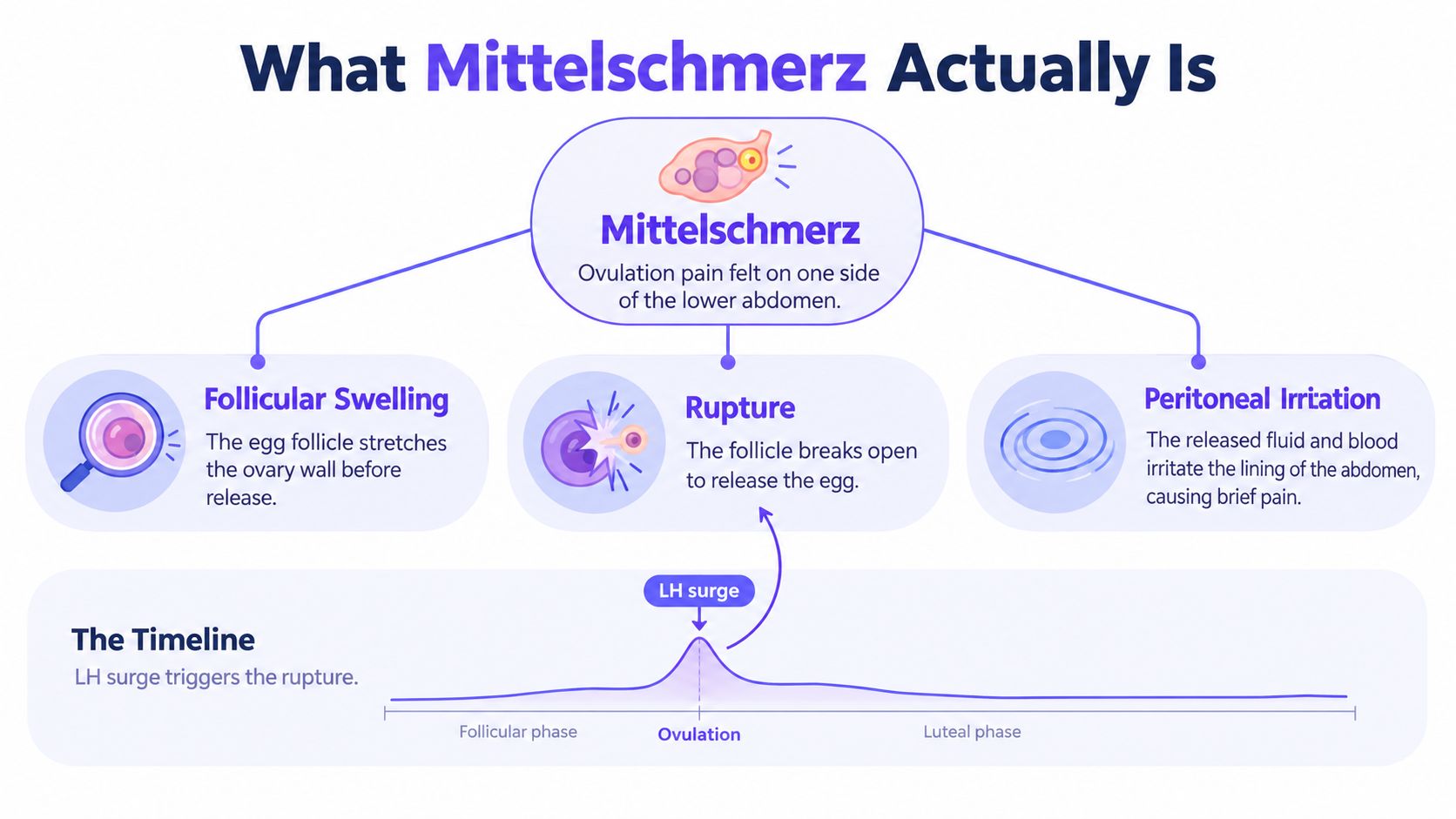
An ovarian follicle is the small, fluid-filled structure in which an egg matures. In the days before release it swells, then ruptures to let the egg out, and the escaping fluid (sometimes with a little blood) can irritate the lining of the abdomen. Each stage can produce sensation, so saying the ovary "stretches and hurts" undersells the biology. The illustration above simplifies all of this, and a simplified diagram cannot identify the cause of any one person's pain.
When clinicians describe mittelschmerz, the picture usually looks like this:
| Feature | Typical description |
|---|---|
| Where it sits | Lower abdomen, more noticeable on one side |
| How it feels | A sudden twinge, a dull ache, or localized sharper pain |
| How it runs | A brief episode that settles, rather than pain that steadily intensifies |
A menstrual cycle calculator can organize your dates and show where a midpoint would fall if the cycle ran like a textbook. Treat that estimate as calendar context rather than a biological measurement. The more useful baseline is the pattern itself: where the discomfort sits, how it behaves over hours, and whether anything else accompanies it. "Mittelschmerz" describes that pattern at its most typical; it does not certify what happened inside the ovary on any given day.
Why Perimenopause Changes the Picture
Cycles that once ran on a dependable schedule start keeping erratic time. One lasts 26 days, the next stretches past 40, and a twinge that used to mark day 14 can arrive early, late, or never. The sensation may be the same; its position on the calendar no longer means what it once did.
The ovaries wind down unevenly rather than switching off. Some cycles include an egg release while others skip it, and hormone levels rise, stall, and dip instead of following the old arc.
A late-arriving twinge can still be mittelschmerz. It is just harder to confirm.
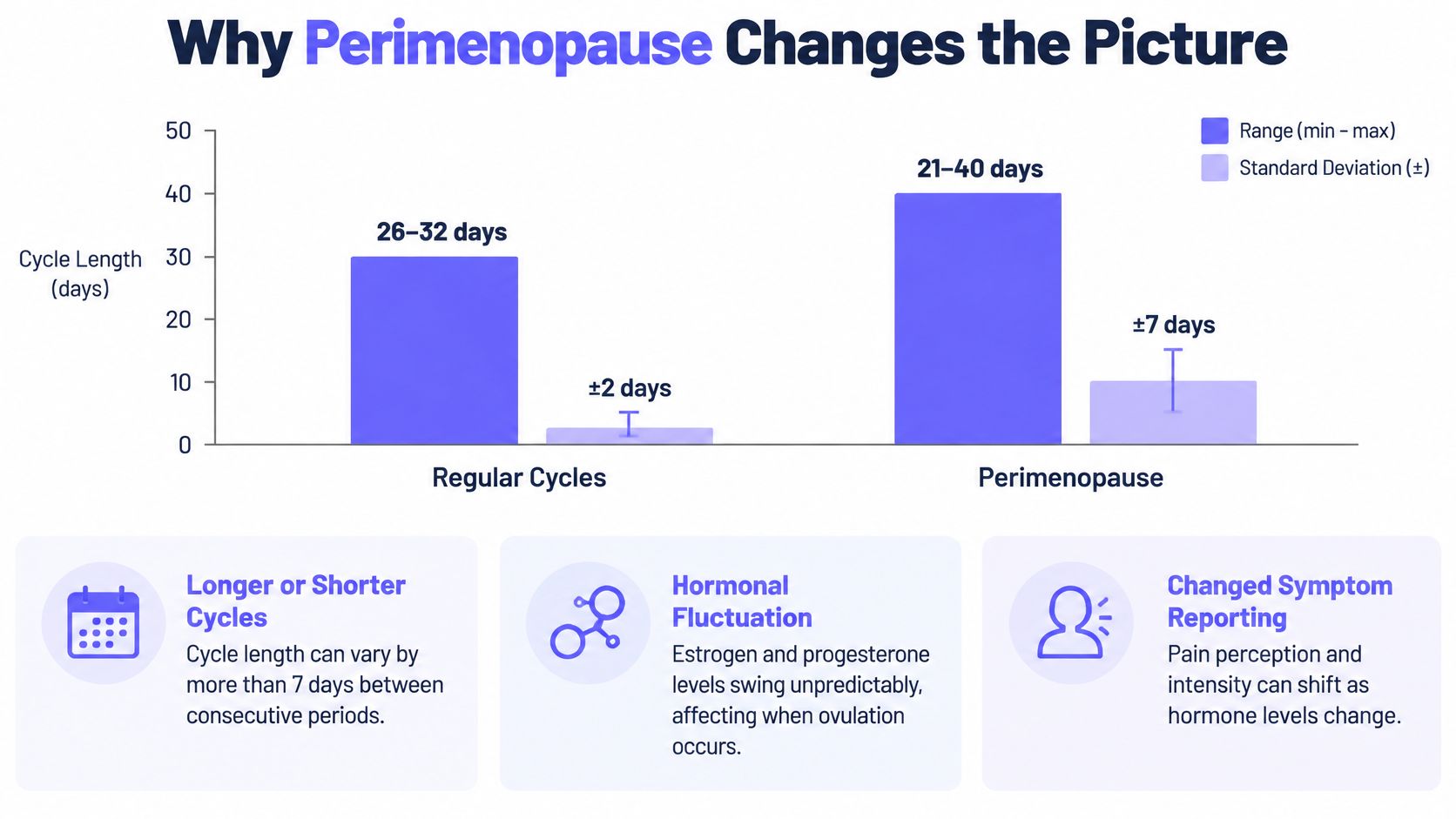
The chart conveys that variability in broad strokes. Its numerical ranges shouldn't be treated as diagnostic cutoffs or universal expectations for regular cycles or perimenopause.
The ambiguity runs both ways. A quiet cycle may have proceeded without ovulation, or the release went unfelt. Recurring pain is no more conclusive, because a familiar sensation does not certify that an egg was released. At this stage, mid-cycle pain works better as a clue to weigh than a signal to trust.
Menstrual pain is a different experience entirely. A 2025 cross-sectional study of perimenopausal women aged 35 and older found that 63.2% reported moderate or severe menstrual pain, while 49.1% reported symptoms dating back to adolescence. Those findings describe pain tied to bleeding, not the prevalence of mittelschmerz.
Keeping separate labels makes the pattern easier to read. A short, localized episode between periods is a candidate for ovulation-related discomfort; pain tied to bleeding days belongs in its own column; anything else earns its own description rather than a guess. The guide to cramps in perimenopause offers more on separating these experiences. Momotaro Apotheca's vulvovaginal perimenopause care guide covers vulvar and vaginal concerns, a separate area of care that shouldn't replace assessment of deeper pelvic pain.
For an additional video resource on the transition:
▶ PlayKeep each sensation in its own category, and the timing puzzle becomes easier to solve.
The Wider Differential Beyond Ovulation
Two people can report pain at the same point in a cycle and need completely different evaluations. One describes a brief twinge that faded by evening and never returned. The other describes pain that has grown stronger over several months, now joined by heavier bleeding and a dragging sensation low in the abdomen. Same general location, very different questions for a clinician.
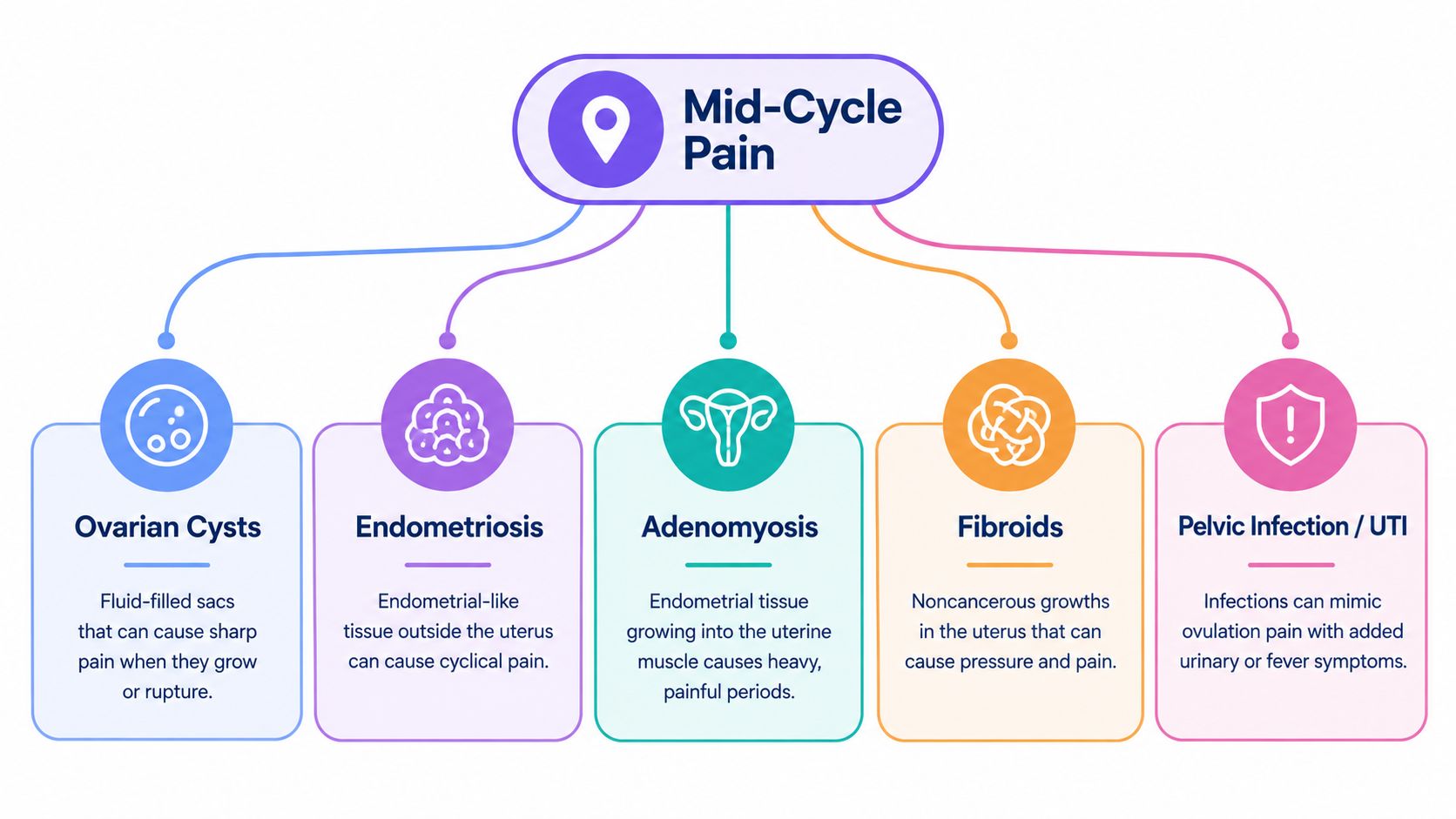
The diagram shows several gynecologic explanations: ovarian cysts, endometriosis, adenomyosis, fibroids, and pelvic infection. Clinicians call a set of candidate explanations like this a differential diagnosis, and the list extends past the reproductive organs. Urinary tract conditions and gastrointestinal problems can produce discomfort in the same region, which is one reason location on its own rarely settles the question. Rarer causes like ectopic pregnancy and ovarian torsion belong on the list too, mainly because missing them carries serious consequences.
An evaluation works by narrowing. Your history and a physical exam rule out most candidates before any scan is ordered. According to Johns Hopkins guidance on acute pelvic pain imaging, pregnancy testing is an initial evaluation step, and pelvic ultrasound is the first-line imaging test when a gynecologic cause is suspected.
What helps most at that first conversation is a precise description rather than a theory. Point to where the pain sits instead of naming an organ you suspect. Say what travels with it: whether bleeding has shifted, whether urination or bowel movements feel different, whether you've felt feverish. Explain what the pain has cost you in practical terms, such as interrupted sleep, a workday cut short, a walk you had to abandon partway through.
Pain that follows your cycle still deserves assessment if it's persistent, worsening, or otherwise unusual for you.
A clear account of what changed is enough to begin a useful evaluation. You don't need to arrive with a suspected condition.
How to Track Mid-Cycle Pain So Patterns Emerge
A useful symptom log records observations without turning them into conclusions. You can use a notebook, a phone note, or a tracking app. Choose the option you'll use when you're uncomfortable.
Mittelschmerz can occur within a broad mid-cycle window and may coincide with the luteinizing hormone, or LH, surge, rather than a fixed calendar date. That's why timing needs context, as described in Mayo Clinic's overview of mittelschmerz symptoms and causes.
Record the details that distinguish patterns
- Date and cycle context: Record when the pain happened and when your most recent bleeding started.
- Side and sensation: Note left, right, central, or widespread pain, plus whether it feels sharp, aching, or cramping.
- Duration and severity: Write when it began, when it settled, and what activities it interrupted.
- Associated symptoms: Include bleeding, bowel changes, urinary symptoms, dizziness, or feeling unwell.
- Next period: When bleeding returns, add that date so you can review the interval afterward.
The guide to tracking your cycle can help you organize those observations without needing a complicated spreadsheet.
Consider this hypothetical sequence, not a patient case study:
| Entry | Observation | Useful interpretation |
|---|---|---|
| Earlier cycle | Brief right-sided twinge that settled | Possibly compatible with ovulation discomfort |
| Following cycle | No similar pain recorded | Doesn't establish whether ovulation occurred |
| Later cycle | Ache persists and urinary symptoms appear | Different pattern requiring assessment |
Review entries after symptoms change and when your next period begins. Add sleep and mood if they help describe your broader experience, but prioritize the pain details.
A useful appointment summary might read: “I've had intermittent localized pain, but the latest episode lasted longer and came with urinary discomfort.” That's more actionable than a collection of calendar predictions.
Red Flags That Change the Triage Level
Severity, progression, and associated symptoms matter more than the cycle date. Acute warning signs include sudden severe pain, fainting, fever, vomiting, marked tenderness, heavy or unusual bleeding, or pain with a positive pregnancy test.
Other warning signs may develop less dramatically: bleeding after sex, postmenopausal bleeding, unexplained weight loss, blood in the urine, or a pelvic mass. These features warrant assessment rather than being filed under hormonal change, as outlined in clinical guidance on the differential diagnosis of pelvic pain-may-june-2011/the-differential-diagnosis-of-acute-pelvic-pain-in-various-stages-of-the-life-cycle-of-women-and-adolescents-gynecological-challenges-for-the-family-physician-in-an-outpatient-setting.pdf?sfvrsn=3f4c9cb6_0).
Triage levels for perimenopausal mid-cycle pain
The time windows below are organizational labels, not validated waiting periods or guarantees of safety. Don't wait out a suggested window if symptoms worsen, and ask a clinician to determine appointment timing when warning signs are present.
| Watch and track 24-48 hours | Routine appointment within 1-2 weeks | Urgent care or ER now |
|---|---|---|
| Familiar, mild discomfort that's already settling | Recurrent unexplained discomfort without acute warning signs | Sudden, severe, or rapidly worsening pain |
| No concerning associated symptoms | A pattern that has changed or keeps disrupting daily life | Fainting, significant dizziness, fever, vomiting, or marked tenderness |
| You can reassess and seek help if anything changes | Questions about persistent symptoms or an unclear cause | Heavy bleeding or pain with a positive pregnancy test |
Postcoital or postmenopausal bleeding, unexplained weight loss, blood in the urine, or a possible mass need prompt clinician contact. Don't assume they belong in the routine waiting column because pain is mild.
Safety boundary: Tracking is appropriate only while the symptom pattern remains suitable for observation. It isn't a commitment to keep waiting.
A perimenopause bleeding checker can help you organize bleeding concerns, but it can't rule out an urgent cause of pain. If you're unsure which level applies, contact a clinical service and describe the pain, bleeding, and associated symptoms together.
Contraception and Pregnancy Are Not Off the Table
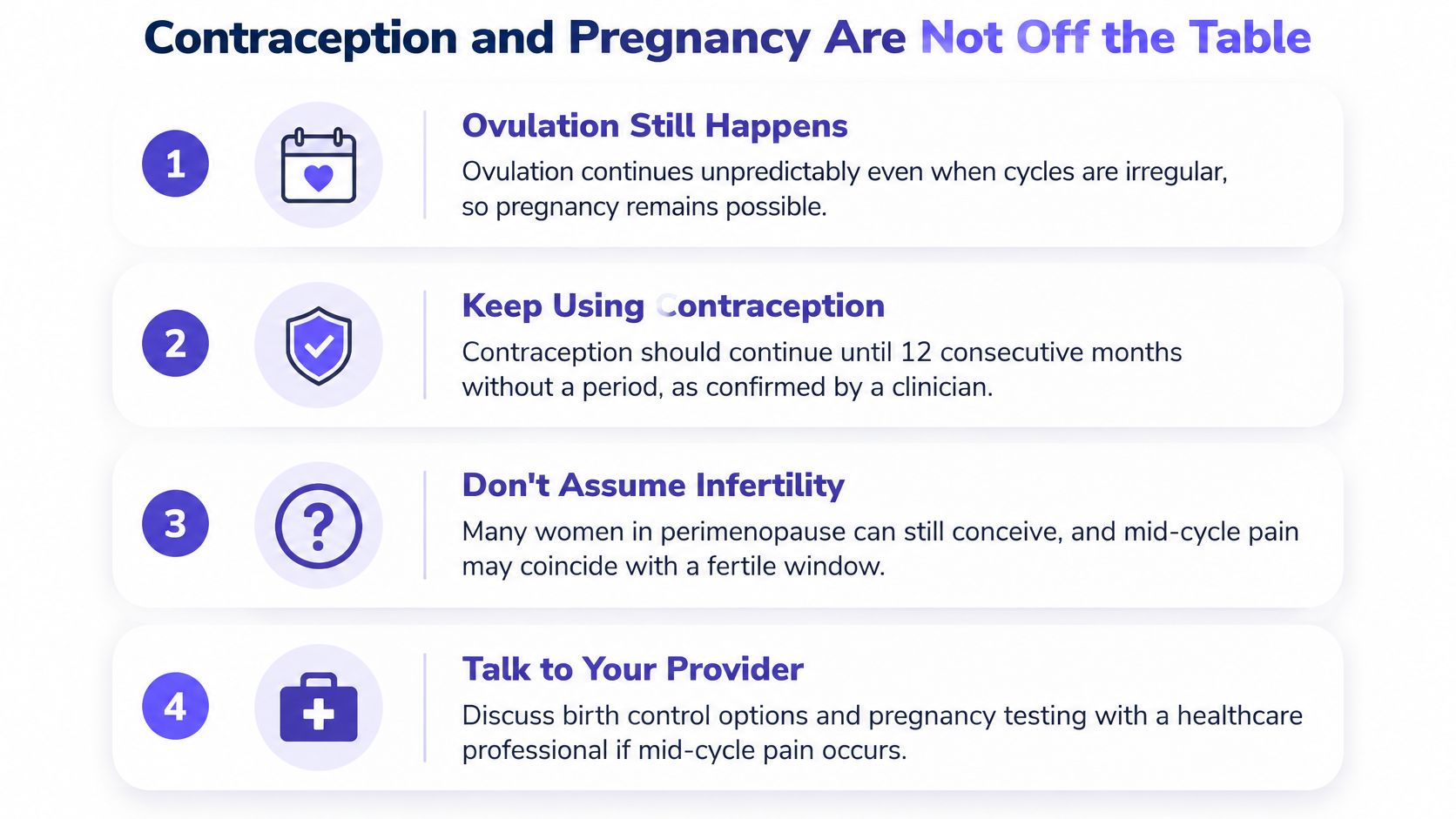
Perimenopause isn't the same as infertility. Because ovulation can still occur unpredictably, a changing cycle doesn't provide reassurance that pregnancy is impossible. Pain also can't tell you that a particular day is safe for unprotected sex.
The infographic summarizes the fertility questions worth raising, but its contraception stopping rule needs individual confirmation rather than automatic application.
Separate menopause recognition from contraceptive advice
Menopause is defined clinically after 12 consecutive months without menstruation, and pain after that point shouldn't be described as ovulation pain, according to the ovulation pain and menopause guidance from Verywell Health. Ask your clinician how to interpret absent periods in your circumstances and when you can stop contraception.
If you're sexually active and develop acute pelvic pain, tell the clinician whether pregnancy is possible, even if you think the likelihood is low. The initial testing described earlier is a safety step, not a judgment about how carefully you've assessed your fertility.
Useful questions for a contraception appointment include:
- Current protection: “Does my current method still fit my health needs and preferences?”
- Irregular cycles: “Am I relying too heavily on predicted dates or symptoms?”
- Recent unprotected sex: “Do I need advice about emergency contraception?”
- Absent bleeding: “How should we decide when contraception is no longer needed?”
A perimenopause pregnancy risk calculator can help frame questions, but it can't determine whether you're pregnant or exclude an ectopic pregnancy. Don't use a calculator result to delay assessment when pain or bleeding is concerning.
Self-Care and When to Bring a Clinician In
Home care belongs alongside sensible observation, not in place of diagnosis. For familiar, mild discomfort that's settling, you might try a warm compress, a comfortable resting position, or gentle movement if it feels better than sitting still. These are comfort measures, not tests of whether the cause is harmless.
Keep expectations realistic. There's no basis here for promising that hydration, an “anti-inflammatory” meal plan, or stress reduction will resolve unexplained pelvic pain. Maintain regular meals, fluids, and a manageable sleep routine as general care rather than treating lifestyle changes as a cure.
Make relief and reassessment separate decisions
- For immediate comfort: Choose warmth or gentle activity according to what feels comfortable, and stop anything that worsens symptoms.
- For medication questions: Ask a pharmacist or clinician which non-hormonal pain relief is appropriate for your medical history and current medicines.
- For ongoing symptoms: Arrange assessment rather than repeatedly covering up pain that remains unexplained.
- For a changed pattern: Reconsider the triage level instead of assuming the previous explanation still applies.
Feeling better after a comfort measure doesn't establish what caused the pain.
Before an appointment, prepare a short summary of the pain's location, course, associated symptoms, and effect on daily life. Bring your bleeding dates and any questions about contraception or pregnancy testing.
The decision loop is straightforward: describe what you feel, check for warning signs, choose the appropriate level of care, and reassess if anything changes. You don't have to solve the hormonal puzzle yourself, and persistent or atypical pain deserves clinical evaluation.
Lila offers daily check-ins and a central place to track symptoms, cycles, sleep, and mood, helping you organize the context around changing pelvic discomfort. Visit Lila to start building a clearer symptom record you can bring to your next clinical conversation, while keeping urgent symptoms on a separate path to medical care.
Get Lila, your personal coach for perimenopause.
Built for women in their 40s. 24/7 coaching, in your pocket.